,
, , , ,
, , ,
.
.
A study on abrasive wear characteristics of side plate of FRP ship
Byung Tak K
IMand Sung Wi K
OH*
School of Mechanical Engineering, Pukyong National University, Busan 608-739, Korea
The present study was undertaken to evaluate the effect of temperature on the results of Charpy impact test for glass fiber reinforced polyurethane(GF/PUR) composites. The Charpy impact test were conducted in the temperature range from 50 to 50 . The impact fracture toughness of GF/PUR composites was considerably affected by temperature and it was shown that the maximum value was appeared at room temperature. It is believed that sensitivity of notch on impact fracture energy were increased with decrease in temperature of specimen. As the GF/PUR composites exposed in low temperature, impact fracture toughness of composites decreased gradually owing to the decrease of interface bonding strength caused by difference of thermal expansion coefficient between the glass fiber/polyurethane resin. And decrease of interface bonding strength of composites with decrease in specimen temperature was ascertained by SEM photographs of Charpy impact fracture surface.
Key words : Temperature effect, Impact test, Impact fracture energy, Fracture analysis, GF/PUR composites
*
Corresponding author: [email protected], Tel: 82-51-629-6192, FAX: 82-51-629-6188, .
,
.
, .
.
, ,
.
(Mateen and Siddiqi, 1989), PP
32 22 C
(Voelker, 1991) . 40 40 C G
IC20 C
G
IC(Chen et al., 1989) ,
(Fernando et al., 1988) . PP
(Sova et al., 1993) , GF/PP
(Tomlinson and Holland, 1994) ,
50 60 C
(Um et al.,
1999) /
(Munro and Lai,
1988) .
, .
GF/PUR 50 50 C
.
. 30.2%
3.46m/s (Tinus
Olsen Model 892) .
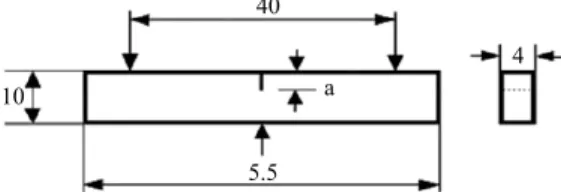
Fig. 1
10mm, 55mm
40mm .
. 1mm
,
/
Fig. 1. Specimen geometries for Charpy impact(mm).
40
4
5.5
10 a
. G
IC50 C, (25 C), 15 C
50 C 4 .
5 .
5 . G
IC.
(1) .
GIC
________
U(1)
B(W a)
U , B
, W , a .
(2) U
BWφ
GIC
(Plati and
Williams 1975, Mashall et al., 1973).
U Uk GICBWφ
(2)
U
, U
k, φ .
φ .
1
a1
S1
φ ___ ___ 2 W _____ ___ _____ 18π
W a/W(3)
S .
1 2.9mm 9
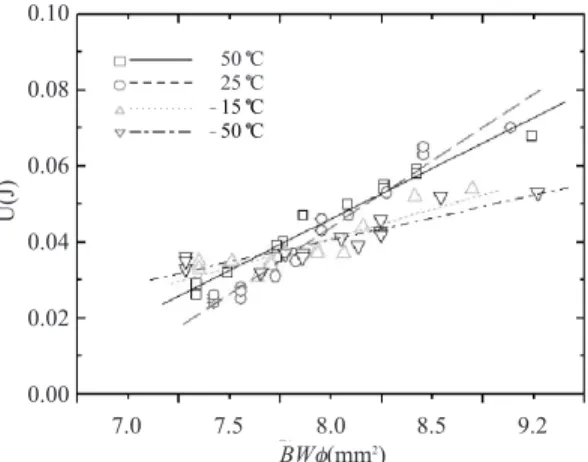
U BWφ
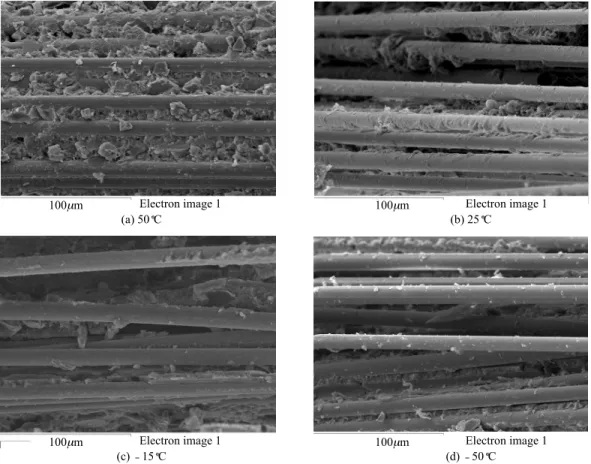
(SEM) .
Fig. 2
(ligament: W a)
50 C, (25 C),
15 C 50 C
.
(uncracked ligament)
Fig. 3. Variation of impact fracture energy with respect to BWφ at various temperatures.
0.10 0.08 0.06 0.04 0.02
0.00
7.0 7.5 8.0 8.5 9.2
U(J)
BWφ(mm2) 50 C
25 C 15 C 50 C
Fig. 2. Variation of impact fracture energy with respect to ligament at various temperature.
0.07
0.06
0.05
0.04
0.03
0.02
7.0 7.5 8.0 8.5 9.2
W-a(mm)
U(J)
___ ___ 50 C
___ ___ 25 C
___ ___ 15 C
___ ___ 50 C
, .
,
, 50 C
. Fig. 3
U
BWφ.
.
BWφ,
BWφ,
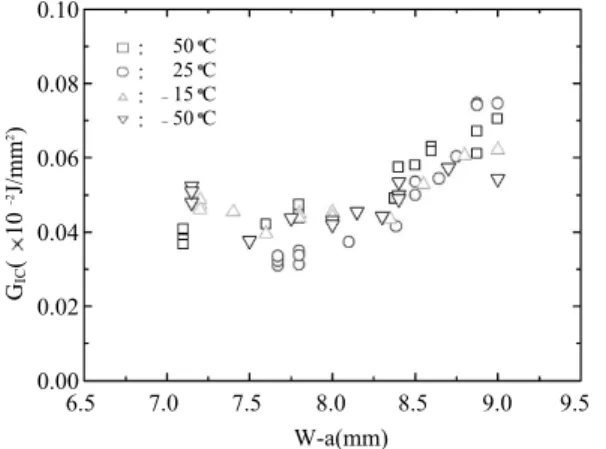
. Fig. 4 GF/PUR
.
G
IC.
.
50 C, 15 C, (25 C), 50 C 0.119, 0.113, 0.107, 0.112
10
2J/mm
2.
.
. Fig. 5
G
IC.
G
IC50 C, 15 C, (25 C), 50 C 0.117, 0.152, 0.351, 0.268 10
2J/mm
2,
.
10 50 80 10
6/ C .
/
Fig. 4. GICvs. W-a at various temperatures.
0.10
0.08
0.06
0.04
0.02
0.006.5 7.0 7.5 8.0 8.5 9.0 9.5
W-a(mm) GIC(102J/mm2)
50 C 25 C 15 C 50 C
Fig. 5. Variation of GICwith respect to various tem- peratures.
0.5
0.4
0.3
0.2
0.1
0.0
50 25 25 50
Temperature( C) GIC(102J/mm2)
,
. σ
r.
σ
r∆α ∆T Em (4)
∆α
, ∆T Em
.
.
. (a) 50 C, (b) (25 C), (c) 15 C (d) 50 C
.
PUR (a)
/ .
.
(c) (d) (b)
/ ,
Fig. 6. SEM photographs of impact fracture surfaces for the GF/PUR composites at various temperatures.
Electron image 1
(a) 50 C (b) 25 C
100µm 100µm Electron image 1
Electron image 1
(c) 15 C (d) 50 C
100µm 100µm Electron image 1
.
, 50 C
(pull out) (debonding)
.
.
GF/PUR 50 50 C
.
G
IC9mm .
GF/PUR
.
, .
Chen, L. S., Y.W. Mai and B. Cotterell, 1989. Impact fracture energy of mineral-filled polypropylene.
Polymer Eng. and Sci., 29(8), 505 512.
Fernando, G. and G.R. Dickson, T. Anderson, H. Reiter and B. Harris, 1988. Fracture of hybrid composites : part 1. J. Mat. Sci., 23, 3732 3743.
Mashall, G.P., J.G. Williams and C.E. Turner, 1973.
Fracture toughness and absorbed energy measurements in impact test on brittle materials. J. Mat. Sci., 8, 949 956.
Mateen, A.Q. and S.A. Siddiqi, 1989. Impact properties of polyurethane and glass fibres reinforced composites. J. Mat. Sci., 24, 4516 4524.
Munro, M. and C.P.Z. Lai, 1988. The elevated temperature dependence of fracture energy mechanism of hybrid carbon-glass fiber reinforced composites. J. Mat. Sci., 23, 3129 3168.
Plati, E. and J.G. Williams, 1975. The determination of the fracture parameters of polymers in impact.
Polymers Eng. Sci., 15, pp. 470 477.
Sova, M., M. Raab, and M. Slizova, 1993. Polypropylene composite materials oriented by solid-state drawing : low-temperature impact behaviour. J. Mat. Sci., 28, 6516 6523.
Tomlinson, W. J. and J.R. Holland, 1994. Pultrusion and properties of unidirectional glass fibre-Polypropylene matrix composites. J. Mat. Sci. Letters, 13, 675 677.
Um, Y.S., K.H. Park, S.W. Koh, and H.J. Kim, 1999. A study on the impact fracture behavior of glass fiber polypropylene composites. Bull. Korean Soc. Fish.
Tech., 35(4), 421 427.
Voelker, M.J., 1991. Low temperature impact properties of long fiber thermoplastic composite molding materials. Polymer Comp., 12(4), 119 121.
/