| Abstract |
2)
Purpose: The purpose of this study was to determine the effectiveness of direct and indirect methods of contract-relax techniques in proprioceptive neuromuscular facilitation (PNF) stretching for improving hamstring flexibility.
Methods: Twenty-six subjects were randomly assigned to either a direct contract-relax technique group or an indirect contract-relax group. For each group, stretching intervention was performed three times a week for a period of two weeks, with 12 seconds for the contraction and 10 seconds for the relaxation per once. The direct contract-relax technique for hamstring flexibility was applied by asking the subject to press down on the shoulder of the trainer in the straight leg-raising position.
Conversely, the indirect contract-relax technique was performed by raising the leg with resistance. To facilitate a comparative analysis of hamstring flexibility between the two groups before and after the stretching intervention, two-way repeated ANOVA was performed. Hamstring flexibility for each group was measured using a passive straight leg-raising test.
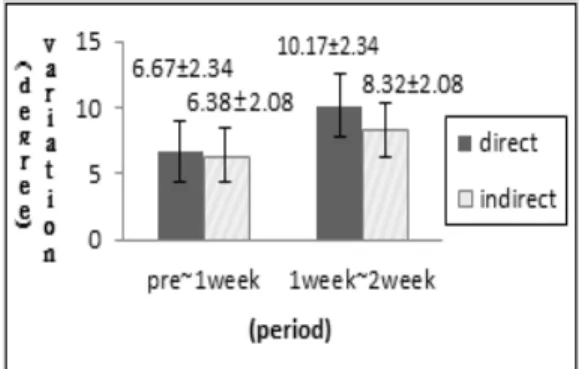
Results: The results showed significant improvement in hamstring flexibility for all subjects in the two groups. However, there was no significant difference between the groups.
Conclusion: In conclusion, both direct and indirect contract-relax techniques are confirmed to be useful for improving hamstring flexibility. The choice of suitable technique has to be made individually according to the condition of each subject.
Key Words: PNF, Contract-relax, Hamstring flexibility
†Coressponding Author : Hyun-Ok Lee ([email protected])
Original Article Open Access
고유수용성신경근촉진법(PNF) 수축-이완 기법의 직접적 간접적 방법의 비교