• 검색 결과가 없습니다.

Undifferentiated Pleomorphic Sarcoma in Mandible

N/A
N/A
Protected

Academic year: 2021

Share "Undifferentiated Pleomorphic Sarcoma in Mandible"

Copied!
5
0
0

로드 중.... (전체 텍스트 보기)

전체 글

(1)

ISSN 2288-8101(Print) ISSN 2288-8586(Online)

Case Report

RECEIVED September 11, 2014, REVISED October 1, 2014, ACCEPTED November 4, 2014 Correspondence to Chul-Hwan Kim

Department of Oral and Maxillofacial Surgery, College of Dentistry, Dankook University 119 Dandae-ro, Dongnam-gu, Cheonan 330-714, Korea

Tel: 82-41-550-0271, Fax: 82-41-551-8988, E-mail: [email protected]

Copyright © 2014 by The Korean Association of Maxillofacial Plastic and Reconstructive Surgeons. All rights reserved.

CC

This is an open access article distributed under the terms of the Creative Commons Attribution Non-Commercial License (http://creativecommons.org/licenses/

by-nc/3.0) which permits unrestricted non-commercial use, distribution, and reproduction in any medium, provided the original work is properly cited.

Undifferentiated Pleomorphic Sarcoma in Mandible

Chul-Hwan Kim, Jong-Won Jang, Moon-Young Kim, Yong-Hwan Kim, Hang-Gul Kim, Joo-Hwan Kim

Department of Oral and Maxillofacial Surgery, College of Dentistry, Dankook University

Abstract

Undifferentiated pleomorphic sarcoma (UPS), previously known as malignant fibrous histiocytoma, occurs commonly in the soft tissues in adult, but is rare in the maxillofacial region. It consists of undifferentiated mesenchymal tumor cells resembling histiocytes and fibroblasts. The purpose of this article is to report a case of UPS in the mandible. A 44-year-old patient presented with a painful growing mass in the mandible of two months’ duration. Computed tomography and positron emission tomography-computed tomography revealed an ill-defined heterogenous, hypermetabolic mass about 4 cm in size in the left mandible invading adjacent soft tissues. A left mandiblulectomy and reconstruction with a fibular free flap were performed.

Immunohistochemical study gave a diagnosis of UPS. The patient was referred for adjuvant chemotherapy after surgical removal of the tumor.

Key words: Undifferentiated pleomorphic sarcoma, Malignant fibrous histiocytoma, Mandible, Immunohistochemical study

Introduction

Undifferentiated pleomorphic sarcoma (UPS), formerly known as malignant fibrous histiocytoma (MFH), is a com- mon soft tissue sarcoma in which any attempt to describe the line of differentiation fails. UPS was first described by Ozzello et al .[1] in 1963, and Feldman and Norman first described primary malignant tumor of bone in 1972 (quoted from [2]). It most commonly involves the ex- tremities and retro-peritoneum. In the head and neck re- gion, the most commonly affected sites are the nasal cavity and the paranasal sinuses (54.3%). The mandible is a rare location, accounting for only 3% of tumors within bones[3].

UPS of head and neck that extend into bony structures

are associated with a much more aggressive clinical course than those that are restricted to soft tissues[4].

In this article, we report a rare case of UPS of the man- dible in a 44-year-old Korean man. We discuss nomencla- ture, diagnosis, histopathological characteristics with treat- ment of this disease.

Case Report

A 44-year-old man was referred to Dankook Dental Hospital from a local neurosurgery clinic. The patient pre- sented with the chief complaint of a rapidly growing mass in the left mandible area within the last two months.

Extra-oral examination revealed a tender, 4 to 5 cm sized

(2)

Fig. 2. Preoperative computed to- mography images revealed 4 cm heterogenous mass in left mandible invading adjacent soft tissues.

Fig. 1. Preoperative panoramic image showing ill-defined radiolucent, radiopaque area in left mandible.

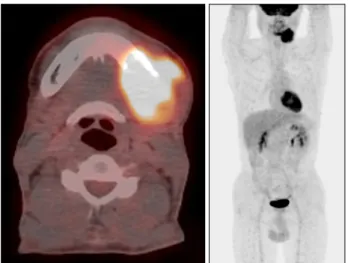
Fig. 3. Preoperative positron emission tomography-computed tomography showing increased metabolic lesion on left mandible.

No other specific metastasis is shown.

solid mass in the left mandible area. No specific lesion such as ulcer or infection was found in intra-oral examination. The patient’s medical history was non-con- tributory and there was no history of trauma or dental treatment recently. Nothing remarkable was found through laboratory data including complete blood count, urine anal- ysis, or chest x-ray in the preoperative exam.

Preoperative panoramic radiographs showed an ill-de- fined radiolucent, radiopaque mixed lesion on the left man- dible area (Fig. 1). A neck computed tomography (CT) with contrast revealed a 4 cm heterogeneously enhancing mass lesion in the left mandible body extending to adjacent soft tissue with bony destruction. Cervical lymph nodes were not enlarged (Fig. 2). Positron emission tomography- computed tomography (PET-CT) revealed a large lobulat- ing hypermetabolic lesion in and around the left sub- mandibular area with possible bone invasion. In both lungs, a few tiny nodular opacities were seen, but these

were too small to be characterized (Fig. 3).

With a clinical diagnosis of malignant tumor of the man- dible, surgery was performed. Under general anesthesia, a mandibulectomy from the symphysis to the left ascending ramus was performed, and reconstructed with vascularized osteocutaneous fibula free flap. To stabilize the flap, inter- maxillary fixation with arch-bar was applied in right half maxilla and mandible (Fig. 4).

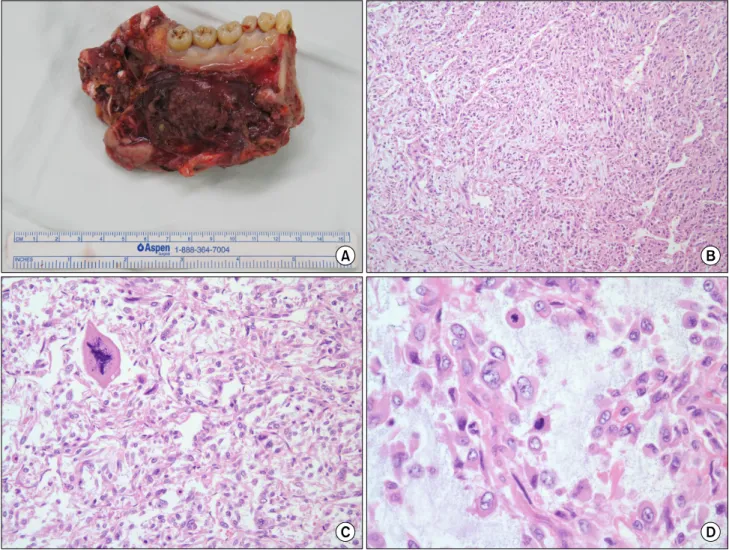
The main tumor mass, with hematoxylin and eosin stain- ing, was highly vascular and hypercellular with an apparent whitish slit-like hemorrhagic space at ×100 magnification.

At ×200 magnification, tissue presented generalized myx-

oid pattern with a loose matrix. The tumor consisted of

(3)

Fig. 5. Main tumor mass (A) and histopathological apprearance of undifferentiated pleomorphic sarcoma (B~D). (B) In low power field, hypervascularity and hypercellularity characteristics are visible (H&E, ×100). (C) Medium power field reveals shaped fibroblast-like cells and osteoclast-like giant cells and myxoid pattern matrix (H&E, ×200). (D) In high power field, tumor cells have marked nuclear pleomorphism and mitotic forms (H&E, ×400).

Fig. 4. Postoperative panoramic image shows reconstructed left mandible with fibula free flap. Right half intermaxillary fixation with arch bar is applied for stability of flap.

fibroblast-like spindle-shaped cells, specifically osteo- clast-like giant cells with remarkably active mitosis. At high-power field (×400 magnification), nuclear pleo- morphism with prominent nuclei that varied in size, figure, and number was visible. The plentiful mitotic figures led

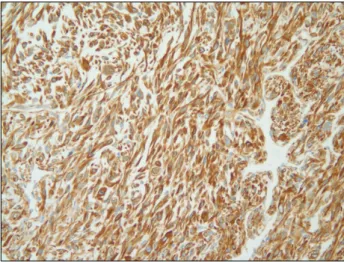
to a diagnosis of malignant neoplasm (Fig. 5). In extensive immunohistochemical study, only vimentin positivity could be detected. Other antibodies such as S-100, desmin, and CK were all negative. Therefore, UPS was diagnosed (Fig. 6).

Postoperatively, the patient was referred to the Depart- ment of Hemato-Oncology for adjuvant chemotherapy.

Upon examination at two months, metastasis to the lung and local recurrence on primary mandible area was de- tected in PEC-CT. Thus, metastatectomy was performed for metastasis of lung, and the patient is receiving con- tinuous palliative chemotherapy.

Discussion

The older term for UPS was MFH, based on the resem-

(4)

Fig. 6. In immunohistochemical study, only vimentin reactivity is detected (Vimentin reactivity, ×200).

blance of the cells to histiocytes and fibroblasts (due to their elongated shapes). The name was modified to UPS because the morphologic pattern of MFH is similar to many other sarcomas.

UPS in the mandible commonly arise in patients aged between 50 and 70[5]. The tumor occurs more frequently in males, about 65%[6-8]. The usual presentation in the literature is a painful mass that expands over a few weeks or months[7]. In our case, the patient was a male in his forties, complaining of a rapidly growing painful mass.

Non-specific symptoms such as paresthesia make diagnosis of the tumor by clinical symptoms difficult. A history of antecedent trauma was found in about 20% of the cases[9].

This implies that some of these tumors may represent an initial proliferative response to trauma[9]. A history of ante- cedent trauma was found in about 20% of the UPS. UPS is either primary or secondary, and secondary tumors are more aggressive and less common than primary tumors[10].

Park et al .[10] reported in a review that CT and magnetic resonance imaging (MRI) features of UPS of head and neck are nonspecific. On CT scans, UPS appears as a non- specific, large, lobulated, soft tissue mass iso-attenuated to muscle. Central areas of low attenuation may be due to necrosis, hemorrhage or myxoid material. In 5% to 20%

of the cases, calcification or ossification can be detected.

On MRI, UPS shows a heterogeneous hyper-intense pattern on T2-weighted images and isointensity that is almost same as muscles on T1-weighted images[10].

The use of immunohistochemistry is essential in the diag-

nostic workup of UPS. UPS typically demonstrates only vimentin immunoreactivity[11,12]. Vimentin positivity means the tumor cells originated from mesenchymal cells.

Non-immunoreactivity for pan-CK, CK8, CK18 allows sar- comatoid or anaplastic hepatocellular carcinoma and chol- angiocarcinoma to be ruled out. Leiomyosarcoma can be excluded by SMA negativity. Angiosarcomas are excluded due to no reactivity for the usual vascular antigens, such as CD31, CD34. Liposarcoma or malignant peripheral nerve sheath tumor (S-100), rhabdomyosarcoma (desmin), malig- nant melanoma (S-100 and HMB-45), malignant lymphoma (LCA) are also excluded. S100, desmin, S-100, HMB-45, LCA in parenthesises are antibody of liposarcoma, rhabdo- myosarcoma, malignant melanoma, malignant lymphoma respectively. Negative histiocytic markers such as CD68 and lysozyme allow histiocytic sarcoma to be excluded.

Fine needle aspiration biopsy can be used for obtaining of biopsy samples, but sensitivity is poor, ranging from 60% to 80%. This is due to the inability to obtain im- munohistochemical stains on most samples from fine nee- dle aspiration biopsy.

There is no established treatment protocol for primary mandibular UPS. The management of UPS of the mandible requires early radical surgery including removal of adjacent normal tissue, with a minimum of 3 cm tumor-free mar- gins[6]. Elective neck dissection is performed only when there is an evidence of cervical lymph node metastasis.

The patient should be re-examined often to rapidly detect local recurrence and distant metastasis.

The efficacy of chemotherapy and radiotherapy treatment

for UPS of mandible is not well established[13,14]. Adjuvant

radiotherapy is advised for soft tissue sarcomas, including

UPS. This is based on randomized trials comparing surgery

with or without radiotherapy that demonstrate the efficacy

of radiotherapy as an adjuvant treatment in decreasing local

recurrence rates. Fagundes et al .[15] reported favorable re-

sults with surgery and postoperative radiotherapy. Adjuvant

radiotherapy may be indicated for patients with probable

insufficient surgical margin when re-resection is not possi-

ble[16]. Chemotherapy is generally reserved for patients with

distant metastases. CYVADIC (cyclophosphamide, vincris-

tine, Adriamycin) is the most frequently used protocol. One

observer noted that CYVADIC did not improve the prognosis,

and a more intensive regimen could have been more effec-

(5)

tive[16]. Therefore, if adjuvant chemotherapy is needed, more intensive chemotherapy might be employed only for the high-risk group such as tumors with history of local recurrence and histologically high-grade because of possible subclinical or microscopic metastasis. The primary goal of treatment should be surgical resection with clear margins.

Cervical lymph node metastases are rare, with a preva- lence between 3.2% to 18%[16,17]. Perhaps 25% to 35%

of patients with UPS of head and neck region will develop metastases, with the lungs as the most common metastatic site from UPS in the head and neck, followed by bone and liver[5,9]. In this case, we detected no lymph node metastasis at the pre-operative examination so we did not perform neck dissection. However, lung metastasis was diagnosed two months after the first surgery. Therefore, metastatectomy was performed for metastasis of lung. UPS of bone aggressively infiltrates the adjacent tissues. This infiltrative growth is an adverse prognostic factor not only for local control, but also for disease-free and meta- stasis-free survival[3,18]. This is because it infiltrates skel- etal muscle fibers and fascial planes[19]. Tumor infiltration into adjacent soft tissue including muscles occurred in this case, accompanied by local recurrence. Overall 5-year sur- vival for mandibular UPS is 45% irrespective of the kind of treatment[20]. Background (primary or recurrent), histo- logic grade, tumor size, and surgical margin are the sig- nificant prognostic factors for the outcome after surgical treatment[1].

In conclusion, the diagnosis of UPS should be reserved only for those cases in which any attempt to identify a line of differentiation has failed. Due to the low numbers of patient with UPS of the head and neck region, a con- sistent therapeutic strategy for this disease is unlikely to be established.

References

1. Ozzello L, Stout AP, Murray MR. Cultural characteristics of ma- lignant histiocytomas and fibrous xanthomas. Cancer 1963;16:

331-44.

2. Weiss SW, Enzinger FM. Malignant fibrous histiocytoma: an analysis of 200 cases. Cancer 1978;41:2250-66.

3. Huvos AG, Heilweil M, Bretsky SS. The pathology of malig- nant fibrous histiocytoma of bone. A study of 130 patients.

Am J Surg Pathol 1985;9:853-71.

4. Iguchi Y, Takahashi H, Yao K, Nakayama M, Nagai H, Okamoto M. Malignant fibrous histiocytoma of the nasal cavity and paranasal sinuses: review of the last 30 years. Acta Otolaryngol Suppl 2002;(547):75-8.

5. Anavi Y, Herman GE, Graybill S, MacIntosh RB. Malignant fibrous histiocytoma of the mandible. Oral Surg Oral Med Oral Pathol 1989;68:436-43.

6. Senel FC, Bektas D, Caylan R, Onder E, Gunhan O. Malignant fibrous histiocytoma of the mandible. Dentomaxillofac Radiol 2006;35:125-8.

7. AL-Salihi KA, Samsudin AR. Malignant fibrous histiocytoma (MFH) of the mandible and submandibular salivary gland:

report of a case. Oral Oncology Extra 2004;40:123-5.

8. Singh B, Shaha A, Har-El G. Malignant fibrous histiocytoma of the head and neck. J Craniomaxillofac Surg 1993;21:262-5.

9. Vargas A, Echevarría E, Guzmán JE. Primary malignant fi- brous histiocytoma of the mandible: surgical approach and report of a case. J Oral Maxillofac Surg 1987;45:634-8.

10. Park SW, Kim HJ, Lee JH, Ko YH. Malignant fibrous histio- cytoma of the head and neck: CT and MR imaging findings.

AJNR Am J Neuroradiol 2009;30:71-6.

11. Al-Agha OM, Igbokwe AA. Malignant fibrous histiocytoma:

between the past and the present. Arch Pathol Lab Med 2008;132:1030-5.

12. Dei Tos AP. Classification of pleomorphic sarcomas: where are we now? Histopathology 2006;48:51-62.

13. Kanazawa H, Watanabe T, Kasamatsu A. Primary malignant fibrous histiocytoma of the mandible: review of literature and report of a case. J Oral Maxillofac Surg 2003;61:1224-7.

14. Abdul-Karim FW, Ayala AG, Chawla SP, Jing BS, Goepfert H. Malignant fibrous histiocytoma of jaws. A clinicopatho- logic study of 11 cases. Cancer 1985;56:1590-6.

15. Fagundes HM, Lai PP, Dehner LP, et al . Postoperative radio- therapy for malignant fibrous histiocytoma. Int J Radiat Oncol Biol Phys 1992;23:615-9.

16. Matsumoto S, Ahmed AR, Kawaguchi N, Manabe J, Matsushita Y. Results of surgery for malignant fibrous histio- cytomas of soft tissue. Int J Clin Oncol 2003;8:104-9.

17. Huvos AG. Primary malignant fibrous histiocytoma of bone;

clinicopathologic study of 18 patients. N Y State J Med 1976;76:552-9.

18. Iwata S, Yonemoto T, Araki A, et al . Impact of infiltrative growth on the outcome of patients with undifferentiated pleomorphic sarcoma and myxofibrosarcoma. J Surg Oncol 2014;110:707-11.

19. Enjoji M, Hashimoto H, Tsuneyoshi M, Iwasaki H. Malignant fibrous histiocytoma. A clinicopathologic study of 130 cases.

Acta Pathol Jpn 1980;30:727-41.

20. Jin GP, Zhao M, Qi JX, Jiang HG, Yu SG. Malignant fibrous histiocytoma of head and neck: clinical analysis of 21 cases.

Ai Zheng 2003;22:523-5.

수치

Fig. 2. Preoperative computed to- to-mography images revealed 4 cm  heterogenous mass in left mandible invading adjacent soft tissues.
Fig. 4. Postoperative panoramic image shows reconstructed left mandible with fibula free flap
Fig. 6. In immunohistochemical study, only vimentin reactivity  is detected (Vimentin reactivity, ×200).

참조

관련 문서

Measurement of proximal contact tightness between the left first molar and second molar(dental implant) in the mandible... Clinical dental anatomy, histology,

In 4-week group, the group filled with bone graft with decortication revealed larger new bone formation area than shown in the group that had a defect area

 In the present study, as a preliminary study, a LACC-based Compton CT was developed to estimate the activity of the spot inside the radioactive waste drum. To

: Bone response to unloaded titanium implants with a sandblasted and acid-etched surface : A histomorphometric study in the canine mandible.. : Early

① , the height of apex of the coronoid process from the inferior border of the mandible; ②, the height of the lingula from the inferior border of the mandible; ③,

• Theory can extent to molten polymers and concentrated solutions.. The single-molecule bead spring models.. a)

CT (Computed Tomography) – TDLAS (Tunable Diode Laser Absorption Spectroscopy) is a non-intrusive diagnostic technique that allows for spatially resolved measurements

We propose novel spectral domain polarization sensitive optical coherence tomography with single camera spectrometer including a multiplexed custom grating, camera