소나무 , 굴참나무 낙엽의 연소 방출가스 분석 및 건강 위험성 평가
Combustion Emission Gas Analysis and Health Hazard Assessment about P. densiflora and Q. variabilis Surface Fuel Beds
김동현·김응식*
†·이명보
Dong Hyun Kim · Eung Sik Kim
*†· Myung Bo Lee
국립산림과학원산림방재연구과
, *
호서대학교 보건안전공학과(2009. 5. 6.
접수/2009. 10. 9.
채택)
요 약
본 연구에서는 우리나라 주요 침엽수종인 소나무
(
Pinus densiflora)
와 활엽수종인 굴참나무(
Quercus variabilis)
의낙엽에대해FTIR(Fourier Transform Infrared)
분광계를이용하여 배출연소가스종류및농도를 측정하였다
.
실험결과 소나무와굴참나무낙엽에서Carbon monoxide, Carbon dioxide, Acetic acid, Butyl acetate, Ethylene, Methane, Methanol, Nitrogen dioxide, Ammonia, Hydrogen Fluoride, Sulfur dioxide, Hydrogen bromide
등13
개 연소가스가 검출되었고 굴참나무 낙엽에서는Nitrogen monoxide
가추가로검출되었다.
방출된연소가스의전체농도는소나무낙엽이굴참나무낙엽에비해4.5
배많이검출되었다
.
특히,
시간가중평균가스농도(Time-Weighted Average, TWA, ppm)
기준을초과하는연소가스는
Carbon monoxide, Carbon dioxide, Butyl acetate
가검출되었고단시간노출기준(Short Term Exposure Limit, STEL, ppm)
기준을초과하는 연소가스는Carbon monoxide, Carbon dioxide
로소나 무및굴참나무모두에서나타났다.
이에산불에서의낙엽의지표화연소시전체가스방출량의99%
이상을차지하고있는
Carbon monoxide, Carbon dioxide
의건강위험성이높은것으로나타났다.
ABSTRACT
Based on fallen leaves of major Korean conifer species ‘
Pinus densiflora’ and major Korean broad- leaved species ‘
Quercus variabilis’, this study sought to identify combustion emission gas types and measure their concentration by means of FTIR (Fourier Transform Infrared) spectrometer. As a result, it was found that there were total 13 types of combustion gas detected from fallen leaves of
Pinusdensiflora
and
Quercus variabilis, such as carbon monoxide, carbon dioxide, acetic acid, butyl acetate, ethylene, methane, methanol, nitrogen dioxide, ammonia, hydrogen fluoride, sulfur dioxide and hydro- gen bromide. Notably, nitrogen monoxide was additionally detected from fallen leaves of
Quercus variabilis. It was found that the overall concentration of combustion gas emitted from the fallen leaves of
Pinus densiflorawas 4.5 times higher than that from fallen leaves of
Quercus variabilis. Particu- larly, it was found that emission concentration of some combustion emission gas types like carbon monoxide, carbon dioxide and butyl acetate exceeded the upper limit of their time-weighted average (TWA, ppm), while the emission concentration of carbon monoxide and carbon dioxide exceeded their short-term exposure limit (STEL, ppm) for both species. Thus, it was found that carbon monoxide and carbon dioxide have higher hazard to health than other gas types, because these two gas types account for higher than 99% of overall gas emission due to combustion of surface fire starting from litter layer in forest.
Key words :
Forest fire, Surface fuel beds, Combustion gas, Health hazard
†
E-mail: [email protected]
1. 서 론
우리나라는최근
10
년평균(1999~2008)
약497
건의 산불 발생으로인해Table 1
과같이 약3,600ha
의산 림피해와인명피해가발생되고있다.
특히대부분의인 명피해는연기 질식에의한것으로 농촌고령자의연 기 질식에 의한 사망 및 부상 사례가 매년 발생되고 있다.
외국의 경우, 80
만ha
의산림피해와251
명의사망자를 기록한
1997
년7
월인도네시아칼리만탄산불(Kalimantan Fire)
로발생된연무로인해인접7
개국으 로이동되어도시형대기오염과겹쳐져주민에게호흡곤란등을일으켜
7,000
만명의환자와2,000
만명의입원환자가 발생하였고이중
17
명의 사망자가발생하 였으며연무로인한시계감소로항공기가추락하여234
명의사망자를발생시켰다
.
3)극동러시아에서도매년산불로발생되는연무로인해연기질식및호흡기질환 자가증가하는것으로 보고되어지고있다
. Figure 1
은2008
년3
월11
일극동러시아산불발생으로인한 연무위성영상 및러시아
Khabarovsk
시의공기오염에 대해보여주고 있다
.
이에 본 연구에서는FTIR(Fourier
Transform Infrared)
분광계를이용하여산림내낙엽연소시발생되는연소가스에 대해정량정성분석을 통해 위험성을 평가하고자하였다
.
2. 이론적 배경
2.1산불발생시연소가스
산림연료의연소는셀룰로오스로구성된탄소중합체 의산화반응으로식
(1)
과같이설명할수있다.
수증기 의경우에는산림의연료가함유하고있는수분함유량 Table 1.Status of an Annual Forest Fire and Human Damage (Source: 2008 Forest Service Statistics)
Status Year 1999 2000 2001 2002 2003 2004 2005 2006 2007 2008 Annual Ave.
• Fores Fire Status
Fires 315 729 785 599 271 544 516 405 418 389 497
Damaged Area (ha) 473 25,607 963 4,467 133 1,588 2,067 254 230 227 3600
• Human Demage
Mortality 5 13 13 12 9 10 10 4 9 6 10
Injury - 17 7 7 - 1 - 1 - - 4
Total 5 30 20 19 9 11 10 5 9 6 14
Figure 1.
(a) MODIS Aqua satellite image (2008. 3. 11) of Far East Russia Forest Fire Smoke and (b) an air pollution
by forest fire in Khabarovsk, Russia (Source: Global Fire Monitoring Center and Pacific Forest Forum).
이열에의해 증발하여대기중으로 방출되는것으로 실제 산림연료가함유하고있는 수분함유량이 대부분 산불로 인한열에의해대기중으로방출되어진다
.
산 림연료의산화반응시 생성되는연무의 대부분이탄소 의산화반응에의한이산화탄소및일산화탄소로배출 된다고 볼수있다(Ward
et al., 1991).
4C
6H
9O
4+ 25O
2+ [0.322MH
2O + 94N
2]
→
18H
2O + 24CO
2+ [0.322MH
2O
→
+ 94N
2] + 11.6 × 10
9J (1)
여기서
,
임내연료의종류에따라각기다르게함유하고 있는특정화학성분에대한 함유하고있는특정 화학물에 대한 연소반응은 고려되지 않았으며
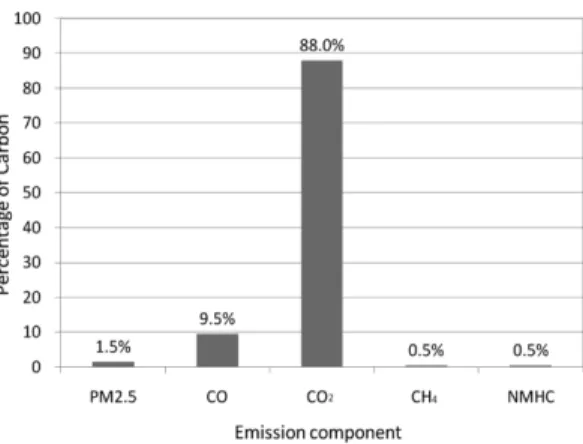
Figure 2
와같이비메탄계탄화수소(Nonmethan Hydrocharbons,
NMHC)
가스들이 방출되는것을 알수 있다.
연소가스의 대부분인 약
88%
의 이산화탄소와9.5%
의 일산 화탄소로구성되어져있는것으로 보고되었다.
하지만소량의
NMHC
계열의 연소가스및 독성가스에 대해서는제시된바없다
.
하지만1993
년이후Ward
et al.에의해주요연소가스및미세먼지에대한추정량알 고리즘 개발및연소가스발생량 비율산정모델이개 발된바있다
.
Ward
et al.(1996)
은savanna
지역의주요연료인초 지와부엽층에대한보정연소효율에대해식2
와같이 제시하였고(R
2= 0.68)
다.
7) 하지만 연소효율에따른 각 산림연료별연소가스및NMHC
발생량은아직제시되 지않았다.
MCE = 0.85 + 0.111G/(L + G)
0.34(2)
여기서
, G
는초지(Grass)
의총질량, L
은부엽토(Litter)
의 총 질량
, MCE
는 ∆CO
2/(
∆CO
2+
∆CO)
로 정의되는보정연소효율
(Modified Combustion Efficiency)
로일반 적인탄소량으로환산되는Biomass
량에대한연소량의 무게비로표현되는연소효율(Combustion Efficiency, CE)
보다실제환경에서측정하기더욱쉬우며탄소화합물 에대한연소량측정에보다많은장점을가지고있다
.
순수화염연소의경우
, MCE
는0.97~0.99
값을가지며 훈소연소(smoldering fire)
의 경우에는0.75~0.85
값을 가진다.
11)이러한연소효율에 의해방출되는연기량은건강에 대한위험성은허용노출한계농도
(PELs, ppm)
로평가된 다.
일반적인노출허용에대한기준은시간가중평균치(Time Weighted Average, TWA)
와단시간노출기준(Short Term Exposure Limit, STEL)
으로평가할 수있다.
시 간가중평균치는 식(3)
과같이1
일8
시간작업을 기준 으로하여 유해요인의측정치에발생시간을곱하여9
시간으로 나눈값을말한다
.
3)
여기서
, C
는 연소가스의 측정치(ppm or mg/m
3), T
는연소가스발생시간
(h)
이다.
단시간노출기준은
1
회15
분간노출되는기준으로1
회노출간격이
1
시간이상인경우, 1
일작업시간동안4
회까지노출이허용될 수있는기준을 말한다.
2.1 적외선분광계
적외선 분광계는 적외선
(IR)
을 이용한 미지시료의spectrum
분석을 통해공기 중검출가스에 대해 정성정량분석을할수있다
.
특히,
본연구에서사용한FTIR
적외선 분광분석기는 미지의연소가스시료를 판별하 는데있어 기분석된 각가스물질별흡수파장대 자료 를가지고있어동시에
150
여개이상의가스물질을판 별할수있는장치이다.
적외선분광계는각분자가다 양한화학결합의 진동에너지와 일치하는파장에서빛 을흡수하는성질을이용해빛의흡수정도를검출기에 의해측정하는것이다.
결과적으로Spectrum
은분자가빛을흡수하는파장에일치하는
Peak
를나타내며흡광도의크기는시료중분자의농도와직접연관되어있 다
. Spectrum-Pattern
은 고유의뒤틀림, Band,
회전 및각원자들의화학결합의회전및진동등분자의실제 구조를 반영한다
.
한분자를 구성하고 있는 원자들은 외부자극에의해움직이며,
적외선은가시광선이나자 외선처럼전자전이를일으킬정도로충분한에너지를TWA = C
1T
1+ C
2T
2+
…+ C
nT
n--- 8
Figure 2.
The average distribution of carbon between the
primary products of combustion for broadcast burns of
logging slash.
갖지못하므로작은에너지차가존재하는분자에흡수 되어분자진동과회전운동을일으킨다
.
진동운동의방 식은 원자들 사이의 결합길이가 변하는 신축운동(Stretching Vibration)
과원자들 사이의 결합각이 변하 는 굽힘(Bending)
또는 변형(Deformation)
진동으로구분할 수있는데 진동운동을 일으키기위해서는결합 의 종류와 세기
,
결합을 하고 있는원자의 종류에 따라고유한 진동주파수에해당하는빛에너지를흡수 해야 한다
.
적외선을 물질에 주사하면이들이 진동을 일으키는데필요한주파수의빛을흡수하여이에너지에대응하는특성적인적외선
Spectrum
을나타나게된다
.
즉 농도(concentration)
에 따라 스펙트럼이 달라진 다.
시료에적외선을비추어서유기화합물을구성하는기
(
基)
는각각거의고유의진동스펙트럼을제공함으 로흡수파장대로부터Figure 3
의각물질별고유파장 대 스펙트럼 분석을 통해 정성(
定性)
분석과 흡수강도 에서 정량(
定量)
분석이 가능하다.
본논문에서는 우리 나라침·활엽수대표수종인소나무,
굴참나무의낙엽 에대해연소가스분석을실시하였다.
3. 실험방법
공시재료의 연소시발생되는가스의 정확한 가스성 분및농도측정을위해
Table 2
와같이소나무,
굴참나 무낙엽20 ± 1g
의연소중량으로 함수율15 ± 2%
의낙엽을
ISO
착화성 시험기에20kW/m
2의복사열에 의한자연발화조건으로일정시간훈소연소를시작하여화염 연소
,
소염연소로 진행되는 각단계 과정별 모니터링 하여연소가스방출특성을조사하였으며10
l/min
의유입속도로측정하였다
.
실험연소물량이많아지면식(1)
에의해연소가스량도많아지게되어 본실험에서는 착화성 시험기기의시험물량에 맞는중량으로실험하 였다
.
2-5)수분함유량
(Fuel Moisture Contents, FMC)
은식(4)
와 같이산출할수있다.
(4)
여기서
, W
1은건조전중량, W
2는건중량이다.
연소가스성분및농도분석을위해적외선분광계실
험방법은정밀한측정을위해먼저
FTIR
기기분석장치 내부의 오염제거를 위하여 질소가스
(dry nitrogen gas)
및액체질소가스(liquid nitrogen gas)
로흡입관세 척및냉각 등의초기화 과정을 실시하였다.
이때 대기압조건은
1
기압상태인14.7psi
조건으로초기화하였다
. FTIR
의고유분석파장대가Figure 3
과같이나타나야지만 분석하고자 하는 가스성분의
Noise
문제없이분석을실시 할수있다
.
이러한Background
가준비후
FTIR
기기와연결된분석컴퓨터에서표준흡수파장대신호상태를 확인하여수분및이산화탄소가깨 끗이 제거된 상태에서실험을 실시하였다
.
연소물질의 연소가스 성분 및 농도를 측정하는 검출기
(Cell-
body)
에 유입도록 실험시 유입(Inlet)
부분을 개방하여낙엽연소가스가유입되고다시검출기의유출
(outlet)
부분으로방출되도록하였다
.
가스종의분석은Figure 3
의 적외선분광계 가스검출 파장대 스펙트럼에서 각 각의 가스종이 가지는 고유 파장대를 비교하여 정성분석을 실시한다
.
여기서Figure 4
는여러검출가스종의 흡수 파장대 중에서 이산화탄소 및 일산화탄소에 대한스펙트럼으로이산화탄소 및일산화탄소의표준 스펙트럼 범위는 각각
3659.725~3759.137, 2034.691~
2412.331
이다.
여기서파장대의좌변축은흡수량을나타낸다
.
검출된연소가스의 정성분석을위해Figure 4
와같이
FTIR
분석기의 가스종류별 흡수파장대와 파장대역 분류법
(Bands Classification)
을 이용하였고 정 량분석을 위해서는검출된 농도를 식(5)
에 의해방출 량을 산정하였다.
여기서 방출량 계산은 표준상태(Standard Temperature and Pressure, STP)
조건으로산정하였다
.
Q
s= C × V
g× t
b× A (5)
여기서
, Q
s는연소가스량(g), C
는 가스방출농도(mg/
l
), V
g는 적외선분광계 흡입가스유량(
l/min), t
b는 연소 가스측정시간(sec), A
는단위환산계수이다.
FMC %
( )= W
1 −W
2W
2--- 100
×Figure 3.
The background wavenumbers of FTIR.
Table 2.
Condition of Combustion Emission Gas Analysis to
P. densiflora,
Q. variabilisWeight Fuel (g)
Moisture Fuel Contents (%)
Energy Heat (kW/m
2)
Indraft Volume (
l/min)
20 ± 1 15 ± 2 20 10
4. 결과 및 고찰
4.1 낙엽연소검출가스정성분석
소나무와굴참나무낙엽의연소시검출된가스는표 준흡수파장대분석을통해
Carbon monoxide, Carbon dioxide, Acetic acid, Butyl acetate, Ethylene, Methane, Methanol, Nitrogen dioxide, Ammonia, Hydrogen Fluoride, Sulfur dioxide, Hydrogen bromide
등13
종이 검출되었고굴참나무낙엽에서는Nitrogen monoxide
가 추가로검출되었다(Table 3).
이중나무를구성하는원소가 아닌
Bromide, Fluoride
등의 화합물 경우,
지표 면에놓여진낙엽이토양의오염에의한검출및연료 의특정화학물질로부터발생될수있다.
따라서 이에 대한정성분석등의검토가필요하다.
4.2낙엽연소검출가스정량분석
소나무낙엽연소시 검출된
13
종의가스농도분석결 과이산화탄소가 약90%
로가장많이검출되었고 일산화탄소가약
9.5%
로검출되었다.
굴참나무낙엽연소시검출가스
14
종의농도분석결 Figure 4.A detection spectrum of CO
2emission gas.
Table 3.
Accumulation Concentration & Emission Amount of Combustion Gases to
P. densiflora,
Q. variabilisFuel Gases Carbon
Monoxide Carbon
Dioxide Acetic
Acid Butyl
Acetate Ethylene Methane Nitrogen Dioxide
P. densiflora
Concentration (ppm) 3493.85 33225.122 57.591 25.603 21.822 21.057 20.403
Emission Amount (g) 174.71 1690.8 2.93 1.3 1.11 1.08 1.04
Q. variabilis
Concentration (ppm) 850.106 7339.321 18.69 6.292 5.434 5.239 6.42
Emission Amount (g) 18.08 156.09 0.39 0.13 0.12 0.11 0.14
Fuel Gases Ammonia Hydrogen Fluoride Sulfur
Dioxide Hydrogen
Bromide Methanol Hydrogen
Chloride Nitrogen Monoxide
P. densiflora
Concentration (ppm) 14.373 8.539 6.845 6.567 5.562 2.467 None
Emission Amount (g) 0.73 0.430 0.350 0.330 0.290 0.120 None
Q. variabilis
Concentration (ppm) 04.894 0.626 2.303 3.489 2.571 0.689 1.484
Emission Amount (g) 0.10 0.020 0.050 0.080 0.050 0.020 0.030
과
,
이산화탄소가약89%,
일산화탄소가약10%
로검 출되었다.
따라서 탄소복합체로 구성된 셀룰로오스의연소시 이산화탄소와 일산화탄소의 연소가스가 전체 방출가스의 약
90%
이상을 차지하였다.
여기서 식5
에 의해 산출된 방출된 연소가스의 전체량은 소나무 낙엽이 굴참나무낙엽에비해
4.5
배많이검출되었다.
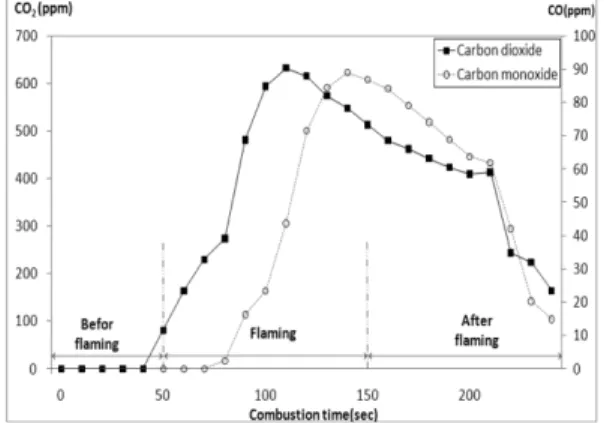
Figure 5
와6
은각각 소나무 낙엽과 굴참나무 낙엽의연소시 발생되는 연소시간대별 이산화탄소
,
일산화탄소 방출농도변화를 분석하였다
.
연소반응시 화염연소와훈소연소상태의각가스방출량은
Table 4
와같이소나무 낙엽의경우
,
화염연소:
훈소연소의 이산화탄소,
일산화탄소 방출비율은 각각
8:2, 8.4:1.6
이고 굴참나 무 낙엽은 각각5.3:4.7, 4.5:5.5
의 비율로 방출되었다.
이는 화염연소지속시간이 굴참나무에비해소나무 낙 엽이약
3.75
배길게나타났기때문이다(Figure 5, 6).
2,6)4.3건강위험성평가
소나무와굴참나무낙엽의연소시발생되는
14
종검출가스에대한건강위험성평가는물질안전보건자료에 서 제공하는 노출기준 및 건강위험성 보고에 기재된
사항을토대로평가하였다
(Table 5).
이중대부분의검출된연소가스는 호흡곤란과질식을 유발하고혈액의 산소공급을저해하는 혈액이상 증세를나타내는 일산 화탄소
,
이산화탄소,
메탄가스가확인되었고 신경이상 및눈자극증세를발생시킬수있는염화수소,
메탄올,
이산화질소가확인되었다
.
특히연소가스의99%
이상 을배출하는이산화탄소,
일산화탄소에서TWA, STEL
농도기준을
Table 3
과Table 5
를각각비교한결과,
모두기준치를초과하는것으로 나타났다
.
5. 결 론
우리나라주요 침엽수종인 소나무
(
Pinus densiflora)
와 활엽수종인 굴참나무
(
Quercus variabilis)
의 낙엽에 대해연소가스종류및농도를 측정및건강위험성을 평가한결론은 다음과같다.
1.
소나무와 굴참나무 낙엽에서Carbon monoxide,
Carbon dioxide, Acetic acid, Butyl acetate, Ethylene, Methane, Methanol, Nitrogen dioxide, Ammonia, Hydrogen Fluoride, Sulfur dioxide, Hydrogen bromide
등
13
개연소가스가검출되었고굴참나무낙엽에서는Nitrogen monoxide
가추가로 검출되었다.
2.
방출된연소가스의전체농도는소나무낙엽이굴 참나무낙엽에비해4.5
배많이검출되어산불발생시 연무에의한건강위험성이 더욱높다고볼수있다.
3.
시간가중평균가스농도와 단시간노출기준을 초과 하는연소가스는Carbon monoxide, Carbon dioxide
가 검출되었고소나무 및굴참나무모두에서 나타났다.
4.
이에산불에서의낙엽의지표화연소시전체가스 방출량의99%
이상을차지하고있는Carbon monoxide,
Carbon dioxide
의건강위험성이높은것으로나타났다.
Figure 5. P. densiflora
CO, CO
2emission concentration variation during combustion.
Figure 6. Q. variabilis
CO, CO
2emission concentration variation during combustion.
Table 4.
Condition of Combustion Emission Gas Analysis to
P. densiflora,
Q. variabilisOxidation gases Emission Rate (%) Flaming Smoldering
P. densiflora
CO
283.55 16.45
CO
279.84 20.16
Q. variabilis
CO
245.05 54.95
CO
253.13 46.87
5.
하지만 검출된 다른 건강위험성 가스의 경우에도연소물질의양이증가할수록연소가스의농도가높 아져건강안정성에 해가있을것으로판단된다
.
6.
검출된 연소가스중 나무의 주요구성원소가 아닌
Bromide, Fluoride
등일부화합물에대해서는향후,
토양으로부터의오염 등에의한검출및연료의 특정 화학물질정성분석등보다면밀한 검토가 필요할것 으로판단된다
.
참고문헌
1.
김동현,
김태구,
김광일, “
산림화재종합위험등급화에 관한연구”,
한국화재소방학회논문지, Vol.15, No.3, pp.49-54(2001).
2.
김동현,
이명보,
강영호,
이시영, “
지표물질착화성실험을통한발화위험성분석
”, 2006
한국방재학회학 술발표대회논문집, pp379-384(2006).
3. AP
로이터통신, “
동남아연무대란또오나”,
신문스 크랩(2008).
Table 5.
Permissible Exposure Limits (PELs) and Health Hazardous of Combustion Emission Gases
7-9)Gases Permissible Exposure Limits (PELs) and Health Hazardous Carbon
Monoxide PELs TWA: 50ppm, STEL: 400ppm Helth Hazardous Blood Dycrasias, Dyspnoea, Asphyxia Carbon
Dioxide PELs TWA: 5,000ppm, STEL: 0,000ppm Helth Hazardous Blood Dycrasias, Dyspnoea, Asphyxia Hydrogen
Chloride PELs TWA: 200ppm, STEL: 250ppm
Helth Hazardous Skin Stimulus, Eye Stimulus, Central Nervous System Inhibition, Nerve Dycrasias Sulfur
Dioxide
PELs TWA: 1mg , STEL: - ppm
Helth Hazardous Swallow Noxious, the Respiratory Tract Stimulus, Eye Stimulus, Allergicreaction, Carcinogenesis Ammonia PELs Not Formulated PELs
Helth Hazardous Not Reported to Target Organs Methane PELs Not Formulated PELs
Helth Hazardous Blood Dycrasias, Dyspnoea, Primary Asphyxia Acetic
Acid PELs TWA: 150ppm, STEL: 187ppm
Helth Hazardous Skin Stimulus and Allergicreaction, Eye Stimulus, the Kidne and the Liver Dycrasias Methanol PELs TWA: 10ppm, STEL: 35ppm
Helth Hazardous Skin Stimulus, Eye Stimulus, Central Nervous System Inhibition, Nerve Dycrasias Nitrogen
Dioxide
PELs TWA: 100ppm, STEL: 150ppm
Helth Hazardous The Respiratory Tract Stimulus, Skin Stimulus, Eye Stimulus, Suction Danger, Central Nervous System Inhibition, Carcinogen in Animal Test Ethylene PELs Not Formulated PELs
Helth Hazardous Not Reported to Target Organs
4.
박형주,
김응식,
김장환,
김동현, “
복사열을이용한소 나무와굴참나무낙엽의연소특성분석”,
한국화재소방학회논문지