A CONCEPTUAL DESIGN OF NEW AUTOMATIC BICYCLE TRANSMISSION BY TRIZ AND DESIGN AXIOM
Kun Sang Lee a,* , Jun Ho Choi b
a
School of Mechanical & Automotive Engineering, Kookmin University
b
Graduate School of Automotive Engineering, Kookmin University 861-1, Jeongneung-dong, Seongbuk-gu, Seoul 136-702, Korea [email protected] (e-mail address of corresponding author)
Abstract
This paper represents a study on the conceptual design of new automatic bicycle transmission. The gear change in a commercial bicycle is carried out by moving the chain between sprockets. By the use of a multiple sprocket for speed change the power loss and transmission shock may occur. To solve the problem of bicycle transmission, the improved solution was derived by the technical contradiction matrix of TRIZ. The conceptual solution is one sprocket which replaces the function of multiple sprockets and adapts actively to the pitch of chain. And it was confirmed to be an adequate design through the Independence Axiom of design axiom.
INTRODUCTION
Figure 1 shows main components for a bicycle drive train. A chain wheel spins freely in one direction and locks in the other. The rear wheel is composed of several sprockets of different diameter. To change the gears, a bicycle has a rear derailleur. The purpose of the arm and lower cog of the derailleur is to tension the chain. The cog and arm are connected to a spring so that the cog pulls backward at all times.
(a) rear derailleur (b) rear wheel (c) chain wheel
Figure 1 - Components for a bicycle drive train
As more power is required to ride, one may make the chain slide from small gear to larger one to reduce the pedal power by human. When it is enough to ride with less power, the higher speed can be arrived by sliding of a chain from large gear to smaller one. The gear change in this structure is carried out by moving the chain between sprockets. Here because of temporary interruption of power transmission between the different pitch circles, power loss and transmission shock could occur.
대한기계학회 2008년도 추계학술대회 논문집
On the premise of the use of bicycle chain, the problem formulation states that a development of bicycle transmission without power loss and transmission shock. To solve the problem of bicycle transmission, the improved solution was derived by the technical contradiction matrix of TRIZ. And it was confirmed to be an adequate design through the Independence Axiom of design axiom.
SOLUTION FINDING PROCEDURE BY THE TECHNICAL CONTRADICTION MATRIX The contradiction matrix
1,2,3)is composed of engineering parameters (“feature to improve” and “degraded feature”) and inventive principles. The engineering parameters in TRIZ are 39 parameters. The inventive principles in TRIZ are summarized 40 principles. The technical contradiction matrix, which is one of solution finding methods in TRIZ, is applied for the search of solution principle. A technical contradiction exists, when in attempting to improve for example parameter A of a technological system, another parameter B deteriorates. The technical contradictions can be defined as follows: By the use of a multiple sprocket for speed change the power loss and transmission shock may occur. The characteristics in the above contradiction expression are “the use of a multiple sprocket for speed change” and “the power loss and transmission shock.” The characteristic “the use of a multiple sprocket for speed change” means “the reduction of energy loss” which is the engineering parameter number 22 in the contradiction table. And the characteristic “the power loss and transmission (or speed change) shock” is “the fall of productivity” which is the engineering parameter number 39 in the contradiction table. Applying the above engineering parameters to the contradiction table (Table 1) the principles could be found to overcome contradictions. Some solution principles derived from the above principles are suggested in Table 2.
Table 1 - Technical contradiction matrix
1,2,3)Degraded Feature
(Conflict)
Feature to Improve
Engineering parameters
1 2 … 22 … 39
Weight of moving
object
Weight of non-moving
object
… Waste of
Energy … Produc- tivity
Engineering parameters
1 Weight of moving object … 2, 6, 19, 34 … 3, 24, 35, 37
2 Weight of nonmoving
object … 15, 18, 19,
28 … 1, 15, 28, 35
… … … … … … … …
22 Waste of Energy 6, 15, 19, 28 6, 9, 18, 19 … … 10, 28,
29, 35
… … … … … … … …
39 Productivity 24, 26, 35,
37 3, 15, 27, 28 … 10, 28, 29,
35 …
Inventive Principles
10 Preliminary Action
28 Mechanics Substitution
29 Pneumatics and hydraulics
35 Parameter changes
Table 2 - Suggested solution principles by the contradiction matrix
Inventive Principles
3)Use of principle in POM activities
3)(POM: Production and Operation Management)
Proposed possible solution principles
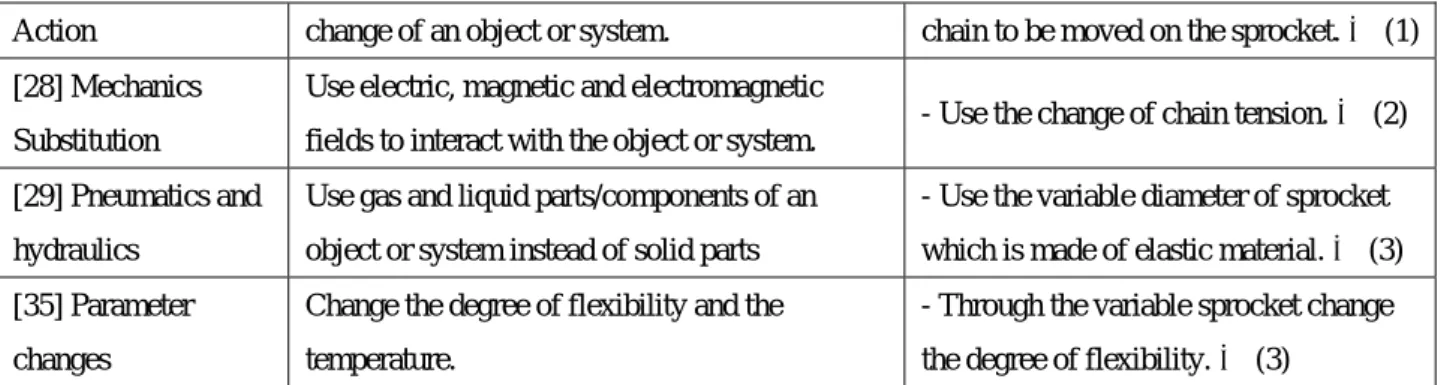
[10] Preliminary Perform, before it is needed, the required - Using many different chains preset the
Action change of an object or system. chain to be moved on the sprocket. Æ (1) [28] Mechanics
Substitution
Use electric, magnetic and electromagnetic
fields to interact with the object or system. - Use the change of chain tension. Æ (2) [29] Pneumatics and
hydraulics
Use gas and liquid parts/components of an object or system instead of solid parts
- Use the variable diameter of sprocket which is made of elastic material. Æ (3) [35] Parameter
changes
Change the degree of flexibility and the temperature.
- Through the variable sprocket change the degree of flexibility. Æ (3)
The solution principles are related to the variation of sprocket diameter, and concretized in three types.
(1) Using many different chains preset the chain to be moved on the sprocket. Æ To reduce the moving time of chain the sprocket diameter must be varied.
(2) Use the change of chain tension. Æ By the reaction of spring, cam and variation of chain tension the sprocket diameter must be varied.
(3) Through the variable sprocket change the degree of flexibility. Æ The gear teeth must be matched
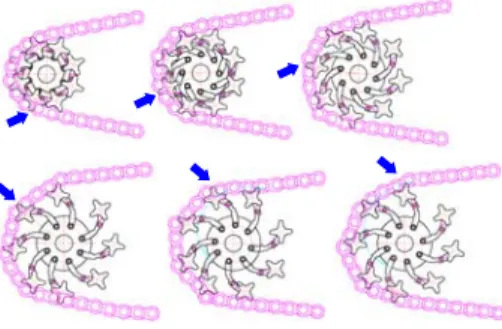
The following resulting conceptual solution is derived from the above solution concepts. The conceptual solution:
“One sprocket which replaces the function of multiple sprockets and adapts actively to the pitch of chain.” One of the final conceptual solutions is represented in Figure 3.
drive
“chain gear”
ratchet
“max. pitch circle”
“min. pitch circle”
drive
drive drive drive
“chain gear”
ratchet
“chain gear”
ratchet
“max. pitch circle”
“min. pitch circle”
drive drive drive
Fig. 2 - The final conceptual design of a bicycle transmission:
‘Chain gear’ is defined as a small gear which has a contact with chain.
ESTIMATION OF A CONCEPTUAL SOLUTION BY DESIGN AXIOM A Commercial Bicycle Transmission
For the current commercial bicycle transmission the functional requirements (FRs) and the corresponding design parameters (DPs) can be defined as follows:
FR
1= Torque must be transmitted by the chain. (T) FR
2= Output to input torque ratio can be changed. (C) FR
3= Deflection of chain should not occur. (D)
FR
4= Torque loss during the torque change must be minimized. (L)
FR
5= Torque transmission shock during the torque change must be minimized. (I) DP
1= The stiffness of sprocket with which torque can be transmitted (S)
DP
2= The different radius of sprocket with which the different torque can be transmitted (R) DP
3= The elasticity of the rear derailleur spring (E)
DP
4= The distance between adjacent sprockets (O)
DP
5= The diameter ratio between adjacent sprockets (P)
The design parameter DP
1(the strength of sprocket, S) should be stiff enough to bear the tension of chain during torque transmission. It is obvious that the torque transmission is not possible without the sufficient stiffness of sprocket S (DP
1). The stiffness of sprocket S (DP
1) is however unrelated with the remaining functional requirements. The multiple sprockets with different diameters R (DP
2) make the change of output torque possible. The purpose of the arm and lower cog of the derailleur is to prevent the deflection D of chain by the providing of tension (DP
3) to chain. When the distance O (DP
4) between adjacent sprockets is larger, the more power loss and transmission shock could occur during gear change. The diameter ratio P (DP
5) between adjacent sprockets is higher, the more power loss and transmission shock could occur during gear change. The relationship between the functional requirements (FRs) and the design parameters (DPs) can be written as Eq. (1):
{ }
FR= [ ]A{ }
DP
[ ]
⎪ ⎪
⎪
⎭
⎪⎪
⎪
⎬
⎫
⎪ ⎪
⎪
⎩
⎪⎪
⎪
⎨
⎧
=
⎪ ⎪
⎪
⎭
⎪⎪
⎪
⎬
⎫
⎪ ⎪
⎪
⎩
⎪⎪
⎪
⎨
⎧
P O E R S
A
I L D C T
j
ij
DP
iA FR
∂
= ∂ (1)
where [A] in Equation (1) is called the design matrix that characterizes the product design. The design matrix [A] can be written as Equation (2):
[ ]
⎥ ⎥
⎥ ⎥
⎥ ⎥
⎦
⎤
⎢ ⎢
⎢ ⎢
⎢ ⎢
⎣
⎡
×
×
×
×
×
×
×
=
⎥ ⎥
⎥ ⎥
⎥ ⎥
⎥ ⎥
⎥ ⎥
⎥
⎦
⎤
⎢ ⎢
⎢ ⎢
⎢ ⎢
⎢ ⎢
⎢ ⎢
⎢
⎣
⎡
∂
∂
∂
∂
∂
∂
∂
∂
∂
∂ ∂
∂
∂
∂
∂
∂
∂
∂
∂
∂ ∂
∂
∂
∂
∂
∂
∂
∂
∂
∂ ∂
∂
∂
∂
∂
∂
∂
∂
∂
∂ ∂
∂
∂
∂
∂
∂
∂
∂
∂
∂
=
0 0 0
0 0 0
0 0 0 0
0 0 0 0
0 0 0 0
P I O
I E
I R I S
I P
L O
L E
L R
L S
L P
D O D E D R D S
D P
C O C E C R C S
C P
T O T E T R T S T
A
(2)
When the FRs are dependent on the DPs, it is denoted as ‘x’, and for the independence ‘o’. According to the above design matrix [A] the current commercial bicycle transmission is a coupled design, and does not satisfy the independence axiom. According to the independence axiom
4)the optimum design always maintains the independence of FRs.
The Here Developed Automatic Bicycle Transmission (“New Transmission”)
For the conceptual solution of bicycle transmission developed by TRIZ the functional requirements (FR
1, FR
2, FR
3, FR
4) remain unchanged from a commercial bicycle transmission. FR
5of the new transmission must be changed because there are no torque transmission shocks. The new functional requirement FR
5’ must be modified as “a torque transmission shock during torque transmission must be minimized (J).”
FR
1= For torque transmission a chain must be used. (T) FR
2= Output to input torque ratio can be changed. (C) FR
3= A chain deflection should not occur. (D)
FR
4= Power loss during torque change must be minimized. (L)
FR
5’= A torque transmission shock during torque transmission must be minimized. (J)
New design parameters (DP
1’, DP
2’, and DP
3’) for the functional requirements FR
1, FR
2, and FR
3of the here
developed automatic bicycle transmission are the same as those of a commercial one. The design parameter DP
4(the distance between adjacent sprockets “O”), however, is always zero in the “new transmission” because only one sprocket is used here. And the design parameter DP
5(the diameter ratio between adjacent sprockets “P”) converges to zero during the velocity change because the sprocket diameter changes continuously. Therefore new design parameters DP
4’ and DP
5’ must be derived from the functional requirements FR
4and FR
5’. The corresponding design parameters (DPs) can be defined as follows:
DP
1’ = DP
1= The stiffness of sprocket with which torque can be transmitted (S)
DP
2’ = DP
2= The different radius of sprocket with which the different torque can be transmitted (R) DP
3’= DP
3= The elasticity of the rear derailleur spring (E)
DP
4’= The teeth numbers of a chain gear which can be engaged with chain (G) DP
5’= The number of chain gear (N)
The virtually new design parameters are DP
4’ and DP
5’. DP
4’ is the teeth number of a chain gear (G), which is related with power loss. When the teeth number of chain gear is appropriate to the chain, the tooth of chain gear can engage smooth to the chain. The engagement between chain and chain gear must be maintain although the sprocket diameter varies. When the sprocket diameter is the smallest, chain and chain gear are good engaged. When the tension of chain is larger, the sprocket diameter increases. When, during increase of sprocket diameter, chain and chain gear are not good engaged, the chain will slide on the chain. Until chain and chain gear engage, the power loss would occur. When the teeth number of chain gear is enough, the possibility of the engagement of chain and chain gear will be larger, and the power loss decreases. The figure 3 shows the good engagement between chain and chain gear with four teeth of chain gear.
Figure 3 – Engagement between chain and chain gear
The size of chain is standardized in KS (Korean Industrial Standard), and the number and teeth number of chain gear
must match the chain. DP
5’ is the number of chain gear (N). The figure 4 shows how chain travels in the cases of three
and eight chain gears. During the sprocket rotates, the position paths of chain are 1 -> 1’ -> 2 -> 1. When chain gear
moves from 1 to 1’, the chain travels very gradually. When chain gear moves from 1’ to 2, chain is removed from 1’ to 2
very quickly. This propagates some shock to sprocket. When chain gear moves from 2 to 1, the chain travels again very
gradually. The power transmission shock would decrease with the increase of number of chain gear.
n o
t t t Δ+
n’
Chain gear Rear wheel
(Sprocket) Chain Chain wheel
o n
t t t+Δ
n’
Chain gear Rear wheel
(Sprocket) Chain Chain wheel
(a) the number of chain gear is three. (b) the number of chain gear is eight.
Fig. 4 - The power transmission shock due to the number of chain gear
The relationship between the functional requirements (FRs) and the design parameters (DPs) for the conceptual solution of bicycle transmission generated by TRIZ can be written as Equation (3):
{ }
FR′ = [ ]{ }A′
DP′
[ ]