. Introduction
Ⅰ
Recently, college students occupy a large part in consumption market as a enormous consumption mass. This is based on increase of their household income and chance for getting part time job. Furthermore, they are under
Corresponding author: Chung Youngju, Tel. +82-10-8470-4721, Fax. +82-31-720-2295 E-mail: [email protected]
consumption-oriented environment with overflown commercial mass media. To pace with growing college students' expenditure, fashion manufacturers are developing aggressive marketing activities targeting college students.
Previous research showed that college students have a much tendency to purchase non brand
A Study on Store Switching Behavior of College Students in On/Offline Apparel Store
Chung Youngju
Dept. of Fashion Design, Dongseoul College
Abstract
This study investigated the store switching behavior of fashion stores targeting college students. A random sample of college students completed a questionnaire that contained measurements of store property, relationship quality, switching intent of store, preference of on/offline store, purchase of brand/non-brand product and monthly clothing expenses. The factors extracted as switching behavior of on/offline fashion store are store property, relationship quality and switching intent of store. Dimensions of store switching behavior in online shopping mall is revealed to be composed of diversity/ easy to search, store reliability, home page layout, sales promotion, reliability, commitment and switching intent of store. Also those of offline store is revealed to be composed of store comfort/salespeople service, product diversity, store location, product price, reliability, commitment and switching intent of store. The significant differences were found between store switching behavior of college students by preference of on/offline store and purchase of national brand/non brand. It is expected that this results can be used as a basic material for further study and setting up the fashion retailing strategies in fashion store for selling non brand products.
Key words : preference of on/offline store, purchase of brand/non brand, relationship quality, store switching behavior
apparel product than national brand apparel product (Chung & Jang, 2012). And also showed that they visit more local market or online shopping mall than a department store and franchise store. Thus, it is revealed that college students visit online shopping mall and offline store when they purchase fashion product. And, college students have a much tendency to search a new store or switch into another store from patronized store to meet their needs with exploring many retailers and checking the store property carefully. Both of online shopping mall and local market are the typical store types for selling non brand apparel. So it is needed for this research to study dimensions of store switching behavior between these stores for selling non brand apparel product.
Research on store switching behavior in clothing & textiles field has been skewed with focussing brand switching or switching barriers.
Research on the components of store switching behavior or the factors influenced on store switching behavior haven't studied actively. Also, it is guessed that store switching behavior between on/offline store could be different significantly. Therefore, this study is designed to investigate store switching behavior in on/offline apparel store targeting college students. We expect that this results can be used in establishing a effective fashion retailing strategies to prevent college students switching into other store and to keep patron with identifying their need.
. Literature Review
Ⅱ
1. Studies on Switching
Researches on store switching in marketing
field has included customer switching, service switching and brand switching. A study on customer switching mainly was to investigate the effectiveness on customer attribute, product property, occasion property, involvement (Um, 2007). A study on service switching was begun since Keaveny (1995) investigated the reason of service switching behavior (Keaveny, 1995). He defined the causes of service switching behavior-service cost, discomfort, failure of key service, disharmony in service confrontation, reaction on mistaken service, competition, moral problem, involuntary switching. According to Bansal and Taylor (1997), service quality and service satisfaction are different concept strictly, so he defined that service quality than service satisfaction has influenced on store switching intent directly (Bansal & Taylor, 1997).
Recent researches on switching in clothing &
textile field are mainly those of the brand switching and store switching barrier. Givon (1984) defined that brand switching is a phenomenon to switch brand label throughout the benefit of switching behavior itself (Givon, 1984). Also, he concluded that choice behavior of brand label is determined by only nature benefit of the brand label but also by benefit getting from switching brand label. Examining previous research on factors influenced on brand label switching, Carpenter and Nakamoto (1996) defined that advertisement, price, brand label, product property have influenced on brand switching (Carpenter & Nakamoto, 1996). Chin, Wu, and Wang (2000) defined that product property, A/S, marketing ability, design or quality, the depth of product line, brand perception have influenced on brand switching (Chin, Wu, & Wang, 2000). S. Lee and Jo (2007) who researched effect of store image on store royalty or brand name switching behavior,
concluded that the dimension store recognition among store images have a significant difference on brand switching behavior and the dimension store royalty composed of salesman reliability and pursuit of novelty also have a significant difference on brand switching behavior (S. Lee & Jo, 2007). Store switching barrier is defined as a difficulty that unsatisfied customers experience when they break the relationship with the patronized store and then switches another new store. Kang and Hong (2003) mentioned that service quality like store VMD, or store atmosphere, store policy has impact on switching barriers (Kang & Hong, 2003). Also, it is reported that customer satisfaction on a certain store have influenced on controlling the switching behavior and make the customer feel the switching barrier strongly.
M. Lee (2000) concluded that high customer satisfaction makes the customers perceive the switching cost higher in her study on effects of customer satisfaction and switching cost perception on the brand royalty (M. Lee, 2000).
Kim and Chung (2005) revealed that perceived store image and customer satisfaction have a influenced on perception of switching barriers positively and the attractiveness toward substitute store has influenced on perception of switching barriers negatively (Kim & Chung, 2005). In a study on effect of service quality, switching barriers, customer satisfaction on store royalty in discount store, O. Lee and Kim (2007) found that service quality and customer satisfaction have a positive effect on switching barriers, and customers perceive the switching barriers higher only throughout the satisfaction of store (O. Lee & Kim, 2007).
2. Store Switching Behavior
As shown in Bansal and Taylor's (1997) study, we knew that the factor influenced on service switching is not service satisfaction but service quality (Bansal & Taylor, 1997). Although the customers aren't satisfied with the service, they can be stayed as long as they feel the serious barrier caused store switching or they have no substitute for dissatisfied service. Or, although the customer are satisfied with the service, they can switch into another store or brand. So, this research defined that store switching behavior is related to store property not store satisfaction.
According to Keaveney's (1995) study, it is revealed that consumers understand the property of product through various product information and then choose a useful product to make their needs satisfy, which brand switching is caused by changing standard of product choice and their expected advantage on competitive brand (Keaveney, 1995). But their beneficial desire on standard and competitive brand tend to change in occasions, brand switching is followed. So it is supposed that consumers first recognize expected store property, and they switch into other store when satisfaction of store property doesn't get to the expectation. Chung (2004) investigated that reliability is the degree to rely on reliable apparel manufacturer and commitment is the psychological affection to generate property like a satisfaction and repurchase intents (Chung, 2004). Also, she found that consumer's relationship quality and store property in online shopping mall and local market is related to switching intents of store.
So it is guessed that store switching behavior includes not only store property but also reliability and commitment as contents of store switching behavior. O. Lee (2010) investigated that interactivity had a positive influence on site stickiness, switching barrier, and intention to
use. And she was found to have a indirect effect on intention to use through site stickiness and switching barrier (O. Lee, 2010). Based on preceeding researches, store switching behavior can be defined as follows. As brand switching behavior is the behavior for switching brand name throughout brand property, store switching behavior is the behavior for switching store throughout store benefit. So it can be defined that store switching is composed of store property, relationship quality, switching intents of store.
. Research Methods and Procedure
Ⅲ
1. Research Questions
The purposes of this study are (1) to investigate the dimensions of store switching behavior in fashion store and (2) to investigate the store switching behavior on the preference of online/offline store and (3) to investigate the store switching behavior on brand/non brand apparel purchase and (4) to investigate the store switching behavior on preferable retail store types for apparel and (5) to investigate the store switching behavior on monthly clothing expense
2. Survey and Participants
This research was focussed on fashion store switching behavior for college students.
Throughout the preliminary survey, online shopping mall and local market were selected as a subject stores to know store switching behavior of on/offline store. In order to validate the research questions of this study, it is reviewed previous researches about store
property, switching intent of store, relationship quality. These are sub variables of store switching behavior and developed measurement tools and empirical research was conducted.
Research was conducted from 2, march to 20, march, 2013 for 18 days with targeting college students in Seoul and Gyeong-gi.
3. Measurement and Data Analysis
The questionnaire method was used to investigate research questions. The questions regarding clothing purchase of brand/non brand, preference of on/offline, preferable retail store types, demographics are asked to answer in two scale or frequency, amount. And the items regarding store switching behavior of internet shopping mall and local market were asked respondents to indicate five Likert scale. 300 questionnaires were distributed and 278 were used in a final analysis. For data analysis, descriptive statistics, t-test, analysis of variance, factor analysis, cross analysis of statistical package SPSS pc were used.
. Results and Analysis
Ⅳ
This results of empirical research on store switching behavior in on/offline store are as follows. General apparel behavior for study subjects is revealed that 68.5% of all subjects likes shopping non brand apparel and 48% of those likes shopping in online shopping mall.
And 44.6% of all respondents selected internet shopping mall as their preferable retail store to purchase clothing, followed by buying shop, local market.
1. Factor Analysis of Store Switching Behavior in Online Shopping Mall and Offline Store
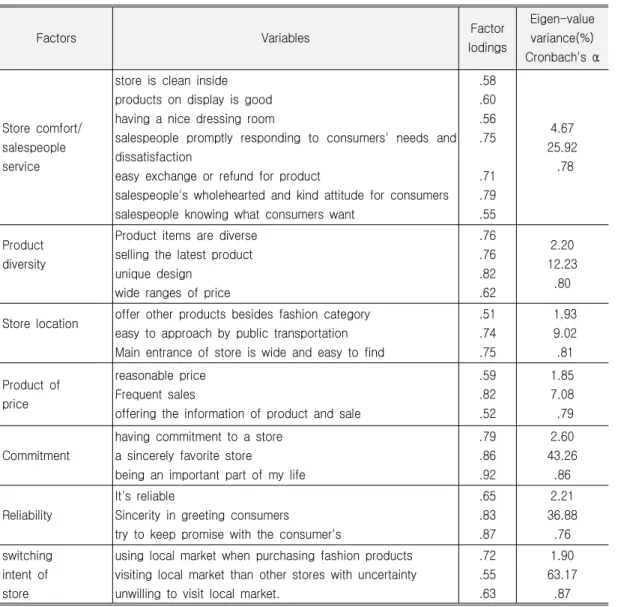
In order to determine the factors of store switching behavior, factor analysis was used and the results are shown in Table 1, Table 2.
Table 1. The Factors of Store Switching Behavior in Offline Store
Factors Variables Factor
lodings
Eigen-value variance(%) Cronbach's α
Store comfort/
salespeople service
store is clean inside products on display is good having a nice dressing room
salespeople promptly responding to consumers' needs and dissatisfaction
easy exchange or refund for product
salespeople's wholehearted and kind attitude for consumers salespeople knowing what consumers want
.58 .60 .56 .75
.71 .79 .55
4.67 25.92 .78
Product diversity
Product items are diverse selling the latest product unique design
wide ranges of price
.76 .76 .82 .62
2.20 12.23 .80
Store location offer other products besides fashion category easy to approach by public transportation Main entrance of store is wide and easy to find
.51 .74 .75
1.93 9.02 .81 Product of
price
reasonable price Frequent sales
offering the information of product and sale
.59 .82 .52
1.85 7.08 .79
Commitment
having commitment to a store a sincerely favorite store
being an important part of my life
.79 .86 .92
2.60 43.26 .86
Reliability
It's reliable
Sincerity in greeting consumers
try to keep promise with the consumer's
.65 .83 .87
2.21 36.88 .76 switching
intent of store
using local market when purchasing fashion products visiting local market than other stores with uncertainty unwilling to visit local market.
.72 .55 .63
1.90 63.17 .87 Cronbach's α was used to test internal consistency of the each measurement. It was revealed as high reliability that the Cronbach's α was more than 0.70 and accumulated variance, factor loadings, eigen-value is displayed.
Factors of store switching behavior in offline store was extracted 7 factors-store comfort/
salespeople service, product diversity, store location, product price, reliability, commitment, store switching intent. Factors of store switching behavior in online shopping mall was also extracted 7 factors-product diversity/easy to search, store reliability, home page layout, sales
Factors Variables Factor
loadings
Eigen-value variance(%) Cronbach's α
Product diversity/
Easy to search
easy to compare price/quality
easy to search the desired product using searching function approach to search product information in a short time having a diverse and many kind of product.
having a unique items that can't be found in any other stores The latest product and new arrival product is offered.
.61 .70 .63 .70 .61 .66
3.74 17.80 .83
Store reliability
product delivery is on time
exchange and refund system is easy
promptly responding to consumers needs and dissatisfaction to check if the money and credit card is safe
.72 .80 .62 .51
2.56 12.21 .86
Homepage layout
script for introducing product is concrete homepage layout for introducing product is good
easy to search for information on size and price information secure my private information
.74 .75 .55 .50
2.56 12.18
.75
Sales promotion
offer extra information(sale, product etc) offer many benefits(event, mileage etc)
community activity between consumers is activated one stop shopping is possible
access to homepage and searching system is easy
.58 .64 .56 .47 .58
2.17 10.33
.78
Commitment
Having commitment to an online shopping mall online shopping mall being a favorite retail shop online shopping being an my important part of life
.87 .83 .86
2.37 39.57
.79
Reliability
It's reliable
sincerity in greeting consumers
trying to keep promises with the consumer's
.72 .87 .86
2.15 35.80
.84 Store
switching intent
Internet shopping mall satisfying the needs
I'll visit this internet shopping mall whenever I purchase fashion product
visiting internet shopping mall than other stores with uncertainty
.73 .81
.70
4.22 60.29
.72 Table 2. The Factors of Store Switching Behavior in Online Shopping Mall
promotion, reliability, commitment, store switching intent. These results shows that consumer's store switching behavior is composed of store property, relationship quality, store switching intent in online/offline store.
2. Store Switching Behavior by the Preference of Online Shopping Mall and Offline Store
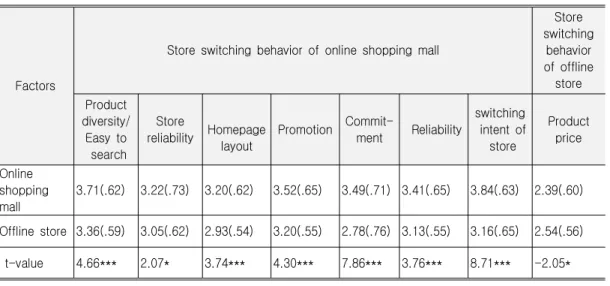
For examining store switching behavior between two groups divided by preference of on/offline store, t-test was operated and the result is shown in Table 3. Significant difference between two groups (students who prefer to shop at online shopping mall, students who prefer to shop at offline store) is shown in store switching behavior of online shopping mall. But significant difference between two groups in store switching behavior of offline store is shown in product price only. It's revealed that college students who prefer to shop for clothing at online shopping mall evaluated store property and relationship quality of online shopping mall much higher and their intent for switching into offline store is much less. Whereas, it is revealed that college students who prefer to shop for clothing at offline store evaluated store
Factors
Store switching behavior of online shopping mall
Store switching
behavior of offline store Product
diversity/
Easy to search
Store
reliability Homepage layout
Promotion Commit-
ment Reliability
switching intent of store
Product price
Online shopping mall
3.71(.62) 3.22(.73) 3.20(.62) 3.52(.65) 3.49(.71) 3.41(.65) 3.84(.63) 2.39(.60)
Offline store 3.36(.59) 3.05(.62) 2.93(.54) 3.20(.55) 2.78(.76) 3.13(.55) 3.16(.65) 2.54(.56) t-value 4.66*** 2.07* 3.74*** 4.30*** 7.86*** 3.76*** 8.71*** -2.05*
Table 3. Store Switching Behavior by the Preference of Online Shopping Mall and Offline Store M(S.D)
* P<.05 ***P<.001
property and relationship quality of online shopping mall much lower and their intent for switching from online shopping mall is much higher. This result indicates that college students who prefer to shop at online shopping mall don't want to switch from online shopping mall into local market designated as the research subject for the offline store, and also indicates that college students who prefer to shop at local market comparatively switch the store without any consideration from offline store into online shopping mall. Especially, significant difference was shown in product price of offline store. This means, if local market keep developing the marketing strategy focused on price, they can prevent their customers switching into online shopping mall. So we can guess that the factor product price of offline store is one of the most effective factors for activating store switching behavior of offline store.
3. Store Switching Behavior by the Purchase of National Brand/Non Brand
For examining store switching behavior between two groups divided by purchase of national brand/non brand, t-test was operated and the result is shown in Table 4. Significant differences between two groups (students who prefer to purchase national brand, students who prefer to purchase non-brand) are shown in Store switching behavior of offline store. But any significant difference between two groups wasn't revealed in store switching behavior of online shopping mall, except the factor reliability of online shopping mall.
It is revealed that college student who prefer to purchase non-brand clothing evaluated store property and relationship quality of offline store affirmatively and their intent for store switching into online shopping mall is much less.
Whereas, it is revealed that students who prefer
Factor
Store switching behavior of offline store
Store switching behavior of online shop-
ping mall Store comfort
/salesman service
Product diversity
Product price
Commit-
ment Reliability
switching intent of
store
Store reliability National
brand purchase
2.42(.67) 3.17(.74) 2.32(.58) 2.12(.88) 2.41(.72) 2.80(.80) 3.29(.67)
Non brand
purchase 2.58(.56) 3.42(.64) 2.53(.57) 2.56(.86) 2.77(.63) 3.13(.64) 3.06(.67) t value -2.81** -2.83** -2.05* -3.81*** -4.09*** -3.68*** 2.52**
Table 4. Store Switching Behavior by the Purchase National Brand and Non Brand M(S.D.)
* P<.05 **P<.01 ***P<.001
to purchase national brand apparel evaluated store property and relationship quality of offline store negatively and they rather trusted online shopping mall than offline store. This results indicate that college students who purchase non brand product at local market don't want to switch the store actively from local market into online shopping mall and also indicates that college students who prefer to purchase national brand visit both of online shopping mall and local market to buy non brand product without preference of any place. Especially, significant difference was shown in store reliability of online shopping mall. This means, if online shopping mall keep developing the marketing strategy focussing reliability, that they can prevent their customers switching into offline local market. So we can guess that the factor reliability of online shopping mall is one of the most effective factors for activating store switching behavior of online shopping mall between college students.
4. Store Switching Behavior by Preferable Retail Store Types
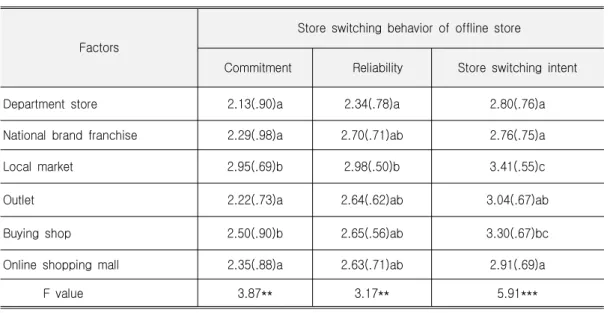
For examining Store switching behavior of on/offline store by preferable retail store types (department store, national brand franchise, local market, outlet, buying shop for non brand, online shopping mall), Anova was operated and the result is shown in Table 5. Significant differences are revealed in store switching behaviors of offline store. Especially, it is revealed that relationship quality and switching intent of offline store have influenced on store switching behavior by preferable retail store types. The factors of store property of online/offline store had no significant differences by preferable retail store types. A significant difference in commitment of offline is revealed between the groups who prefer to department store, franchise for national brand, outlet, online shopping mall and the groups who prefer to
Factors
Store switching behavior of offline store
Commitment Reliability Store switching intent
Department store 2.13(.90)a 2.34(.78)a 2.80(.76)a
National brand franchise 2.29(.98)a 2.70(.71)ab 2.76(.75)a
Local market 2.95(.69)b 2.98(.50)b 3.41(.55)c
Outlet 2.22(.73)a 2.64(.62)ab 3.04(.67)ab
Buying shop 2.50(.90)b 2.65(.56)ab 3.30(.67)bc
Online shopping mall 2.35(.88)a 2.63(.71)ab 2.91(.69)a
F value 3.87** 3.17** 5.91***
Table 5. Store Switching Behavior by Preferable Retail Store Types M(S.D.)
**P<.01 ***P<.001 *abc means results of Duncan test
local market, buying shop. That is, only groups who prefer to local market and buying shop have a high commitment to local market and they don't want to switch the store. But it is revealed that rest groups except the group who prefer to department store have a reliability toward local market. Switching intent of offline store by preferable retail store types is revealed that two groups who prefer to local market and buying shop have a intent not to switch the local market, like the result of commitment. This implies that store switching behavior can't be illustrated only as satisfaction on store property and is supported by commitment to preferable store. So it is estimated that commitment to preferable store can make the customers not to switch the store. It also identified that many college students purchase the national brand product in online shopping mall positively, throughout the result shown in Table 3, Table 4, Table 5.
Although both of subject stores (online shopping mall, local market) for this research sell the non brand product, it is revealed that store switching behavior between online/offline store is significantly different by preferable retail store types.
5. Store Switching Behavior on Clothing Expenses
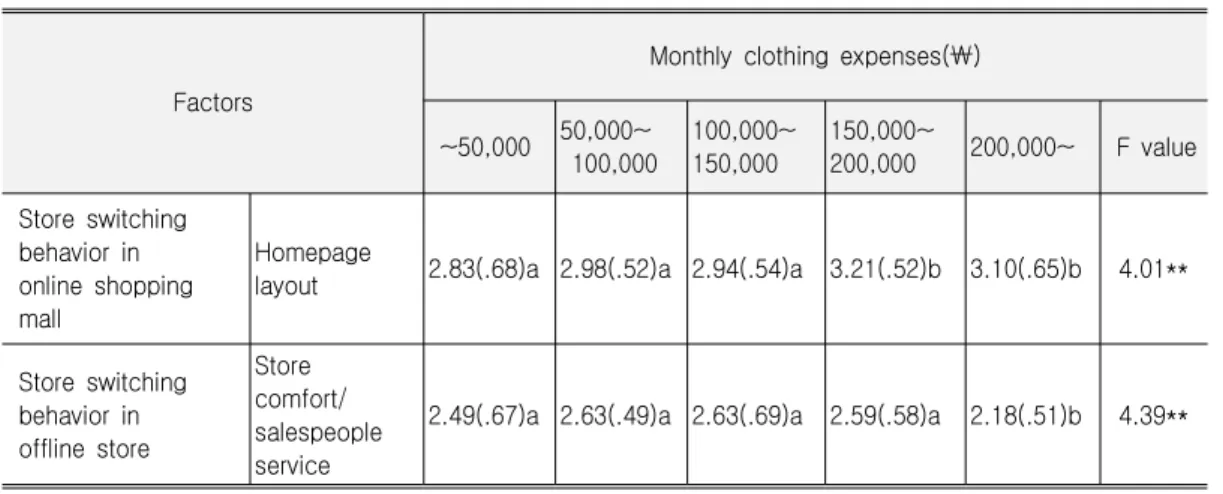
The result of investigating store switching behavior by monthly clothing expenses is shown in Table 6. The factor homepage layout of online shopping mall had a significant difference by monthly clothing expenses. Groups of spending more than ₩150,000 for monthly clothing expense are revealed to consider homepage layout of online shopping mall as a major factor for store switching behavior. In other words, the group of spending much more expense for clothing purchase switches into other type of stores or another online shopping mall by the factor layout of online shopping mall.
Factors
Monthly clothing expenses( )₩
~50,000 50,000~
100,000
100,000~
150,000
150,000~
200,000 200,000~ F value Store switching
behavior in online shopping mall
Homepage
layout 2.83(.68)a 2.98(.52)a 2.94(.54)a 3.21(.52)b 3.10(.65)b 4.01**
Store switching behavior in offline store
Store comfort/
salespeople service
2.49(.67)a 2.63(.49)a 2.63(.69)a 2.59(.58)a 2.18(.51)b 4.39**
Table 6. Store Switching Behavior on Monthly Clothing Expenses M(S.D.)
** P<.01 * ab means results of Duncan test
The factor store comfort/salespeople service of offline store switching behavior had a significant difference by monthly clothing expenses. Group of more ₩200,000 for monthly clothing expense are revealed to consider store comfort/salespeople service of offline store as a major factor for store switching behavior. It is implied that group of spending much money for clothing purchase have much tendency to switch the store into other types of store by store comfort/salesman service of local market.
. Conclusion and Suggestion
Ⅴ
This study was designed to investigate store switching behavior of online shopping mall and offline store with targeting college students. It is revealed that online shopping mall was the most frequently visited clothing store for College students and buying shop, local market are followed. Also, revealed that they preferred national brand apparel to non brand apparel.
Dimensions of store switching behavior in offline store were store comfort/salespeople service, product diversity, store location, product price, reliability, commitment, switching intent of store. Dimensions of store switching behavior in online shopping mall were product diversity/
easy to search, store reliability, home page layout, sales promotion, reliability, commitment, switching intent of store. These results illustrated that consumer's store switching behavior in online/offline store is composed of store property, relationship quality, switching intent of store. It is recommended for further research to study on path for developing dimensions of store switching behavior.
As a result of research on store switching behavior by preference of online/offline store, it is identified that the college students who prefer to shop in online shopping mall don't want to switch the store from online shopping mall into local market designated for the offline store. But it is identified that college students who prefer to shop at local market switch the store from offline store into online shopping mall without any consideration. That's based on the commitment between retail stores and customers and, that is the college students who prefer to shop at online shopping mall have a commitment to online shopping mall and the college students who prefer to shop at local market don't have commitment to local market.
Thus, it is identified that college students who prefer online shopping mall tend to switch local market into other stores because of product price of local market. So, marketing strategy emphasizing price is needed for local market to prevent college students switching into online shopping mall. Marketer in local market need to build a marketing strategy to build up commitment and reliability between local market
and customers throughout sustaining relationship.
This result identified that college students isn't activated to switch from online store to offline store when they purchase non brand product.
So it is recommended for many small manufacturers in local market to run their offline store in parallel with online shopping mall. Thus, officers of big shopping mall in local market need to offer the tenant merchants solutions to launch online shopping mall. It will be the effective way to draw customers from online shopping mall to their shopping mall building ultimately.
It is identified that college students who prefer to purchase brand product have the confidence of online shopping mall than local market when they purchase non brand apparel. It is revealed that college students who prefer to purchase non brand product evaluate the store property of local market positively and establish a high relationship quality with offline store. Considering local market is the subject store of offline store for this study, we can guess that the college students who prefer to purchase non brand mainly visit local market or buying shop more than online shopping mall. So, it's needed for the college students preferred non brand strategic plan to reinforce relationship quality with local market. And needed for the students preferred national brand strategic plan to keep emphasizing reliability of online shopping mall.
Especially, when college students purchase casual apparel items, it is known to show the high purchase rate of non brand apparel than national brand apparel. This means that online shopping mall retailers who sells casual item of non brand try to draw the customers who prefer national brand product. While, it's also identified that college students visit online shopping mall frequently to purchase national
brand. This implies that online shopping mall need to reinforce product merchandising of national brand.
It is identified that college students who have high monthly clothing expenses activate store switching behavior by homepage layout of online shopping mall and store comfort/salespeople service of store switching behavior of offline store. It is also revealed that college students of spending much monthly clothing expenses evaluated store switching behavior of local market negatively. Therefore, offline retailers should build retailing strategy to draw college students who spend much clothing expenses, which relationship marketing is necessary not store of national brand store but store for selling non brand product.
Lastly, Suggestion for limitation and future study of this research is as follows. First, the results from this study can not be generalized as the interviewees were limited to college students who live in the Seoul and Kyung gi.
Second, store types for research subject was not categorized by accurate standards so it is needed for future study to investigate store switching behavior by store types and accurate standards. Third, this study was so exploratory that there isn't any support research enough to extract dimensions of store switching behavior and it is considered to be needed further study about store switching behavior.
References
Bansal, H., & Taylor, S. (1997). Investigating the relationship between service quality, satisfaction and switching intentions. Developments in Marketing Science, 20, 304-313.
Carpenter, G., & Nakamoto, K. (1996). Order of
competitor response time to a new product introduction. Journal of Marketing Research, 32, 42-53.
Chin, L., & Wu, W., & Wang, Z. (2000). The effect of the brand switching and brand loyalty. Advances in Consumer Research, 35-47.
Chung, Y. (2004). A study on a process of establishing of customer voluntary performance by apparel store types (Unpublished doctoral dissertation). Sook Myung Women's University, Seoul, Korea.
Chung, Y., & Jang, E. (2012). The effects of the store attributes and relationship quality on the conversion intent of fashion store. Journal of Fashion Business, 16(4), 75-87.
Givon, M. (1984). Variety seeking through brand switching. Marketing Science, 3, 1-22.
Kang, M., & Hong, K. (2003). The effect of fashion store service quality on perceived switching barriers and store royalty, Journal of the Korean Society of Clothing and Textile, 27(8), 935-945.
Keaveny, S. (1995). Consumer switching behavior in service industries an exploratory study. Journal of Marketing, 59, 71-82.
Kim, S., & Chung, M. (2005). A path analysis of store perception variables on consumer's store loyalty in apparel product purchasing.
Journal of the Korean Society of Clothing and Textile, 29(2), 356-366.
Lee, M. (2000). Analysis of effectiveness of consumer satisfaction and perceived switching cost on brand loyalty (Unpublished master’s thesis). Kyung Book University, Daegu, Korea.
Lee, O. (2010). Effect of interactivity, stickiness, switching barrier on intention to use. Journal of Fashion Business, 14(2), 166-178.
Lee, O., & Kim, J. (2007). A study of effect of store image and switching barrier on store
loyalty in discount store. Fashion & Textile Research Journal, 9(4), 409-417.
Lee, S., & Jo, S. (2007). The effects of Multi-shop's store image on the store loyalty and brand switching behavior. Journal of the Korean Home Economics Association, 45(1), 51-61.
Um, R. (2007). The effects of the customer's switching barriers on switching intent and re-purchase intent (Unpublished doctoral dissertation). Sejong University, Seoul, Korea.
Received (July 22, 2013)
Revised (May 26, 2014; June 16, 2014) Accepted (July 11, 2014)