ISSN 2288-1069 (Online)
http://dx.doi.org/10.12925/jkocs.2017.34.4.778
Preparation and Properties of Anionic Water-Dispersed Polyurethane Containing Polypropylene Glycol and Casein
Lee Joo-Youb
✝Department of Renewable Energy Engineering, Jungwon University Chungbuk, Korea
(Received October 4, 2017; Revised October 26, 2017; Accepted November 3, 2017)
Abstract : In this study, analyzed the changes occurred after adding casein emulsions to water - dispersed polyurethane using polypropylene glycol (PPG). For this purpose, anionic water - dispersed polyurethane containing PPG, IPDI and DMPA and casein emulsion prepared by dissolving casein in distilled water using ammonia water were prepared. As a result of measuring the alkali resistance by using the prepared resin, there was no change in the physical properties.
The tensile strength of the sample having a high casein content was measured to be 2.227 kgf /
㎟. Elongation was measured at 474% for samples containing less casein and The abrasion resistance was measured as 46.090 ㎎.loss of sample containing much casein as a result of the surface roughness measurement.
Keywords : polyurethane, waterborne, polyol, leather coatings, casein
1. Introduction
Since polyurethane was developed by Otto Bayer et al. In 1937 in Germany, up until recently, studies on the acceptability of PU or water oxidation have been made steadily due to environmental issues. Generally, polyurethane water dispersions (PUD) are known through various publications, which can exhibit various physical properties depending on the content and structure of polyol, diisocyanate, ionic group and chain extender used in the production[1-3].
Particularly, the polyol constituting the PU
✝Corresponding author (E-mail: [email protected],)
functions as a soft segment and exhibits the low temperature characteristics of the PU, and the physical properties are controlled very sensitively according to the molecular weight and the structure. In fact, in order to control the physical properties of PUD, polyol and other resins with different structures are used together to compensate for the weak point of the main polyol[4-8].
The anionic water - dispersed polyurethane used in this study is produced by the condensation reaction of diol or polyol with hydroxyl or amino group and diisocyanate or polyisocyanates[9].
The poly ethylene oxide group of the polyol
used in the synthesis of water-dispersed
polyurethane improves the water-solubility of
the polymer and functions as a functional
group that prevents the water dispersion from gelation even at a low temperature by maintaining a stable state with respect to the electrolyte[10]. The carboxyl group of dimethylolpropanoic acid which forms the anionic urethane group in the polymer is formed by amine neutralization and the -NCO group existing at the end of the prepolymer copolymer is increased by the chain extender such as diamine to synthesize a resin having strong urethane bond[11,14,15].
To compensate for the physical weakness of the polyol in the production of anionic water-soluble polyurethanes, casein is used as a feed additive. Casein is produced from phosphorus protein, skim milk, which is the main component of milk. Casein is also used in the manufacture of adhesives, emulsifiers and water-based paints. Casein is not soluble in water and organic solvents, but soluble in dilute alkali.The industrially produced casein is used as a raw material for foods, medicines, industrial adhesives, paper coatings and paints, and is a biodegradable natural polymer. In addition, it is made into various formulations with adhesive strength and strong heat resistance, and is used as drug transfer and eco-friendly film resin, and is used as a core resin for environmentally friendly paints.[12,13]
In this study, we synthesized anionic water - dispersed polyurethane resin which is widely used in the field of industrial safety films. A sample was prepared by varying the addition amount of casein dissolved in water to the prepared anionic water-dispersible polyurethane. To obtain the physical property data of the study, we prepared the sample in two forms, film type and leather-coated form.
The film type measured tensile strength and elongation, and leather-coated form measured abrasion resistance and alkali resistance.
2. Experiment
2.1. Material
The reagents used for PUD synthesis were polypropylene glycol (PPG, molecular weight 2000, Korean polyol), isoporon diisocyanate (IPDI, Bayer), dimethylolpropionic acid (DMPA, GEO), aceton (BASF), dibutyltin dilaurate (DBTDL, Aldrich) TEA, (Fluka), ethylene diamine (EDA, Fluka), BYK-080 (defoamer, BYK chemi) were used. For the synthesis of aqueous milk casein resin, milk casein (Fonterra) and ammonia water (35%).
2.2. Analytical instrument
Fourier transform infrared spectrophotometer (FT-IR 430, Jascow), UTM(Universal testing machine, Instron Co., U.S.A.), Scanning electron microscope(SEM, CX-100S, COSEM), Taber abrasion tester(TO 880T, TESTONE), Sun lamp(DW-300, DONGSUNG SCIENCE)
2.3. Anion water dispersion polyurethane / casein emulsion synthesis
First, distilled water is prepared at 80 ℃ in a three-necked flask to dissolve casein in water. Subsequently, the milk casein is added and dispersed sufficiently at 100 rpm for 30 minutes. Then, the prepared ammonia water (35%) is added and stirred for 1 hour to dissolve the casein resin in water. After completely dissolving, cool to 40 ℃. Then, a prepolymer is synthesized for synthesizing anion water-dispersed polyurethane. PPG, acetone and DMPA were added to the prepared four-necked flask, and the flask was purged with nitrogen and stirred at 60 ℃ for 2 hours. Next, IPDI and DBTDL were slowly added dropwise to the flask and stirred at 85
℃ for 4 hours. After the reactor was cooled
to 35 ℃ to 40 ℃, TEA (neutralizing agent)
was added and stirred at 300 rpm to complete
the neutralization reaction. After completion of
neutralization, distilled water was further
added to disperse the polymer in water. EDA
was then slowly added dropwise over 2 hours
for the chain extension reaction. EDA After
completion of the addition of the chain
Components Casein Ammonium hydroxide
solution (50%) Water
Casein emulsion 30 10 70
Table 1. Recipe for Casein emulsion
Sample polypropyle
ne glycol(g) DMPA(g) IPDI(g) TEA(g) EDA(g) Appearance Casein emulsion(g)
PUD-C1 80 12.01 40 9.01 2.73 Transperant 0
PUD-C2 80 12.01 40 9.01 2.73 transperant
milky white 10
PUD-C3 80 12.01 40 9.01 2.73 transperant
milky white 15
PUD-C4 80 12.01 40 9.01 2.73 transperant
milky white 20 Table 2. Sample composition of anionic polyurethane dispersion preparation with casein emulsion
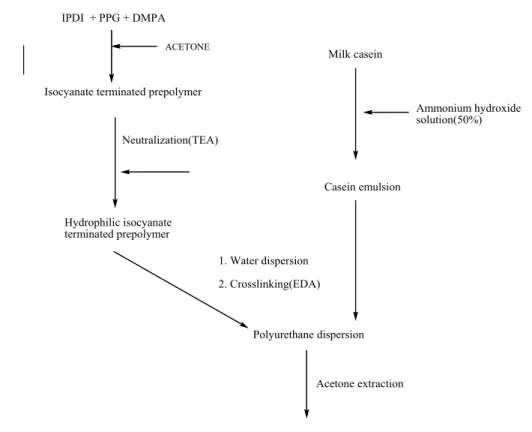
extender, the mixture is stirred for 3 hours, then 0.2% of defoamer (BYK-080) is added and stirred for 1 hour. The casein emulsion compounds used in the analysis are shown in Table 1 and the anionic polyurethane compound samples are shown in Table 2. The synthesis process is shown in Fig. 1 Respectively.
3. Results and Discussion 3.1. FT-IR analysis
In the synthesis of anion-water-dispersed polyurethane, the completion of the reaction was confirmed by the disappearance of the isocyanate group (-NCO) of diisocyanate and the -OH group of polyol in the FT-IR spectrum, and the formation of -NH and C═
O absorption bands of urethane. The FT-IR for polyurethane in Fig. 2 shows no specific absorption band of -N = C = O of isocyanate and -OH functional group at 3400 cm -1 at 2259 cm –1. In addition, the absorption band for (-NH) and (-C═O) urethane groups was observed at 3280 cm -1
and 1735 cm -1, and the specific -CH 2 functional group present in the molecule of the polyol at 2950 cm -1 and 2865 cm -1 The absorption band can be seen. As a result of the above analysis, the successful synthesis of the polyurethane was confirmed.
3.2. Mechanical properties measurement analysis
Table 3 shows the measured values of alkali
resistance, tensile strength, wear resistance and
elongation of the prepared samples. In order
to measure tensile strength and elongation,
samples were prepared in a thickness of 0.1
mm and a size of 25 mm x 25 mm. The
prepared samples were stretched at a tensile
speed of 100 ± 20 mm / min by a tensile
testerand the maximum stress value applied to
the cross-sectional area of the test piece at the
time of cutting was measured. To measure
abrasion resistance, a leather specimen (Full
grain, KDIC chem) is coated on the urethane
surface with a thickness of 0.1 mm and dried
at room temperature for 24 hours after then
dried at 80 ℃ for 10 hours. The abrasion
resistance was measured by measuring the
IPDI + PPG + DMPA
Isocyanate terminated prepolymer
Neutralization(TEA)
Hydrophilic isocyanate terminated prepolymer
1. Water dispersion 2. Crosslinking(EDA)
Polyurethane dispersion
Anionic polyurethane dispersion with casein ACETONE
Acetone extraction Milk casein
Ammonium hydroxide solution(50%)
Casein emulsion
Fig. 1 Reaction schematic diagram of anionic polyurethane dispersion with casein.
Fig. 2. FT-IR spectra of anionic polyurethane dispersion.
weight of the test piece according to the ASTM 1175 test method, and thereafter, the reduction weight was measured after 1,000 rotations with the wheel number CS-10 by the measuring device. The alkali resistance was
measured by applying a 30% NaOH solution to the surface according to the KS M 5307 method, and then measuring the degree of external deformation of the coating film at room temperature for 24 hours.
T = → (1)
T is the tensile strength (kgf /㎟), W is the maximum load (kgf) at the time of cutting, and S is the cross-sectional area (㎟) (thickness x width) of the test piece.
Elongation(%) =
× 100 → (2) Where A is the initial length and A
0is the stretched length.
A
0- A A
W
S
ITEM UNIT SAMPLES
METHOD
PUD PUD-C1 PUD-C2 PUD-C3
Alkali resistance Appear ance
No change
No change
No change
No
change KS M 5307
Tensile strength kg
f/㎟ 2.030 2.088 2.112 2.227 UTM
Elongation % 474 466 444 431 UTM
Abrasion mg.
loss 50.331 49.887 47.966 46.090 ASTM 1175
(H-22, 1,000 cycle) Table 3. Mechanical properties test result of PUD samples
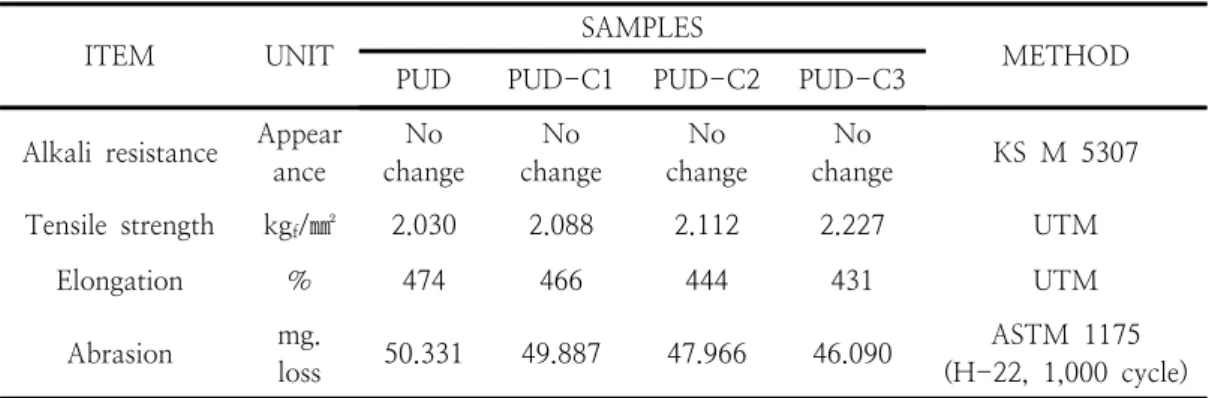
The measured results of abrasion resistance, tensile strength, elongation and alkali resistance according to Table 4 are shown in the graph of Fig. 3,4,5,6 And Fig. 7, Fig. 8 shows the surface of the sample which has been subjected to alkali resistance abrasion resistance measurement by using SEM.
In Fig. 3, PUD which without casein was measured lowest abrasion resistance results with a measured value of 50.331 mg.. In case of PUD-C3, which has the highest amount of casein resin, the abrasion resistance is 46.090 mg, which shows that the strength of the coated leather surface increases as the ratio of casein resin increases. For tensile strength in Fig. 4, the PUD was measured at 2.030 kgf / mm 2, and the tensile strength of PUD-C3 was measured at 2.227 kgf / mm 2. These results indicate that the tensile strength of the film increases with increasing mixing ratio of casein resin. As shown in Fig. 5, in case of elongation, casein-free PUD samples showed the best elongation rate of 474% and PUD-C3, which has a high mixing ratio of casein, was 431%. The improvement of the tensile strength and the lowering of the elongation as the above results are considered to be the result of the amino(-NH) group of the casein being involved in the urethane bonding and strongly forming the chain bonding force.
PUD PUD-C1 PUD-C2 PUD-C3 46
47 48 49 50 51
mg.loss
Sample
Fig. 3. Abrasion resistance measurement graph of anionic polyurethane dispersion samples containing casein.
PUD PUD-C1 PUD-C2 PUD-C3
2.00 2.05 2.10 2.15
2.20 2.25
kgf/mm
2
Fig. 4. Tensile strength measurement graph of
anionic polyurethane dispersion samples
containing casein.
PUD PUD-C1
PUD-C2 PUD-C3
Fig. 6. Alkali resistance measurement of coated leather surface as measured by SEM.
PUD PUD-C1 PUD-C2 PUD-C3 430
440 450 460 470 480
elongation
%
sample