• 검색 결과가 없습니다.

Ocular complications in patients with anti-adhesion barrier agent during arthroscopic shoulder surgery

N/A
N/A
Protected

Academic year: 2021

Share "Ocular complications in patients with anti-adhesion barrier agent during arthroscopic shoulder surgery"

Copied!
6
0
0

로드 중.... (전체 텍스트 보기)

전체 글

(1)

Ocular complications in patients with anti-adhesion barrier agent during arthroscopic shoulder surgery

Hyun Joo Heo 1 , Ji Hye Lee 1* , Yu Yil Kim 1 , Seung Min Baek 2 , Da Wa Jung 2

1

Staff, Department of Anesthesiology and Pain Medicine, Presbyterian Medical Center, Jeonju, Korea

2

Resident, Department of Anesthesiology and Pain Medicine, Presbyterian Medical Center, Jeonju, Korea

견관절경 수술에서 사용된 유착방지제와 수술 후 안구 합병증의 연관성

허현주 1 , 이지혜 1* , 김유일 1 , 백승민 2 , 정다와 2

1

예수병원 마취통증의학과 과장,

2

예수병원 마취통증의학과 전공의

Abstract Background: Intraoperative and postoperative ocular complications are rare. We retrospectively investigated the abnormal ocular findings in patients who underwent arthroscopic shoulder surgery.

Methods: The records were investigated of patients who underwent shoulder arthroscopic surgery at our hospital between January 2018 and March 2019. Ocular complications were confirmed by review of medical records. We performed logistic regression analysis to defined the main factors associated with ocular complications. Results: The overall prevalence of postoperative ocular complications was 8.5%

(18/211). A significant association was found between anti-adhesion barrier agent and ocular complications ( p =0.020). Conclusions: Anti-adhesion barrier agent used during surgery may be the cause of postoperative ocular complication.

Key Words : Allergy, Anti-adhesion barrier, Complications, Ocular, Postoperative

요 약 배경; 수술 중, 후에 안과적 문제가 발생하는 경우는 매우 드물다. 이 연구는 견관절 수술 후 눈에 이상이 발견된 환자를 확인하고 그의 원인을 후향적으로 조사하였다. 방법; 2018년 1월에서 2019년 3월까지 본원에서 견관절경 수 술을 받은 환자를 대상으로 후향적 연구방법을 통해 환자의 의무기록, 사용 약물들을 확인하였다. 로지스틱회귀분석을 통해 눈의 이상과 관련될 수 있는 여러 인자들을 가지고 연관성을 확인하였다. 결과; 8.5% (18/211)의 환자에서 눈의 이상이 발견되었고, 유착방지제와 안과적 합병증이 통계적 연관성을 보였다( p =0.020). 결론; 수술부위의 유착방지를 위해 사용되는 유착방지제에 젤라틴과 키토산 성분이 포함되어 알레르기 반응을 일으켜 안과적 합병증을 발생시킬 수 있을 것으로 생각된다.

주제어 : 알레르기, 유착방지, 합병증, 눈, 수술 후

*Corresponding Author : Ji Hye Lee([email protected]) Received August 24, 2020

Accepted October 20, 2020 Revised September 24, 2020 Published October 28, 2020

1. Introduction

Anesthesiologists must always pay attention to

the various complications that arise pre, intra,

and post anesthesia. Eye complications such as

corneal abrasion, blurred vision, visual loss

(2)

Characteristics Totally Post-operative eye complication P value

Negative Positive

Gender Male 108 98 10

0.698

Female 103 95 8

Age 18-88 64.95 ± 0.85 62.33 ± 1.80 0.749

Height (m) 1.35-1.88 1.604 ± 0.006 1.627 ± 0.021 0.310

BMI (kg/m

2

) 17.16-37.02 25.18 ±0.24 24.62 ± 0.56 0.488

ASA

1 37 31 6

0.240

2 109 100 9

3 61 58 3

4 4 4 0

Anesthesia type General 66 64 2

0.054

BPB 145 129 16

Anti-adhesion barrier agent Not used 104 101 3

0.004

Used 107 92 15

Table 1. Demographics data of patients. Continuous variables were shown as range and mean ± standard deviation.

Categorical variables were shown as frequency.

usually result from damage, compression, ischemic, and infection of the eye are rare, accounting for 0.0008 - 0.15% of total anesthesia cases[1-3]. However, the eye complications such as episcleritis, uveitis, and subconjunctival hemorrhage, which are different from common cases, can also occur. The purpose of this study was reviewed the records of patients who underwent arthroscopic shoulder surgery, and analyzed the patients who had eye complications after surgery, and identified cause.

2. Materials and Methods 2.1 Patients

Data collection for this study was approved by the Institutional Review Board of our facility (IRB number 2019-05-015). Of the 211 patients who underwent arthroscopic shoulder surgery between January 2018 and March 2019 at the orthopedics department of our hospital.

In our practice, data collect every patient demographic information, anesthetic data, postoperative ocular complications and diagnosis by an ophthalmologist, all the medications and materials used during perioperative period.

2.2 Statistical analysis

The data were analyzed with SPSS Statistics

software version 23 (IBM SPSS Inc., USA).

Continuous variables (age, height, body mass index (BMI)) were shown as mean ± standard deviation, and analyzed by Student t-test.

Chi-squared test was used for categorical data (gender, american sociaty of anesthsiologist physical status (ASA), anesthesia type, used materials) analysis. Logistic regression analysis was applied to identify the risk factors for postoperative eye complications. A value of P <

0.05 was considered to be statistically significant.

3. Result

In present study, retrospective analysis of 211

patients was performed. All the patients

underwent surgery in the sitting position; 66

patients received general anesthesia, and the

remaining 145 patients received a regional

anesthesia (brachial plexus block (BPB)). 107

patients (50.7%) were used the anti-adhesion

barrier agent. The 18 patients had complained of

eye discomfort and diagnosis by ophthalmologist

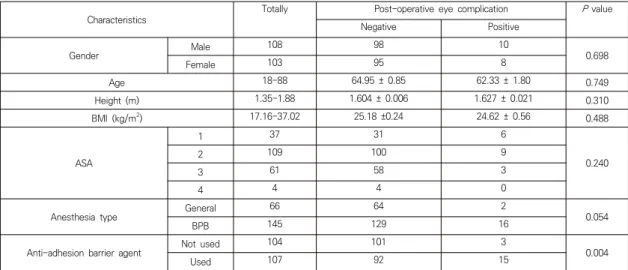
as shown Table 1. The prevalence eye

(3)

Parameters OR P value

Gender 1.29 0.771

Age 1.04 0.264

BMI 0.99 0.931

ASA

1 0.35 0.147

2 0.19 0.085

3 0.0 0.999

4 0.0 0.999

Anesthesia technique 1.810 0.489

Anti-adhesion barrier agent 5.368 0.020

Table 2. Logistic regression analysis for post-operative eye complications.

complication was 8.5%.

Analysis result suggested that the gender, age, height, body mass index, American society of anesthesiologist physical status (ASA), and anesthesia types are not associated eye complication as shown Table 1.

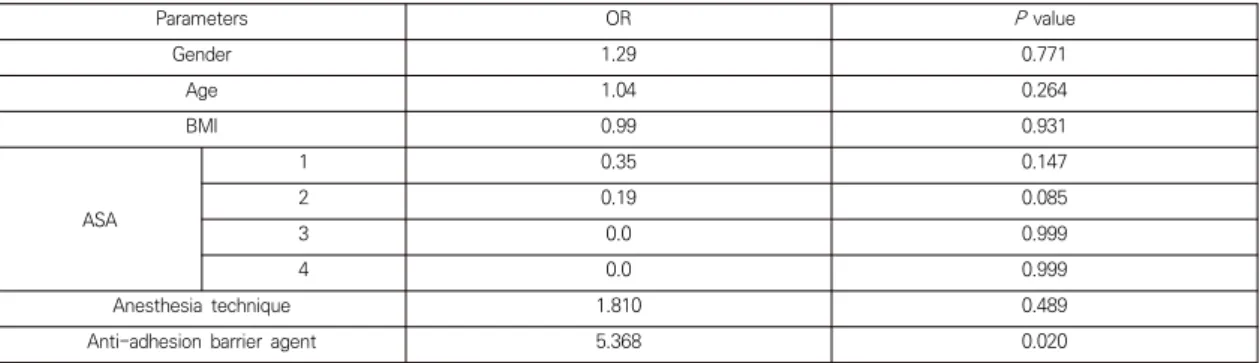
Multivariate logistic regression analysis conducted to investigate the correlation between eye complication and variables. Anti-adhesion barrier agent revealed significant relationship (OR = 5.368, 95% CI = 1.304–22.089, P=0.02). The correlation between eye complication and the others revealed no significant relationship as shown Table 2.

4. Discussion

Patients, surgeons, and physicians often suspect problems during surgery when abnormal findings not present before surgery manifest themselves postoperatively. Anesthesiologist pay attention to the management of the patient during surgery, but complications may occur, prompting the need to identify the cause and effect. The most common cause of eye problems is corneal abrasion, followed by conjunctivitis, blurred vision, hyperemia, and loss of vision [1-4].

In this study, the patients who complained of eye discomfort usually developed symptoms 2-3 days after surgery or as late as 5 days later. All

the patients reported hyperemia as the most important chief complaint as shown Fig. 1, although 4 patients reported pain with a pain rating scale score of 1 or 2, which indicated that and was not severe. No corneal abrasion, which occurs most frequently in the ophthalmologic clinic, was observed, and anterior uveitis, episcleritis, and subconjunctival hemorrhage were diagnosed.

Fig. 1. Patient’s hyperemic appearance on eye in ophthalmic examination.

In the case of eye injury, existing literatures

indicate that the risk factors include prone

position during surgery, general anesthesia, head

and neck surgeries, preoperative anemia, and

intraoperative hypotension [1-4]. In our case,

most of the patients had a beach chair position

and received a regional anesthesia (BPB) for

shoulder surgery. None of the patients had a

(4)

preoperative anemia and underwent induction hypotension during surgery. Interscalene BPB can cause block of the phrenic nerve or stellate ganglion due to unwanted drug spreading.

However, ophthalmic complications also occurred in patients who received general anesthesia, symptoms appeared 2-3 days after the operation, and there were no symptoms such as blepharoptosis or miosis. The ocular complications of the patient in this study were uveitis, episcleritis, and subconjunctival hemorrhage.

The causes of the development of uveitis are currently unclear, and possible causes include eye damage, surgery, autoimmune disease, inflammatory disease, infection, or cancer. In most cases, the causes of episcleritis are unknown and may occur in cases similar to uveitis. Not all cases of eye problems were uveitis or episcleritis. Some cases were conjunctival hyperemia and subconjunctival hemorrhage.

These are caused by congestion of blood vessels of the eye, which can also be caused by infection, inflammation, allergy, and elevated intraocular pressure [5].

Therefore, the influence of the drugs used during or after surgery was confirmed. After reviewing all of the patients’ medications, we confirmed that the anti-adhesion barrier agent was commonly used. In this study, Mediclore

(CGBIO, Republic of Korea) was used by anti-adhesion barrier agent.

Mediclore

is a thermosensitive sol-gel consisting of poloxamer, gelatin, and chitosan.

Poloxamer is a synthetic polymer used to transport drugs, as it is biodegradable in the human body. Unexpected side effects may occur because of the possibility that the contained materials may remain unnecessarily in the body in the long term [6-9].

Chitosan is which can cause an allergic reaction. It is extracted from crustaceans such as shrimp, crab, and crayfish, and is currently used

in various fields such as food and cosmetics, with very few side effects. However, whether it does not cause an allergic reaction is unclear [10-13].

Gelatin can usually be extracted from cattle and cause an allergic reaction. Allergic reactions were observed in patients who received vaccines containing gelatin, and allergic reactions that included anaphylactic reactions were observed in pediatric patients who used suppositories containing gelatin [14,15].

Mediclore

was also used in our hospital for other operations outside the shoulder joint. The product containing 5 ml was used in arthroscopic shoulder surgery, and most cases were laparoscopic cholecystectomy using 3 ml.

Other surgeries, which were not shoulder arthroscopy, did not show abnormal findings in the eyes or other allergic reactions. In arthroscopic shoulder surgery, many cases of such eye problems occur. Thus, we might consider that most cases of arthroscopic shoulder surgery are performed in closed spaces with microvascular openings, which may increase the probability of absorption of drugs that can cause allergic reactions. The volume itself is 5 ml, which is much higher than the volume used in abdominal surgery, considering the surface area. In addition, because the shoulder and head are close to each other, the probability of absorption of the drug to the eye also increases.

Further research into the association between anti-adhesion agents and ophthalmic complications in other surgeries should be required.

The patients were treated with topical

corticosteroids, antibiotics, and hyaluronic acid

eye drops, depending on the symptoms. With the

exception of one patient who had undergone a

previous cataract surgery and patients who had

been treated previously with recurrent corneal

erosion, symptoms improved after 6–14 days of

treatment. The patients with eye complications

after the study were recommended to undergo

(5)

testing for allergies to crustaceans or gelatin, and the patients postponed them for reasons such as cost and time.

Patients must use anti-adhesion agent with caution, as it contains gelatin or chitosan, which may cause eye problems due to allergic reactions. Anesthesiologists and doctors must be careful and protect and manage patients’ eyes from existing causes such as posture or pressure when an eye problem occurs, as it can also be caused by substances.

REFERENCES

[1] P. G. Barash et al. (2017). Clinical anesthesia. 8th ed.

Philadelphia : Wolters Kluwer.

[2] S. Roth, R. A. Thisted, J. P. Erickson, S. Black. & B. D.

Schreider. (1996) Eye injuries after nonocular surgery.

A study of 60,965 anesthetics from 1988 to 1992.

Anesthesiology, 85(5), 1020-1027.

[3] K. L. Segal et al. (2014) Evaluation and treatment of perioperative corneal abrasions. Journal of Ophthalmology, 2014.

DOI: 10.1155/2014/901901

[4] H. D. Yu, A. H. Chou, M. W. Yang & C. J. Chang.

(2010). An analysis of perioperative eye injuries after nonocular surgery. Acta Anaesthesiologica Taiwanica, 48(3), 122-129.

DOI:10.1016/S1875-4597(10)60043-4

[5] D. Pavan-Langston. (2008). Manual of Ocular Diagnosis and Therapy. 6th edition. Philadelphia:

Lippincott Williams & Wilkins.

[6] A. M. Bodratti & P. Alexandridis. (2018). Formulation of poloxamers for drug delivery. Journal of Functional Biomaterials, 9(1), 11.

DOI:10.3390/jfb9010011

[7] E. Russo & C. Villa. (2019). Poloxamer hydrogels for biomedical applications. Pharmaceutics, 11(12), 671.

DOI:10.3390/pharmaceutics11120671

[8] T. K. Giri, A. Thakur, A. Alexander, H. Badwaik & D.

K. Tripathi. (2012). Modified chitosan hydrogels as drug delivery and tissue engineering systems: present status and applications. Acta Pharmaceutica Sinica B, 2(5), 439-449.

DOI:10.1016/j.apsb.2012.07.004

[9] J. Kim, S. Y. Cheon, D. I. Shin, C. M. Lee & K. Y. Lee.

(2017). Adhesion barrier of methylcellulose based thermo-responsive sol-gel. Polymer(Korea), 41(2), 318-323.

DOI:10.7317/pk.2017.41.2.318

[10] R. A. A. Muzzarelli. (2010). Chitins and chitosans as immunoadjuvants and non-allergenic drug carriers.

Marine drugs, 8(2), 292-312.

DOI:10.3390/md8020292

[11] C. A. Acevedo, P. Diaz-Calderon, D. Lopez & J.

Enrione. (2015). Assessment of gelatin-chitosan interactions in films by a chemometrics approach.

CyTA-Journal of Food, 13(2), 227-234.

DOI:10.1080/19476337.2014.944570

[12] S. D. Ray. (2011). Potential aspects of chitosan as pharmaceutical excipient. Acta Pol. Pharm, 68(5), 619-622.

[13] S. Ahmed & S. Ikram. (2016). Chitosan based scaffolds and their application in wound healing. Achievements in the Life Sciences, 10(1), 27-37.

DOI:10.1016/j.als.2016.04.001

[14] M. Sakaguchi & S. Inouye. (2000). Systemic allergic reactions to gelatin included in vaccines as a stabilizer. Japanese Journal of Infectious Diseases, 53(5), 189-195.

[15] M. Sakaguchi & S.Inouye. (2001). Anaphylaxis to gelatin-containing rectal suppositories. Journal of allergy and clinical immunology, 108(6), 1033-1034.

DOI: 10.1067/mai.2001.119412

허 현 주(Hyun Joo Heo) [정회원]

․ 2004년 2월 : 이화여자대학교 의학과 (의학사)

․ 2008년 2월 : 이화여자대학교 의학과 (의학석사)

․ 2009년 3월 : 마취통증의학과 전문의 취득

․ 2014년 3월 ~ 2015년 2월 : 전북대 학교 마취통증의학과 전임의

․ 2015년 12월 ~ 현재 : 예수병원 마취통증의학과 과장

․ 관심분야 : 의학, 마취통증의학, 회복실관리

․ E-Mail : [email protected]

(6)

이 지 혜(Ji Hye Lee) [정회원]

․ 2007년 2월 : 전북대학교 의학과(의학 사)

․ 2012년 2월 : 전북대학교 마취통증의 학과 전문의

․ 2011년 2월 : 전북대학교 의학과 석사 수료

․ 2012년 3월 ~ 2014년 2월 : 전북대 학교 마취통증의학과 전임의

․ 2012년 3월 ~ 2013년 2월 : 전북대학교 마취통증의학과 임 상교수

․ 2012년 3월 ~ 현재 : 예수병원 마취통증의학과 과장

․ 관심분야 : 의학, 마취통증의학, 통증의학, 심폐마취

․ E-Mail : [email protected]

김 유 일(Yu Yil Kim) [정회원]

․ 2000년 2월 : 전북대학교 의학과(의학 사)

․ 2009년 2월 : 전북대학교 마취통증의 학과 전문의

․ 2009년 3월 ~ 현재 : 예수병원 마취 통증의학과 과장

․ 관심분야 : 의학, 마취통증의학, 통증 의학

․ E-Mail : [email protected]

백 승 민(Seung Min Baek) [정회원]

․ 2016년 2월 : 서남대학교 의학과(의학 사)

․ 2017년 3월 ~ 현재 : 예수병원 마취통 증의학과 전공의

․ 관심분야 : 의학, 마취통증

․ E-Mail : [email protected]

정 다 와(Da Wa Jung) [정회원]

․ 2012년 2월 : 전남대학교 의학과(의학 사)

․ 2018년 3월 ~ 현재 : 예수병원 마취통 증의학과 전공의

․ 관심분야 : 의학, 마취통증

․ E-Mail : [email protected]

수치

Table 1. Demographics data of patients. Continuous variables were shown as range and mean ± standard deviation
Table  2.  Logistic  regression  analysis  for  post-operative  eye  complications.

참조

관련 문서

This showed that the surgical outcome was successfulin 269 patients (98.89%),butthe revision surgery due to surgicalrelapse was performed in three patients.Of 152 patients

Objective: The purpose of this study was to analyze recent trend in incidence of basal cell carcinoma and squamous cell carcinoma in patients from the Gwangju City

The purpose of this study was to identify the frequency and related factors of advanced airway management for patients with cardiac arrest by the

This study prepares an educational program which helps the patients reduce anxiety on surgery which is considered as one of the biggest emotional crises

Using this leap motion, a surgeon can perform the virtual shoulder arthroscopic surgery skillfully and reduce mistakes in surgery.. The simulation using leap motion shows

Purpose: The purpose of this study is to report the safety and effectiveness of arthroscopic-assisted implantation of Cartistem®, an articular cartilage

Then humeral head prosthetic design of a Bigliani-Flatow (BF) shoulder system was used to do simulation humeral arthroplasty surgery and the humeral head size

With these results, we can suggest the hypothesis that increased cardiac output in the patients who administered ketamine increased muscle blood flow, and this is the