https://doi.org/10.7848/ksgpc.2017.35.1.41
Thermal Image Mosaicking Using Optimized FAST Algorithm
Nguyen, Truong Linh
1)ㆍHan, Dong Yeob
2)Abstract
A thermal camera is used to obtain thermal information of a certain area. However, it is difficult to depict all the information of an area in an individual thermal image. To form a high-resolution panoramic thermal image, we propose an optimized FAST (feature from accelerated segment test) algorithm to combine two or more images of the same scene. The FAST is an accurate and fast algorithm that yields good positional accuracy and high point reliability; however, the major limitation of a FAST detector is that multiple features are detected adjacent to one another and the interest points cannot be obtained under no significant difference in thermal images. Our proposed algorithm not only detects the features in thermal images easily, but also takes advantage of the speed of the FAST algorithm. Quantitative evaluation shows that our proposed technique is time-efficient and accurate. Finally, we create a mosaic of the video to analyze a comprehensive view of the scene.
Keywords : Image Stitching, Image Feature Detection, Thermal Image, Optimized Fast Algorithm
Original article
Received 2017. 01. 16, Revised 2017. 01. 31, Accepted 2017. 02. 15
1) Member, Dept. of Civil and Environmental Engineering, Chonnam National University (E-mail: [email protected])
2) Corresponding Author, Member, Dept. of Marine and Civil Engineering, Chonnam National University (E-mail: [email protected])
This is an Open Access article distributed under the terms of the Creative Commons Attribution Non-Commercial License (http://
creativecommons.org/licenses/by-nc/3.0) which permits unrestricted non-commercial use, distribution, and reproduction in any medium,
1. Introduction
Image mosaicking is a technique in which several overlapp- ing images are combined to form a panoramic image of high resolution. Recent development of mobile imaging leads to research interest in mosaic image creation. Depending on the tile dataset and the imposed constraints for positioning the deformations, various mosaics can be created for an image.
Thermal video mosaicking allows the creation of a large field of view using a thermal camera, and in some specific cases, it is used by managers to support decision making from an evaluation of the temperature distribution.
Image stitching techniques can be categorized into two general approaches: direct and feature based techniques. In the direct technique, pixel-to-pixel dissimilarity is minimized to perform image stitching. Meanwhile, in the feature-based technique, a set of features is extracted and then matched with each other (Arya, 2015). The development of feature detection techniques for image mosaicking is an important
research subject in the field of computer vision (Bheda et al., 2014). There are several feature detection techniques, which include SIFT (scale-invariant feature transform) (Lowe,2004;
Alhwarin et al., 2008; Kai et al., 2012), FAST (Adel et al., 2014), SURF (speeded-up robust feature) (Bay et al., 2008;
Adel et al., 2014; Pravenaa and Mennaka, 2016), Harris (Jain et al., 2012), PCA – SIFT (Ke and Sukthankar, 2004), and ORB (Rublee et al., 2011) techniques. The SIFT technique is very robust; however, the computation time makes it less feasible. The Harris corner is not invariant to scale changes and needs to set a threshold value. Many redundant corners can be occurred or effective corners can be lost by uncertain threshold selection. The SURF is a fast and robust algorithm;
however, it is poor at handling viewpoint and illumination changes. The FAST algorithm can detect the interest points for real-time applications; however, the major limitation of FAST is that multiple features are detected adjacent to one another.
Several studies on image mosaicking have been carried
out. A study conducted by Manmohan Sharma (2014) at the IIITA Campus (Indian Institute of Information Technology, Allahabad) included steps such as selecting the control points, image writing, and blending on the images taken with the help of a digital camera (Sharma, 2014). It enables the user to obtain a very wide-angle image without using any expensive wide-angle camera. A new compact large FOV (Field Of View) multi-camera system is introduced (Lu et al., 2016). The camera has seven small complementary metal-oxide-semiconductor sensor modules, which can obtain seven images in a single shot at the rate of 13 frames per second. The actual luminance of the objects was used to blend the images to create panoramas, so that the final image reflects the objective luminance accurately. A method for the construction of a mosaic from video sequences obtained by rotating the camera was presented in study of Hoseini and Jafari (2011). The distinctive features are first detected and matched using a localized scene coherence method, and then, the mapping function parameters are estimated for feature matching. The frames are mapped to the surface of the middle frame using the obtained transformations, and finally, the warped frames are combined (Hoseini and Jafari, 2011).
Several works in the literature have already improved the algorithm with an aim to reduce the computation time of SIFT. Kai et al. (2012) used the original SIFT algorithm to extract numerous matching points and the precise matching points were selected using the maximum of minimum distance cluster algorithm. This optimized SIFT can avoid noise and structurally unrelated matching points, and thus
improve the accuracy of image matching. Alhwarin et al.
(2008) improved the SIFT algorithm by dividing the features extracted from both the test and the model object image into several sub-collections before they are matched. In addition, from the different frequency domains, the features are divided into several sub-collections by considering the features arising from different octaves. Compared to the original SIFT algorithm, 40% reduction in the processing time for matching the stereo images was achieved.
This paper presents a mosaicking technique for thermal images that have relatively small number of feature. We propose an optimized FAST algorithm that takes advantage of the quickness of the FAST algorithm, but overcomes its disadvantages.
2. Image Mosaicking
2.1 The steps of image mosaicking
Image mosaicking is an important technique in the field of computer vision, image processing, and panoramic image creation. Image mosaicking involves the stitching of multiple correlated images to generate a single large seamless image (Bheda et al., 2014). It requires an understanding of the geometric relationships between images. The geometric relations are affine transformations that relate the coordinate systems of different images (Sharma, 2014). Image stitching can be divided into three main processes: calibration, image registration, and blending. The goal of camera calibration is to produce an estimate of the extrinsic and intrinsic camera parameters. During image registration, multiple images are Fig. 1. Steps of image mosaicking
Collecting different images that have overlapping regions
Calculating the transformation matrix between the two images
Obtaining the final image in panoramic view
Blending the stitched border of the image so that the image is seamless
Stitching up the images using
the transformation
matrix
compared to obtain the translations that can be used for the alignment of images. After registration, these images are merged to form a single image. Then, image blending technique will be used to modify the gray levels of image in the vicinity of a boundary to obtain a smooth transition between images. The overall process of image mosaicking is shown in Fig. 1.
2.2 Determination of the orientation of the image
2.2.1 DLT (Direct Linear Transformation)
DLT describes a direct connection between the 3D and image coordinates (Molnar, 2010). This method is based on the collinearity equations, extended by an affine transformation of the image coordinates. It does not require the image coordinate system to be fixed with the camera. The transformation equation of the DLT is given by Eq. (1):
1 2 3 4
9 10 11
5 6 7 8
9 10 11
1 1 L X L Y L Z L x L X L Y L Z
L X L Y L Z L y L X L Y L Z
+ + +
= + + +
+ + +
= + + +
(1)
where L
i: DLT parameters, x, y: image coordinates, X, Y, Z: 3D coordinates.
Determination of the 11 DLT parameters requires a minimum of 6 reference points. The calculation is processed in two steps: first, the DLT parameters are estimated using the control points for each image, and the unknown points are then calculated if they appear on more than two oriented images. The least squares method, with some modifications,
is used for the adjustment.
2.2.2 BA (Bundle Adjustment)
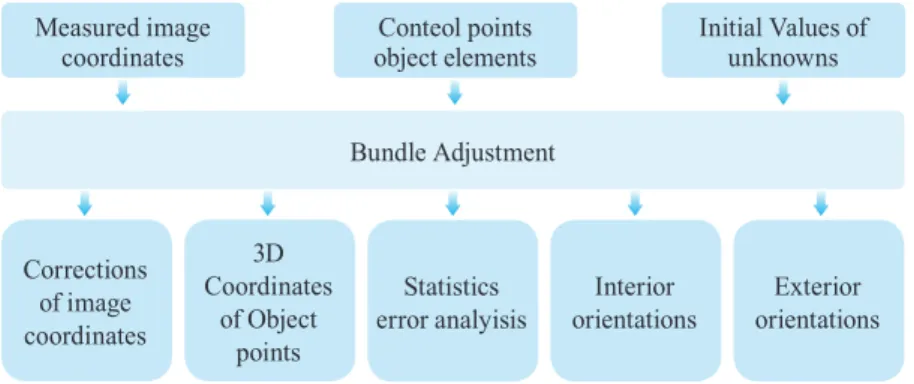
Fig. 2 shows the principle data flow for a BA process. The input data for the BA are typically photogrammetry image coordinates generated by manual or automatic (digital) image measuring systems. Additional information in the object space can also be taken into account. They provide the definition of an absolute scale and the position and orientation of the object coordinate system. This information is entered into the system as, for example, reference point files or additional observations. In order to linearize the functional model, approximate values must be generated.
The principal results of the BA are the estimated 3D coordinates of the object points. In addition, the exterior orientation parameters of all the images are estimated.
The interior orientation parameters are estimated if the cameras are calibrated simultaneously within the adjustment (Luhmann et al., 2006).
The collinearity equations (Eq. (2)) are a mathematical model for the bundle block adjustment. The mathematical model consists of both functional and stochastic models (Lee and Yu, 2009).
( ) ( ) ( )
( ) ( ) ( )
( ) ( ) ( )
( ) ( ) ( )
11 0 21 0 31 0
' ' ' '
0
13 0 23 0 33 0
12 0 22 0 32 0
' ' ' '
0
13 0 23 0 33 0
r X X r Y Y r Z Z
x x z x
r X X r Y Y r Z Z r X X r Y Y r Z Z
y y z y
r X X r Y Y r Z Z
− + − + −
= + + ∆
− + − + −
− + − + −
= + + ∆
− + − + −
(2)
The structure of these equations allows the direct formulat-
Fig. 2. Data flow for the BA process Corrections
of image coordinates
Coordinates 3D of Object
points
Statistics
error analyisis Interior
orientations Exterior orientations Bundle Adjustment
Conteol points
object elements Initial Values of unknowns Measured image
coordinates
ion of primarily observed values (image coordin-ates) as functions of all unknown parameters in the photogramme- tric imaging process. The collinearity equations, linearized at approximate values, can be used directly as observation equations for a least-squares adjustment according to the Gauss-Markov model.
2.3 Space intersection
Space forward intersection is commonly used to determine the ground coordinates X, Y, and Z of points that appear in the overlapping areas of two or more images based on known interior and exterior orientation parameters. The collinearity condition, which states that the corresponding light rays from the two exposure stations pass through the corresponding image points on the two images and intersect at the same ground point, is enforced. Fig. 3 illustrates the principle of forward intersection (Jia et al., 2010), where P is an arbitrary point on the ground, O1 and O2 indicate the camera station, and p1 and p2 are the corresponding image points of P.
Space forward intersection techniques assume that the exterior orientation parameters associated with the images are known. Using the collinearity equations, the exterior orientation parameters along with the image coordinate measurements of point P on Image 1 and Image 2 are input to compute the X
P, Y
P, and Z
Pcoordinates of the ground point P.
2.4 RANSAC (RANdom SAmple Consensus) algorithm
The RANSAC algorithm proposed by Fischler and Bolles, (1981) is a general parameter estimation approach designed to cope with a large proportion of outliers in the input data. The RANSAC algorithm has four steps:
(1) Randomly select the minimum number of points required to determine the model parameters
(2) Solve for the parameters of the model
(3) Determine the number of points from the set of all points that fit with a predefined tolerance
(4) If the fraction of the number of inliers over the total number of points in the set exceeds a predefined threshold t, re-estimate the model parameters using all the identified inliers and terminate the process (5) Otherwise, repeat steps 1 through 4
The number of iterations is chosen high enough to ensure that the probability that at least one of the sets of random samples does not include an outlier.
2.5 Blending
Once we have registered all the input images with respect to each other, we need to decide how to produce the final stitched image. First, a compositing surface, which is flat and cylindrical, is chosen. Next, it is decided how to blend them to create the panorama.
For stitching fewer images, a natural approach is to select one of the images as the reference and then warping all the images according to the reference coordinate system. The colors are adjusted to compensate for the exposure differences between images. The images are blended together and the seam line is adjusted to minimize the visibility of seams between images (Shashank et al., 2014).
3. The Optimized FAST Descriptor
Before image registration and alignment, the mathematical relationship between the pixels coordinates of one image with respect to the others need to be established (Pravenaa and Mennaka, 2016). Both direct and feature based techniques are considered for image stitching.
In the direct technique, all the pixel intensities of the image
Fig. 3. Space intersection
are compared with each other. In this technique, each pixel is compared with each other, and therefore it is a very complex technique. The main advantage of the direct method is that they make optimal use of the information available in the image alignment. They measure the contribution of every pixel in the image. The main limitation of this technique is a limited range of convergence between one another (Adel et al., 2014).
In feature-based techniques, all the feature points in an image pair are compared with that of every feature in another image, using local descriptors. The different steps required for image stitching based on feature-based techniques are feature extraction, registration, and blending. Feature-based methods begin by establishing correspondences between points, lines, edges, corners, or other shapes (Adel et al., 2014). The uniqueness of the robust detectors incorporates invariance to the noisy image, scale invariance, translation invariance, and rotation transformations. There are several feature detection techniques, such as SIFT, SURF, and FAST (Rosten and Drummond, 2006).
3.1 SIFT
The SIFT operator is one of the most frequently used technique for region detection. It was first conceived by Lowe, (2004) and is currently employed for various applications (Lingua et al., 2009). The SIFT algorithm for image feature generation is invariant to image translation, scaling, and rotation and is partially invariant to illumination changes and affine projection (Alhwarin et al., 2008). SIFT can be used to identify similar objects in other images. When checking for an image match, two sets of key-point descriptors are given as input to the NNS (Nearest Neighbor Search) problem and closely matching key-point descriptors are produced.
The SIFT algorithm consists of four stages (Aghdasi et al., 2009; Kai et al., 2012; Adel et al., 2014; Bheda et al., 2014).
Scale-space local extrema detection, Key-point localization, Orientation assignment, Key-point descriptor. Though it is comparatively slow, the SIFT algorithm is a robust algorithm for image comparison. The running time of a SIFT algorithm is high as it takes more time to compare two images.
3.2 SURF
SURF is an algorithm developed for local, similarity
invariant representation and comparison (Bay et al., 2008). In addition, Bay demonstrated that the SURF detector is several times faster than SIFT and more robust against different image transformations (Besbes et al., 2015). The SURF algorithm is performed in three main steps (Adel et al., 2014; Pravenaa and Mennaka, 2016). Detection, Description, Matching. The main advantage of the SURF approach lies in its fast computation, enabling real-time applications such as tracking and object recognition. It improves upon the speed of the SIFT detection process by giving priority to the quality of the detected points. It gives more focus on speeding-up the matching step.
3.3 Optimization of FAST algorithm
The FAST technique identifies interest points in an image (Adel et al., 2014). The pixel A is recognized as a FAST corner if the neighborhood around pixel A has sufficient pixels, which are in a gray that is different from the pixel A.
The FAST detector compares the pixels only on a circle of fixed radius around a point. A point is classified as a corner only if a large set of pixels that are significantly brighter or darker than the central point can be found in a circle of fixed radius around the point. As shown in Fig. 4, the FAST algorithm considers a circle of 16 pixels around the corner candidate p. An interesting point is indicated when all the pixels in a set of n contiguous pixels in the circle are brighter than the candidate pixel I
pplus a threshold t, or all the pixels are darker than I
p≤ t shown in Eq. (3). The corner detector should satisfy the following criteria (Arya, 2015).
(1) The detected positions should be consistent, insensitive to the variation of noise, and they should not move when multiple images of the same scene are acquired.
(2) Accuracy: The corners should be detected as close as possible to the correct positions.
(3) Speed: The corner detector should be fast enough.
FAST is an accurate and fast algorithm that yields good positional accuracy and high point reliability.
x p
I − I > t (3)
The two major limitations of the FAST detector are that multiple features are detected adjacent to one another and that the features cannot be detected if the image has no significant difference in gray-scale values. It means that, we do not obtain the pixel p, which satisfies the condition of being brighter or darker than a circle of 9 or 12 pixels. In other words, p satisfying the above equation does not exist.
To overcome this limitation, the image data need to be pre- processed.
First, by considering the overall gray value of the input images, all the positions where there are significant differences in gray values are found. The region that includes 16 pixels around the pixel that satisfies the conditions of the algorithm is obtained like that shown in Fig. 4. Second, using the FAST algorithm, the position in the image where no pixels have been found is chosen and compared with 16 pixels surrounding it, to decrease the cost time. The optimized FAST
Fig. 4. FAST corner detection
algorithm used in this paper is summarized in Fig. 5. With the input image, the portions that have significant difference in gray value will be found, that portions are saved as the point p (h, v). Then, the region include 16 pixels around the position p (h, v) will be obtained. Set the value for other pixels to find the difference from the region of 16 pixels. From that, all new values are saved to new matrix M (1: h, 1: v). From now, the input data of algorithm is not original input image which was processed, the input data for algorithm is matrix M.
4. Experiment
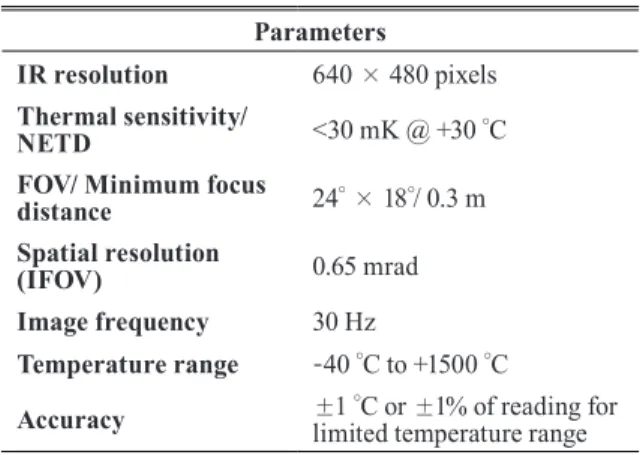
The thermal camera (FLIR SC660 shown in Fig. 6) provides a combination of infrared and visible spectrum images that have superior quality and temperature measurement accuracy, and features a contrast optimizer, laser pointer, voice annotation, and a host of other advanced features. It can measure the temperature by taking a thermal image, sequence video, or video. The FLIR SC660 has a high-resolution pixel detector of 640×480 pixels having a high accuracy. Table 1 shows the technical specifications of FLIR SC660 Flir-Systems, 2008().
Input images
Output feature points of images