http://crossmark.crossref.org/dialog/?doi=10.14474/ptrs.2019.8.3.158&domain=pdf&date_stamp=2019-9-25
Received: 2 September, 2019 Revised: 20 September, 2019 Accepted: 20 September, 2019 Corresponding author: Hwa Kyung Shin (ORCID https://orcid.org/0000-0003-3876-0710)
Department of Physical Therapy, College of Bio and Medical Science, Daegu Catholic University, 13-13 Hayang-ro, Geumnak-ri, Hayang-eup, Gyeongsan 38430, Republic of Korea
Tel: 82-53-850-2532 Fax: 82-53-350-6770 E-mail: [email protected]
This is an Open-Access article distributed under the terms of the Creative Commons Attribution Non-Commercial License (http://creativecommons.org/licenses/
by-nc/4.0) which permits unrestricted non-commercial use, distribution, and reproduction in any medium, provided the original work is properly cited.
Copyright © 2019 Korean Academy of Physical Therapy Rehabilitation Science https://doi.org/10.14474/ptrs.2019.8.3.158
pISSN 2287-7576 eISSN 2287-7584
Phys Ther Rehabil Sci 2019, 8 (3), 158-161 www.jptrs.org
Effects of internal focus and external focus of attention on postural balance in school-aged children
Hwa Kyung Shin, Ryu-Min Kim, Jae-Moon Lee
Department of Physical Therapy, College of Bio and Medical Science, Daegu Catholic University, Gyeongsan, Republic of Korea
Objective: Attentional focus is one of the critical factors that has consistently been demonstrated to enhance motor performance and motor skill. Focusing attention on the inside of the body while engaging in a particular exercise is called internal focus (IF) and focus on the external environment is called external focus (EF). The purpose of this study was to identify effects of IF and EF of at- tention on postural balance in healthy school-aged children.
Design: Cross-sectional study.
Methods: Twenty-four healthy school-aged children participated in this study. School-aged children was defined as children ages 8-12 years old. They performed the one-legged standing with EF (focusing on the marker at the level of participants’ chest and 150 cm away), IF (focusing the supporting feet), and control (no instruction) respectively. The order of the focus condition was ran- domly selected. The center of pressure (COP) range, distance, and velocity was measured to compare the effects of applying differ- ent attentional focuses in the three conditions.
Results: The results of our study show that differences in COP range, distance, and velocity among groups were not significant between the different attentional focuses, although all variables of EF were smaller than IF. It is postulated that the reason for this may be that school school-aged children between 8-12 years old go through a transitional phase from IF to EF in effective motor learning.
Conclusions: These findings reveal that the type of attentional focus did not have any effect on postural balance in healthy school-aged children.
Key Words: Attention, Child, Motor skill, Posture
Introduction
Balance involves regulation of movement of linked body segments over supporting joints and base of support [1-4].
Most of these actions include lower limbs, supporting and moving body mass over the feet while standing [3,5,6].
Motor learning for postural control and balance is embedded in the motor development process, and it can have positive effects on motor developmental stages [7].
Attentional focus is one of the critical factors that has con- sistently been demonstrated to enhance motor performance and motor learning [7,8]. Attentional focus implies ‘where’
attention is focused while engaging in a specific movement.
Focusing attention on the inside of the body while engaging in a particular exercise is called internal focus (IF) and focus on the external environment is called external focus (EF). IF feedback comes from any sensory source from inside the body, such as from proprioceptors or outside the body when a person sees that a target was not hit or a ball was hit out of bounds [7]. IF is directed to specific body segments involved in movement. EF feedback is extra or augmented sensory in- formation received by the mover from an external source [8]. EF is directed to a specific outcome or effects produced by movement in the environment (e.g., a target, implement, Original Article
Shin, et al: Attentional focus on postural balance in school-age children 159
Table 1. General characteristics of subjects (N=24)
Variable Value
Age (y) 10.90 (2.20)
Sex (male/female) 12/12
Height (cm) 143.70 (6.49)
Weight (kg) 35.65 (12.20)
Dominant leg (right/left) 23/1
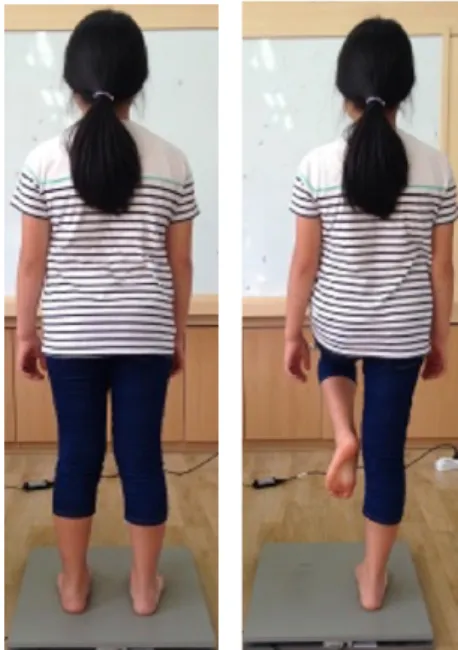
Values are presented as mean (SD) or number only. Figure 1. One-legged standing.
or apparatus).
Studies have shown that EF is generally more effective on motor performance and motor learning than IF [3,9]. Also, studies on a particular population, such as the elderly, Par- kinson’s patients, and ankle sprain patients have revealed similar benefits [9,10]. The advantage of EF was also ob- served in gait conditions. Studies involving patients with multiple sclerosis, Parkinson’s disease, and the elderly have shown improvement in gait quality when using EF. Also, benefits of EF have been demonstrated in movement effi- ciency and kinematics and extend across different types of tasks as well as skill levels [3,9,10].
Several age-based studies have reported that EF is effec- tive in performing balance tasks in healthy elderly and other adults. However, effects of IF or EF on children’s motor learning remain controversial [10,11]. Thus, the purpose of this study was to identify effects of IF and EF of attention on postural balance in healthy school-aged children, and to pro- vide more useful information on motor learning.
Methods Participants
Twenty-four healthy school-aged children were recruited from the Daegu area in Korea for this study. School-aged children was defined as children ages 8-12 years old. They were informed about the procedure and obtained parental consent. Selection criteria of subjects were as follow; those with no limit to range of motion of the ankle joint, those who maintained one-legged standing (OLS) posture for more than 15 seconds, those with no visual problems, and those with no orthopedic or neurological challenges, dizziness, or balance disorders, or those that use drugs that may affect balance. All subjects understood the purpose of this study and provided written informed consent prior to participation in this experiment. The ethical committee of Daegu Catholic University has approved this study (CUIRB-2016-0111).
General characteristics of subjects are shown in Table 1.
Experimental tools and procedures
A force plate (Newton; AMTI Inc., Watertown, MA, USA) was used to assess postural balance during the OLS posture [12]. Data of the force plate was collected using an A/D card (DT3002; Data Translation, Marlboro, MA, USA) and the sampling frequency was set to 200 Hz. Analog data collected from the force plates was digitally converted by the A/D converter (VSAD-102-3C) and stored in the com- puter’s hard drive.
The examiner explained the procedure of the experiment to the subjects and allowed them to practice the OLS posture two times in barefoot conditions (Figure 1). In the process, subjects looked forward and stood comfortably on both legs.
Subjects then transferred their full weight to their dominant legs and maintained balance in one of three conditions for more than 15 seconds with OLS [12]. The dominant leg was defined as the preferred leg used to kick a soccer ball. The IF condition focused attention on the supporting feet. The EF condition focused attention on the circle placed 150 cm away from the subject at chest-height. The control condition enabled the performance of OLS without indication of attention. The interval between three repetitions within each condition was 30 seconds, and interval between each con- dition was three minutes. All subjects performed the control condition first. Subsequently, to offset the order effect on at- tentional focus, 12 subjects were in the order of IF and EF,
160 Phys Ther Rehabil Sci 8(3)
Table 2. Change of range, velocity and distance of COP (N=24)
Variable Control IF EF F (p)
COP range AP (cm) 7.92 (2.08) 7.90 (2.24) 7.89 (2.52) 0.01 (0.99)
COP range ML (cm) 6.28 (1.50) 6.21 (1.35) 6.20 (1.79) 0.05 (0.95)
COP distance AP (cm) 235.69 (66.18) 240.69 (70.13) 234.30 (64.40) 0.25 (0.78)
COP distance ML (cm) 210.29 (62.84) 212.24 (63.85) 209.85 (55.66) 0.06 (0.94)
COP velocity AP (m/s) 7.86 (2.21) 8.02 (2.34) 7.81 (2.15) 0.25 (0.78)
COP velocity ML (m/s) 7.01 (2.09) 7.07 (2.13) 6.99 (1.86) 0.06 (0.94)
Values are presented as mean (SD).
COP: center of pressure, IF: internal focus, EF: external focus, AP: anterior posterior, ML: medial lateral.
and the other eight subjects were reversed. Order of focus condition was randomly selected. In the control, subjects were not provided with instructions regarding attentional focus. In the IF, subjects were instructed to stand on one leg while focusing on his/her lower limb movements. In the EF, subjects were instructed to stand on one leg by focusing on the markers placed in front.
Data analysis and statistics
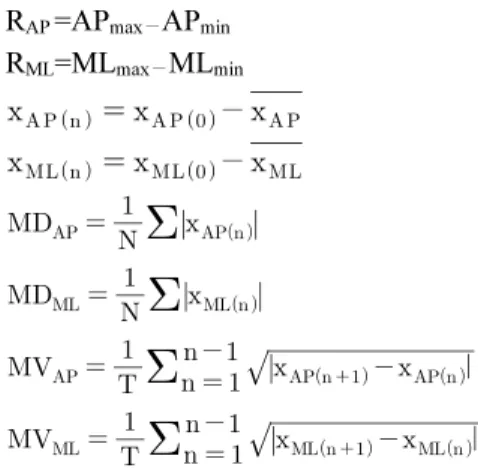
The center of pressure (COP) data for 10 seconds except the first 5 seconds were used for analysis in order to remove the initial fluctuations that might occur in the subjects. The variables used in the analysis included the following; the range of the COP (RAP, RML), the coordinates of the COP (xAP(n), xML(n)), the moving distance (MDAP, MDML), and the moving velocity (MVAP, MVML) along the anteroposterior (AP) and mediolateral (ML) directions [12]. In the equations below, (n) indicates the number of data points used in the analysis, and T indicates the time for measurement.
RAP =APmax−APmin
RML=MLmax−MLmin
−
−
−
− Statistical analysis was performed using IBM SPSS Statistics for Windows, Version 20.0 (IBM Co., Armonk, NY, USA). The repeated one-way ANOVA was used to ana-
lyze differences between IF, EF, and control states. The sig- nificance level (α) was set to 0.05.
Results
This study measured the range, distance, and velocity of COP during OLS in EF, IF, and the control condition.
Although all variables of EF were smaller than IF, no vari- ables for the COP showed any significant difference be- tween the three conditions (p>0.05) (Table 2).
Discussion
The purpose of this study was to identify effects of IF and EF of attention on postural balance in healthy school-age children, and to provide more useful information on motor learning. Many studies are reporting that EF is more effec- tive for motor learning in healthy adults [9,13]. However, in the case of children, results of previous studies were incon- sistent [11,14]. Some studies have reported no significant differences in motor learning between EF and IF, and some studies have reported that IF is more effective [15]. Emanuel et al. [11] reported that IF is more effective than EF in trans- fer of children’s motor skills. Cluff et al. [6] reported no sig- nificant difference between EF and IF for children. External attention can facilitate the automatic processing of the motor system and can be useful for motor learning. On the other hand, conscious control of movement by internal attention can interfere with automatic processing [7]. The constrained action hypothesis states that IF interferes with effective mo- tor control by making conscious control during movement [7]. On the contrary, EF was found to promote automatic in- formation processing of motor skill, thereby improving mo- tor control. However, the kinesthetic sense in school-aged children are immature and may lack experience with phys-
Shin, et al: Attentional focus on postural balance in school-age children 161
ical activity, and may thereby encounter difficulty with auto- matic motor processing [9]. Thus, they may cause IF or EF to be more effective in motor learning, or may cause no sig- nificant difference between the three conditions [11,16]. In this study, EF did not have a greater significant effect than IF in postural sway. It is postulated that the reason for this that school age-childhood between 8-12 years old go through a transitional phase from IF to EF in effective motor learning.
Some studies have reported that attention focus on motor learning was changing from IF to EF. This is because school-age period in childhood is a transitional stage of de- velopment of the kinesthetic system that may affect motor awareness or motor learning. Also, this may be the reason for no significant difference to have been found between IF and EF in this study. To apply attentional focus more effec- tively for clinical exercise rehabilitation, the physical devel- opment level (e.g., developmental age, skill level, task diffi- culty, etc.) should be considered [3,17-19].
The limitations of this study are as follows: First, it was difficult to generalize the results of the study in all school- aged children as we did not subclassify the subject’s group by their age. Second, it was not possible to represent the ef- fect of attentional focus through continuous training by mea- suring only the immediate effects. Therefore, further studies on the role of attentional focus provided to learners should be continued in order to generalize the results of this study.
It is proposed that scientific evidence for more efficient and concrete methods to improve postural balance in school-age children should be continuously reported in connection with various variables.
Conflict of Interest
The authors declared no potential conflicts of interest with respect to the authorship and/or publication of this article.
References
1. Raymakers JA, Samson MM, Verhaar HJ. The assessment of body sway and the choice of the stability parameter(s). Gait Posture 2005;21:48-58.
2. Stins JF, Emck C, de Vries EM, Doop S, Beek PJ. Attentional and sensory contributions to postural sway in children with autism spectrum disorder. Gait Posture 2015;42:199-203.
3. Schmidt RA, Lee TD, Winstein CJ, Wulf G, Zelaznik HN. Motor control and learning: a behavioral emphasis. Champaign (IL):
Human Kinetics; 2018.
4. Kim KH, Shin HK. The effects of water-based exercise on pos- tural control in children with spastic cerebral palsy. Phys Ther Rehabil Sci 2017;6:72-82.
5. Parreira RB, Amorim CF, Gil AW, Teixeira DC, Bilodeau M, da Silva RA. Effect of trunk extensor fatigue on the postural balance of elderly and young adults during unipodal task. Eur J Appl Physiol 2013;113:1989-96.
6. Cluff T, Gharib T, Balasubramaniam R. Attentional influences on the performance of secondary physical tasks during posture control. Exp Brain Res 2010;203:647-58.
7. Wulf G, McNevin N, Shea CH. The automaticity of complex mo- tor skill learning as a function of attentional focus. Q J Exp Psychol A 2001;54:1143-54.
8. Calatayud J, Vinstrup J, Jakobsen MD, Sundstrup E, Colado JC, Andersen LL. Influence of different attentional focus on EMG amplitude and contraction duration during the bench press at dif- ferent speeds. J Sports Sci 2018;36:1162-6.
9. Chiviacowsky S, Wulf G, Wally R. An external focus of attention enhances balance learning in older adults. Gait Posture 2010;32:
572-5.
10. Johnson L, Burridge JH, Demain SH. Internal and external focus of attention during gait re-education: an observational study of physical therapist practice in stroke rehabilitation. Phys Ther 2013;93:957-66.
11. Emanuel M, Jarus T, Bart O. Effect of focus of attention and age on motor acquisition, retention, and transfer: a randomized trial.
Phys Ther 2007;88:251-60.
12. Doyle RJ, Hsiao-Wecksler ET, Ragan BG, Rosengren KS.
Generalizability of center of pressure measures of quiet standing.
Gait Posture 2007;25:166-71.
13. Li LL, Li YC, Chu CH, Pan CY, Chen FC. External focus of at- tention concurrently elicits optimal performance of supra- postural pole-holding task and postural stability in children with developmental coordination disorder. Neurosci Lett 2019;703:
32-7.
14. Olivier I, Palluel E, Nougier V. Effects of attentional focus on postural sway in children and adults. Exp Brain Res 2008;185:
341-5.
15. van Cappellen-van Maldegem SJM, van Abswoude F, Krajenbrink H, Steenbergen B. Motor learning in children with develop- mental coordination disorder: the role of focus of attention and working memory. Hum Mov Sci 2018;62:211-20.
16. Perreault ME, French KE. External-focus feedback benefits free-throw learning in children. Res Q Exerc Sport 2015;86:
422-7.
17. Lee DY, Choi WJ, Lee SW. The effect of focus of attention by electroencephalogram feedback on balance in young adults.
Phys Ther Rehabil Sci 2012;1:13-5.
18. Lee DW, Shin HK, Kim KW. Effects of dynamic myofascial re- lease on trunk mobility and standing balance in persons with chronic nonspecific low back pain. Phys Ther Rehabil Sci 2019;8:74-8.
19. Lee JW, Hwang S. Effects of balance imagery of semi-tandem stance on a flat floor and balance beam for postural control: a comparison between older and younger adults. Phys Ther Rehabil Sci 2015;4:87-93.