Introduction
Tuberculosis (TB) is a contagious disease caused by Myco- bacterium tuberculosis that continues to be a significant glob- al problem. The recommended first-line regimen for the treat- ment of active TB consists of a combination of the following medications: isoniazid (INH), rifampin (RFP), pyrazinamide (PZA), and ethambutol (EMB)
1. Although this first-line regi- men has been shown to be very effective in treating TB, these medications are associated with significant adverse drug reac- tions
2-4. In addition, the increasing worldwide prevalence of drug-resistant TB requires the use of alternative regimens.
The fluoroquinolones (FQNs) are a family of synthetic broad-spectrum antibacterial drugs. They have been shown to have good anti-mycobacterial activity and are considered important substitutes for the treatment of multidrug-resistant
Current Status of Fluoroquinolone Use for Treatment of Tuberculosis in a Tertiary Care Hospital in Korea
Bo Hyoung Kang, M.D.
1, Kyung-Wook Jo, M.D., Ph.D.
2and Tae Sun Shim, M.D., Ph.D.
21
Department of Pulmonary and Critical Care Medicine, Dong-A University Hospital, Dong-A University College of Medicine, Busan,
2Department of Pulmonary and Critical Care Medicine, Asan Medical Center, University of Ulsan College of Medicine, Seoul, Korea
Background: Fluoroquinolones are considered important substitutes for the treatment of tuberculosis. This study investigates the current status of fluoroquinolone for the treatment of tuberculosis.
Methods: In 2009, a retrospective analysis was performed at one tertiary referral center for 953 patients diagnosed with tuberculosis.
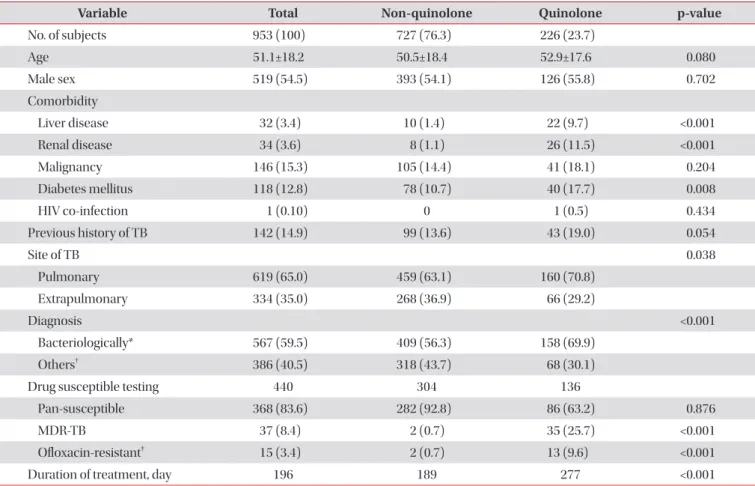
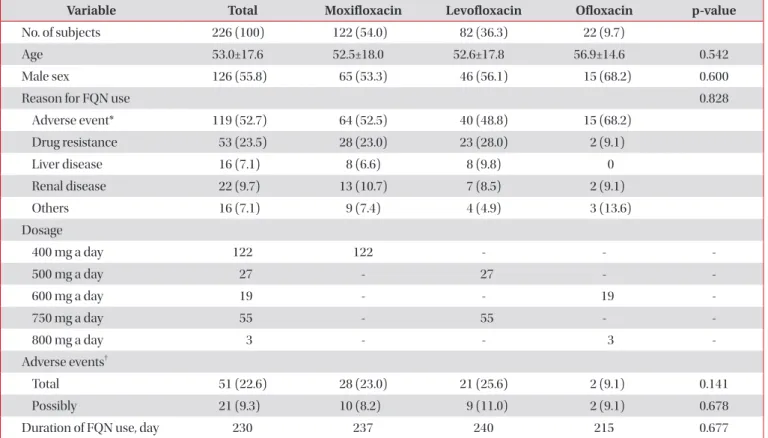
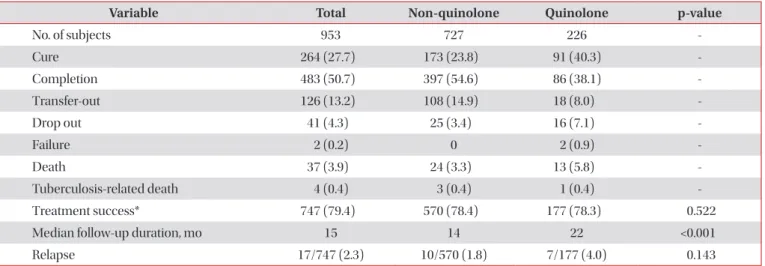
Results: A total of 226 patients (23.6%), who received fluoroquinolone at any time during treatment for tuberculosis, were enrolled in this study. The most common reasons for fluoroquinolone use were adverse events due to other anti- tuberculosis drugs (52.7%), drug resistance (23.5%), and underlying diseases (16.8%). Moxifloxacin (54.0%, 122/226) was the most commonly administered fluoroquinolone, followed by levofloxacin (36.3%, 82/226) and ofloxacin (9.7%, 22/226). The frequency of total adverse events from fluoroquinolone-containing anti-tuberculosis medication was 22.6%, whereas fluoroquinolone-related adverse events were estimated to be 2.2% (5/226). The most common fluoroquinolone- related adverse events were gastrointestinal problems (3.5%, 8/226). There were no significant differences in the treatment success rate between the fluoroquinolone and fluoroquinolone-naïve groups (78.3% vs. 78.4%, respectively).
Conclusion: At our institution, fluoroquinolones are commonly used for the treatment of both multidrug-resistant tuberculosis and susceptible tuberculosis, especially as a substitute for adverse event-related drugs. Considering the low adverse event rates and the comparable treatment success rates, fluoroquinolones seem to be an invaluable drug for the treatment of tuberculosis.
Keywords: Fluoroquinolones; Tuberculosis; Therapeutics; Drug Resistance
Address for correspondence: Tae Sun Shim, M.D., Ph.D.
Department of Pulmonary and Critical Care Medicine, Asan Medical Center, University of Ulsan College of Medicine, 88 Olympic-ro 43-gil, Songpa-gu, Seoul 05505, Korea
Phone: 82-2-3010-3892, Fax: 82-2-3010-6968 E-mail: [email protected]
Received: Aug. 4, 2016 Revised: Dec. 5, 2016 Accepted: Jan. 23, 2017
cc It is identical to the Creative Commons Attribution Non-Commercial License (http://creativecommons.org/licenses/by-nc/4.0/).