This is an open-access article distributed under the terms of the Creative Commons Attribution Non-Commercial License (http://creativecommons.org/
licenses/by-nc/4.0/), which permits unrestricted non-commercial use, distribution, and reproduction in any medium, provided the original work is properly cited.
CC
Leukocyte- and platelet-rich fibrin as an adjuvant to the surgical approach for osteoradionecrosis: a case report
Gustavo Maluf 1 , Rogério Jardim Caldas 1 , Eduardo Rodrigues Fregnani 2 , Paulo Sérgio da Silva Santos 1
1 Department of Surgery, Stomatology, Pathology and Radiology, Bauru School of Dentistry, University of São Paulo, Bauru,
2 Departament of Oral Medicine, Hospital Sírio-Libanês, São Paulo, Brazil
Abstract (J Korean Assoc Oral Maxillofac Surg 2020;46:150-154)
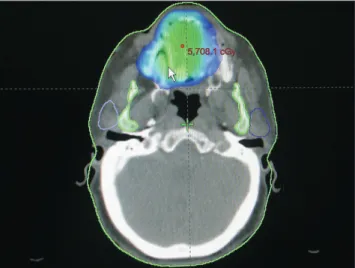
We present a case of osteoradionecrosis treated with leukocyte- and platelet-rich fibrin (LPRF) and surgery and followed up with clinical and tomo- graphic investigations. A 65-year-old woman presented with pain in the posterior region of the right palate. Her medical history included cardiovas- cular disease and squamous cell carcinoma in the anterior region of the floor of the mouth that had been treated with intensity-modulated radiation therapy. Measurements of isodose curves showed a full dosage of 6,462.6 cGy in the anterior mandibular region, whereas that in the posterior region on the right side of the maxilla reached 5,708.1 cGy. Osteotomy was performed using rotary instruments, and debridement and placement of two LPRF membranes were also carried out. New gum tissue with no bone exposure was noted 14 days postoperatively. Tissue repair was complete, and the patient had no further complaints. During a 39-month follow-up period, the oral mucosa remained intact, and the patient was rehabilitated with a new upper denture. Since there is no consensus regarding the best protocol to treat osteoradionecrosis, LPRF might be an interesting adjuvant to a surgical approach. The use of LPRF is simple and reduces operational costs, time of handling, probability of technical failure, and associated morbidities for patients with osteoradionecrosis.
Key words: Osteoradionecrosis, Oral surgery, Cone-beam computed tomography
[paper submitted 2018. 4. 24 / revised 2018. 7. 3 / accepted 2018. 7. 4]
Copyright © 2020 The Korean Association of Oral and Maxillofacial Surgeons. All rights reserved.
I. Introduction
Osteoradionecrosis (ORN) is defined as an area of exposed bone that persists for more than three months 1 . It is a diagno- sis of exclusion and affects 2% to 15% of patients undergoing radiotherapy of the head and neck 2 . However, ORN may only be evident in radiographic images if no clinical manifesta- tions are present, such as disruption in the oral mucosa or cervicofacial skin 3 . Mandibular ORN is more prevalent than maxillary ORN because the mandibular bone is dense but weakly vascular 2 .
Marx 4 described ORN as a conjunction of hypoxia, hypo- cellularity, and hypovascularization and proposed that the condition be managed with surgery and hyperbaric oxygen (HBO) treatment. Research has been performed on HBO and many other modalities of treatment, including antiseptic mouthwashes, antibiotics, sequestrectomy, ultrasound thera- py, biological molecules, and surgical treatments (including those that involve microvascular reconstruction) 5 . Intensity- modulated radiation therapy (IMRT) is a radiotherapy tech- nique used to deliver precise doses of radiation to a malignant tumor or specific areas within a tumor and thereby minimizes the amount delivered to surrounding normal tissue. As a result, IMRT decreases the incidence and severity of ORN more than other conventional radiotherapy techniques 5 .
Platelet-rich plasma (PRP) promotes coagulation. Platelets are a rich source of important growth factors (platelet-derived growth factor, transforming growth factors beta 1 and 2, and vascular endothelial growth factors) involved in the angio- genic cascade and in the healing of both soft and hard tis- sues 6 . Scala et al. 7 reported the first case of ORN to be treated with autologous platelet concentrates. The necrotic bone was Gustavo Maluf
Department of Surgery, Stomatology, Pathology and Radiology, Bauru School of Dentistry, University of São Paulo, Al. Dr. Octávio Pinheiro Brisolla, 9-75, Bauru 17012-901, Brazil
TEL: +55-14-3235-8000 FAX: +55-14-3226-6113 E-mail: [email protected]
ORCID: https://orcid.org/0000-0001-5507-1824
removed, and PRP was used for primary closure of the mu- cosa. No injuries were noted during the two-year follow-up period.
Leukocyte- and platelet-rich fibrin (LPRF) is a second-gen- eration platelet concentrate (autologous natural fibrin matrix) that accelerates angiogenesis and multiplication of fibroblasts and osteoblasts 8 . LPRF is an immunological platelet concen- trate retained in a single membrane of fibrin that contains all the blood components favorable for healing and immunity 9 . When combined with a bone graft, LPRF accelerates bone healing. Histologically, bones form and mature in a shorter time with use of LPRF than with the aid of other techniques.
The healing effects of LPRF on tissues are superior to those of PRP 9 .
Surgical treatment with LPRF has been used to manage medication-related osteonecrosis of the jaw with promising results 10 . Nonetheless, to the best of our knowledge, there have been no reports on use of LPRF in treatment of ORN.
Therefore, we present a case in which LPRF and surgery were used to treat ORN and for which there were both clini- cal and tomographic follow-up data available. Patient consent was obtained for publication of these case details.
II. Case Report
A 65-year-old woman presented with pain in the posterior region of the right palate. Her medical history included car- diovascular disease (subepicardial ischemia) and squamous cell carcinoma, for which she was treated with IMRT in the
anterior region of the floor of the mouth. Measurements of isodose curves showed a full dosage of 6,462.6 cGy in the anterior mandibular region. In the posterior region on the right side of the maxilla, the dosage reached 5,708.1 cGy.
(Fig. 1) The patient was taking 500 mg acetylsalicylic acid (AAS; Sanofi Aventis, Gentilly, France) and 75 mg clopi- dogrel (Plavix; Sanofi Aventis). A section of approximately 12 mm of exposed bone was visible, and purulent secretion draining from the posterior alveolar ridge on the right side of the maxilla was accompanied by pain in that area. The patient wore an upper denture.(Fig. 2) Thus, the condition was diag- nosed as Stage III ORN 2 . Cone-beam computed tomography (CBCT) findings included osteolysis of the posterior alveolar ridge on the right side of the maxilla and the maxillary si- nus floor with bone sequestrum and complete opacification caused by ORN.(Fig. 3) The leukocyte count was 6,400 cells/
µL (4,160 segmented neutrophils/µL; 0 band neutrophils/µL).
The hemoglobin level was 10.4 g/dL, and the platelet count was 351,000 cells/mm 3 .
An osteotomy was performed using rotary instruments; the area was debrided, and two LPRF membranes were placed.
We used the LPRF protocol developed in France by Chouk- roun et al. 8 . The LPRF was obtained from a 20-mL venous blood sample obtained from the patient before surgery.(Fig.
4) An antibiotic (875 mg amoxicillin/clavulanic acid) and mouth rinsing regime (0.2% chlorhexidine gluconate) were prescribed daily for the next three weeks.
New gum tissue with no bone exposure was noted 14 days postoperatively. Thus, the tissue repair was complete, and the patient had no further complaints. During the 39-month
5,708.1 cGy 5,708.1 cGy
Fig. 1. Radiation dosage distribution map of the osteoradionecro- sis area.
Gustavo Maluf et al: Leukocyte- and platelet-rich fibrin as an adjuvant to the surgical approach for osteoradionecrosis: a case report. J Korean Assoc Oral Maxillofac Surg 2020
Fig. 2. Area of exposed bone in the maxilla with purulent drain- age.
Gustavo Maluf et al: Leukocyte- and platelet-rich fibrin as an adjuvant to the surgical
approach for osteoradionecrosis: a case report. J Korean Assoc Oral Maxillofac Surg
2020
follow-up period, the oral mucosa remained intact, and the patient was rehabilitated with a new upper denture.(Fig. 5) Tomographic images obtained 36 months postoperatively showed that sequestra, sinusitis, and bone lysis were absent, although there was disruption of the cortical bone of the max- illary sinus caused by the osteotomy.(Fig. 6)
III. Discussion
ORN is a debilitating complication of radiation therapy, and the most effective measure against this condition is pre-
vention. Conservative management with antibiotics, local treatment, and HBO has been shown to be effective in 25% to 44% of cases 3,11 . Maier et al. 12 demonstrated that postopera- tive HBO was not effective in cases of severe ORN and is not a treatment choice in cases of surgical failure. Bessereau and Annane 13 showed that HBO was ineffective as a sole treat- ment. In a meta-analysis, Bennett et al. 14 confirmed that HBO
Fig. 4. Leukocyte- and platelet-rich fibrin placement in the surgi- cal area.
Gustavo Maluf et al: Leukocyte- and platelet-rich fibrin as an adjuvant to the surgical approach for osteoradionecrosis: a case report. J Korean Assoc Oral Maxillofac Surg 2020
Fig. 5. Postoperative period of 39 months showing complete mu- cosal wound covering.
Gustavo Maluf et al: Leukocyte- and platelet-rich fibrin as an adjuvant to the surgical approach for osteoradionecrosis: a case report. J Korean Assoc Oral Maxillofac Surg 2020
Fig. 3. Computed tomography findings: Sinusitis (complete opaci- fication of maxillary sinus), sequestrum formation, cortical disrup- tion, and osteolysis. (V: buccal, P: lingual, CND: right nasal cavity, XX: osteolysis, VEL: opacification of maxillary sinus, ROMP: corti- cal disruption)
Gustavo Maluf et al: Leukocyte- and platelet-rich fibrin as an adjuvant to the surgical approach for osteoradionecrosis: a case report. J Korean Assoc Oral Maxillofac Surg 2020
5 6 7 8
9 10 11 12
13 14 15 16