
http://dx.doi.org/10.7841/ksbbj.2012.27.4.199
총설
광학분리를 위한 키랄 크라운 에테르를 이용한 키랄공학의 개발과 응용
백만정1, 윤원남, 이원재*
The Development and Application of Chirotechnology Using Chiral Crown Ethers for Enantiomer Separation
Man-Jeong Paik1, Won Nam Yun, and Wonjae Lee*
접수: 2012년 7월 30일 / 게재승인: 2012년 8월 20일
© 2012 The Korean Society for Biotechnology and Bioengineering
Abstract:
1)Chiral crown ethers are synthetic macrocyclic polyethers that bind protonated chiral primary amines with high selectivity and affinity. They have been widely used to separate or distinguish the enantiomers of chiral compounds containing a primary amino moiety by high-performance liquid chromatography, capillary electrophoresis, and NMR spectroscopy. In this paper, two important chiral crown ethers including chiral binaphthyl unit and (18-crown-6)-2,3,11,12- tetracarboxylic acid as chiral selectors are focused. And several chiral resolution techniques and their applications in chirotechnology using these chiral crown ethers with related chiral recognition mechanism studies are reviewed. Especially, it was shown that the commercially available HPLC columns based on (18-crown-6)-2,3,11,12-tetracarboxylic acid have been developed and successfully applied for the resolution of various primary amino compounds including amino acids.Keywords: Chiral crown ether, 18-Crown-6-2,3,11,12-
tetracarboxylic acid, Chiral selector, High-performance liquid chromatography, Capillary electrophoresis, NMR spectroscopy조선대학교 약학대학 약학과
College of Pharmacy, Chosun University, Gwangju, 501-759, Korea Tel: +82-62-230-6376, Fax: +82-62-222-5414
e-mail: [email protected]
1순천대학교 약학대학 약학과
1College of Pharmacy, Sunchon Nationnal University, Sunchon, Jeonnam, 540-950, Korea
1. 서론
1987년 Charles J. Pedersen, Donald J. Cram, Jean-Marie Lehn 는 크라운 에테르를 이용한 생체내 분자연구의 host-guest chemistry 선구자로 인정받아 노벨 화학상을 수상하였다. 크 라운 에테르는 macrocyclic polyether로서 특정한 사이즈의 cavity를 가지고 있는데 1967년 Pedersen에 의해 처음으로 실험실에서 합성되어 소개되었다 [1]. 크라운 에테르의 ether oxygen은 그 cavity의 내벽을 둘러싸게 되는데, 이는 전자를 donate하는 배위원자로서 역할을 하며 이에 따라 금속이나 암모니아 양이온들이 cavity 안으로 포획되어 complex를 형 성할 수 있다. 그 이후 1970년대 후반에 host-guest chemistry 대가로 잘 알려진 Cram 교수에 의해 chiral 1,1’-binaphthyl unit 등을 첨가한 여러 chiral crown ether들이 액체-액체 추 출법과 HPLC에서 키랄 고정상의 키랄 선택자로 처음으로 이용되어 α-amino acid과 1차 아미노기를 가진 화합물들을 광학분리하는데 사용되었다 [2]. 키랄 크라운 에테르는 크라 운 에테르 안에 적절한 키랄 단위로써 키랄 장애물 (barrier) 을 첨가하여 개발되어 왔다. 예를 들면 binaphthyl이나 biphenanthryl 단위와 같은 큰 키랄성 방향족 고리 화합물 이나 helicene 유도체, 그리고 tartaric acid나 탄수화물 같 은 광학활성 천연물들이 크라운 에테르 안에 키랄 장애물 역할을 하여 효과적인 키랄 크라운 에테르를 제조하게 되었 다. 이외에도 키랄 aza 크라운 에테르, 키랄 pyridino 크라 운 에테르와 페놀류 키랄 크라운 에테르들이 개발되어 연구 되어 왔다 [2-4].
크라운 에테르를 이용한 host-guest chemistry의 생체내 분자연구는 매우 중요한 연구분야이기에 여러 다양한 구조 의 키랄 크라운 에테르 화합물이 개발되고 연구되어 왔지만,
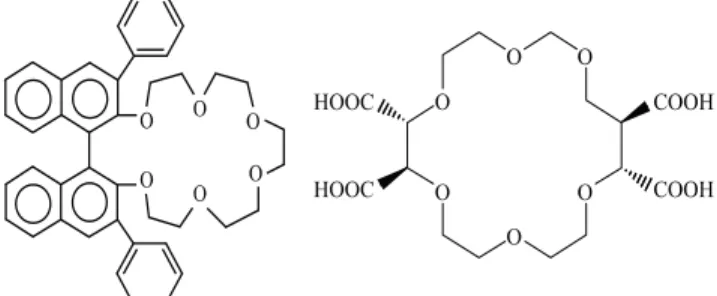
본고에서는 광학분리 연구에서 현재까지 가장 널리 사용되 어 오고 있는 1,1’-binaphthyl로부터 유도된 키랄 크라운 에 테르와 tartaric acid로부터 유도된 (18-crown-6)-2,3,11,12- tetracarboxylic acid (18-C-6-TA) 키랄 크라운 에테르에 초 점을 맞추고자 한다 (Fig. 1). 그리하여 이 두 개의 키랄 크 라운 에테르들이 HPLC 고정상과 모세관 전기영동, NMR 연구에서 키랄선택자로 사용되어 왔던 여러 광학분리와 연구결과 및 응용들에 관련된 Chirotechnology에 대해 기술 하고자 하였다.
Fig. 1. The structures of two chiral crown ethers derived from 1,1’–
binaphthyl moiety and L-tartaric acid, respectively.
2. 1,1’-binaphthyl에 기초한 키랄 크라운 에테르를 이용 한 광학분리
앞에서도 기술한 바와 같이 HPLC에 이용되는 키랄 크라운 에테르형태의 HPLC column은 1979년 Donald J. Cram 교수 에 의해 소개되었다 [2]. 그 가운데 bis-(1,1'-binaphthyl)-22- crown-6 화합물을 이용한 chiral column이 1987년 일본의 Daicel company에서 (www.chiraltech.com) Shinbo에 의해 개발되어 Crownpak CR (+)와 Crownpak CR (-)라는 이 름으로 상품화되었다 (Fig. 1) [5,6]. Crownpak CR 컬럼은 ODS silica gel의 octadecyl 그룹과 높은 친유성 성질의 3,3'- diphenyl-1,1'-binaphthyl 그룹을 가지는 키랄 크라운 에테르 사이의 lipophilic interaction을 이용하여 코팅되어 제조되었 다. 또한 Crownpak CR 컬럼의 키랄 선택자는 binaphthyl group과 함께 분자내의 chiral crown ether의 chiral cavity를 가지고 있어 여기에 일차 아미노기를 가지는 racemic 화합물 사이의 host-guest stereoselective complexation을 통하여 광 학분리를 일으킨다 [2,5]. 이 Crownpak CR column은 amino acid을 포함한 일차 아미노기를 가지는 키랄 화합물의 광학 분리에 매우 효과적으로 이용되어 왔다 [2-6]. 그러나 HPLC용 Crownpak CR 컬럼의 경우, 제조할 때 ODS silica gel 고체지 지체에 키랄 선택자의 chiral crown ether를 흡착시키기 때문 에 15% methanol/water (v/v) 이내의 이동상만 사용해야 하 는 근본적인 약점을 가지고 있다. 그러므로 15% methanol/
water (v/v) 이상의 용매나 methanol이 아닌 다른 용매를 사용 할 경우, 흡착된 키랄 선택자가 씻겨나가 컬럼이 손상되는 문 제가 있다. 특히 hydrophobicity가 큰 화합물의 경우 용리자체 가 되지 않거나 분석시간이 매우 길어지는 단점을 보인다 [6,7].
개선된 Crownpak CR 컬럼을 개발하기 위해 Shinbo 그룹
은 앞에서의 키랄선택자에 2개의 octyl 그룹을 첨가한 (6,6'- dioctyl-3,3'-diphenyl-1,1'-naphthyl)-20-crown-6을 octadecyl silica gel에 코팅한 키랄고정상을 제조하였다 [8]. 첨가한 2개 의 octyl 그룹은 키랄 크라운 에테르에 붙어 있어 이들 ODS 고 정상의 octadecyl 그룹과 키랄 크라운 에테르 간의 lipophilic interaction을 향상시킬 것을 기대하여 α-amino acids, 1- phenylethylamine, 3-aminocaprolactam 등의 광학분리에서 매우 성공적이었다.그러나 이 키랄고정상도 40% 이상의 methanol/water (v/v)을 HPLC 이동상으로 사용할 때는 코 팅에서 벗겨져 나와 컬럼이 손상을 입게 된다. 키랄선택자 가 흡착된 형태의 Crownpak CR 컬럼을 근본적인 단점을 극복하기 위해, 앞에서의 bis-(1,1'-binaphthyl)-22-crown-6 키랄선택자를 실리카 젤에 공유결합한 여러 키랄고정상을 새롭게 개발하였다 [9-11]. 키랄선택자가 silica gel에 공유 결합된 안정성으로 인해 HPLC 컬럼상에서 어떤 이동상 이던지 제한없이 사용할 수 있어 amino acid을 포함한 1차 아미노기를 가진 여러 물질들의 광학분리에 매우 유용함을 보고하였다.
3. (18-crown-6)-2,3,11,12-tetracarboxylic acid 키랄 크 라운 에테르를 이용한 모세관 전기영동에서의 광학분리
키랄 크라운 에테르인 (+)-(18-crown-6)-2,3,11,12-tetracarboxylic acid (18-C-6-TA)를 키랄선택자로 이용하여 1992년 처음 으로 Kuhn group에서 capillary electrophoresis 분석법으로 amino acid과 키랄 일차 아민들을 광학분리한 연구결과를 보고하였다 [12,13]. Kuhn group에서 사용한 키랄 크라운 에테르 (+)-18-C-6-TA 화합물은 본래 크라운 에테르 개발로 노벨 화학상을 수상한 Lehn에 의해 L-(+)-tartaric acid으로 부터 시작하여 여러 단계를 거쳐 1980년 처음으로 합성된 물 질이다 (Fig. 1) [14]. 본 연구팀에서도 여러 종류의 aromatic amino acids와 이들 esters 화합물들을 (+)-18-C-6-TA와 (-)- 18-C-6-TA를 이용하여 capillary electrophoresis 분석법으로 훌륭하게 광학분리하였는데 이들의 대표적인 결과를 Fig. 2 와 Table 1에서 보여주고 있다 [15-17]. 특히 Table 1에서는 phenylglycine (PG)과 여러 PG esters들을 동일한 capillary electrophoresis 분석 조건에서 광학분리할 수 있음을 보여주 고 있다. Capillary electrophoresis 분석법으로 Fig. 2와 같이 amino acids 등의 분석물질을 (+)-18-C-6-TA와 (-)-18-C-6-TA 를 각각 이용하여 각 분석물질의 elution order가 정반대되도 록 광학분리한 것은 본 연구팀이 최초이다 [15]. 또한 capillary electrophoresis 분석법으로 β-blocker를 광학분리하고자 할 때 cyclodextrin 일종인 DMβCD만을 키랄선택자로 사용하는 것보다 18-C-6-TA를 chiral additive로 함께 사용하는 것이 광학분리결과가 더욱 좋게 나타났다. Capillary electrophoresis 분석법으로 β-blocker를 광학분리하는데 DMβCD 뿐만 아 니라 18-C-6-TA를 키랄선택자로 동시에 사용하여 광학분리 효율성을 높인 것은 본 연구팀이 최초이다. Fig. 3은 11개의 β-blocker를 DMβCD와 (+)-18-C-6-TA를 함께 키랄선택자로 사용하여 capillary electrophoresis 동시분석법으로 광학분리
한 결과이며, Fig. 4는 이들 CE 분석조건에서의 대표적인 예 로, β-blocker인 racemic atenolol과 propranolol 표준품과 실제 시판되고 있는 의약품을 분석한 결과이다 [17].
Table 1. Enantiomer resolution of PG and PG ester derivatives by
CE with (+)-18-C-6-TA as a chiral selector [17]Entry Analyte chiral selector: 0 mM 5 mM
t t1a t2 αb Rsc
1 2 3 4 5
PG
PG methyl ester PG ethyl ester PG n-propyl ester PG n-butyl ester
15.96 5.86 6.19 6.46 6.72
22.18 9.23 9.55 10.22 10.82
30.07 11.73 12.42 13.38 14.40
1.36 1.27 1.30 1.31 1.33
15.76 13.90 14.88 17.33 17.28 CE buffer solution: 0 mM or 5 mM (+)-18-C-6-TA as a chiral selector in 20 mM Tris-Citric acid (pH 2.50); UV 200nm; Temperature ambient (about 20℃). aMigration time (min) of the first eluted enantiomer.
bSeparation factor. cResolution factor.
Fig. 2. Enantiomer separation of three enantiomerically enriched
(3:1) amino acids in (+)-18-C-6-TA (top) and (-)-18-C-6-TA (bottom) selector modes by CE [15]. Peaks; 1 = baclofen; 2 = DOPA; 3 = 3-hydroxyphenylglycine.Fig. 3. Simultaneous enantiomer separation of eleven β-blockers
by CE [17]. Peaks: 1,1 = Sotalol, 2,2 = Atenolol, 3,3 = Practolol, 4,4 = Propranolol, 5,5 = Metoprolol, 6,6 = Oxprenolol, 7,7 = Bisprolol, 8,8 = Alprenolol, 9,9 = Pronethalol, 10,10 = Betaxolol, 11,11 = Penbutolol. IS = (S) - Pindolol.Fig. 4. Typical enantiomer separation of CE results of standards
and commercial products of atenolol and propranolol analytes [17].4. 18-C-6-TA 키랄 크라운 에테르를 이용한 고성능 액체 크로마토 그래피에서의 광학분리
앞에서도 언급하였던 바와 같이 Crownpak CR은 일본 Daicel company에서 1,1’-binaphthyl 기초한 키랄 선택자를 ODS silica gel에 흡착시켜 제조하여 전세계에 시판되어 널리 쓰 이고 있는 유일한 키랄 크라운 에테르 형태의 HPLC 컬럼이 다 [5,6]. Crown ether 키랄 선택자가 coating 되어 있는 단점 을 가진 Crownpak CR 컬럼보다 우수한 컬럼을 제조하기 위해, 국내에서 본 연구팀과 현명호교수 연구팀이 공동연구 로 키랄선택자를 silica gel에 covalent bonding시킨 새로운 crown ether type column을 개발하고자 시도하여 세계 최초 로 키랄 크라운 에테르 형태의 공유결합된 HPLC 컬럼을 개발하여 상품화하고자 하였다. 이를 위해 Kuhn group에서 capillary electrophoresis 분석법으로 키랄선택자로 사용한 키랄 크라운 에테르인 (+)-18-C-6-TA를 주목하고 이를 이용 하였다. 그래서 (+)-18-C-6-TA를 acetyl chloride를 처리하여 (+)-18-C-6-TA dianhydride로 변환하였고 이를 triethylamine 의 존재 하에 aminopropyl silica gel과 함께 반응시켜 (+)- 18-C-6-TA 키랄선택자를 covalent bonding 시킨 새로운 키랄 고정상 CSP 1을 개발하여 그 연구결과를 1998년부터 발표 하였다 (Fig. 5) [18-25].
한편 일본 Machida group에서도 (+)-18-C-6-TA를 coupling agent EEDQ (2-ethoxy-1-ethoxycarbonyl-1,2-dihydroquinoline) 의 존재 하에 aminopropyl silica gel과 반응시키고 나서 pyridine의 존재 하에 앞선 반응물을 acetic anhydride와 함께 처리하여 (+)-18-C-6-TA를 covalent bonding 시킨 CSP 2를 제조하여 광학분리한 연구결과를 1998년 발표하 였다 (Fig. 5) [26,27]. 흥미롭게도 두 그룹에서 독자적으로 같은 시기에 동일한 크라운 에테르 키랄선택자에서 유도된 HPLC 컬럼을 개발하였다. 동일한 키랄 선택자인 (+)-18-C- 6-TA로부터 출발하여 이를 covalent bonding 시킨 크라운 에테르 형태의 키랄 컬럼을 각각 제조하였지만 이를 위한 화학적 제조방법이 서로 달라 Fig. 5에서 보는 바와 같이 실제 적인 고정상의 구조와 형태가 서로 다름을 볼 수 있다. 그러나
Fig. 6. Covalently bonded ChiroSil RCA(+)(CSP 1) and ChiroSil SCA(-) derived from (+)- and (-)-18-C-6-TA, respectively [25].
동일한 amino acids과 키랄아민 등을 광학분리하였을 때, 본 연구팀에서 개발한 CSP 1에서의 광학분리한 결과가 Machida group에서 개발한 CSP 2에서의 광학분리한 결과보다 훨씬 우수함을 볼 수 있었다. 한 예로, amino acids 분석물질의 경우, CSP 1에서 CSP 2보다 뛰어난 광학분리를 보였고 asparagine, aspartic acid, isoleucine, threonine, valine, baclofen의 경우 CSP 1에 의해서는 성공적인 광학분리를 보였지만 CSP 2에 의해서는 전혀 광학분리가 되지 않았다 [24,26]. CSP 1을 사용하여 α-amino acids 뿐만 아니라 α-amino acid ester들 에 대해서도 광학분리하였지만 α-amino acid ester들의 광학 분리는 전반적으로 α-amino acids 보다 낮게 나타난다. 또 한 1차 아미노 그룹을 가지는 amino acid가 광학분리되기 때문에 1차 아미노기가 존재하지 않는 proline은 광학분리 되지 아니하였다. 이외에도 1차 아미노 그룹을 가진 여러 종 류의 키랄 amines, amino alcohols, gemifloxacin을 포함한 fluoroquinolone 항균물질, tocainide와 유도체들, β-amino acids, 그리고 aryl α-amino ketones의 광학분리에 성공적이 었다 [10,11,18-25].
(a)
(b)
Fig. 5. The structures of the same chiral selector (+)-18-C-6-TA
derived CSP 1 (a) developed by our group and CSP 2 (b) by Michida group, respectively [19,24,26].(+)-18-C-6-TA로부터 출발하여 새로 개발한 crown ether column의 경우, 키랄선택자를 silica gel에 공유결합을 시 켰기 때문에 컬럼 안정성 측면에서 어떤 HPLC 이동상이 던지 제한 없이 사용할 수 있는 장점이 있고 앞에서 언급한 Crownpak CR과 같이 amino acid를 포함한 일차 아미노기 를 가지는 키랄화합물의 광학분리에 매우 유용하다. 이는 특히 hydrophobicity가 큰 화합물의 광학분리나 분취분리 (preparative separation)에서 Crownpak CR과는 비교할 수 없는 탁월한 장점을 가지고 있다. Hydrophobicity가 큰 화합 물의 경우, Crownpak CR의 경우 아예 용리자체가 되지 않 거나 용리시간이 매우 길어지는 단점이 있고 이를 짧게 하기 위한 이동상 사용에 제한이 있다 [7,23]. 특히 분취분리를 진행할 경우, 흡착된 키랄 크라운 에테르나 코팅시키기 위해 부가한 물질이 용리될 수 있는 가능성이 상당한 단점으로 나타난다. 이러한 Crownpak CR의 단점에 우위를 두고, 키랄 선택자 18-C-6-TA로부터 출발하여 개발된 이 chiral HPLC column은 국내 RS Tech Corp. 벤처회사 (www.rstechcorp.
com)를 통하여 세계 최초로 상품화하였다. 그래서 현재 (+)- 18-C-6-TA로 부터 유도된 ChiroSil RCA (+)와 (-)-18-C-6-TA 로부터 유도된 ChiroSil SCA (-)라는 이름의 컬럼으로 시판 되고 있는데 두 개의 키랄선택자가 서로 enantiomer인 관계 로 ChiroSil RCA (+)와 ChiroSil SCA (-)를 각각 사용함으 로 용리순서 (elution order)를 원하는 대로 바꿀 수 있는데 이는 광학순도를 측정하는 실제적인 분석과정에서 매우 유용 한 장점이 있다 (Fig. 6) [25]. Fig. 7은 amino acid의 구조형 태를 가지고 있는 thyroxine (S:R = 90:1) 시료를 ChiroSil RCA (+)와 ChiroSil SCA (-) 컬럼에서 각각 광학분리한 크로마토그램이다 [25]. Fig. 8은 해외시장판매를 목적으로 국내기술로 개발되어 FDA 허가를 받은 국내 최초의 신약 이라 불리우는 제 4세대 항생제인 racemic Gemifloxacin (LB20304a; 상품명 Factive) 물질을 Crownpak CR (+)에서 와 ChiroSil SCA (-) 컬럼에서 광학분리한 결과이다 [7].
Gemifloxacin은 Crownpak CR컬럼에서도 우수한 광학분리 결과를 보이지만 hydrophobicity가 큰 화합물이므로 용리 하는데 한 시간이상의 시간이 걸리지만 ChiroSil 컬럼에서는 훨씬 뛰어난 광학분리 결과를 보이면서도 빠르게 용리한다. CSP 1의 키랄 인지 효율성과 안정성을 높이기 위해 (+)-18- C-6-TA를 기초로 한 개선된 키랄고정상 개발을 위해 많은 노력을 기울였다 [10,11]. 그 중에서 CSP 1의 aminopropyl silica gel에서의 두개의 amide tethers의 N-H 대신 N-CH3
로 치환된 CSP 3를 개발하였다 [28]. Amino acid의 광학분 리에서는 CSP 1이 CSP 3보다 약간 우수한 것으로 나타나나 amino acid 에스터의 광학분리의 경우에는 CSP 3가 CSP 1
보다 조금 우수해 보인다. 그래서 CSP 1에서 전혀 광학분리 되지 않았던 phenylalanine methyl ester, leucine methyl ester 등이 CSP 3에서는 광학분리된다. 또한 1차 키랄 아민 들의 광학분리에서는 CSP 3는 CSP 1보다 더욱 우수한 것으 로 나타났다. 또한 (+)-18-C-6-TA을 Crownpak CR 컬럼과 같이 ODS silica gel 고체지지체에 키랄 선택자를 dynamic coating 시킨 새로운 컬럼을 제조하였다 [29]. 이를 위해 (+)- 18-C-6-TA의 N-dodecyl diamide를 만든 후 ODS silica gel 에 흡착시켰다. 이렇게 (+)-18-C-6-TA의 N-dodecyl diamide 유도체를 흡착시킨 컬럼에서의 광학분리는 (+)-18-C-6-TA 를 aminopropyl silica gel에 공유결합시킨 컬럼에서의 광학 분리보다 전체적으로 좋지 못하였다. 그래서 aspartic acid 등 을 포함한 여러 amino acid들은 이 컬럼에서 광학분리되지 못하였지만, 반면에 amino acid ester들의 경우에는 조금 더 나은 광학분리결과를 보여주기도 하였다. (+)-18-C-6-TA을 키랄선택자로 기초한 CSP 1에서 광학분리할 경우에, 2차 아미노 그룹을 가진 isopropyl amino alcohol 화합물의 광학 분리도 예외적으로 보고된 바가 있지만 일반적으로는 1차 아미노 그룹을 가진 화합물이어야만 한다 [10]. 그래서 chiral carboxylic acid 화합물의 경우, 키랄 크라운 에테르를 가진 CSP 1에서 광학분리할 수 없지만 이 carboxylic acid 화합 물을 N-hydrazide derivatives로 치환한 다음에 광학분리할 수 있으리라 기대하였다. 그래서 제초제 성분으로 사용되고 있는 chiral 2-aryloxypropionic acid를 N-hydrazide derivatives 치환체로 변환한 후에 이들을 성공적으로 광학분리한 결과를 보고하였다 [30].
(a) (b)
Fig. 7. Chromatograms of the resolution of an enantiomerically
enriched thyroxine (S:R = 90:1) on ChiroSil RCA (+) (a) and ChiroSil SCA(-) (b).(a) (b)
Fig. 8. Chromatograms of enantiomer resolution of racemic LB
20304a (Gemifloxacin) on Crownpak CR (+) (a) and ChiroSil SCA(-) (b).5. 18-C-6-TA 키랄 크라운 에테르를 이용한 NMR에서 의 광학분리
앞에서 (+)-18-C-6-TA를 키랄선택자로 사용하여 만든 HPLC 용 키랄컬럼에서 amino acid과 그 유도체들을 광학분리하는 데 매우 유용한 실험결과를 보여주었기 때문에 HPLC에서 amino acid과 그 유도체들을 광학분리한 키랄메커니즘이 키랄선택자로 (+)-18-C-6-TA를 이용한 용액상태의 NMR상 에서의 광학분리에도 동일하게 적용될 수 있으리라 기대하 였다. Table 2에서 보는 바와 같이, NMR spectroscopy를 이용한 광학분리실험에서 (+)-18-C-6-TA 키랄선택자를 사 용하였을 때 사용한 총 10개의 amino acids와 amino acids methyl ester 유도체의 분석물질의 경우 α-proton이 0.100- 0.322 ppm의 상당히 큰 chemical shift nonequivalences (ΔΔδ) 를 보여주고 있고 18-C-6-TA 키랄선택자를 사용한 CSP 1 상에서의 HPLC 실험결과에서도 두개의 분석물질을 (leucine methyl ester와 phenylalanine methyl ester) 제외하고는 1.18- 2.47의 separation factor를 보여주며 잘 분리되고 있다. 흥미 로운 것은 NMR을 이용한 광학분리실험에서는 대체적으로 amino acids methyl ester가 amino acids보다 더 큰 chemical shift nonequivalences를 보여주고 있는 반면, CSP 1 상에서 의 HPLC를 이용한 광학분리실험에서는 모든 amino acids가 해당 amino acids methyl ester보다 더 큰 separation factor 를 보여주고 있다는 사실이다. 특이한 것은 leucine methyl ester와 phenylalanine methyl ester enantiomer의 경우 18-C- 6-TA을 키랄선택자로 한 HPLC column에서는 광학분리되 지 않았지만 NMR에서 이를 이용해 실험할 경우 α-proton의 ΔΔδ결과가 각각 0.158 ppm과 0.286 ppm을 나타낼 만큼 상당히 크게 광학분리 되어졌다 [19]. 그러나 이 결과에서 보여주는 것처럼 1H NMR 연구에서 관찰된 분석물질의 chemical shift nonequivalences의 크기와 HPLC 연구결과
Table 2. Comparative results of chiral discrimination of several
amino acids and their methyl esters by NMR and HPLCEntry Analyte ΔΔδa(D-L) Separation factorb Conf.c 1
2 3 4 5 6 7 8 9 10
Alanine Leucine Phenylglycine Phenylalanine Valine
Alanine methyl ester Leucine methyl ester Phenylalanine methyl ester Phenylglycine methyl ester Valine methyl ester
0.102 0.100 0.210 0.211 0.322 0.112 0.158 0.286 0.231 0.227
1.35 1.67 2.47 1.75 1.64 1.18 1.00 1.00 2.24 1.21
D D D D D D - - D D
aChemical shifts obtained by subtracting its (L)values from the (D) ones of α-proton of 1H NMR. The chemical shifts were based on the spectrum of racemic analytes (2mM) in the presence of 1 equivalent of 18-C-6-TA. bSeparation factor observed on CSP 1 derived from (+)-18-C-6-TA by HPLC [Mobile phase: 80% methanol in water (V/V) containing 10 mM H2SO4; Flow rate = 1ml/min; UV 210 nm;
Temperature ambient (about 25℃)]. cThe configuration of the second eluted enantiomer by HPLC.
에서 나타난 separation factor 크기는 서로 직접적인 관계가 없음에 주의해야 된다. Fig. 9,10은 phenylalanine (Phe)과 phenylalanine methyl ester (Phe-ME)의 complexation되기 전과 complexation된 후의 1H NMR spectra의 변화와 그에 따른 chemical shift nonequivalences의 대표적인 실험결과를 보여주고 있다. 그러므로 NMR spectroscopy에서 18-C-6-TA 인 키랄선택자를 chemical shift nonequivalences를 이용하여 광학순도를 측정하는 유용한 chiral solvating agent로 사용 이 가능하리라 기대한다. 대표적인 한 예로, phenylglycine (D:L = 1:10) 시료의 (+)-18-C-6-TA의 3당량 (3 mM) 존 재하에서 α-proton 1H NMR peak를 보여주고 있다 (Fig. 11).
이외에도 NMR spectroscopy 분석기기를 이용하여 (+)-18- C-6-TA를 키랄선택자로 하여 PG와 alanine 그리고 그들의 ester 유도체 뿐만 아니라 thrombin inhibitor의 저해제의 키 랄 선구물질로 사용되는 diphenylalanine의 chiral solvating agent와 관련된 광학분리 연구가 보고되었다 [31-33].
Fig. 9.
1H NMR spectra of Phe and Phe/18-C-6-TA complex with equimolar mixtures (2.0 mM each); (a) (L)-Phe with 18-C-6-TA, (b) racemic Phe with 18-C-6-TA, (c) racemic Phe.Fig. 10.
1H NMR spectra of Phe-ME and Phe-ME/18-C-6-TA complex with equimolar mixtures (20 mM each); (a) (L)-Phe-ME with 18-C- 6-TA, (b) racemic Phe-ME with 18-C-6-TA, (c) racemic Phe-ME.Fig. 11.
1H NMR spectrum of the α-proton of an enantiomerically enriched phenylglycine sam ple (D:L = 1:10) containing 3 equivalents (3 mM) of (+)-18-C-6-TA (left peak D-isomer, right peak L-isomer).6. 18-C-6-TA 키랄 크라운 에테르를 이용한 키랄인지 메카니즘 연구
Amino acid와 그 유도체들을 광학분리하는데 (+)-18-C-6-TA 를 silica gel에 공유결합하여 제조한 HPLC용 키랄컬럼에서 의 광학분리와 (+)-18-C-6-TA를 chiral solvating agent로써 키랄선택자로 사용한 NMR에서의 광학분리가 모두 용액상 태에서 일어나기 때문에 후자의 NMR 키랄인지 연구결과를 통해 전자의 HPLC 키랄 메커니즘을 예상할 수 있어 이에 관련된 메커니즘 연구가 진행되었다 [31]. Fig. 12는 (+)-18- C-6-TA과 각각 phenylglycine (PG) enantiomer와의 키랄 메 커니즘에서 NMR 연구를 통한 molecular dynamic calculation 한 결과와 QSPR에 기초한 CoMFA (comparative molecular field analysis)의 연구결과를 보여주고 있고, 이에 기초하여 (+)-18-C-6-TA에서 유도된 CSP 1과 분석물질로써 amino acid들과 이들 ester들을 광학분리하는 일반적인 키랄 메커 니즘을 보여주고 있다 [16,24,31]. 키랄선택자 (+)-18-C-6-TA 과 분석물질이 complexation을 이룰 때 amino acid 분석 물질의 ammonium ion이 키랄선택자와 (+)-18-C-6-TA의 crown ether의 여러 oxygen들과 tripod 형태의 intermolecular hydrogen bonding을 이루는 것이 기본적인 mechanism이 다. 여기에다가 amino acid chiral center의 치환 group이 complexation을 이루는 분자구조의 orientation에 영향을 주 어 광학분리를 위한 키랄인지 메커니즘에 직접적인 영향을 주는 것으로 보아진다. 또한 더 중요한 것은 Fig. 12에서 보 여주고 있는 것처럼, (+)-18-C-6-TA과 PG enantiomer와의 NMR 연구를 통한 molecular dynamic calculation에 의한
(a)
(b)
Fig. 12. Structure of (+)-18-C-6-TA/D-PG complex (a) generated
from NOE data and molecular dynamics calculations and proposed chiral recognition (b) between (+)-18-C-6-TA derived CSP 1 and the second eluted enantiomer of the D-amino acids or esters, showing intermolecular hydrogen bonding (dotted line) between the chiral selector of the CSP 1 and the carbonyl oxygen of the D-amino acid or its ester [24,31].키랄 메커니즘에서 (+)-18-C-6-TA의 carboxylic acid와 D-PG 분석물질의 carbonyl group 간의 intermolecular hydrogen bonding이 가장 중요한 역할을 하는 것으로 보이며 L-PG 분석물질의 경우에는 이 hydrogen bonding interaction이 나타나지 않는다 [31]. 그래서 HPLC 키랄 고정상 CSP 1에 서 amino acid들과 이들 ester들을 광학분리하는데 일어나는 키랄 메커니즘을 도식적으로 표시하면 Fig. 12와 같다 [24].
단, HPLC 키랄 고정상을 이용한 연구에서는 (+)-18-C-6-TA 가 aminopropyl silica gel과 공유결합되어 고정상에 고정되 어 있지만, NMR 기기를 이용한 연구에서는 (+)-18-C-6-TA 자체를 키랄선택자로 사용하므로 이들이 고정되어 있지 않 고 용액상에서 자유롭게 이동하는 측면이 키랄 메카니즘의 차이점으로 나타날 수 있음을 고려해야 한다.
7. 18-C-6-TA 키랄 크라운 에테르를 이용한 광학분리 의 응용
18-C-6-TA를 chiral HPLC 컬럼에서만의 키랄 선택자로 사용하는 것만이 아니라, capillary electrochromatography (CEC)와 capillary liquid chromatography (CLC)에도 사용 하여 키랄분석에 응용되었다. (-)-18-C-6-TA 키랄선택자를 aminopropyl silica gel에 공유결합시킨 후에 만든 동일한 capillary 컬럼을 사용하여 MeOH/Bis-Tris buffer 수용액 이동상에서 pH를 변화시켜 방향족 amino acid을 광학분리 하였는데 일반적으로 CEC에서의 광학분리가 CLC보다 우수 하게 나타났다 [34]. 또한 (+)-(18-crown-6)-TA를 이용한 컬럼에서의 광학분리의 응용연구로 티록신에 대한 연구를 수행하였다 [35-37]. 티록신은 amino acid 형태의 구조를 가진 생체물질인데, L-티록신 (L-T4; 레보티록신)은 생체내 존재하는 갑상선 호르몬으로 갑상선 기능장애 치료제로 중 요하게 사용되고 있다. 여러 광학분리 방법중에 키랄고정상 을 이용한 티록신의 직접적인 광학분리법 연구결과가 가장 효과적이나 현재까지 본 연구팀의 분석법을 제외하고는 효 과적인 분석법이 거의 없다고 말할 수 있다 [35]. 본 연구의 ChiroSil RCA (+)와 ChiroSil SCA (-) 컬럼을 이용하여, 상용되고 있는 L-T4 화합물의 광학순도 측정은 물론, 국내외 에서 의약품으로 시판되고 있는 여러 제약회사의 레보티록신 나트륨 정제 (tablet)의 광학순도 측정을 위해 티록신의 직접 적인 광학분리 분석법과 전처리 과정을 새롭게 개발하였고 이를 적용하였다 [35,36]. 본 연구에서 개발된 편리하고 용 이한 광학분리 분석법이 국내외에서 상용되는 레보티록신 나트륨 제품의 품질 확인과 양질의 키랄의약품을 개발하고 제품을 관리하는데 매우 도움이 되리라 기대한다. 또한 인체 plasma에 존재하는 L-T4와 D-T4를 동시에 정량분석할 수 있는 HPLC 분석법을 개발하고 검증하였다 [37].
8. 결론
본고에서 이제까지 보고된 여러 형태의 구조를 가진 키랄 크 라운 에테르중에서 가장 많이 사용되고 있는 것으로 알려진
1,1’-binaphthyl에 기초한 키랄 크라운 에테르와 18-C-6-TA 키랄 크라운 에테르 두가지 화합물에 초점을 맞추어, 주로 amino acid을 포함하여 1차 아미노기를 가진 화합물을 대상 으로 광학분리하는 chirotechnology의 분석기술의 특성과 그 응용에 대해 살펴보았다. 이들을 키랄선택자로 사용한 HPLC 고정상, 모세관 전기영동, NMR 등 연구에서 광학분 리의 연구개발과 관련된 많은 기술과 응용은 아직도 미개척 분야라 할 수 있으며 그 전망은 무궁무진하다고 볼 수 있다. 키랄 의약품의 광학이성질체가 약리, 독성, 약동학적 특성 등에서 서로 다른 활성과 차이가 보고되고 있기 때문에 산업 체나 제약회사에서 키랄 의약품의 개발과정중 광학이성질 체의 분리연구는 기본적이면서도 필수적이다 [38,39]. 본고 의 키랄 크라운 에테르를 이용한 광학분리의 개발과 응용에 대한 연구결과가 이들을 키랄선택자로 이용하여 광학분리 하는 chirotechnology의 기술발전과 함께 키랄 의약품들의 개발연구와 분석응용에 크게 기여하리라 기대한다.
References
1. Pedersen, C. J. (1967) Cyclic polyethers and their complexes with metal salts. J. Am. Chem. Soc. 89: 2495-2496.
2. Cram, D. J. (1988) The design of molecular hosts, guests, and their complexes. Angew. Chem. Int. Engl. 27: 1009-1020.
3. Zhang, X.-X., J. S. Bradshaw, and R. M. Izatt (1997) Enantiomeric recognition of amine compounds by chiral macrocyclic receptors.
Chem. Rev. 97: 3313-3362.
4. Vögtle, F. and E. Weber (1985) Host Guest Complex Chemistry-
Macrocycles, pp. 1-41. Springer-Verlag, Berlin.
5. Shinbo, T., T. Yamaguchi, K. Nishimura, and M. Sugiura (1987) Chromatographic separation of racemic amino acids by use of chiral crown ether-coated reversed-phase packings.
J. Chromatogr. A. 405: 145-153.
6. Application guide for chiral HPLC selection, 3rd Ed., (2002) Daicel Chemical Industries, Ltd.
7. Lee, W. and C. Y. Hong (2000) Direct liquid chromatographic enantiomer separation of new fluoroquinolones including gemifloxacin. J. Chromatogr. A. 879: 113-120.
8. Shinbo, T., T. Yamaguchi, H. Yanagishita, D. Kitamoto, K.
Sakaki, and M. Sugiura (1992) Improved crown ether-based chiral stationary phase. J. Chromatogr. A. 625: 101-108.
9. Hyun, M. H., S. C. Han, B. H. Lipshutz, Y.-J. Shin, and C. J.
Welch (2001) New chiral crown ether stationary phase for the liquid chromatographic resolution of α-amino acid enantiomers.
J. Chromatogr. A. 910: 359-365.
10. Hyun, M. H. (2006) Preparation and application of HPLC chiral stationary phases based on (+)-(18-crown-6)-2,3,11,12- tetracarboxylic acid. J. Sep. Sci. 29: 750-761.
11. Hyun, M. H. (2005) Development and application of crown ether-based HPLC chiral stationary phases. Bull. Kor. Chem.
Soc. 26: 1153-1631.
12. Kuhn, R., F. Erni, T. Bereuter, and J. Hausler (1992) Chiral recognition and enantiomeric resolution based on host-guest complexation with crown ethers in capillary zone electrophoresis.
Anal. Chem. 64: 2815-2820.
13. Kuhn, R., J. Wagner, Y. Walbroehl, and T. Bereuter (1994) Potential and limitations of an optically active crown ether for
chiral separation in capillary zone electrophoresis. Electrophoresis.
15: 828-834.
14. Behr, J.-M., J.-M. Girodeau, R. C. Heyward, J.-M. Lehn, and J.-P. Sauvage (1980) Molecular receptors. functionalized and chiral macrocyclic polyethers derived from tartaric acid. Helv.
Chim. Acta. 63: 2096-2111.
15. Lee W., S. La, Y. Choi, and K.-R. Kim (2003) Chiral discrimination of aromatic amino acids by capillary electrophoresis in (+)- and (-)-(18-crown-6)-2,3,11,12-tetracarboxylic acid selector modes.
Bull. Kor. Chem. Soc. 24: 1232-1234.
16. Park H.-J., Y. Choi, W. Lee, and K.-R. Kim (2004) Enantioseparation of aromatic amino acids and amino acid esters by capillary electrophoresis with crown ether and prediction of enantiomer migration orders by a three-dimensional quantitative structure- property relationship/comparative field analysis model.
Electrophoresis 25: 2755-2760.
17. Paik, M.-J. and W. Lee, Unpublished results.
18. Hyun, M. H., J. S. Jin, and W. Lee (1998) A new HPLC chiral stationary phase for the direct resolution of racemic quinolone antibacterials containing a primary amino group. Bull. Kor.
Chem. Soc. 19: 819-821.
19. Hyun, M. H., J. S. Jin, and W. Lee (1998) Liquid chromatographic resolution of racemic amino acids and their derivatives on a new chiral stationary phase based on crown ether. J. Chromatogr.
A. 822: 155-161.
20. Hyun, M. H., J. S. Jin, and W. Lee (1999) Liquid chromatographic resolution of racemic amines and amino alcohols on a chiral stationary phase derived from crown ether. J. Chromatogr. A.
837: 75-82.
21. Hyun, M. H., S. C. Han, J. S. Jin, and W. Lee (2000) Separation of the stereoisomers of racemic fluoroquinolone antibacterial agents on a crown-ether-based chiral HPLC stationary phase.
Chromatographia 52: 473-476.
22. Hyun, M. H., S. C. Han, Y. J. Cho, J. S. Jin, and W. Lee (2002) Liquid chromatographic resolution of gemifloxacin mesylate on a chiral stationary phase. Biomed. Chromatogr. 16: 356-360.
23. Lee, W., C.-S. Baek, and K. Lee (2002) Chromatographic enantiomer separation of diphenylalanine on chiral stationary phases derived from chiral crown ethers. Bull. Kor. Chem. Soc.
23: 1677-1679.
24. Lee, W., J. Y. Jin, and C.-S. Baek (2005) Comparison of enantiomer separation on two chiral stationary phases derived from (+)-18-crown-6-2,3,11,12-tetracarboxylic acid of the same chiral selector. Microchem. J. 80: 213-217.
25. Jin, J. Y., W. Lee, and M. H. Hyun (2006) Development of the antipode of the covalently-bonded crown ether type chiral stationary phase for the advantage of the reversal of elution order. J. Liq. Chrom. & Rel. Tech. 29: 841-848.
26. Machida, Y., H. Nishi, K. Nakamura, H. Nakai, and T. Sato (1998) Enantiomer separation of amino compounds by a novel chiral stationary phase derived from crown ether. J. Chromatogr.
A. 805: 85-92.
27. Machida, Y., H. Nishi, and K. Nakamura (1998) Nuclear magnetic resonance studies for the chiral recognition of the novel chiral stationary phase derived from 18-crown-6 tetracarboxylic acid.
J. Chromatogr. A. 810: 33-41.
28. Hyun, M. H., Y. J. Cho, J. A. Kim, and J. S. Jin (2003) Preparation and application of a new modified liquid chromatographic chiral stationary phase based on (+)-(18-crown-6)-2,3,11,12- tetracarboxylic acid. J. Chromatogr. A. 984: 163-171.
29. Hyun, M. H., H. J. Koo, J. S. Jin, and W. Lee (2000) Liquid chromatographic resolution of racemic compounds containing a primary amino group on a dynamic chiral stationary phase derived from chiral crown ether. J. Liquid Chrom. & Rel. Tech.
23: 2669-2682.
30. Jin, J. Y. and W. Lee (2007) Liquid chromatographic enantiomer resolution of N-hydrazide derivatives of 2-aryloxypropionic acids on a crown ether derived chiral stationary phase. Chirality.
19: 120-123.
31. Bang, E., J.-W. Jung, W. Lee, D. W. Lee, and W. Lee (2001) Chiral recognition of (18-crown-6)-tetracarboxylic acid as a chiral selector determined by NMR spectrocropy. J. C. S. Perkin
Trans. 2: 1685-1692.
32. Lee, W., E. Bang, and W. Lee (2003) Chiral resolution of diphenylalanine by high-performance liquid chromatography on a crown-ether-based chiral stationary phase and by NMR spectroscopy. Chromatographia. 57: 457-461.
33. Lee, W., E. Bang, C.-S. Baek, and W. Lee (2004) Chiral discrimination studies of (+)-(18-crown-6)-2,3,11,12-tetracarboxylic acid by high-performance liquid chromatography and NMR spectroscopy. Magn. Reson. Chem. 42: 389-395.
34. Lee, T., W. Lee, M. H. Hyun, and J. H. Park (2010) Enantioseparation of native α-amino acids on an 18-crown-6-tetracarboxylic acid- bonded silica by capillary electrochromatography. J. Chromatogr.
A. 1217: 1425-1428.
35. Jeon, S. H., M. H. Kim, H.-K. Han, and W. Lee (2010) Direct enantiomer separation of thyroxine in pharmaceuticals using crown ether type chiral stationary phase. Arch. Pharm. Res. 33:
1419-1423.
36. Jeon, S. H. and W. Lee (2010) Monitoring of the optical purity for levothyroxine sodium in pharmaceuticals using crown ether derived chiral columns. KSBB J. 25: 449-452.
37. Jin, J. Y., C.-S. Baek, and W. Lee (2007) Development of a validated HPLC method for the simultaneous determination of D- and L-thyroxine in human plasma. Bull. Kor. Chem. Soc.
28: 1070-1072.
38. Lee, W. (2009) The application of chiral HPLC columns for enantiomer separation of chiral drugs. Yakhak Hoeji. 53: 60-68.
39. Kim, K. J., I. Choi, K. Seo, H.-K. Han, and W. Lee (2011) Regulatory requirements on the safety and efficacy evaluation for the development of stereoisomeric drugs. Yakhak Hoeji.
55: 426-431.
![Fig. 3. Simultaneous enantiomer separation of eleven β-blockers by CE [17]. Peaks: 1,1 = Sotalol, 2,2 = Atenolol, 3,3 = Practolol, 4,4 = Propranolol, 5,5 = Metoprolol, 6,6 = Oxprenolol, 7,7 = Bisprolol, 8,8 = Alprenolol, 9,9 = Pronethalol, 10,10 = Betax](https://thumb-ap.123doks.com/thumbv2/123dokinfo/4906030.292294/3.918.92.445.467.743/simultaneous-enantiomer-separation-propranolol-metoprolol-oxprenolol-alprenolol-pronethalol.webp)
![Fig. 6. Covalently bonded ChiroSil RCA(+)(CSP 1) and ChiroSil SCA(-) derived from (+)- and (-)-18-C-6-TA, respectively [25].동일한 amino acids과 키랄아민 등을 광학분리하였을 때, 본 연구팀에서 개발한 CSP 1에서의 광학분리한 결과가 Machida group에서 개발한 CSP 2에서의 광학분리한 결과보다 훨씬 우수함을 볼 수 있었다](https://thumb-ap.123doks.com/thumbv2/123dokinfo/4906030.292294/4.918.91.433.479.887/respectively-키랄아민-광학분리하였을-연구팀에서-광학분리한-광학분리한-결과보다-우수함을.webp)


