고성능 액체 크로마토그래피에 의한 다당 유도체의 키랄 고정상에서 플록세틴의 새롭게 개발된 분석 및 반분취의 광학분리
김석진2†, 남경욱2†, 박보현2, 이스람 포크롤1, 이원재1*
A Newly Developed Analytical and Semi-preparative Enantiomer Sep- aration of Fluoxetine using Polysaccharide-derived Chiral Stationary Phases by High Performance Liquid Chromatography
Seok Jin Kim2†, Kyung Wook Nam2†, Bohyun Park2, Md. Fokhrul Islam1, and Wonjae Lee1*
Received: 4 August 2016 / Revised: 21 September 2016 / Accepted: 23 September 2016
© 2016 The Korean Society for Biotechnology and Bioengineering
Abstract: A liquid chromatographic method for the enantio- mer separation of fluoxetine was performed using covalently bonded and coated type polysaccharide-derived chiral station- ary phases (CSPs). The degree of enantioseparation is affected by the used CSPs and mobile phases. The performance of Chiralpak IC was superior to the other CSPs used in this study. Out of various solvent composition and additives, the greatest separation and resolution was observed using Chiral- pak IC with mobile phase of 2-propanol in hexane with diethyl- amine as an additive. Semi-preparative separation of fluoxe- tine was performed on the analytical Chiralpak IC column to obtain (R)- and (S)-fluoxetine enantiomer with high chemical and optical purity. From the overall study, the developed liq- uid chromatographic method on polysaccharide-derived CSPs is expected to be very useful for the enantiomer separation of fluoxetine.
Keywords: Chiral stationary phase, Enantiomer separation, Fluoxetine
1. INTRODUCTION
Most of the therapeutic agents at present contain chiral com- pounds. Various efforts have been made in the field of chemistry, pharmacology and medicinal chemistry for the development of chiral drugs consisting of single enantiomer [1]. An accurate and fast determination of enantiomeric composition of chiral compounds is essential in the field of chirotechnology [2]. For this instance, various analytical methods have been reported and applied for the enantiomer separation of chiral compounds.
Liquid chromatographic enantiomer separation using chiral sta- tionary phases (CSPs) is known to be one of the most conveni- ent and versatile methods among the available techniques [2- 5]. Fluoxetine is the first selective serotonin reuptake inhibitors and an antidepressant chiral drug commonly prescribed under the brand name of “Prozac” [6]. Specifically, (R)-fluoxetine is effective on depression, while (S)-fluoxetine for migraine pain [7]. Although the separation and analysis of fluoxetine enan- tiomers has been of great concern, only a few liquid chromato- graphic methods have been reported for the resolution of deter- mination of fluoxetine enantiomers [8-12]. Among several CSPs derived from cyclodextrin, ovomucoid and cellulose derivatives in these reports, Cyclobond I CSP (α = 1.06, Rs = 0.87) or Chiralcel OD-H CSP (α = 1.09-1.13, Rs = 1.25-2.11) has been mainly used under normal or reversed mobile phase conditions. Also, enantiomer resolution using capillary electro-
†
These authors equally contributed to this work.
1
조선대학교 약학대학
1
College of Pharmacy, Chosun University, Gwangju 61452, Korea Tel: +82-62-230-6376, Fax: +82-62-222-5414
e-mail: [email protected]
2
과학영재학교 광주과학고등학교
2
Gwangju Science Academy, Gwangju 61452, Korea
연구논문
phoresis with cyclodextrins has been reported with moderate enantioselectivity (α = 1.06, Rs = 0.62) [9]. In our previous research, enantiomer separation of amino acids and their esters as N-protected and benzophenone imine derivatives was perf- ormed using several covalently bonded and coated type CSPs based on polysaccharide derivatives [13-15]. In this study, we attempted to investigate the liquid chromatographic enantiomer separation of fluoxetine under normal HPLC using these sev- eral polysaccharide-derived CSPs.
2. MATERIALS AND METHODS
The liquid chromatographic analysis was performed at room temperature using Waters Breeze HPLC system which consists of a waters model 1525 binary pump, waters model 717 plus auto sampler, and a waters model 2487 dual absorbance detec- tor. HPLC grade hexane, 2-propanol, ethyl acetate, tetrahydro- furan and methylene chloride were purchased from J.T. Baker (Philipsburg, NJ). Fluoxetine hydrochloride was purchased from Tokyo Chemical Industry (Tokyo, Japan) while (R)-fluoxetine hydrochloride was obtained from Toronto Research Chemicals (Toronto, Canada). The other reagents were obtained from Sigma-Aldrich (St. Louis, MO). Chiralpak IA, Chiralpak IB, Chiralpak IC, Chiralpak ID, Chiralpak IE, Chiralpak IF, Chiral- pak AD-H and Chiralcel OD-H (250 mm × 4.6 mm, I.D., 5 µm) were purchased from Daicel Chemical Company (Tokyo, Jap- an). Amylose-1 and Cellulose-1 (250 mm × 4.6 mm, I.D., 5 µm) were donated by Phenomenex (Torrance, CA). The entire chro- matographic analysis was performed with a flow rate of 1 mL/
min under UV detection at the wavelength of UV 227 nm.
3. RESULT AND DISCUSSION
The liquid chromatographic enantiomer separation of fluoxetine
was performed using several covalently bonded and coated type polysaccharide-derived CSPs using 3% 2-propanol/hexane (v/
v) containing 0.1% Et
3N. Table 1 shows the enantiomer separa- tion of fluoxetine using ten polysaccharide-derived CSPs; from six covalently bonded (entries 1-6) and from four coated types columns (entries 7-10), respectively. Structure of the amylose or cellulose derivative as a chiral selector of CSP as well as column type of immobilization significantly influenced the degree of enantioselectivity of fluoxetine. It was observed that fluoxetine enantiomers were base-line resolved on Chiralpak IC, Chiralpak IE, Chiralpak AD-H and Amylose-1. On the other hand, Chiralpak ID, Chiralcel OD-H and Cellulose-1 gave mar- ginal or partial separation and there was no enantioseparation on Chiralpak IA, Chiralpak IB and Chiralpak IF. The degree of enantioselectivity for the seven CSPs was in the following des- cending order: Chiralpak IC > Amylose-1 > Chiralpak IE > Chi- ralpak AD-H > Cellulose-1 > Chiralcel OD-H > Chiralpak ID.
It was observed that the coated type Chiralpak AD-H and Amy- lose-1 showed good results, while the covalently bonded Chir- alpak IA gave no resolution, which contain the same amylose Table 1. Enantiomer separation of fluoxetine on several CSPs
Entry CSPs α k
1R
sConf.
1 Chiralpak IA 1.09 5.56 - -
2 Chiralpak IB 1.00 3.85* - -
3 Chiralpak IC 1.19 1.93 1.63 R
4 Chiralpak ID 1.04 1.13 0.17 S
5 Chiralpak IE 1.18 1.38 1.20 S
6 Chiralpak IF 1.00 2.03 - -
7 Chiralpak AD-H 1.14 1.55 1.03 R
8 Amylose-1 1.15 1.73 1.47 R
9 Chiralcel OD-H 1.10 5.58 0.57 R
10 Cellulose-1 1.04 3.37 0.64 R
Flow rate: 1 mL/min, Detection: UV 227 nm, Mobile phase: 3% 2- propanol/hexane (v/v) containing 0.1% Et
3N. α: Separation factor. k’
1: Capacity factor of first eluted enantiomer. R
s: Resolution factor. Conf.:
The absolute configuration of the second eluted enantiomer. *3% 2- propanol/hexane (v/v) containing 0.1% diethylamine.
Fig. 1. Chromatograms of enantiomer separation of fluoxetine using mobile phase of 3% 2-propanol/hexane with 10 mM (A) n-butylamine,
(B) diethylamine, (C) morpholine, (D) piperidine (E) triethylamine on Chiralpak IC. See the chromatographic section in Table 2.
tris(3,5-dimethylphenylcarbamate) as the chiral selector for three CSPs [13-15]. In the same way, the coated type Chiralcel OD-H and Cellulose-1 exhibited moderate results, while the covalent type Chiralpak IB gave no separation, which have the same cellulose tris(3,5-dimethylphenylcarbamate) as the chiral selector. Therefore, in comparison of covalently bonded and coated type CSPs, enantioselectivities of the coated type CSPs (entries 7-10) were generally better than those of the covalently bonded type CSPs (entries 3-5) in Table 1. Higher enantiosel- ectivity of coated type CSPs than the covalently bonded CSPs could be due to the lack of ordered arrangement of the same polysaccharide derivative of the chiral selector bonded to the silica matrix [13-15]. However, among all CSPs used in this study, the covalently bonded type Chiralpak IC with cellulose tris(3,5-dichlorophenylcarbamate) as a chiral selector gave the best resolution and separation factor. In order to optimize the mobile phase conditions, several solvent compositions and addi- tives (acid, base and salt) were used for the enantiomer separa- tion of fluoxetine using Chiralpak IC. Fig. 1 shows chromato- grams of fluoxetine enantiomer separation using with the mob- ile phase 3% 2-propanol/ hexane (v/v) with several base addi- tives.
As shown in Tables 2 and 3, from chromatographic results obtained using various solvent compositions and additives, the greatest separation factors and resolution factors were observed in mobile phase containing 2-propanol in hexane with diethyl- amine additive. In Table 2, the use of acid or salt as an additive dramatically deteriorates enantiomer resolution of fluoxetine.
Presumably, it is considered that fluoxetine ammonium salt analyte formed under the acidic and salt conditions interrupts the chiral recognition on Chiralpak IC, despite of the possible hydrogen bonding interaction between fluoxetine ammonium salt analyte and the chiral selector of the CSP during transient diasteromeric complexation [16]. Overall, the best enantiomer separation was observed on Chiralpak IC using 3% 2-propanol in hexane containing diethylamine as an additive. The enantio- selectivity obtained in this study is superior to the previously reported results [8-12]. Furthermore, Table 4 shows the results of enantiomer separation of fluoxetine using the mobile phase 3% 2-propanol in hexane containing different concentrations (1 mM to 35 mM) of diethylamine on Chiralpak IC. With the optimum mobile phase by adding the additives concentration we can see that, there is gradual increase in resolution and sep- aration factors up to 30 mM but resolution and separation fac- tors was decreased at the concentration of 35 mM diethylamine.
The similar chromatographic behavior in the previous study using Chiralcel OD-H was observed [12].
Semi-preparative separation of fluoxetine was carried out on the analytical chiral column Chiralpak IC using the optimized
chromatographic condition; no previous studies have been rep- orted about semi-preparative separation using analytical chiral columns. In order to perform a desirable preparative separa- tion, an optimized condition for injection amount was required.
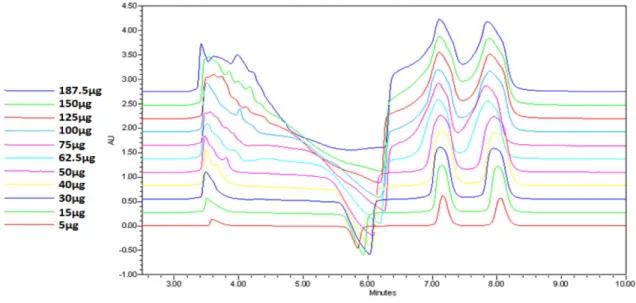
So, enantiomer separation of fluoxetine with different injection amounts was carried out. As shown in Fig. 3, the maximum amount for an injection was found to be 0.18 mg for semi- preparative separation using analytical Chiralpak IC column (250 mm × 4.6 mm, I.D., 5 µm). The semi-preparative separa- tion was conducted 67 times using Chiralpak IC with mobile Table 2. Enantiomer separation of fluoxetine on Chiralpak IC using the mobile phase containing acid, base and salt additives
Additives α k’
1R
sBase
10 mM n-butylamine 1.23 1.13 2.77 10 mM diethylamine 1.22 1.16 3.27 10 mM morpholine 1.20 1.17 2.06 10 mM piperidine 1.25 1.05 2.58 10 mM triethylamine 1.17 1.57 1.35 Acid 10 mM trifluoroacetic acid 1.00 2.00* -
10 mM AcOH 1.00 8.05* -
Salt
20 mM Et
2NH/ AcOH 1.00 2.65 - 10 mM Et
2NH/ AcOH 1.00 2.81 - 10 mM Et
2NH + 5 mM AcOH 1.00 2.70 - 10 mM Et
2NH + 1 mM AcOH 1.06 2.01 0.84
10 mM Et
2NH + 1 mM
trifluoroacetic acid 1.00 3.86 - Flow rate: 1 mL/min; Detection: UV 227 nm, Mobile phase: 3% 2- propanol/hexane (v/v) containing the above additive. *10% 2-propanol/
hexane (v/v).
Table 3. Resolution of enantiomers of fluoxetine on Chiralpak IC using the different mobile phase composition containing 10 mM diethylamine as an additive
Entry Mobile Phase α k’
1R
s1 3% ethyl acetate/hexane 1.19 1.93 3.01 2 3% methylene chloride/hexane 1.00 1.32 -
3 3% 2-propanol/hexane 1.23 1.16 3.27
4 3% tetrahydrofuran/hexane 1.22 1.81 2.83 Flow rate: 1 mL/min; Detection: UV 227 nm.
Table 4. Resolution of enantiomers of fluoxetine on Chiralpak IC using the mobile phase containing different concentration of diethylamine additive
Entry Concentration of diethylamine α k’
1R
s1 1 mM 1.19 1.49 2.52
2 5 mM 1.23 1.25 2.83
3 10 mM 1.23 1.17 2.87
4 15 mM 1.24 1.06 2.96
5 20 mM 1.25 1.04 2.99
6 25 mM 1.28 0.98 3.07
7 30 mM 1.34 1.30 3.67
8 35 mM 1.23 1.17 2.44
Flow rate: 1 mL/min; Detection: UV 227 nm, Mobile phase: 3% 2-
propanol/hexane (v/v) containing the above additive.
phase 3% 2-propanol in hexane containing 15 mM diethylamine.
After collection of each enantiomer fraction, 3.5 mg of (S)-flu- oxetine and 3.0 mg of (R)-fluoxetine were recovered, respect- ively. Using these fractions obtained by preparative separation, we performed the determination of chemical and optical purity of the first and second eluted (S)- and (R)-fluoxetine, and com- mercially available (R)-fluoxetine (Toronto Research Chemicals) on Chiralpak IC. The chemical and optical purity results on Chiralpak IC for the resolved analyte, (S)- and (R)-fluoxetine were 93.68%, 98.27% and 95.08%, 97.65%, respectively, as shown in Table 5. For the commercially available (R)-fluoxe- tine, the chemical and optical purity results were 92.39% and 99.17%, respectively. It was observed that the preparatively
resolved (R)- and (S)-fluoxetine gave higher chemical purity than the commercially available (R)-fluoxetine, although the latter commercially available (R)-fluoxetine gave a little higher optical purity than the former resolved fluoxetine enantiomers.
Fig. 4 illustrate chromatograms of (S)- and (R)-fluoxetine ob- tained after semi-preparative separation including the commer- cially available (R)-fluoxetine on analytical chiral column Chiralpak IC.
4. CONCLUSION
For the normal HPLC analysis, the liquid chromatographic enantiomer separation of fluoxetine was performed using sev- eral polysaccharide-derived covalently bonded and coated type CSPs. In general, the coated type CSPs showed the good enan- tiomer separation of fluoxetine compared to the covalently bonded type CSPs. However, Chiralpak IC is the best CSP for Fig. 2. Graph of chromatographic parameters versus additive con-
centration (mM) of diethylamine. See chromatographic conditions in Table 4.
Fig. 3. Overlaid chromatograms of enantiomer separation with loading amount of racemic-fluoxetine on analytical chiral column Chiralpak IC. Chromatographic condition: Flow rate: 1 mL/min; Detection: UV 227 nm, Mobile phase: 3% 2-propanol/hexane (v/v) containing 15 mM diethylamine.
Table 5. Comparative results of chemical and optical purity of (S)- and (R)-fluoxetine after preparative separation and commercially available (R)-fluoxetine on analytical chiral column Chiralpak IC
Entry Analyte Chemical
purity
Optical purity 1 (S)-1st eluted isomer 93.68±0.11% 98.27±0.20%
2 (R)-2nd eluted isomer 95.08±0.26% 97.65±0.04%
3 Commercially available
(R)-fluoxetine 92.39±0.40% 99.17±0.06%
Flow rate: 1mL/min; Detection: UV 227nm, Mobile phase: 3% 2-
propanol/hexane (v/v) containing 10mM diethylamine
fluoxetine enantioseparation from this study and the perform- ance of Chiralpak IC is superior to those of the other CSPs used in the previous reports [8-12]. Also, we performed semi- preparative separation of fluoxetine on analytical chiral column Chiralpak IC and obtained each enantiomer of fluoxetine. The chemical and optical purities of (S)- and (R)-fluoxetine after preparative separation were determined along with the com- mercially available (R)-fluoxetine. It was found that the prep- ared (R)- and (S)-fluoxetine analytes are chemically more and optically less pure than the commercially available (R)-fluoxe- tine. By investigating the obtained results of this study, we ex- pect that the present enantiomer separation of fluoxetine using the analytical and semi-preparative method will be useful for further research in pharmaceutical area.
Acknowledgements
This study was supported by research fund from Chosun Uni- versity, 2016.
REFERENCES