고성능 액체크로마토그래피의 다당유도체를 기초로 한 키랄 고정상에 서 이동상 첨가제가 키랄 아민의 광학분리에 미치는 영향
백만정1, 윤혜란2, 이원재*
Effect of Mobile Phase Additive on Enantiomer Resolution for Chiral Amines on Polysaccharide-derived Chiral Stationary Phases by High Performance Liquid Chromatography
Man-Jeong Paik1, Hye-Ran Yoon2, and Wonjae Lee*
접수: 2014년 4월 8일 / 게재승인: 2014년 6월 24일
© 2014 The Korean Society for Biotechnology and Bioengineering
Abstract: Chromatographic enantiomer resolution of chiral amines was performed on several covalently immobilized and coated chiral stationary phases (CSPs) based on polysaccha- ride derivatives under the mobile phase conditions containing base or acid or acid/base additive. The chromatographic parameters including separation factors and capacity factors were greatly influenced by the nature of the mobile phase containing base or acid or salt additive as well as the used CSPs. When 0.05% triethylamine/0.05% trifluoroacetic acid as an additive in the mobile phase was used on all CSPs in this study, the greatest enantiomer resolution was observed except for Chiralpak AD. Also, it was shown that the change of base additive into acid or salt in the mobile phase may directly affect chiral recognition mechanisms between the
chiral selectors and analytes occurring during enantiomer sep- aration, resulting in the change of elution orders.
Keywords: Chiral amine, Chiral stationary phase, Enantiomer resolution, Mobile phase additive
1. INTRODUNTION
키랄물질의 광학분리를 위해 다당류 셀룰로오스와 아밀로 오스 유도체를 키랄선택자 (chiral selector)로 이용하여 만들 어진 키랄 고정상 (chiral stationary phase)으로 많은 거울상 이성질체 화합물을 고성능 액체 크로마토그래피에서 성공 적으로 분리해 왔다 [1-3].키랄 고정상을 사용하여 키랄 car- boxylic acid를 광학분리하고자 할 때 일반적 분석방법으로 소량의 산을 이동상에 첨가제로 사용하였다 [4-6]. 같은 맥락 으로 키랄 아민을 키랄 고정상에서 광학분리하고자 할 경우, 일반적으로 소량의 아민을 첨가제로 이동상에 사용하여 효 과적으로 수행하여 왔다 [3]. 키랄 아민 화합물을 광학분리 하는데 있어서 소량의 아민을 이동상에 첨가하는 이유는 분 석물질인 아민과 고정상의 실리카와의 비특이성 상호작용 을 (non-specific interaction) 최소화하여 분석물질의 머무름 시간을 줄여주거나 또는 피크가 꼬리끌기 (tailing) 되어 용리 되는 것을 막아주는 효과를 가지고 있기 때문이다 [7].그런 데 몇 연구그룹에서 키랄 아민을 광학분리할 때 소량의 아민 조선대학교 약학대학 약학과
College of Pharmacy, Chosun University, Gwangju, 501-759, Korea Tel: +82-62-230-6376, Fax: +82-62-222-5414
e-mail: [email protected]
1순천대학교 약학대학 약학과
1College of Pharmacy, Sunchon National University, Sunchon 540- 950, Korea
2덕성여자대학교 약학대학 약학과
2College of Pharmacy, Duksung Women's University, Seoul 132-714, Korea
연구논문
을 염기 첨가제로 이동상에 가하여 분석하는 일반적인 분석 법대신에 산을 첨가제로 사용한 광학분리 결과를 보고하였 다 [7-10]. 그 연구에서, 키랄 아민 분석물질의 종류와 분석에 사용된 키랄 컬럼에 따라 이동상에 산 첨가제를 사용하는 것 이 광학분리에 가끔씩 효과적이라는 결과를 보여주었다. 그 러나 선행 연구에서 키랄 아민화합물을 광학분리할 때 염기 이동상 첨가제로 사용하는 경우와 비교해서 산을 이동상 첨 가제로 얻은 분석결과만을 단순보고하는 경우가 대부분이 었고 이에 대한 체계적인 연구가 진행되지 아니하였다. 그러 므로 본 연구에서는 다당유도체를 모체로 하는 대표적인 키 랄 컬럼인 Chiralpak IA, Chiralpak IB, Chiralpak IC, Chiral- pak AD, Chiralcel OD를 사용하여 산 또는 염기 등의 첨가제 를 각각 함유한 이동상에서 키랄 아민을 광학분리하는 크로 마토그래피 연구결과를 비교하여 이들 이동상 첨가제 사용 이 광학분리에 미치는 영향을 살펴보며 그 연구결과를 보고 하고자 한다 [2].
2. MATERIALS AND METHOD 2.1. 재료 및 시약
HPLC 용매로 사용하는 hexane, ethanol (EtOH)은 J. T Baker (Phillipsburg, NJ)로부터 구입하였고 trifluoroacetic acid (TFA), triethylamine 및 분석물질인 α-methylbenzylamine, 1-(1-naph- thyl)ethylamine, phenylglycine (PG) methyl ester, phenylala- nine (Phe) methyl ester, 2-phenylglycinol 모두 Aldrich (Milw- aukee, WI) 혹은 Sigma (St. Louis, Missouri) 회사로부터 구입 하였다.
2.2. 분석기기 및 방법
고성능 액체크로마토그래피 실험은 다음의 기기들로 구성 된 HPLC를 사용하여 상온에서 수행하였다. HPLC 구성 기 기로 Waters model 1525 binary pump, 20 µL loop를 가진 Rheodyne model 7125 주입기, a dual absorbance detector (Waters 2487 detector)를 사용하였다. HPLC용 키랄 컬럼으 로 Chiralpak IA, Chiralpak IB, Chiralpak IC, Chiralpak AD, Chiralcel OD (250 mm L × 4.6 mm I.D. 일본 Daicel Chemical 회사)을 사용하였다 [4-6,11]. Chiralpak IA, Chiralpak IB, Chi-
ralpak IC는 다당유도체를 키랄선택자로 사용하여 실리카에 코팅시켜 제조된 키랄 컬럼이고 Chiralpak AD, Chiralcel OD 는 다당유도체를 실리카에 코팅시켜 제조된 키랄 컬럼이다 [2,5,6]. HPLC 이동상 용매로는 5% ethanol/hexane (v/v)에 0.1% Et3N, 0.05% Et3N/0.05% TFA, 0.1% TFA를 각각 첨가제 로 넣어 사용하였고 유속은 1 mL/min, UV 254 nm에서 검출 하여 분석하였다. 시료농도는 10 mg/mL이고 주입 부피를 (injection volume) 1µL로 실험하였다.
3. RESULTS AND DISCUSSION
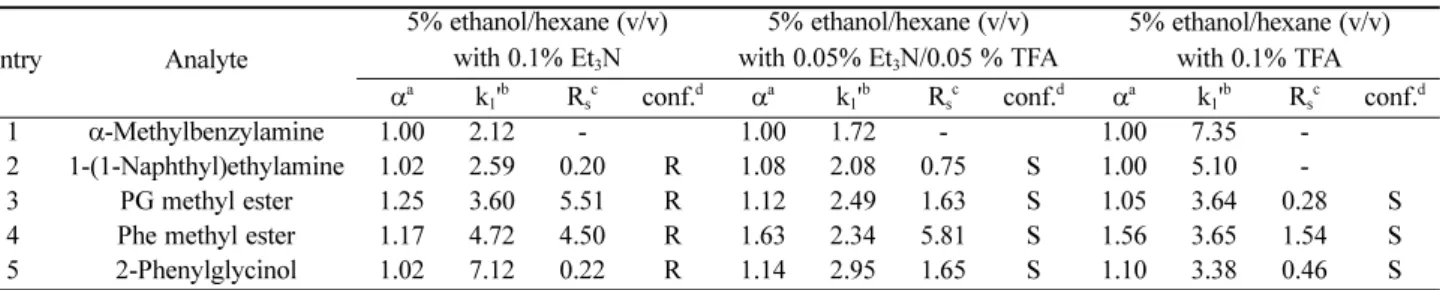
Table 1~5에서 다당유도체를 키랄선택자로 이용하는 5개의 키랄컬럼에서 키랄 아민의 광학분리를 위해 이동상에 산, 염 기, 산/염기 등을 각각 첨가하여 얻은 연구결과를 보여주고 있다. 전체적인 결과에서 보여주는 것처럼 광학분리의 선택 성과 머무름시간은 산 또는 염기 등의 첨가제가 포함된 이동 상의 성질에 크게 영향을 받는 것으로 나타나는데 이러한 실 험결과는 사용하는 키랄 컬럼의 종류에 따라 매우 다르게 나 타났다. 특히 사용한 컬럼중에서, Chiralpak IA와 Chiralpak AD는 동일한 amylose tris (3,5-dimethylphenylcarbamate) 키 랄 선택자를 실리카에 각각 공유결합하거나 코팅시켜 제조 된 컬럼이며, 마찬가지로 Chiralpak IB와 Chiralcel OD는 동 일한 cellulose tris (3,5-dimethylphenylcarbamate) 키랄 선택자 를 실리카에 각각 공유결합하거나 코팅시켜 제조된 컬럼이 다 [2,5,6]. 이동상 첨가제로 0.1% Et3N 또는 0.05% Et3N/
0.05% TFA를 사용할 경우에는 Table 1의 키랄 선택자인 amy- lose 유도체가 공유결합된 Chiralpak IA에서 Table 4의 키랄 선택자가 코팅된 Chiralpak AD보다 더 좋은 광학분리 결과 를 보이나, 0.1% TFA 첨가제를 사용할 때에는 Table 4의 Chi- ralpak AD가 더 좋은 광학분리를 보여주었다. 반면에 Table 5 의 cellulose 유도체가 코팅된 Chiralcel OD에서는 이동상 첨 가제 종류에 관계없이 Table 2의 cellulose 유도체가 공유결 합된 Chiralpak IB 보다 분명하게 더 좋은 광학분리 결과를 보여주었다.
Table 1, 4의 Chiralpak IA와 Chiralpak AD 그리고 Table 2, 5 의 Chiralpak IB와 Chiralcel OD는 동일한 키랄 선택자를 각각 공유결합하거나 코팅시켜 제조한 컬럼이기 때문에 제조과정
Table 1. Separation of the enantiomers of chiral amines using the mobile phase with additive on Chiralpak IA
Entry Analyte
5% ethanol/hexane (v/v) with 0.1% Et3N
5% ethanol/hexane (v/v) with 0.05% Et3N/0.05 % TFA
5% ethanol/hexane (v/v) with 0.1% TFA αa k1'b Rsc conf.d αa k1'b Rsc conf.d αa k1'b Rsc conf.d
1 α-Methylbenzylamine 1.00 2.12 - 1.00 1.72 - 1.00 7.35 -
2 1-(1-Naphthyl)ethylamine 1.02 2.59 0.20 R 1.08 2.08 0.75 S 1.00 5.10 -
3 PG methyl ester 1.25 3.60 5.51 R 1.12 2.49 1.63 S 1.05 3.64 0.28 S
4 Phe methyl ester 1.17 4.72 4.50 R 1.63 2.34 5.81 S 1.56 3.65 1.54 S
5 2-Phenylglycinol 1.02 7.12 0.22 R 1.14 2.95 1.65 S 1.10 3.38 0.46 S
Chromatographic conditions: Flow rate=1 mL/min; Detection UV 254 nm;
aSeparation factor.
bCapacity factor of the first eluted enantiomer.
c
Resolution factor.
dThe absolute configuration of the second eluted enantiomer.
에서 키랄선택자로 사용된 키랄선택자의 키랄성을 얼마나 유지하고 있느냐가 광학분리에 영향을 줄 수 있다. 키랄 선택 자를 공유결합하거나 코팅시킨 것에 따른 차이가 광학분리 에 약간의 영향을 줄 수 있다고 하더라도, 키랄 선택자와 분 석물질간의 키랄인지 매커니즘 (chiral recognition mechani- sm)에서는 전체적으로 유사할 것이라 예상한다 [5,6]. 실제,
동일한 키랄 선택자가 사용되었다고 볼 수 있는 Table 1, 4의 Chiralpak IA와 Chiralpak AD 그리고 Table 2, 5의 Chiralpak IB와 Chiralcel OD에서 동일한 첨가제의 이동상을 사용하였 을 경우에 광학분리되어 용출된 용리순서 (elution order)가 동일하게 나타나는 것이 이에 대한 하나의 증거라 말할 수 있 다. 한 예로, 0.05% Et3N/0.05% TFA를 첨가제로 얻은 분석결 Table 2. Separation of the enantiomers of chiral amines using the mobile phase with additive on Chiralpak IB
Entry Analyte
5% ethanol/hexane (v/v) with 0.1% Et3N
5% ethanol/hexane (v/v) with 0.05% Et3N/0.05 % TFA
5% ethanol/hexane (v/v) with 0.1% TFA αa k1'b Rsc conf.d αa k1'b Rsc conf.d αa k1'b Rsc conf.d
1 α-Methylbenzylamine 1.00 3.54 - 1.00 3.10 - 1.00 6.27 -
2 1-(1-Naphthyl)ethylamine 1.08 3.97 0.17 R 1.87 4.10 9.77 R 1.42 7.98 2.55 R
3 PG methyl ester 1.06 2.43 0.78 R 1.06 4.29 0.87 R 1.05 7.83 0.37 R
4 Phe methyl ester 1.00 1.93 - 1.00 3.46 - 1.00 6.68 -
5 2-Phenylglycinol 1.00 7.63 - 1.00 4.03 - 1.00 9.87 -
Chromatographic conditions: Flow rate=1 mL/min; Detection UV 254 nm;
aSeparation factor.
bCapacity factor of the first eluted enantiomer.
c
Resolution factor.
dThe absolute configuration of the second eluted enantiomer.
Table 3. Separation of the enantiomers of chiral amines using the mobile phase with additive on Chiralpak IC
Entry Analyte
5% ethanol/hexane (v/v) with 0.1% Et3N
5% ethanol/hexane (v/v) with 0.05% Et3N/0.05 % TFA
5% ethanol/hexane (v/v) with 0.1% TFA αa k1'b Rsc conf.d αa k1'b Rsc conf.d αa k1'b Rsc conf.d
1 α-Methylbenzylamine 1.11 3.15 1.41 R 1.19 4.44 3.04 R 1.19 2.09 1.25 R
2 1-(1-Naphthyl)ethylamine 1.39 3.17 4.99 R 1.89 4.81 9.91 R 1.70 3.05 2.90 R
3 PG methyl ester 1.00 5.48 - 1.48 10.26 6.91 R - NEe -
4 Phe methyl ester 1.07 4.89 1.60 R 2.46 7.34 9.51 R - NEe -
5 2-Phenylglycinol 1.07 8.43 1.00 R 1.59 8.52 6.53 R 1.40 3.65 6.14 R
Chromatographic conditions: Flow rate=1 mL/min; Detection UV 254 nm;
aSeparation factor.
bCapacity factor of the first eluted enantiomer.
c
Resolution factor.
dThe absolute configuration of the second eluted enantiomer.
eNo elution for 1 hr.
Table 4. Separation of the enantiomers of chiral amines using the mobile phase with additive on Chiralpak AD
Entry Analyte
5% ethanol/hexane (v/v) with 0.1% Et3N
5% ethanol/hexane (v/v) with 0.05% Et3N/0.05 % TFA
5% ethanol/hexane (v/v) with 0.1% TFA αa k1'b Rsc conf.d αa k1'b Rsc conf.d αa k1'b Rsc conf.d
1 α-Methylbenzylamine 1.00 1.80 - 1.00 1.25 - 1.12 4.43 0.68 S
2 1-(1-Naphthyl)ethylamine 1.00 2.40 - 1.05 1.65 0.53 S 1.29 8.38 3.12 S
3 PG methyl ester 1.18 3.00 1.62 R 1.07 2.10 0.38 S 1.05 6.53 0.30 S
4 Phe methyl ester 1.23 3.73 2.52 R 1.62 1.88 4.53 S 1.77 4.30 3.16 S
5 2-Phenylglycinol 1.00 6.64 - 1.10 2.18 1.05 S 1.13 12.41 0.68 S
Chromatographic conditions: Flow rate=1 mL/min; Detection UV 254 nm;
aSeparation factor.
bCapacity factor of the first eluted enantiomer.
c
Resolution factor.
dThe absolute configuration of the second eluted enantiomer.
Table 5. Separation of the enantiomers of chiral amines using the mobile phase with additive on Chiracel OD
Entry Analyte
5% ethanol/hexane (v/v) with 0.1% Et3N
5% ethanol/hexane (v/v) with 0.05% Et3N/0.05% TFA
5% ethanol/hexane (v/v) with 0.1% TFA αa k1'b Rsc conf.d αa k1'b Rsc conf.d αa k1'b Rsc conf.d
1 α-Methylbenzylamine 1.00 4.18 - 1.08 2.39 0.57 S 1.07 2.98 0.19 S
2 1-(1-Naphthyl)ethylamine 1.29 4.22 0.88 R 3.05 6.05 11.48 R 2.52 5.86 3.52 R
3 PG methyl ester 1.20 3.57 1.47 R 1.21 4.14 1.80 R 1.28 4.11 1.67 R
4 Phe methyl ester 1.00 2.63 - 1.12 2.81 0.92 S 1.11 3.40 0.73 S
5 2-Phenylglycinol - NEe - 1.07 3.40 0.51 R 1.06 4.34 0.13 R
Chromatographic conditions: Flow rate=1 mL/min; Detection UV 254 nm;
aSeparation factor.
bCapacity factor of the first eluted enantiomer.
c
Resolution factor.
dThe absolute configuration of the second eluted enantiomer.
eNo elution for 1 hr.
과에서 Table 1의 Chiralpak IA와 Table 4의 Chiralpak AD에서 광학분리된 4개의 분석물질의 S-isomer가 모두 두번째로 용 출되나, Table 2의 Chiralpak IB와 Table 5의 Chiralcel OD에서 는 광학분리된 2개의 분석물질의 (entry 2와 3) R-isomer가 모 두 두번째로 용출되어 나타난다.
그러나 이러한 결과보다도, 앞에서도 언급한 바와 같이 동 일 키랄 컬럼상에서 이동상에 산 또는 염기, 산/염기 등의 첨 가제가 각각 다르게 사용되었을 때 키랄 아민의 광학분리가 전체적으로 상당히 달라지고 있음을 실험결과에서 보여주고 있다 [8]. 이러한 이동상의 첨가제가 광학분리에 미치는 효과 는 광학분리된 정도와 머무름 정도 그리고 광학분리된 물질 의 용출된 용리순서를 통해서 그러한 현상이 발견된다. 일반 적으로 Table 1, 2, 4에서의 광학분리에서는 산 첨가제를 사 용할 때가 염기 첨가제를 사용하는 것에 비해 용량인자 값이 상당히 증가하게 되지만, Table 3의 광학분리에서는 첨가제 로 0.05% Et3N/0.05% TFA 사용했을 때가 산 또는 염기 첨가 제를 사용하는 것에 비해 용량인자 값이 가장 크게 나타났으 며, Table 1과 4에서의 광학분리에서는 첨가제로 0.05%
Et3N/0.05% TFA를 사용했을 때가 용량인자 값이 가장 작게 나타났다. 또한 Table 4에서 약간 예외적인 부분이 나타나긴 하지만, 전체적으로 Table 1~3과 Table 5에서 이동상 첨가제 로 0.05% Et3N/0.05% TFA를 사용하는 경우가 0.1% Et3N 또 는 0.1% TFA를 사용하는 경우보다 더 좋은 광학분리를 나타 내었다. 특히 여러 키랄 컬럼 중 Table 3의 Chiralpak IC에서 0.05% Et3N/0.05% TFA를 첨가제로 얻은 광학분리 결과가 전 반적으로 가장 좋게 나타났고 분석물질에서 모두 기준분리 를 보여주었다. 대표적인 예로, Chiralpak IC에서 phenylgly- cine methyl ester를 광학분리할 때, 이동상 첨가제로 0.1%
Et3N을 사용하는 경우에 전혀 분리되지 않았고, 0.1% TFA를 사용하는 경우에도 1시간 동안에 전혀 용리되지 않았다 (Table 3, entry 3). 그런데 이동상 첨가제로 0.05% Et3N/0.05% TFA 를 사용하였을 때는 매우 좋은 광학분리결과를 보인 것처럼
이동상의 산, 염기, 산/염기 첨가제 종류의 변화만 주어도 광 학분리 결과가 매우 크게 달라지는 현상을 발견할 수 있었다.
또한 이렇게 이동상의 첨가제가 광학분리에 전반적으로 미 치는 영향은 키랄 선택자와 분석물질간의 키랄인지 매커니 즘에 직접적인 영향을 주기 때문이고 이는 광학분리의 용리 순서에도 매우 큰 영향을 주는 것으로 관찰된다. 예를 들어, Table 2, 3, 5에서 사용된 컬럼들의 경우 이동상의 첨가제 변 화에 따른 용리순서 변화는 없는 것으로 나타나지만, Table 1 의 Chiralpak IA와 Table 4의 Chiralpak AD 경우에는 첨가제 로 0.1% Et3N을 사용한 용리순서가 첨가제로 0.05% Et3N/
0.05% TFA 또는 0.1% TFA를 사용한 용리순서와는 정반대 로 나타난다. 그래서 전자의 경우 광학분리된 분석물질의 R- isomer가 모두 두 번째로 용출되어 나타나지만 후자의 경우 에는 S-isomer가 모두 두 번째로 용출되어 나타난다. 이는 전 자에서의 키랄인지 매커니즘이 후자의 경우와 다르다는 것 을 의미하고 있다. 이동상에 0.1% TFA나 0.05% Et3N/0.05%
TFA의 첨가제를 사용하게 될 경우, 분석물질인 키랄 아민은 키랄 ammonium salt를 형성한 후 키랄 선택자와의 키랄인지 를 통한 광학분리가 진행될 것이라 예상된다 [여기서 0.05%
TFA (6.7 mM)와 0.05% triethylamine (3.6 mM)를 동시에 사 용할 경우, 화학량적인 (stoichiometric) 관점에서 acidic한 조 건을 유지하게 된다]. 그에 비해 이동상에 0.1% Et3N의 첨가 제를 사용하게 될 경우, 이동상이 염기성을 띄기 때문에 분석 물질인 키랄 free amine 자체가 키랄 선택자와의 키랄인지를 할 것이라 보아진다. 그러한 광학분리 용리순서의 역전현상 이 산성을 띠는 이동상의 경우에 Chiralpak IA와 Chiralpak AD에서만 일어난다는 것은 이들 컬럼에서는 키랄 선택자와 의 키랄 ammonium salt와의 hydrogen bonding으로 인한 inter- action이 존재하기 때문이라 추정할 수 있다.
이와는 달리, Table 2, 5의 Chiralpak IB와 Chiralcel OD 뿐만 아니라 Table 3의 Chiralpak IC에서는 앞에서 기술했던 Chi- ralpak IA와 Chiralpak AD에서 일어나는 첨가제의 산, 염기,
Fig. 1. Typical chromatograms showing additive effect in the mobile phase on enantiomer resolution of 1-(1-naphthyl)ethylamine on Chiralcel OD using (a) 15% ethanol/hexane (v/v) with 0.1% Et3N, (b) 0.05% Et3N/0.05% TFA and (c) 0.1% TFA, respectively; Flow rate=
1.0 mL/min; Detection UV 254 nm; Injection amount 10µg.
염기에 따라 분석물질의 용리순서의 역전현상이 일어나지 않는다. 이는 첨가제로 이동상이 염기성이 아닌 산성성질을 띄어 아민 분석물질이 키랄 ammonium salt를 형성하더라도 키랄 선택자와 ammonium salt 사이의 키랄인지에서 hydro- gen bonding interaction이 존재하지 않기 때문에 위와 같은 용리순서의 역전현상이 나타나지 않는 것이라 보인다. Fig. 1 는 Chiralcel OD을 사용하여 1-(1-naphthyl)ethylamine을 광학 분리할 때 염기, 산 또는 산/염기 각각 첨가제를 사용한 이동 상에서의 전형적인 크로마토그램을 비교하며 보여주고 있 다. Chiralcel OD를 사용할 때 광학분리가 이동상의 첨가제에 따라 매우 큰 영향을 받게 되는데 0.05% Et3N/0.05% TFA 첨 가제를 가했을 때 가장 좋은 광학분리를 보여주고 있으며 0.1% Et3N 염기 첨가제를 가했을 때 가장 좋지 않는 광학분리 를 보여주고 있다.
4. CONCLUSION
고성능 액체크로마토그래피에서 다당유도체를 기초로 하는 키랄 고정상들을 사용하여 산 또는 염기 등의 첨가제가 포함 된 각각의 이동상에서 키랄 아민의 광학분리를 수행하였다.
산 또는 염기 등의 첨가제가 각각 포함된 이동상뿐만 아니라 사용한 키랄 고정상에 따라 광학분리된 선택성과 분리인자, 용량인자가 크게 영향을 받았다. Chiralpak AD를 제외한 모 든 컬럼에서 이동상에 0.05% Et3N/0.05% TFA를 첨가제로 사용했을 경우가 0.1% Et3N 또는 0.1% TFA를 첨가제로 사 용했을 경우보다도 훨씬 좋은 광학분리를 보였다. 이동상의 산, 염기 등의 첨가제의 변화만으로도 광학분리 결과에 큰 영향을 주면서, 때로는 용리순서에도 상당히 큰 영향을 주는 것을 볼 때 이러한 첨가제 변화는 광학분리 중에 일어나는 키랄인지 매커니즘의 상호작용에 직접적으로 연계되어 있 음을 보여주고 있는 것이라 보아진다.
REFERENCES
1. G. Subramanian, (Ed.) (2001) Chiral Separation Techniques: A practical approach. 2nd revised ed., VCH, Weinheim.
2. W. Lee (2009) The application of chiral HPLC columns for enanti- omer separation of chiral drugs. Yakhak Hoeji 53: 60-68.
3. Application Guide for Chiral HPLC selection, 4th ed., (2008) Dai- cel Chemical Industries, Ltd.
4. Li, Y. H. and W. Lee (2005) Liquid chromatographic enantiomer resolution of N-fluorenylmethoxycarbonyl α-amino acids and their ester derivatives on polysaccharide-derived chiral stationary phas- es. J. Sep. Sci. 30: 2057-2060.
5. Jin, J. Y., W. Lee, and C. S. Baek (2008) Enantiomer resolution of non-steroidal anti-inflammatory drugs on chiral stationary phases derived from polysaccharide derivatives. Chin. J. Anal. Chem. 36:
1207-1211.
6. Jin, J. Y., S. K, Bae, and W. Lee (2009) Comparative studies bet- ween covalently immobilized and coated chiral stationary phases based on polysaccharide derivatives for enantiomer separation of N-protected α-amino acids and their ester derivatives. Chirality 21: 871-877.
7. Strigham, R. W. and Y. K. Ye (2006) Chiral separation of amines by high-performance liquid chromatography using polysaccharide stationary phases and acidic additives. J. Chromatogr. A 1101: 86- 93.
8. Ye, Y. K. and R. W. Strigham (2006) The effect of acidic and basic additives on the enantioseparation of basic drugs using polysac- charide-based chiarl stationary phases. Chirality 18: 519-530.
9. Tang, Y., W. L. Zielinski, and H. M. Bigott (1998) Separation of ni- cotine and nornicotine enantiomers via normal phase HPLC on de- rivatized cellulose chiarl stationary phases. Chirality 10: 364-369.
10. S. Caccamese, S. S. Bianca, and G. T. Carter (2007) Direct high- performance liquid chromatographic separation of the enantiomers of an aromatic amine and four aminoalchols using polysaccharide chiral stationary phases and acidic additive. Chirality 21: 647-653.
11. Xu, W. J., J. Y. Jin, and W. Lee (2011) Enantiomer separation of chiral amino alcohols as 9-anthraldimine derivatives on coated and covalently bonded chiral stationary phases based on polysaccha- ride derivatives by high performance liquid chromatography. Kor.
Soc. Biotech. Bioeng. J. 26: 323-327.