DOI 10.17480/psk.2018.62.2.71
Liquid chromatographic separation of the enantiomers of N-fluorenylmethoxycarbonyl α-amino acids on a covalently bonded type polysaccharide-derived chiral
stationary phase under fluorescence detection
Suraj Adhikari*,†, Jing Yu Jin**,†, Hyungbum Kim***, and Wonjae Lee*,***,#
*College of Pharmacy, Chosun University, Gwangju, Korea
**ZheJiang Apeloa JiaYuan Pharmaceutical Co., Ltd, ZheJiang, China
***Department of Food and Drug, Chosun University Graduate School, Gwangju, Korea (Received February 23, 2018; Revised March 30, 2018; Accepted April 2, 2018)
Abstract — The liquid chromatographic enantiomer separation of N-fluorenylmethoxycarbonyl (FMOC) α-amino acids was performed using a covalently immobilized CSP (Chiralpak IB) with cellulose tris(3,5-dimethylphenylcarbamate) as a chiral selector under fluorescence detection. Several mobile phases with acid additives were used to show the effect of the reversed mobile phase on the chromatographic parameters of the separation and resolution factors. In this study, we observed that the enantioseparation of investigated FMOC α-amino acids on Chiralpak IB using 90% MeOH/water with 10 mM methanesulfonic acid as an additive in the reversed mobile phase (α = 1.18 - 2.31; Rs = 1.20 - 9.08) was significantly greater than that using other mobile phases including the conventional normal mobile condition. Owing to higher sensitivity and selectivity in fluorescence detection than in UV detection, this analytical method using the reversed phase mode is expected to enlarge their application of enantiomer resolution.
Keywords amino acid, chiral stationary phase, enantiomer separation, reversed phase
Chiral discrimination is frequently observed in the biological systems.1,2) The search for chirotechnology which can discrimi- nate specific enantiomers has been of great interest for the development of chiral drugs.2,3) Amino acids have been widely used as an important chiral building block of peptides and chi- ral drugs in pharmaceutical and biochemical fields.2,4) Among the several N-protecting groups for α-amino acids, fluorenyl- methoxycarbonyl (FMOC) group is one of the most essential protecting group for α-amino acids which has advantages with mild synthetic process for increasing solubility or high purifica- tion of final product in solid-phase synthesis.5-7) Also, derivat- ization of α-amino acids with FMOC group as a good approach of enantiomer separation provides high sensitivity and selectiv- ity during separation in fluorescence detection. In our previ-
ous reports, polysaccharide-derived chiral stationary phases (CSPs) were used for the enantiomer separation and purifica- tion of N-protected FMOC α-amino acids and their ester deriv- atives by normal HPLC under UV detection.8,9) However, there are only a few reports of enantiomer separation of N-pro- tected FMOC α-amino acids derivatives by reversed phase HPLC.9,10) In fact, most of the studies using polysaccharide- derived CSPs were carried out in normal mode under UV detection. Polysaccharide-derived CSPs can also be used suc- cessfully for the separation of enantiomers in reverse phase conditions using polar solvents.9-11) An immobilized CSP, Chi- ralpak IB, having cellulose tris(3,5-dimethylphenylcarbamate) as a chiral selector has never been used for the enantiomeric separation of N-FMOC α-amino acids using fluorescence detec- tion under reversed phase conditions. In this study, we applied Chiralpak IB for the liquid chromatographic enantiomeric sepa- ration of N-FMOC α-amino acids using fluorescence detection under reversed phase conditions with different solvent sys- tems and acid additives. We also compare the results obtained from normal phase HPLC and reversed phase HPLC with effects of acid additives.
#Corresponding Author Wonjae Lee
College of Pharmacy, Chosun University, Gwangju, Korea Tel.: 062-230-6376 Fax.: 062-222-5414
E-mail: [email protected]
†Suraj Adhikari and Jing Yu Jin have equally contributed on this work.
Short Report종설
Experimental methods
Apparatus
Liquid chromatographic analysis was performed using an HPLC system with HP series 1100 HPLC system with a micro-vacuum degasser, a G1310A isocratic pump, an auto- matic sample injector, and an HP1046A programmed fluores- cence detector. The enantiomeric separation of N-FMOC α- amino acids were carried out at ambient temperature with fluo- rescence detection (Ex: 267 nm, Em: 312 nm) at a flow-rate of 0.5 mL/min. The covalently bonded-type, Chiralpak IB (250 mm× 4.6 mm, i.d., 5 μm), having chiral selector of cellu- lose tris(3,5-dimethylphenylcarbamate) was purchased from Daicel company (Tokyo, Japan).
Chemicals
HPLC-grade acetonitrile (ACN), methanol (MeOH), 2-propa- nol and hexane were purchased from Burdick & Jackson (Mor- ristown, NJ). Methanesulfonic acid, ethanesulfonic acid, trifluoroacetic acid, formic acid, acetic acid and all analytes for investigation were obtained from Aldrich (Milwaukee, WI) or Sigma (St. Louis, MO). The derivatizing reagent, fluorenylme- thoxycarbonyl (FMOC) chloride was procured from Fluka com- pany (Switzerland). The racemic and L-N-FMOC protected α- amino acids were prepared according to conventional meth- ods.12)
Results and Discussions
The chromatographic enantiomeric separation of α-amino acid as N-FMOC α-amino acid derivatives was performed on a covalently bonded immobilized polysaccharide-derived CSP,
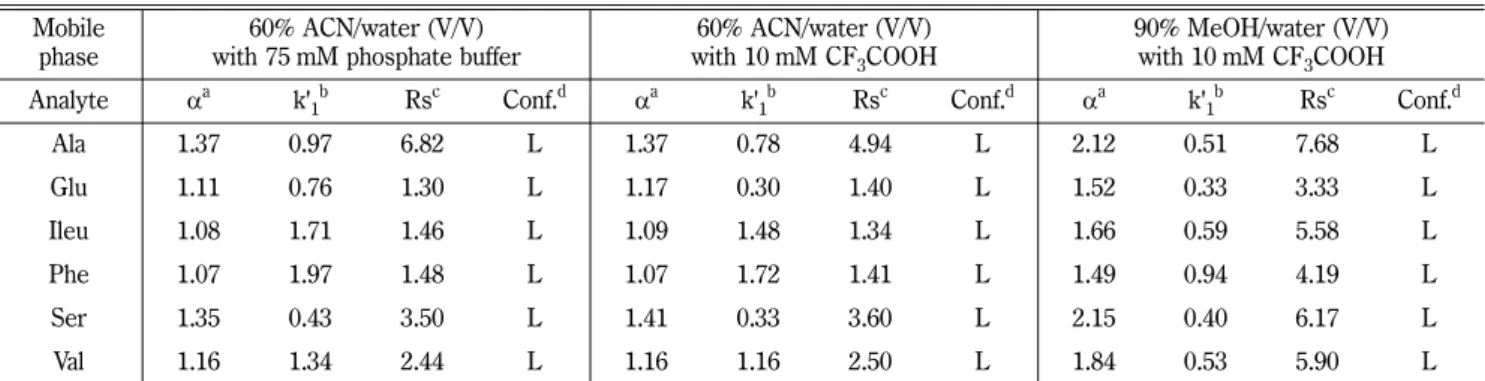
Chiralpak IB, using reversed phase HPLC under fluorescence detection. The covalently bonded immobilized CSPs offer sol- vent versatility as well as their high column stability. Table I shows the effect of different mobile phases with acid additives for the enantiomeric separation of N-FMOC α-amino acids.
Solvent selection is one of the most important parameters in reversed phase HPLC separation due to the effect of selectiv- ity and retention time. Acetonitrile (ACN) is often the solvent of choice due to its ability to solubilize many small molecules and its low viscosity which allows for faster chromatography due to the increased rate of mass transfer.13) For enantiomer separation of chiral acids, therefore, aqueous ACN solution with acidic additive has been generally used under reversed phase conditions. Previously, in our group, the reverse chro- matographic enantiomeric separation of N-FMOC α-amino acids using 40% ACN/water with acidic phosphate buffer solu- tion on coated-type polysaccharide-derived CSPs was per- formed with good enantioseparation.10) In this study, different mobile phases with 60% ACN/water with 75 mM phosphate buffer and 10 mM CF3COOH were used in fluorescence detec- tion, respectively. And these two chromatographic results were compared with those obtained using 90% MeOH/water solu- tion with 10 mM CF3COOH as acid additive, as shown in Table I.
All the six analytes as N-FMOC α-amino acids were enantiosepa- rated with good resolution and selection under two different solvent systems. In Table I, 60% ACN/water system having either 75 mM phosphate buffer or 10 mM CF3COOH as an additive showed the similar separation pattern with all the ana- lytes and their enantiomers were well resolved with good baseline separation. Among three reversed mobile conditions, 90% MeOH/water (V/V) with 10 mM CF3COOH showed the best enantioseparation. It is notable that separation and resolu-
Table I − Effect of different mobile phase systems on the enantiomer separation of N-FMOC α-amino acids in reversed phase HPLC Mobile
phase
60% ACN/water (V/V) with 75 mM phosphate buffer
60% ACN/water (V/V) with 10 mM CF3COOH
90% MeOH/water (V/V) with 10 mM CF3COOH Analyte αa k'1b Rsc Conf.d αa k'1b Rsc Conf.d αa k'1b Rsc Conf.d
Ala 1.37 0.97 6.82 L 1.37 0.78 4.94 L 2.12 0.51 7.68 L
Glu 1.11 0.76 1.30 L 1.17 0.30 1.40 L 1.52 0.33 3.33 L
Ileu 1.08 1.71 1.46 L 1.09 1.48 1.34 L 1.66 0.59 5.58 L
Phe 1.07 1.97 1.48 L 1.07 1.72 1.41 L 1.49 0.94 4.19 L
Ser 1.35 0.43 3.50 L 1.41 0.33 3.60 L 2.15 0.40 6.17 L
Val 1.16 1.34 2.44 L 1.16 1.16 2.50 L 1.84 0.53 5.90 L
Flow rate = 0.5 mL/min; Fluorescence detection (Ex: 267 nm, Em: 312 nm); aSeparation factor. bCapacity factor of the first eluted enantiomer. cResolution factor. dThe absolute configuration of the second eluted enantiomer.
tion factors shown for N-FMOC α-amino acids on Chiralpak IB using MeOH/water systems in Table I were significantly greater than those for the corresponding analytes under ACN/
water systems. As a typical example, FMOC alanine analyte (entry 1) in 90% MeOH/water with CF3COOH showed enhanced separation and resolution factors (α = 2.12, Rs = 7.68), compared with those obtained in 60% ACN/water with CF3COOH (α = 1.37, Rs = 4.94). The capacity factors of 90%
MeOH/water system with CF3COOH acid were pretty lower than those of ACN/water system with acid additives. It is interesting that the chromatographic results on the same 60%
ACN/water mobile phase system with two different additives showed almost similar separation factors in most of cases which implies that enantioselection were less influenced irre- spective of the different additives used. The degree of enanti- oselectivity among these mobile phase systems was as follows:
MeOH/water with 10 mM CF3COOH > ACN/water with 10 mM CF3COOH ~ ACN/water with 75 mM phosphate buf- fer. It is believed that the different solvochromatic properties, such as hydrogen bonding and dipole moment may be the rea- son for different enantiomer separation pattern between these different solvent systems in Table I.13)
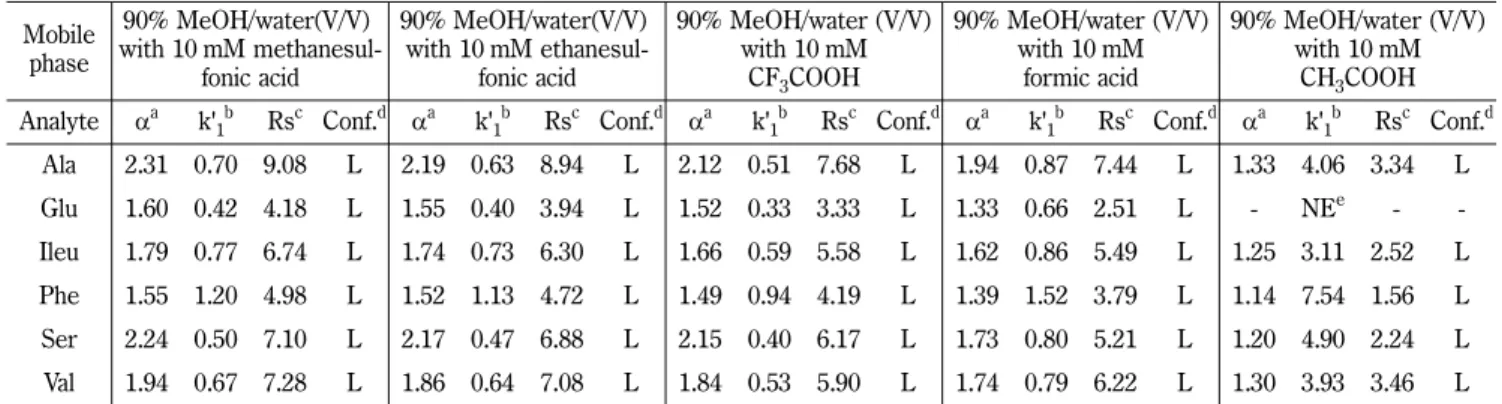
Table II shows the effect of the different acid additives using 90% MeOH/water as mobile phases on the enantiomeric sepa- ration of N-FMOC α-amino acids. Similarly, it was reported that several acidic additives were used to modulate selectivity and retention for enantiomeric separation of NSAIDs.11) The capacity factors observed in this study were greatly influenced by different degree of acidity of the used additives in 90%
MeOH/water system.11,14) Amongst them, 90% MeOH/water with 10 mM methanesulfonic acid (strongest acid additive)
showed the greatest resolution and separation and followed according to the degree of acidity of the used additives. The order of enantiomeric separation with 10 mM different acid addi- tives using 90% MeOH/water as mobile phases was as follows:
methanesulfonic acid > ethanesulfonic acid > CF3COOH >
HCOOH > CH3COOH. The strongest acid additives methane- sulfonic acid (pKa = −1.89) and ethanesulfonic acid (pKa = − 1.61) showed similar selectivity but stronger methanesulfonic acid showed enhanced retention and resolution of the investi- gated analytes.11) The weakest acid additive (acetic acid) showed the worst separation as one (entry 2, glutamine) of the investigated analytes did not show any separation. Also, the retention times for the elution of analytes increased for the weaker acid additives (formic acid and acetic acid) showing the less selectivity for separating the enantiomers as capacity fac- tor increases which is presented in Table II. The reason of these exceptionally longer retention times with the weaker acid additives (formic acid and acetic acid) is not clear. It should be mentioned that the elution orders of all the investi- gated N-FMOC α-amino acid derivatives were identical as L- enantiomer was preferentially retained regardless of the used acid additives. Overall chromatographic enantiomer separation results using different acid additives show that methanesulfonic acid could be applied as a useful acid additive for the better enantiomeric resolution of chiral acids than CF3COOH in 90%
MeOH/water reversed phase conditions. Therefore, we used 90% MeOH/water with methanesulfonic acid or CF3COOH as mobile phases for the separation of enantiomers of various FMOC α-amino acids.
Table III shows the comparative enantioseparation results on Chiralpak IB under reversed and normal phase HPLC along
Table II − Acid additives effect on the separation of enantiomers of N-FMOC α-amino acids in reversed phase HPLC
Mobile phase
90% MeOH/water(V/V) with 10 mM methanesul-
fonic acid
90% MeOH/water(V/V) with 10 mM ethanesul-
fonic acid
90% MeOH/water (V/V) with 10 mM
CF3COOH
90% MeOH/water (V/V) with 10 mM
formic acid
90% MeOH/water (V/V) with 10 mM
CH3COOH Analyte αa k'1b Rsc Conf.d αa k'1b Rsc Conf.d αa k'1b Rsc Conf.d αa k'1b Rsc Conf.d αa k'1b Rsc Conf.d
Ala 2.31 0.70 9.08 L 2.19 0.63 8.94 L 2.12 0.51 7.68 L 1.94 0.87 7.44 L 1.33 4.06 3.34 L Glu 1.60 0.42 4.18 L 1.55 0.40 3.94 L 1.52 0.33 3.33 L 1.33 0.66 2.51 L - NEe - - Ileu 1.79 0.77 6.74 L 1.74 0.73 6.30 L 1.66 0.59 5.58 L 1.62 0.86 5.49 L 1.25 3.11 2.52 L Phe 1.55 1.20 4.98 L 1.52 1.13 4.72 L 1.49 0.94 4.19 L 1.39 1.52 3.79 L 1.14 7.54 1.56 L Ser 2.24 0.50 7.10 L 2.17 0.47 6.88 L 2.15 0.40 6.17 L 1.73 0.80 5.21 L 1.20 4.90 2.24 L Val 1.94 0.67 7.28 L 1.86 0.64 7.08 L 1.84 0.53 5.90 L 1.74 0.79 6.22 L 1.30 3.93 3.46 L Flow rate = 0.5 mL/min; Fluorescence detection (Ex: 267 nm, Em: 312 nm); aSeparation factor. bCapacity factor of the first eluted enantiomer. cResolution factor. dThe absolute configuration of the second eluted enantiomer. e No elution during 90 min.
with the same acid additive of CF3COOH. Previously, it was observed that enantioseparation on the same CSP in normal phase HPLC is generally greater than in reversed phase HPLC.9,11) Contrary to previous reports, surprisingly, we observed that the enantiomeric separation of all N-FMOC α- amino acids obtained by reversed phase HPLC on Chiralpak IB showed much better resolution and separation factors than by normal phase HPLC, except for one analyte of phenylglycine.
Another good advantage in this reversed phase separation on Chiralpak IB was that the analytes were separated in dramati- cally reduced retention times, as the capacity factors were about 10 fold lesser than in normal phase separation. It indi- cates that hydrophobic interaction between stationary phase and mobile phase for the chiral recognition is different in reversed and normal phase condition. As an example, no reso- lution was found for the phenylglycine analyte in reversed phase HPLC with methanesulfonic or CF3COOH additives, while pretty great resolution and separation was observed in
case of normal phase HPLC in Table III. On the other hand, glutamic acid was resolved with good enantioseparation in reversed phase but it showed no resolution in normal phase condition. The elution orders of the resolved analytes in case of reversed phase HPLC were consistent as L-enantiomers were preferentially retained for all resolved analytes. How- ever, in normal phase HPLC mode, there is no consistency in elution orders. These results indicate that not only the chemi- cal structure of cellulose-derived chiral selector is responsible for the change in the elution orders but also the composition of the mobile phase used and mode of separation. This study showed that Chiralpak IB with cellulose tris(3,5-dimethyl- phenylcarbamate) as a chiral selector is highly effective to both normal and reversed phase conditions for enantiomeric resolu- tion of N-FMOC α-amino acids. Also, it should be pointed out that the fluorescence detection for the enantiomer separation of N-FMOC α-amino acids in this study has advantages of sen- sitivity as well as selectivity. Fig. 1 shows the typical chromato- Table III − Comparative enantiomer separation of N-FMOC α-amino acids in reversed and normal phase mode
Analyte
Reversed phase mode Normal phase mode
90% MeOH/water(V/V) with 10 mM methanesulfonic acid
90% MeOH/water(V/V) with 10 mM CF3COOH
5% 2-propanol/hexane(V/V) with 10 mM CF3COOH αa k'1b Rsc Conf.d αa k'1b Rsc Conf.d αa k'1b Rsc Conf.d
Ala 2.31 0.70 9.08 L 2.12 0.51 7.68 L 1.63 8.10 7.39 L
ABAe 2.00 0.69 7.46 L 1.83 0.51 6.21 L 1.35 6.71 5.03 L
ACAf 1.61 1.14 5.56 L 1.48 0.83 4.79 L 1.26 5.50 3.30 -
Asn 1.64 0.42 3.80 L 1.53 0.31 3.19 L 1.18 4.90g 1.28 L
Asp 1.67 0.49 2.78 L 1.55 0.38 2.77 L 1.24 4.88h 1.77 L
Gln 1.18 0.61 1.20 L 1.15 0.45 1.15 L 1.00 6.15g - -
Glu 1.60 0.42 4.18 L 1.52 0.33 3.33 L 1.18 5.69h 1.52 L
Ileu 1.79 0.77 6.74 L 1.66 0.59 5.58 L 1.40 5.07 4.84 D
Leu 1.44 0.71 4.18 L 1.35 0.55 3.21 L 1.35 5.22 4.06 D
Met 1.40 0.92 3.96 L 1.33 0.71 3.38 L 1.07 4.10h 0.77 L
Norleu 1.58 0.84 5.42 L 1.50 0.64 4.67 L 1.16 6.08 2.37 L
Norval 1.60 0.72 5.80 L 1.53 0.56 4.51 L 1.12 6.55 2.23 L
PG 1.00 1.23 - - 1.00 0.92 - - 1.32 3.81h 3.31 D
Phe 1.55 1.20 4.98 L 1.49 0.94 4.19 L 1.09 3.73h 0.99 L
Ser 2.24 0.50 7.10 L 2.15 0.40 6.17 L 1.84 1.90g 4.52 L
Thr 1.73 0.44 4.76 L 1.65 0.35 4.05 L 1.10 4.32h 0.76 L
Tyr 1.70 0.67 5.54 L 1.65 0.52 4.94 L 1.05 11.22g 0.40 L
Val 1.94 0.67 7.28 L 1.84 0.53 5.90 L 1.14 5.27 1.96 D
Chromatographic conditions: Flow rate = 0.5 mL/min (reversed phase), 1 mL/min (normal phase); Fluorescence detection (Ex: 267 nm, Em: 312 nm); aSeparation factor. bCapacity factor of the first eluted enantiomer. cResolution factor. dThe absolute configuration of the second eluted enantiomer. e2-Aminobutyric acid. f2-Aminocaprylic acid. g,h20% and 10% 2-propanol/hexane(V/V) with 10 mM CF3COOH, respectively.
grams of different analytes for the enantiomeric separation of N- FMOC α-amino acids using 90% MeOH/water (V/V) with 10 mM methanesulfonic acid as a mobile phase under fluores- cence detection.
Conclusion
Enantiomeric separation of N-FMOC α-amino acids were performed on covalently immobilized chiral column, Chiralpak IB, using reversed phase HPLC under fluorescence detection.
Almost all analytes under consideration were enantiosepa- rated by reversed phase HPLC with pretty high resolution and separation factors. The effect of mobile phases with several acid additives in enantiomeric separation was fully studied.
The comparison of enantiomeric separation between normal and reversed phase HPLC was performed. Reversed phase HPLC using 90% MeOH/water with methanesulfonic acid as an additive showed the best enantiomer separation. This ana- lytical method using fluorescence detection affords high sensi- tivity as well as selectivity for determination of enantiomeric purity of amino acids in chirotechnology.
Acknowledgments
This study was supported by research funds from Chosun
University, 2017.
References
1) Zhang, Y., Wu, D-R., Wang-Iverson, D. B. and Tymiak, A. A.:
Enantioselective chromatography in drug discovery. Drug Discov.
Today. 10, 571 (2005).
2) Subramanian, G. (ed.) : Chiral separation techniques: A practical approach 3rd ed., Wiley, Weinheim (2007).
3) Chen, X., Yamamoto, C. and Okamoto, Y.: Polysaccharide derivatives as useful chiral stationary phases in high-performance liquid chromatography. Pure Appl. Chem. 79, 1561 (2007).
4) Adhikari, S., Kang, J. S. and Lee, W.: A convenient and validated enantiomer separation of chiral aliphatic amines as nitrobenzoxadiazole derivatives on polysaccharide-derived chiral stationary phases under simultaneous ultraviolet and fluorescence detection. Chirality. 28, 789 (2016).
5) Greene, T. W. and Wuts, P. G.: Protective Groups in Organic Synthesis 3rd ed., John Wiley & Sons, New York, p. 17 (1999).
6) Einarsson, S., Folestad, S., Josefsson, B. and Lagerkvist, S.:
High-resolution reversed-phase liquid chromatography system for the analysis of complex solutions of primary and secondary amino acids. Anal. Chem. 58, 1638 (1986).
7) Thomson, S. A., Josey, J. A., Cadilla, R., Gaul, M. D., Hassman, C. F., Luzzio, M. J., Pipe, A. J., Reed, K. L., Ricca, D. J., Wiethe, R. W. and Noble, S. A.: Fmoc mediated synthesis of peptide nucleic acids. Tetrahedron 51, 6179 (1995).
Fig. 1 − Typical chromatograms of enantiomeric separation of N-FMOC isoleucine (the top left), and valine (the top right), aminobutyric acid (the bottom left) and glutamic acid (the bottom right), using 90% MeOH/water (V/V) with 10 mM methanesulfonic acid as a mobile phase. Flow rate = 0.5 mL/min; Fluorescence detection (Ex: 267 nm, Em: 312 nm).
8) Li, Y. H., and Lee, W.: Liquid chromatographic enantiomer resolution of N-fluorenylmethoxycarbonyl α-amino acids and their ester derivatives on polysaccharide-derived chiral stationary phases. J. Sep. Sci. 28, 2057 (2005).
9) Jin, J. S., Lee, K.-A., Kang, J. S., Kang, Y. K., Baek, C.-S. and Lee, W.: Dual-mode of reversed and normal-phase liquid chromatographic enantiomer separation on coated cellulose derived chiral stationary phases. Bull. Kor. Chem. Soc. 27, 1222 (2006).
10) Lee, K-A., Yeo, S., Kim, K. H., Lee, W. and Kang, J. S.:
Enantioseparation of N-fluorenylmethoxycarbonyl α-amino acids on polysaccharide-derived chiral stationary phases by reverse mode liquid chromatography. J. Pharm. Biomed. Anal. 46, 914 (2008).
11) Huang H., Jin J. Y., Hong, J. H., Kang, J. S. and Lee, W.: Liquid
chromatographic enantiomer separation of non-steroidal anti- inflammatory drugs on immobilized polysaccharide derived chiral stationary phase under reversed and normal phase mode. Bull. Kor. Chem. Soc. 30, 2827 (2009).
12) Bodansky, M. and Bodansky, A.: The Practice of Peptide Synthesis, Springer, New York (1984).
13) Raffertya, J. L., Siepmanna, J. L. and Schurec, M. R.: Mobile phase effects in reverse-phase liquid chromatography: A comparison of acetonitrile/water and methanol/water solvents as studied by molecular simulations. J. Chromatogr. A. 1218, 2203 (2011).
14) Makarov, A., LoBrutto, R. and Kazakevich, Y.: Liophilic mobile phase additives in reversed phase HPLC. J. Liq. Chrom. Relat.
Technol. 31, 1533 (2008).