Research in Plant Disease pISSN 1598-2262, eISSN 2233-9191 www.online-rpd.org
The Korean Society of Plant Pathology
This is an open access article distributed under the terms of the Creative Commons Attribution Non-Commercial License (http://creativecommons.org/licenses/
by-nc/4.0/), which permits unrestricted non-commercial use, distribution, and reproduction in any medium, provided the original work is properly cited.
Effect of Bacillus mesonae H20-5 on Fruit Yields and Quality in Protected Cultivation
Sung-Je Yoo1,2, Jeong Woong Kim3, Sang Tae Kim1,4, Hang-Yeon Weon1, Jaekyeong Song1, and Mee Kyung Sang 1*
1Division of Agricultural Microbiology, National Institute of Agricultural Science, Rural Development Administration, Wanju 55365, Korea
2Department of Agriculture, Biotechnology and Natural Resources, Gyeongsang National University, Jinju 52828, Korea
3Central Research Institute, Kyung Nong Corporation, Gyeongju 38175, Korea
4Department of Applied Bioscience, Dong-A University, Busan 49315, Korea
A variety of microorganisms in rhizosphere affect plant health by plant growth promotion, mitigation of abiot- ic stresses as well as protection from pathogen attacks. In our previous study, we selected a bacterium, Bacillus mesonae H20-5, for alleviation of salinity stress in tomato plants. In this study, we verified the effect of a liquid formulation of B. mesonae H20-5 (TP-H20-5) on fruit production and phytochemical accumulation including ly- copene and polyphenol in cherry tomato and strawberry fruits in on-farm tests of protected cultivation under salinity stress. When vegetables including tomato, cherry tomato, strawberry, and cucumber were treated with TP-H20-5 by irrigated systems, final marketable yields were increased by 21.4% (cherry tomato), 9.3% (ripen to- mato), 120.6% (strawberry), and 14.5% (cucumber) compared to untreated control. Moreover, treatment of TP- H20-5 was showed increase of phytochemicals such as lycopene and total polyphenol compared to untreated control in cherry tomato and strawberry. Therefore, these results indicated that a formulant of B. mesonae H20- 5 can be used as a potential biofertilizer for increasing fruit production and quality.
Keywords: Fruit quality, plant growth promotion
Vegetables including tomato, strawberry, and cucumber are generally grown in protective houses in Korea, however, there are a few problems such as salinity by continuous crop- ping system. Salinity is one of destructive stresses that can cause limit of growth and productivity (Munns and Gilliham, 2015). For mitigating salinity stress, in our previous study, we selected Bacillus mesonae H20-5 which can induce tolerance to salinity stress in tomato plants (Yoo et al., 2018).
Vegetables and fruits including tomato, strawberry, and cucumber have become well known as important sources
for daily intake with phytochemicals. These bioactive con- stituents of fruits help protect against human diseases by antioxidant activity such as free radical scavengers or antimi- crobial activity. The most known phytochemicals from fruits are polyphenols including flavonols, flavanones and cin- namate derivatives; lycopene in red color of fruits, they have medicinal values for reducing cardiovascular and prostate cancer diseases as well as one of determinants for fruit qual- ity including fruit colors and firmness (Martínez et al., 2012).
In this study, we evaluated effects of a liquid formulation of B. mesonae H20-5 on marketable production of cherry to- mato, ripen tomato, strawberry and cucumber in protected cultivation under salinity stress as well as fruit contents of bioactive components including lycopene and total poly- phenol in cherry tomato and strawberry fruits.
*Corresponding author Tel: +82-63-238-3055 Fax: +82-63-238-3834 E-mail: [email protected] ORCID
https://orcid.org/0000-0001-9032-7012
Received June 4, 2019 Revised June 11, 2019 Accepted June 12, 2019
On-farm tests for effect of a liquid formulation of B. mes- onae H20-5 on fruit yield and quality in protected cultivation under salinity stress. In our previous study, salinity tolerant bacteria, B. mesonae H20-5, was selected (Yoo et al., 2018). In this study, we used a liquid formulation of B. mesonae H20-5 (TP-H20-5) produced by Kyung Nong Corporation for evalu- ation of fruit yield and quality in protected cultivation under salinity stress. For on-farm tests, four vegetables including cherry tomato, ripen tomato, strawberry, cucumber were tested. Three treatments including untreated control (wa- ter), ZY (©Zeroyeom) as a positive control, TP-H20-5 (final concentration 5 × 10⁶cells/ml) produced by Kyung Nong Corporation were used by drip irrigation system during a growing season in protected cultivation. For cherry tomato test, seedlings (Solanum lycopersicum var. cerasiforme, ‘Non- ari’) were transplanted into salinity soils (EC 4.7 dS/m) located in province Gimje, Korea at September 29 in 2018; experi- mental field area was 660m2/treatment; each treatment was drip-irrigated at September 29 in 2018, October 10 and 26 in 2018. Marketable fruits of cherry tomato were harvested from December 23 in 2018 to March 30 in 2019. For ripen tomato, seedlings (Solanum lycopersicum L., ‘SuperSunroad’) were transplanted into salinity soils (EC 5.8 dS/m) located in province Gunsan, Korea at September 15 in 2018; experi- mental field area was 660m2/treatment; each treatment was drip-irrigated at September 17, October 4 and 11 in 2018.
Marketable fruits of ripen tomato were harvested from Feb- ruary 15 to April 13 in 2019. For strawberry, seedlings (Fragaria
× ananassa, ‘Seolhyang’) were transplanted into salinity soils (EC 3.0 dS/m) located in province Yangpyeong, Korea at September 15 in 2018; experimental field area was 330m2/ treatment; each treatment was drip-irrigated at September 20 and 30, October 9 in 2018. Marketable fruits of strawberry
were harvested from December 20 in 2018 to February 28 in 2019. For cucumber, seedlings (Cucumis sativus L., ‘Ipc- hunakhab’) were transplanted into salinity soils (EC 5.8 dS/
m) in province Gunsan, Korea at September 15 in 2018; ex- perimental field area was 660m2/treatment; each treatment was drip-irrigated at September 17, and October 4 in 2018.
Marketable fruits of cucumber were harvested from October 21 in 2018 to November 28 in 2018. Total marketable pro- duction in the tested plants were accumulated.
During a growing season in on-farm tests, marketable productions of cherry tomato, ripen tomato, strawberry, and cucumber were evaluated (Table 1). Cherry tomato plants treated with TP-H20-5 produced totally 2058.5 kg/660 m2 in a growing season, whereas untreated control and ZY-treated plants did 1695 and 1835.5 kg/660 m2, respectively. TP-H20- 5 increased yield by 21.4% compared to untreated control.
Ripened tomato plants treated with TP-H20-5 were har- vested 9.3% more; strawberry plants treated with TP-H20-5 were dramatically increased 120.6% compared to untreated control plants. In case of cucumber plants, TP-H20-5 induced 14.5% higher productivity compared to untreated control.
Treatment of ZY as a positive control increased productivity by 8.3% for cherry tomato, and 18.9% for cucumber, how- ever, it decreased by 0.3% for ripen tomato and 50.4% for strawberry compared to untreated control (Table 1).
Fruit quality assessment of cherry tomato and strawberry plants influenced by a liquid formulation of B. mesonae H20- 5. Marketable cherry tomatoes with four replications at February 11 in 2019, and strawberries with five replications at February 27 in 2019 were randomly sampled; each rep- lication was consisted of five fruits. Sampled fruits of cherry tomato and strawberry were prepared by freeze drying method at -40oC, 0.100mbar for 7 days; after maceration by Table 1. Yields of cherry tomato, ripen tomato, strawberry, and cucumber treated with a liquid formulation TP-H20-5, ZY (a positive control), and untreated control during a growing season in protected cultivation under salinity stress
Treatment Total yield (kg), (increasing rate, %)
Cherry tomato Ripen tomato Strawberry Cucumber
Control 1695 a 6050 114.3 1522
ZS 1835.5(8.3) 6030(-0.3) 56.7(-50.4) 1810(18.9)
TP-H20-5 2058.5(21.4) 6610(9.3) 252.2(120.6) 1742(14.5)
aTotal productivity of cherry tomato from December 23 in 2018 to March 30 in 2019 in Gimje; ripen tomato from February 15 in 2019 to April 13 in 2019 in Gunsan; strawberry from December 20 in 2018 to February 28 in 2019 in Yangpyeong; cucumber from October 21 in 2018 to November 28 in 2018 in Gunsan.
a laboratory mill, powders passed through a sieve (250 μm opening micrometer, 60mesh), and then put into a scintil- lation vial and stored at -80oC during a period of analysis (Hallmann, 2012). For polyphenol contents of cherry toma- toes and strawberries, extraction and measurement of fruit samples were followed by Vasco et al. (2008). Briefly, 0.2 g of freeze-dried samples were first extracted with 20ml of 50%
methanol and then second extracted with 20 ml of 70% ac- etone under continuous stirring for 1 hr. After extractions, su- pernatants were collected by centrifugation at 4,000 rpm for 15 min. For measurement, 0.5 ml of Folin-Ciocaltew reagent and 10 ml of sodium carbonate solution was added, and then measured absorbance at 750 nm by a UV-vis spectro- photometry (Infinite M200 PRO, TECAN, Austria). Gallic acid was used as standard curves.
For lycopene contents of cherry tomatoes and straw- berries, freeze-dried samples were extracted with hexane:ethanol:acetone (2:1:1, v/v) containing butylated hydroxytoluene, and the extract was determined using a at 505nm by a UV-vis spectrophotometer (Kuti and Konuru, 2005)
For total soluble solid and titratable acidity of cherry to- matoes, fresh fruit samples were passed through a 1 mm metallic sieve for juice extraction. 1 ml of the fruit juice was filtered using a syringe filter (0.45 μm pore size), two drops of filtrate were carefully applied on the refractometer, and then total soluble solids were determined as percentage (brix range: 0~32%) (Tigchelaar, 1986). For titratable acidity, 10 g of extracted juice was mixed with 50 ml of deionized distilled water. The mixture was titrated by adding 0.1 N NaOH until a pH 8.1, the added volume of NaOH was recorded, and then calculated by using titration formula for determination of titratable acidity (Anonymous, 1968).
Statistical analyses were performed using the Statistical Analysis System software (SAS Institute, Cary, NC). Pooled data from repeated experiments were used for statistical analysis after confirming the homogeneity of the variances by Levene’s test. Analyses of variance were performed using the general linear model (GLM) procedure and differences between means were investigated using the least significant difference (LSD) test at P < 0.05.
Bioactive components including polyphenol and lyco- pene, total soluble solid, and titratable acidity from fruits of cherry tomato plants treated with TP-H20-5, ZY, and untreated control were assessed (Fig. 1). There were signifi-
cant effects of TP-H20-5 on bioactive component such as polyphenol and lycopene, total soluble solid, and titratable acidity compared to that of untreated control (Fig. 1). Bioac- tive components related to antioxidant such as polyphenol and lycopene significantly (P <0.05) increased when TP-H20- 5 was applied to cherry tomato plants (Fig. 1). Similar to poly- phenol and lycopene, total soluble solid or titratable acidity related to consumer’s tastes and flavor was also changed by treatments. Total soluble solid in cherry tomato fruits was af- fected by treatment TP-H20-5 but titratable acidity was not (Fig. 1).
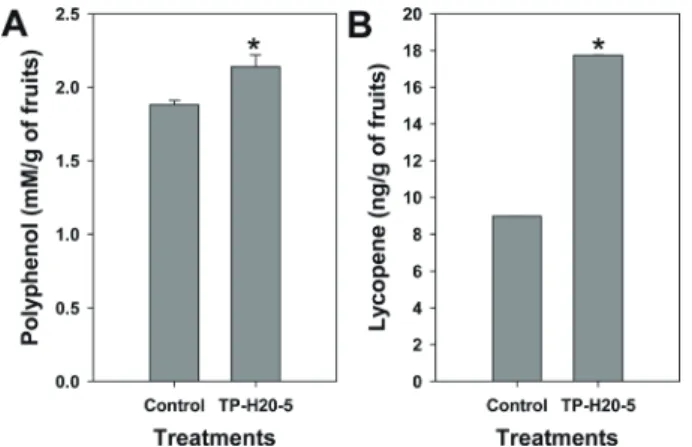
When TP-H20-5, ZY, and untreated control were applied to strawberry plants, higher lycopene and polyphenol con- tents were achieved by TP-H20-5 (Fig. 2). Application of TP- H20-5 increased the lycopene content by about ca. 97.77%;
polyphenol content by about ca. 13.83 % as compared to Fig. 1. Bioactive component and quality alterations on cherry to- mato fruits by B. mesonae H20-5 (TP-H20-5) treatment. (A) Polyphe- nol, (B) lycopene contents, (C) total soluble solid (%), and (D) titrat- able acidity from cherry tomato fruits in protected cultivation under salinity stress. Plants were treated with a liquid formulation B. mesonae H20-5 (TP-H20-5), ZY as a positive control, untreated control in on-farm located in Gimje, Korea. An asterisk on the bars indicates significant difference by LSD test at P< 0.05.
untreated control (Fig. 2).
In this study, significant increases in marketable fruit were observed when TP-H20-5 was applied into vegetables includ- ing cherry tomato, ripen tomato, strawberry, and cucumber plants. Enhanced marketable yield by bacterial treatment had been reported. Mena-Violante and Olalde-Portugal (2007) observed tomato yield increasing by inoculation of B. subtilis;
Bernabeu et al. (2015) showed that Burkholderia tropica could significantly colonized in the roots, and it led to an increase of tomato production in two different growing seasons. In addi- tion to plant growth promotion by beneficial microorganisms under general growing conditions, other roles of bacterial strains in induced systemic tolerance (IST) against abiotic stresses are currently being studied (Singh et al., 2018). Espe- cially, salinity is one of the most severe abiotic stresses during last few decades, it causes reduction in productivity and im- balance in development of plants (Cicek and Cakirlar, 2002).
Origin bacteria B. mesonae H20-5 of TP-H20-5 was selected by mitigative effect of salinity and plant growth-promoting char- acters including phosphorus solubilization, (ACC) deaminase and phytohormone-like auxin production in our previous study (Yoo et al., 2018); in this study, its final effects in protec- tive houses under natural salinity condition could be shown as increasing marketable productivity. Moreover, phospho- rus solubilization activity of B. mesonae H20-5 from TP-H20- 5 could help promote fruit yield by increasing a number of
blossoms of tested plants during early stages of growth and fruiting (Sainju et al., 2003). As well as increased fruit yield, this study demonstrated that application of TP-H20-5 could play a role in accumulation of phytochemical contents in cherry to- mato and strawberry. The lycopene and polyphenol contents of cherry tomato and strawberry in fruits were increased by application of TP-H20-5, which was similar results to Nzanza et al. (2012). It has been reported that these contents in fruits could be affected by environmental condition, ripening stage, and nutrient status; TP-H20-5 could induce tolerance to salin- ity and mitigate stress in plants; it could affect plant’s lyco- pene and polyphenol contents. Moreover, the market quality of cherry tomato and strawberry fruit is affected by lycopene which is a major determinant of fruit color; therefore, TP-H20- 5 could be an effective applicant to enhance fruit quality as well as quantitative yield.
Taken together, application of TP-H20-5 is required to in- crease fruit yield and quality including lycopene, polyphenol, and total soluble solid in protective cultivation under salinity by continuous cropping. Our findings of this study suggest that application of TP-H20-5 can be utilized as a potential biofertilizer for improving yield and fruit quality.
Summary
In this study, we verified the effect of a liquid formulation of B. mesonae H20-5 (TP-H20-5) on fruit production and quality including phytochemicals in cherry tomato and strawberry fruits in on-farm tests of protected cultivation under salinity stress. When vegetables including tomato, cherry tomato, strawberry, and cucumber were treated with TP-H20-5 by irrigated systems, final marketable yields were increased by 21.4% (cherry tomato), 9.3% (ripen tomato), 120.6% (straw- berry), and 14.5% (cucumber), and phytochemical compo- nents such as lycopene and total polyphenol compared to untreated control in cherry tomato and strawberry. These results implied that a formulation of B. mesonae H20-5 can be used as a potential biofertilizer for improving yield and fruit quality.
Conflicts of Interest
No potential conflict of interest relevant to this article was reported.
Fig. 2. Bioactive component alteration on strawberry fruits by B.
mesonae H20-5 (TP-H20-5) treatment. (A) Polyphenol, and (B) lyco- pene contents from strawberry fruits in protected cultivation un- der salinity stress. Plants were treated with a liquid formulation B.
mesonae H20-5 (TP-H20-5), ZY as a positive control, untreated con- trol in on-farm located in Yangpyeong, Korea. However, fruits from ZY treatment were not tested. An asterisk on the bars indicates sig- nificant difference by LSD test at P < 0.05.
Acknowledgements
This research was supported by a research grant (Project No. PJ011850) from Rural Development Administration, Re- public of Korea.
References
Anonymous. 1968. Laboratory manual for food canners and pro- cessors. 3rd ed. National Canners Association, Westport, CT, USA. 444 pp.
Bernabeu, P. R., Pistorio, M., Torres-Tejerizo, G., Estrada-de los Santos, P., Galar, M. L., Boiardi, J. L. et al. 2015. Colonization and plant growth-promotion of tomato by Burkholderia tropica. Sci. Hortic.
191: 113-120.
Cicek, N. and Cakirlar, H. 2002. The effect of salinity on some physi- ological parameters in two maize cultivars. Bulg. J. Plant Physiol.
28: 66-74.
Hallmann, E. 2012. The influence of organic and conventional cul- tivation systems on the nutritional value and content of bioac- tive compounds in selected tomato types. J. Sci. Food Agric. 92:
2840-2848.
Kuti, J. O. and Konuru, H. B. 2005. Effects of genotype and cultiva- tion environment on lycopene content in red-ripe tomatoes. J.
Sci. Food Agric. 85: 2021-2026.
Martínez, R., Torres, P., Meneses, M. A., Figueroa, J. G., Pérez-Álvarez, J. A. and Viuda-Martos, M. 2012. Chemical, technological and in
vitro antioxidant properties of mango, guava, pineapple and passion fruit dietary fibre concentrate. Food Chem. 135: 1520- 1526.
Mena-Violante, H. G. and Olalde-Portugal, V. 2007. Alteration of tomato fruit quality by root inoculation with plant growth- promoting rhizobacteria (PGPR): Bacillus subtilis BEB-13bs. Sci.
Hortic. 113: 103-106.
Munns, R. and Gilliham, M. 2015. Salinity tolerance of crops - what is the cost? New Phytol. 208: 668-673.
Nzanza, B., Marais, D. and Soundy, P. 2012. Yield and nutrient con- tent of tomato (Solanum lycopersicum L.) as influenced by Trich- oderma harzianum and Glomus mosseae inoculation. Sci. Hortic.
144: 55-59.
Sainju, U. M., Dris, R. and Singh, B. 2003. Mineral nutrition of tomato.
J. Food Agric. Environ. 1: 176-183.
Singh, V. K., Singh, A. K., Singh, P. P. and Kumar, A. 2018. Interaction of plant growth promoting bacteria with tomato under abiotic stress: A review. Agric. Ecosyst. Environ. 267: 129-140.
Tigchelaar, E. C. 1986. Tomato breeding. In: Breeding vegetables crops, ed. by M. J. Bassett, pp.135-171. AVI Publishing Company, Westport, USA.
Vasco, C., Ruales, J. and Kamal-Eldin, A. 2008. Total phenolic com- pounds and antioxidant capacities of major fruits from Ecuador.
Food Chem. 111: 816-823.
Yoo, S.-J., Shin, D. J., Weon, H.-Y., Song, J. and Sang, M. K. 2018. Selec- tion of bacteria for enhancement of tolerance to salinity and temperature stresses in tomato plants. Korean J. Organic Agric.
26: 463-475 (in Korean).