• 검색 결과가 없습니다.

Outcome of Limited Resection for Lung Cancer Jeong Su Cho, M.D.*, Sanghoon Jheon, M.D.**

N/A
N/A
Protected

Academic year: 2021

Share "Outcome of Limited Resection for Lung Cancer Jeong Su Cho, M.D.*, Sanghoon Jheon, M.D.**"

Copied!
7
0
0

로드 중.... (전체 텍스트 보기)

전체 글

(1)

DOI:10.5090/kjtcs.2011.44.1.51 ISSN: 2233-601X (Print) ISSN: 2093-6516 (Online)

*Department of Thoracic and Cardiovascular Surgery, Pusan National University Hospital

**Department of Thoracic and Cardiovascular Surgery, Seoul National University College of Medicine

***Department of Thoracic and Cardiovascular Surgery, Seoul National University Bundang Hospital

†The authors of this study was granted a research fund by Seoul National University Bundang Hospital (Research serial number: 02-2008-002).

Received: July 19, 2010, Revised: September 14, 2010, Accepted: September 16, 2010

Corresponding author: Sanghoon Jheon, Department of Thoracic and Cardiovascular Surgery, Seoul National University College of Medicine, Seoul National University Bundang Hospital, 166, Gumi-ro, Bundang-gu, Seongnam 463-707, Korea

(Tel) 82-31-787-7133 (Fax) 82-31-787-4050 (E-mail) [email protected]

C

The Korean Society for Thoracic and Cardiovascular Surgery. 2011. All right reserved.

CC
This is an open access article distributed under the terms of the Creative Commons Attribution Non-Commercial License (http://creative- commons.org/licenses/by-nc/3.0) which permits unrestricted non-commercial use, distribution, and reproduction in any medium, provided the original work is properly cited.

Outcome of Limited Resection for Lung Cancer

Jeong Su Cho, M.D.*, Sanghoon Jheon, M.D.**

,

***, Sung Joon Park, M.D.***, Sook-Whan Sung, M.D.**

,

***, Choon Taek Lee, M.D.**

,

***

Background: Up to now, lobectomy, bilobectomy and pneumonectomy combined with extensive lymph node dis- section have been regarded as the standard procedures for non-small cell lung cancer (NSCLC). In high-risk pa- tients, however, limited resection (LR) has been attempted as a salvage procedure, and, recently, indication for LR has been extended to selected cases with early-stage NSCLC. Material and Methods: Among the 773 patients who underwent surgical procedures for NSCLC in Seoul National University Bundang Hospital from May 2003 to December 2008, 43 patients received LR. Medical records of these patients were retrospectively reviewed. Results:

Mean age at operation was 66.0±12.4 years, and there were 30 males. Twenty-five patients underwent con- servative limited resection (CLR) and 18 underwent intentional limited resection (ILR). Indications for CLR were mul- tiple primary lung cancer in 9 (9/25, 36%) and severe concomitant diseases in 5 (5/25, 20%). Of these, 6 patients underwent segmentectomy and 19 received wedge resection. During the follow-up period of 28.0±17.8 months, 15 patient developed recurrent lung cancer. ILR was selectively performed in lesions almost purely composed of ground glass opacity (≥95%), or in small solid lesions (≤2 cm). Of these, 11 patients underwent segmentectomy and 7 underwent wedge resection. During the follow-up period of 31.7±11.6 months, no patient developed recurrence. Conclusion: Intermediate-term outcome of LR for early-stage lung cancer is comparable to that of standard operation. For the delineation of the indications and appropriate surgical techniques for LR, prospective randomized multi-institutional study may be expedient.

Key words: 1. Lung neoplasm 2. Risk

3. Lung surgery

INTRODUCTION

Ever since the clinical reports in 1950s indicated that lo- bectomy is superior to pnemonectomy in terms of survival and postoperative complications [1-3], pulmonary lobes have been regarded as the basic units of surgical excision in non-small cell lung cancer (NSCLC). Thus, lobectomy, bi-lo-

bectomy and pneumonectomy in combination with extensive

lymph node dissection have long been the standard proce-

dures for NSCLC. In patients with poor lung function or

compromised general condition, however, limited resection

(LR) of the lung has also been performed as a salvage proce-

dure (i.e. conservative LR or CLR), and, from this experi-

ence, indication for LR has been extended to selected cases

(2)

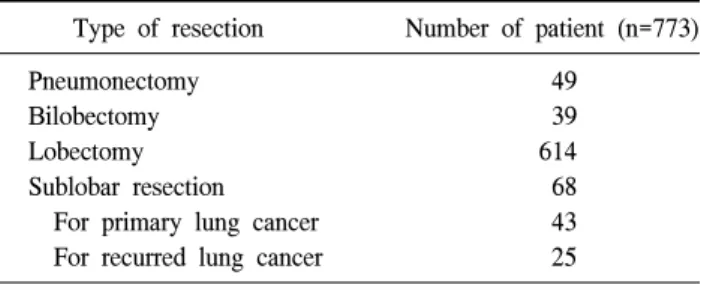
Table 1. Number of patients with lung cancer according to the types of resection

Type of resection Number of patient (n=773)

Pneumonectomy 49

Bilobectomy 39

Lobectomy 614

Sublobar resection 68

For primary lung cancer 43 For recurred lung cancer 25 of early-stage NSCLC as a minimally invasive procedure (i.e.

intentional LR or ILR). Given the preoperative condition of the patients, the outcome of CLR is presumed to be poor. To the contrary, the outcome of LR for early-stage NSCLC, par- ticularly in cases with low grade malignancy, would well be good, considering less aggressive nature of the cancer, less surgical trauma and minimal excision of normal lung tissue.

The exact indication and appropriate surgical technique of LR, however, have remained unclear and arbitrary, because they are mainly based on individual surgeon’s preference rather than a scientific algorithm. Thus, by analyzing the pre- operative patient characteristics and postoperative outcome of LR in our series, we sought to delineate the subset of pa- tients with NSCLC who would best benefit from this new therapeutic strategy, which may help to postulate a guideline of LR for this disease entity.

MATERIAL AND METHODS

Between May 2003 and December 2008, 773 patients un- derwent lung resection for NSCLC in our institute, and the extent of the excised lung tissue was smaller than a lobe in 68 patients, including 43 patients with primary lung cancer who constituted study population in this research. There had been no well-established guideline or principle regarding the indication for limited resection (LR) during this time frame, and the employment of LR strategy was at the discretion of individual surgeon’s decision. Consent to LR was obtained preoperatively in all patients after fully detailed information regarding LR was provided. For the preoperative diagnostic work-up, all patients underwent chest computerized tomog- raphy (CT) scanning, and other diagnostic studies, such as positron emission tomography (PET), bronchoscopy, percuta- neous needle aspiration, and mediastinoscopy, were se- lectively conducted, if indicated. For the prediction of post- operative pulmonary function and determination of oper- ability, pulmonary function test (PFT) was performed in all patients, and other studies, such as treadmill test, echo- cardiography and myocardial SPECT (Single-Photon Emission Computed Tomography), were selectively done. Surgery was conducted through open thoracotomy or thoracoscopic ap- proach, and the latter was preferred to the former, if possible.

Postoperative follow-up in the out-patient department (OPD) was monthly for postoperative 3 months, every 3 months be- tween postoperative 3 months and 3 years, every 4 months between postoperative 3 years and 5 years, and every 6 months from then on. There was no follow-up loss. Studies for postoperative assessment in the OPD, such as simple chest X-ray, chest CT, PET scan, bronchoscopy, PFT, and tu- mor marker assay, were performed in a timely manner, and more frequently if cancer recurrence was suspected.

RESULTS

The extent of lung resection in the 773 patients with NSCLC is summarized in Table 1. Among the 68 patients who underwent LR, postoperative pathological diagnosis was proven to be primary lung cancer in 43, who constituted study population. Their age were 66.0±12.4 years, and 30 were males. LR was done as a salvage procedure in 25 (conservative LR or CLR group) and was done as a mini- mally invasive procedure for early-stage lung cancer in 18 (intentional LR or ILR group).

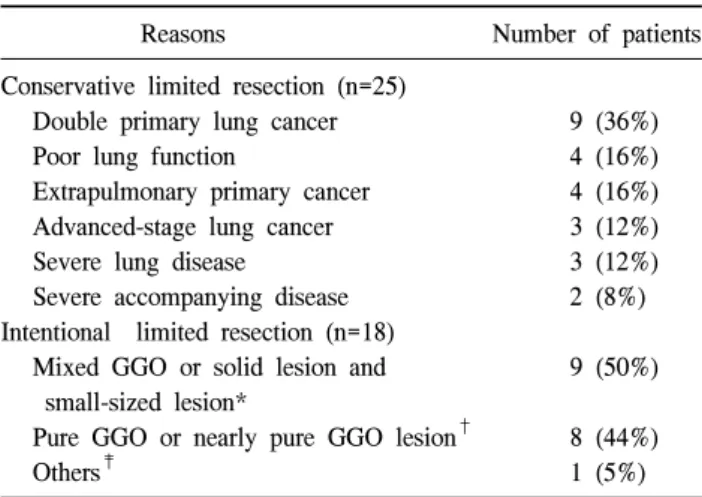
The rationales for CLR are summarized in Table 2. Among

the 25 patients with CLR, 10 had surgical risk score, pro-

posed by American society of anesthesiologists (ASA score),

of 3 or 4. In the 4 patients who had CLR for poor pulmo-

nary function, their forced expiratory volume in one second

was 1.11±0.22 L (53±19% of predicted value). Preoperative

clinical staging of the NSCLC was stage I in 20, II to IIIa in

3, IIIb in 1 and IV in 1. Among the 20 patients with pre-

operative stage I, 7 remained to be stage I postoperatively, 1

changed to stage II due to positive regional lymph node, and,

in the remaining 12, precise cancer staging remained un-

(3)

Table 2. Reasons of limited resection

Reasons Number of patients Conservative limited resection (n=25)

Double primary lung cancer 9 (36%)

Poor lung function 4 (16%)

Extrapulmonary primary cancer 4 (16%) Advanced-stage lung cancer 3 (12%)

Severe lung disease 3 (12%)

Severe accompanying disease 2 (8%) Intentional limited resection (n=18)

Mixed GGO or solid lesion and 9 (50%) small-sized lesion*

Pure GGO or nearly pure GGO lesion

8 (44%)

Others

1 (5%)

GGO=Ground glass opacity; *=Small size: ≤2 cm;

=Nearly pure GGO lesion: GGO>95% of the lesion;

=Tumor size:

2.3 cm and mixed GGO lesion.

certain because extensive lymph node dissection was dis- pensed with due to the palliative nature of the procedure.

Two patients with stage IIIb showed intra-pleural seeding of the cancer (T4N0M0), and received CRL of the primary can- cer with intra-pleural hyperthermic perfusion therapy. As to the surgical technique of LR, 6 received segmentectomy and 19 had wedge resection, and resection of the primary tumor was deemed complete (R0 resection) in 22 and incomplete (R1, R2 resection) in 3. Surgical approach was thoracoscopic in 11 (segmentectomy: 1, wedge resection: 10). Lymph node dissection was dispensed with in 14, selectively sampled in 8, and extensively done in 3. Pathological types were adeno- carcinoma in 11, squamous cell carcinoma in 11, bronchio- loalveolar carcinoma in 2, and larger cell tumor in 1. Posto- perative hospital stay was 7.58±4.4 days. Postoperative com- plications developed in 7, and most of them were not sig- nificant except for one case of surgical bleeding which neces- sitated reoperation. There was no surgical mortality. Late deaths occurred in 12, and 10 were related to cancer recur- rence. Follow-up was complete with a mean duration of 28.0±17.8 months, and, during the follow-up, cancer re- currence occurred in 15. Mean expected duration of can- cer-free survival was 18.5±16.8 months. Recurrence devel- oped in the same side as the primary lung cancer in 6 (in the same lobe in 4, in the resection margin in 2), in the lymph node in 1, in the chest wall in 2, in the contra-lateral lung in

3, and in the distant location in 3. The primary cancer stage of the 15 patients who developed recurrence was uncertain in 8, stage I in 3, II and IIIa in 3, IIIb in 1 and IV in 1. Ten patients with recurrent lung cancer have died to date, and the remaining 5 patients have received chemotherapy or radio- therapy with partial (n=3) or no remission (n=2).

ILR strategy was selected based on the tumor size, location and the degree of the association of ground glass opacity (GGO), which signifies low-grade malignancy. Among the 18 patients with ILR, 11 had segmentectomy and 7 had wedge resection. The indications for wedge resection were small sized (≤2 cm) pure GGO lesion (n=4), and small (≤2 cm) peripheral mixed GGO-solid lesion (n=3). These criteria for wedge resection, however, were not exclusively applied, for one patient who had 1.6 cm-sized pure GGO lesion received segmentectomy. The indications for segmentectomy were small lesion without GGO lesion, or mixed GGO-solid tumor with solid lesion dominance. PET scan was performed in pa- tients with solid tumor dominance (n=9), and maximal stand- ardized uptake value was 2.13±2.04. Among these nine pa- tients, there were cases with non-visualization of the tumor on PET scan. With respect to surgical approach, both thor- acoscopic approach (n=9) and open thoracotomy approach (n=9) were used equally. Postoperative hostpital stay was 6.24±3.49 days, and postoperative follow-up duration was 31.7±11.6 months. On postoperative pathologic examination, five patients showed findings of bronchioloalveolar carcinoma (BAC), and 4 received wedge resection. When Noguchi clas- sification system [4] for adenocarcinoma was applied for five patients with BAC, the number of patients with type A, B and C was 1, 2, and 2, respectively. One patient with BAC who had segmentectomy was proven to have type C lesion.

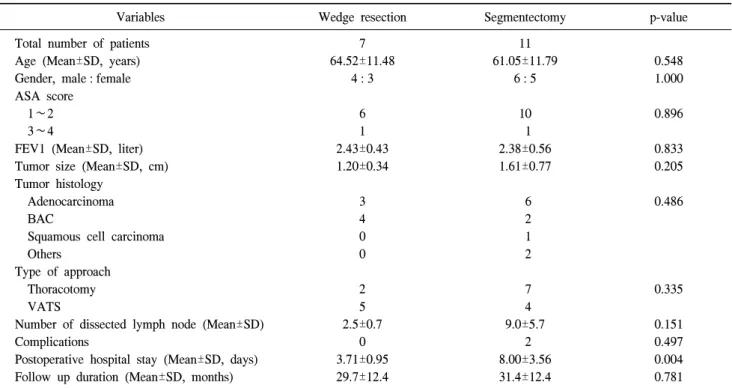
In patients with ILR, there was no difference in postoperative course between wedge resection group and segmentectomy group, except for the hospital stay, which was longer in the latter (Table 3). There was no recurrence of lung cancer dur- ing the follow-up period. One patient died of colon cancer 41 months after the lung cancer surgery.

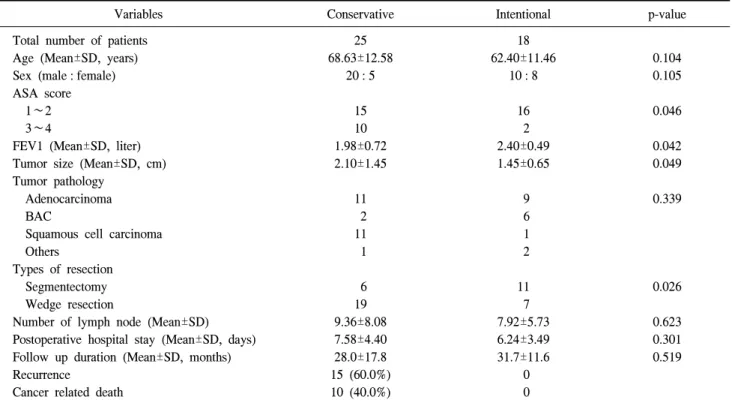
Clinical characteristics of patients with LR according to the

rationale for LR (i.e. CLR versus ILR) are summarized in

Table 4. There were significant differences in FEV1, tumor

size, ASA risk score and the surgical procedure (wedge re-

(4)

Table 3. Comparison of tumor characteristics and clinicopathological parameters of the patients with stage Ia NSCLC according to the sur- gical procedures of intentional limited resection

Variables Wedge resection Segmentectomy p-value

Total number of patients Age (Mean±SD, years) Gender, male : female ASA score

1∼2 3∼4

FEV1 (Mean±SD, liter) Tumor size (Mean±SD, cm) Tumor histology

Adenocarcinoma BAC

Squamous cell carcinoma Others

Type of approach Thoracotomy VATS

Number of dissected lymph node (Mean±SD) Complications

Postoperative hospital stay (Mean±SD, days) Follow up duration (Mean±SD, months)

7 64.52±11.48

4 : 3

6 1 2.43±0.43 1.20±0.34

3 4 0 0

2 5 2.5±0.7

0 3.71±0.95 29.7±12.4

11 61.05±11.79

6 : 5

10 1 2.38±0.56 1.61±0.77

6 2 1 2

7 4 9.0±5.7

2 8.00±3.56 31.4±12.4

0.548 1.000

0.896

0.833 0.205

0.486

0.335

0.151 0.497 0.004 0.781

NSCLC=Non-small cell lung cancer; SD=Standard deviation; ASA=American society of anesthesiologists; FEV1=Forced expiratory volume in 1 second; BAC=Bronchioloalveolar carcinoma; VATS=Video-assisted thoracic surgery.

section versus segmentectomy) between the two groups.

DISCUSSION

Application of LR strategy for NSCLC is still contro- versial. While Ginsberg and Rubinstein [5] claimed that the outcome of LR for early-stage lung cancer is worse than that of more extensive resection, others asserted that long-term outcome of LR would be better than that of lobectomy be- cause larger amount of normal lung tissue is preserved while the risk of cancer recurrence is comparable to lobectomy [6-11]. This striking discrepancy in outcome interpretation be- tween various clinical researches pertaining to this issue may result from the differences in study population, non-stand- ardized surgical technique, and lack of consensus-based treat- ment algorithm.

Conservative LR (CLR) has been performed for a various proportion of patients with hardly-operable/hardly-resectable NSCLC, depending on the indication for LR or capability of each program in postoperative care. The rationale for conven-

tional LR centers around improving early survival and quality

of life, and preoperative risk analysis should be cautiously fo-

cused on precise assessment of risk-benefit relationship on an

individual patient basis. Because patients with stage I NSCLC

who are indicated for non-surgical treatment due to multiple

risk factors are rare, there have been only a few reports on

the long-term outcome of CRL in comparison to radiotherapy

or chemotherapy [12,13] for this subset. In our study, the

overall surgical outcome after CRL was less than optimal

with high recurrence rate. This could partly be attributed to

advanced disease in 5 patients whose clinical stage was high-

er than II, and pathologic staging of the patients with clinical

stage I could have been changed to a higher grade if they

had had extensive lymph node dissection. Furthermore, all pa-

tients except for two had solid tumor without ground glass

opacity, and their maximal standardized uptake value (MSUV)

on PET scan was higher than 3.0, which was the average

MSUV of whole population with stage I NSCLC during the

same time frame. These findings suggest that patients with

preoperatively ‘presumed’ stage I would have had a high risk

(5)

Table 4. Comparison of tumor characteristics and clinicopathological parameters of patients with NSCLC according to the rationales for limited resection

Variables Conservative Intentional p-value

Total number of patients Age (Mean±SD, years) Sex (male : female) ASA score

1∼2 3∼4

FEV1 (Mean±SD, liter) Tumor size (Mean±SD, cm) Tumor pathology

Adenocarcinoma BAC

Squamous cell carcinoma Others

Types of resection Segmentectomy Wedge resection

Number of lymph node (Mean±SD) Postoperative hospital stay (Mean±SD, days) Follow up duration (Mean±SD, months) Recurrence

Cancer related death

25 68.63±12.58

20 : 5

15 10 1.98±0.72 2.10±1.45

11 2 11 1

6 19 9.36±8.08 7.58±4.40 28.0±17.8 15 (60.0%) 10 (40.0%)

18 62.40±11.46

10 : 8

16 2 2.40±0.49 1.45±0.65

9 6 1 2

11 7 7.92±5.73 6.24±3.49 31.7±11.6

0 0

0.104 0.105

0.046

0.042 0.049

0.339

0.026

0.623 0.301 0.519

NSCLC=Non-small cell lung cancer; SD=Standard deviation; ASA=American society of anesthesiologists; FEV1=Forced expiratory volume in 1 second; BAC=Bronchioloalveolar carcinoma.

of recurrence even after conventional resection, and extensive lymph node dissection might have lowered the recurrence rate, at least to some extent. Considering the 6 cases with lo- cal recurrence at the resection margin or in the same lobe, some may argue that they would have benefitted from con- ventional resection in terms of recurrence rate. However, giv- en that 4 of the 6 patients were older than 70 years, 2 had severe associated lung disease, 2 had multiple lung cancer, and one had ASA grade of 3, it is prudent to say that these patients would have poorly tolerated lung resection more ex- tensive than limited resection.

With respect to intentional LR (ILR), indications for per- forming ILR are less complicated than CLR. As to the size of the primary tumor, Tsubota et al proposed rationale for in- tentionally performed segmentectomy for NSCLC with small lesion (≤2 cm), and they have accumulated data to sub- stantiate their novel strategy [6-8]. New TNM staging system categorizes small tumor (≤2 cm) as T1a, and this sub-classi- fication is expected to boost the application of ILR for early

stage NSCLC [14]. This new strategy, however, may render

extensive lymph node dissection even more important, and

planned ILR should be converted to conventional resection

once lymph node metastasis becomes evident by frozen

biopsy. As to the pathologic type of NSCLC, Noguchi et al

proposed a histologic classification of adenocarcinoma [4],

which has been proven to correlate well with the degree of

ground glass opacity on chest CT [15,16]. Based on recent

studies from Japan [17,18], patients with pure GGO on chest

CT, which is equivalent to Noguchi type A or B, are good

candidates for wedge resection, because the malignant poten-

tial of this lesion is even lower than that of small peripheral

lung cancer. However, the application of ILR for GGO le-

sions is still controversial, and only a few studies have been

undertaken in western countries. Furthermore, there is no con-

sensus on the extent of lung resection for GGO, and some

favor wedge resection as a definitive surgery while others

perform segmentectomy or lobectomy after pathologic diag-

nosis is obtained by frozen biopsy from the wedge resection

(6)

specimen. The rationales for the former strategy are as fol- lows: 1) The differentiation between Noguchi type A lesion (localized bronchioloalveolar carcinoma, LBAC) and atypical adenomatous hyperplasia (AAH) is difficult by frozen biopsy, 2) Procurement of tumor tissue for frozen biopsy may jeop- ardize the precise pathologic assessment later on, 3) By some scholars, Noguchi type A or B lesions are classified as carci- noma in situ or stage 0 disease [4], and, therefore, it is sen- sible to minimize surgical excision for very early stage dis- ease in which intra-lobar spread of the cancer is less likely.

Current practice for NSCLC in Korea is characterized by decreased frequency of pneumonectomy, sleeve lobectomy, or other types of extensive resection, which may be due, at least in part, to the decreased incidence of once-prevailing cen- tral-type squamous cell carcinoma. To the contrary, the in- creasing number of peripheral adenocarcinoma or stage I dis- ease has propelled the less extensive surgery employing thor- acoscopic surgery technique. This contemporary trend towards minimally invasive surgery, however, has more to do with minimizing surgical trauma and hospital stay, rather than minimizing the extent of surgery for lung cancer, which may violate the principles for cancer surgery. In a practical sense, segmentectomy or wedge resection as a cancer surgery is a technically more demanding and complicated compared to those for benign lung lesions. In this regard, standard surgical technique of ILR needs to be defined. Furthermore, the con- sensus-based criteria for ILR in early-stage NSLCL have not established yet. Given that the number of patients with pe- ripheral tumors and GGO lesions, who are potential candi- dates for ILR, is rapidly growing in Korea, benefits from ILR for this subset should be delineated as soon as possible, by thorough review of the patients who were indicated for ILR.

Multi-institutional study may be expedient to this end.

REFERENCES

1. Paulino F, Pernambuco P, Junqueira DE, Mascarenhas BC.

Lobectomy and pneumonectomy in carcinoma, abscess and bronchiectasis. Rev Bras Cir 1950;20:883-98.

2. Jones JC, Meyer BW, Robinson JL. Indications for lobec- tomy in the treatment of carcinoma of the lung. J Thorac Surg 1956;32:500-7.

3. Alieva TA. Lobectomy in treatment of lung cancer. Khirur- giia (Mosk) 1957;33:34-9.

4. Noguchi M, Morikawa A, Kawasaki M, et al. Small ad- enocarcinoma of the lung: histologic characteristics and prognosis. Cancer 1995;75:2844–52.

5. Ginsberg RJ, Rubinstein LV. Randomized trial of lobectomy versus limited resection for T1 N0 non-small cell lung cancer. Lung Cancer Study Group. Ann Thorac Surg 1995;

60:615-22.

6. Yoshikawa K, Tsubota N, Kodama K, Ayabe H, Taki T, Mori T. Prospective study of extended segmentectomy for small lung tumors: the final report. Ann Thorac Surg 2002;

73:1055-8.

7. Okada M, Nishio W, Sakamoto T, et al. Effect of tumor size on prognosis in patients with non-small cell lung cancer:

The role of segmentectomy as a type of lesser resection. J Thorac Cardiovasc Surg 2005;129:87-93.

8. Okada M, Koike T, Higashiyama M, Yamato Y, Kodama K, Tsubota N. Radical sublobar resection for small-sized non-small cell lung cancer: a multicenter study. J Thorac Cardiovasc Surg 2006;132:769-75.

9. Schuchert MJ, Pettiford BL, Keeley S, et al. Anatomic seg- mentectomy in the treatment of stage I non-small cell lung cancer. Ann Thorac Surg 2007;84:926-32.

10. Sienel W, Dango S, Kirschbaum A, et al. Sublobar re- sections in stage IA non-small cell lung cancer: segmentec- tomies result in significantly better cancer-related survival than wedge resections. Eur J Cardiothorac Surg 2008;33:

728-34.

11. Yamamoto K, Miyamoto Y, Ohsumi A, et al. Sleeve lung resection for lung cancer: Analysis according to the type of procedure. J Thorac Cardiovasc Surg 2008;136:1349-56.

12. Hsie M, Morbidini-Gaffney S, Kohman LJ, Dexter E, Scalzetti EM, Bogart JA. Definitive treatment of poor-risk patients with stage I lung cancer: a single institution experience. J Thorac Oncol 2009;4:69-73.

13. Lencioni R, Crocetti L, Cioni R, et al. Response to radio- frequency ablation of pulmonary tumours: a prospective, in- tention-to-treat, multicentre clinical trial (the RAPTURE study). Lancet Oncol 2008;9:621-8.

14. Goldstraw P, Crowley J, Chansky K, et al. The International Association for the Study of Lung Cancer International Staging Committee: The IASLC Lung Cancer Staging Project: Proposals for the revision of the TNM stage group- ings in the forthcoming (seventh) edition of the TNM classi- fication of malignant tumours. J Thorac Oncol 2007;2:

706-14.

15. Saito H, Yamada K, Hamanaka N, et al. Initial findings and progression of lung adenocarcinoma on serial computed to- mography scans. J Comput Assist Tomogr 2009;33:42-8.

16. Ikeda N, Maeda J, Yashima K, et al. A clinicopathological study of resected adenocarcinoma 2 cm or less in diameter.

Ann Thorac Surg 2004;78:1011-6.

17. Minami Y, Matsuno Y, Iijima T, et al. Prognostication of

(7)

small-sized primary pulmonary adenocarcinomas by histo- pathological and karyometric analysis. Lung Cancer 2005;48:339-48.

18. Kodama K, Higashiyama M, Takami K, et al. Treatment

strategy for patients with small peripheral lung lesion(s): in-

termediate-term results of prospective study. Eur J Cardio-

thorac Surg 2008;34:1068-74.

수치

Table 1. Number of patients with lung cancer according to the  types of resection
Table 2. Reasons of limited resection
Table 3. Comparison of tumor characteristics and clinicopathological parameters of the patients with stage Ia NSCLC according to the sur- sur-gical procedures of intentional limited resection
Table 4. Comparison of tumor characteristics and clinicopathological parameters of patients with NSCLC according to the rationales for  limited resection

참조

관련 문서

a prospective analysis of 50 cases. Preoperative staging of non-small-cell lung cancer with positron-emission tomography. Staging of non- small-cell lung cancer

D Choose the correct words and rewrite the sentences...

Patients with breast cancer; ovarian cancer; renal cell carcinoma; pancreatic neuroendocrine cancer; colorectal cancer; head and neck cancer; non-small cell lung

Now th at in dividua l Annex I country ta rgets have been set, the interna tional debate has shifted towar d the qu estion of cost effective and environmentally credible

Kameoka, “Sentinel lymph node biopsy for breast cancer patients using fluorescence navigation with indocyanine green,” World Journal of Surgical Oncology, Vol..

The reduction of power series ( , m→ ∞) to polynomials (m is finite) is a great advantage.. because then we have solutions for all x,

 The simplest method of storing a raster layer in the memory of the computer is using a data structure called an array..  We consider alternative methods for searching through

Beichel,“Automated 3-D segmentation of lungs with lung cancer in CT data using a novel robust active shape model approach,” IEEE Trans.. 저작물의