INTRODUCTION
Child sexual abuse leads to physical problems such as gen- ital trauma, sexually transmitted disease, and pregnancy as well as multiple psychological symptoms. The related se- quelae of child and adolescent psychological trauma include post-traumatic stress disorder (PTSD) symptoms (re-experi- encing, hyperarousal, avoidance behavior, nightmare, and dissociation), emotional reactions (depression, attention def- icit, sleep disorder, excessive sense of guilt, fear and distrust of strangers), refusal to attend school, lack of confidence, and suicidal ideation and even regressed behaviors (enuresis and encopresis).
1-3)On the other hand, increase in inappro- priate sexual behavior, such as engaging in excessive mas-
turbation and repeated play imitating sexual intercourse, have also been reported.
3,4)Beitchman et al.
5)performed in 1992 a meta-analysis of 32 studies examining long-term impacts of child sexual abuse and found that victims of child sexual abuse tend to experi- ence sexual dysfunction, anxiety, depression, and suicidal ideation lasting into adulthood. Other problems reported include interpersonal conflicts, low self-esteem, child-rear- ing difficulties, and substance abuse.
5)Various interventions have been attempted to address the sequelae of child sexual abuse described above, and many studies investigated therapeutic effects of such interven- tions. Chard
6)reported the findings that significant PTSD- related improvements were achieved by administering cog- nitive behavior therapy in PTSD patients with a history of child sexual abuse and that such results lasted at least one year. In South Korea, Choi et al.
7)reported significant improvements
This is an Open Access article distributed under the terms of the Creative Commons Attribution Non-Commercial License (http://creativecommons.org/licenses/by-nc/4.0) which permits unrestricted non-commercial use, distribution, and reproduction in any medium, provided the original work is properly cited.
Aftermath of Child Sexual Abuse in Children in Korea:
Data from the Nation-Funded Sexual Violence Victim Protection Center for Children
Soo Young Lee
1, Tae-Kyoung Kim
2, Keun-Ah Cheon
3,4, and Dong-Ho Song
3,41Yonsei i Psychiatric Clinic, Busan, Korea
2Department of Counseling Psychology, Woosuk University, Wanju, Korea
3Department of Psychiatry, College of Medicine, Yonsei University, Seoul, Korea
4Institute of Behavioral Science in Medicine, College of Medicine, Yonsei University, Seoul, Korea
Objectives: This study aimed to investigate the 3-year mean periods aftermath of child sexual abuse and to compare the sexual vio- lence victims regard to the treatment.
Methods: 682 sexual violence victims were recruited by Seoul Sunflower Children Center, a nation-funded sexual violence victim protection center for children age 13, from 2004 to 2008. Data from 49 victims among 116 consented a follow-up, were analyzed. The victims were assessed by psychological test. Data was analyzed by SPSS ver. 15.0 (SPSS Inc.).
Results: The average time elapsed from the last presumed sexual abuse was 39.7 months [standard deviation (SD) 26.02]. Overall, Children’s Depression Inventory (CDI) was significantly decreased from 15.8 (SD 9.33) to 10.4 (SD 9.98), and several subscales (depression, anxi- ety, anger, posttraumatic stress, and dissociation) of Trauma Symptom Checklist for Children (TSCC) were also significantly de- creased. CDI and TSCC scores showed no statistical difference between treatment-given and not-given groups, but Revised Children’s Manifest Anxiety Scale (RCMAS) was decreased in treatment-given group, whereas it was increased in treatment-not-given group.
The difference of RCMAS scores between the two groups was statistically significant [F(1,28)=4.54, p<0.05].
Conclusion: Sexually abused children showed overall symptom decreases over time, but anxiety was not decreased in treatment not- given group.
Key Words: Child sexual abuse; Treatment; Natural outcome.
Received: January 10, 2017 / Revision: March 22, 2017 / Accepted: October 25, 2017
Address for correspondence: Dong-Ho Song, Department of Psychiatry, College of Medicine, Yonsei University, 50-1 Yonsei-ro, Seodaemun-gu, Seoul 03722, Korea
Tel: +82-2-2228-1620, Fax: +82-2-313-0891, E-mail: [email protected]
achieved by the cognitive behavioral therapy in PTSD, dis- sociation, sex-related problems, parent-reported behavioral problems, and so on. Some reported varying therapeutic ef- fects of various types of interventions.
8,9)Interestingly, some studies reported delayed manifestation of symptoms in vic- tims of child sexual abuse who did not show any symptoms immediately after the event with 10-20% of them showing symptoms 12-18 months after the event.
10,11)This phenom- enon, known as “sleeper effects,” suggests the possibility of recurrence of various sequelae after a considerable lapse of time even in children who completed treatment.
With growing social awareness of and interest in child sex- ual abuse, various assessments and therapies have been pre- sented. In South Korea, however, there is little empirical re- search data on psychological sequelae, not to mention follow- up studies tracking sexually victimized children after a longer lapse of time to monitor their psychological states. To fill this research void, we investigated the psychological states of the children who received counseling as sexual abuse victims in the Seoul Sunflower Children’s Center, a nation- funded sexual violence victim protection center.
METhODs
Participants and study design
Total Participants were 682 children who presented to the Seoul Sunflower Children’s Center, a sexual violence victim protection center specializing in child sexual abuse, be- tween 2004 and 2008 and received initial counseling, psy- chiatric diagnosis, and comprehensive psychological tests.
The counselors contacted their parents/caregivers by phone in 2009 and 2010, explained the purpose of the study, and asked about their willingness to participate. One hundred six- teen participants and parents/caregivers of total participants (17%) agreed to participate, and the questionnaires were sent by post to the parents/caregivers who gave informed consent.
Of them, 49 (42.2%) returned duly filled-in questionnaires.
To check symptoms and adaptation outcomes, we compared the baseline and follow-up psychological test results and an- alyzed the variables influencing child’s sequelae. This study was approved by the Institutional Review Board of the Yonsei University College of Medicine (IRB No. 2-2009-0169).
Psychiatric diagnosis and psychological evaluation When a parent/caregiver-child pair presented to the center, diagnostic interview was conducted with the parent/caregiv- er and the child using the Kiddie-Schedule for Affective Disorders and Schizophrenia-Present and Lifetime Version (K-SADS-PL),
12)and the resulting dataset was used for anal- ysis. The K-SADS-PL is a semi-structured instrument designed
for school-age children (6-18 years). This scale is composed of an overall interview questionnaire and five supplementa- ry scoring questionnaires (affective disorders, psychotic dis- orders, anxiety disorder, behavior disorder, substance use disorder, and other disorders).
Diagnosis was made in two periods-“present illness” and
“past illness”-covering the pre- and post-episode periods, i.e., the time from the sexual abuse episode to the present and the time prior to the sexual abuse episode, respectively.
The severity of sequelae was evaluated in a case conference in which certified child and adolescent psychiatrists and cer- tified clinical psychologists carried out comprehensive in- depth evaluations based on the information and data ob- tained from psychiatric interviews, psychological tests, and behavior observations. The severity of symptom manifesta- tion was rated in four grades of “no symptoms,” “mild” (slight problems manifested but not to the degree of impairing ad- aptation functioning), “moderate” (experiencing consider- able psychological distress with symptoms pertaining to psychiatric diagnostic criteria but treated with psychothera- py and medication over the past six months), and “severe”
(experiencing severe psychological distress, undergoing a pro- longed treatment in excess of six months and requiring hos- pitalization).
Psychological measurement instruments
Children’s self-assessmentChildren’s Depression Inventory
The Children’s Depression Inventory (CDI) is a scale de- signed by Kovacs
13)to assess school children’s depression. Its Korean version (K-CDI), translated and normed by Cho and Lee,
14)was used in this study. The K-CDI consists of 27 items.
The reliability of this scale was tested (Cronbach’s α=0.76), and it was confirmed to be a reliable scale for assessing chil- dren showing depressive symptoms.
Revised Children’s Manifest Anxiety Scale
This study used the Revised Children’s Manifest Anxiety Scale (RCMAS) developed by Reynolds and Richmond
15)and adapted by Choi and Cho (K-RCMAS).
16)The K-RCMAS aims to quantify the degree of anxiety-related symptoms and con- sists of 37 items. It was tested in an anxiety assessment study with Korean children (test-retest reliability r=0.79, interrater reliability r=0.86).
Trauma Symptom Checklist for Children
The Trauma Symptom Checklist for Children (TSCC) was
developed by Briere
17)and normed by Chung.
18)This mea-
sure consists of two validity scales measuring hyper-response and under-response and six clinical scales comprising anxi- ety, depression, anger/aggression, posttraumatic stress, dis- sociation (clear, ambiguous), and sexual concerns (preoccupa- tion, distress). This self-report checklist of trauma symptoms consists of 54 items rated on a 4-point scale from 0 (never) to 3 (almost always). The version used in this study, which was carried out prior to its norming, was the English TSCC version translated faithful to the original by a clinical psychol- ogist and a psychiatrist who are well-versed in both languag- es and back-translated by another bilingual psychologist.
The internal consistency of the original version when it was developed by Briere
17)(Cronbach’s alpha) was 0.82-0.89. In the result analysis of this study, both US-normed converted score and raw score were used.
Parents’ assessment
Trauma Symptom Checklist for Young Children
The Trauma Symptom Checklist for Young Children (TSCYC) is a scale developed by Briere.
19)It is designed to be completed by parents/caregivers for children ages 8-16 years.
This measure contains two validity scales measuring response level and atypical response and nine clinical scales compris- ing anxiety, depression, anger/aggression, posttraumatic stress intrusion, posttraumatic stress avoidance, posttrau- matic stress arousal, posttraumatic stress total, dissociation, and sexual concerns. It consists of 90 items rated on a 4-point scale from 1 (never) to 4 (almost always). The version used in this study, which was carried out prior to its norming by Bae et al.,
20)was the English TSCYC version translated faith- ful to the original by a clinical psychologist and a psychiatrist who are well-versed in both languages and back-translated by another bilingual psychologist. The internal consistency (Cronbach’s alpha) of the original version when it was devel- oped by Briere
19)was 0.87. In the result analysis of this study, the raw score of each scale was used.
Korean-Child Behavior Checklist
This measure is designed for parents/caregivers to assess children’s adaptation functioning and problem behaviors on a 3-point scale, normed by Oh et al.
21)based on the original scale developed by Achenbach and Edelbrock.
22)The Kore- an-Child Behavior Checklist (K-CBCL) is divided into the social competence scale and the problematic behavior scale, consisting of 16 and 113 items, respectively. The problematic behavior scale includes withdrawal, somatic complaints, anxiety, immaturity, thought problems, attention problems, delinquent behavior, aggressive behavior, internalizing be- havior problems, externalizing behavior problems, total prob-
lems, sexual problems, and emotional instability. Age-equiv- alent scores were used for analysis.
REsULTs
Demographic characteristics
Of the 49 participants included in data analysis, 42 were girls (85.7%), and 7 were boys (14.3%), similar to the gender ratio of the total participants (n=682) targeted in this study.
The mean age at the time of presenting to the Center was 7.31 years [range=2-12, standard deviation (SD)=2.62], and the mean age at the time of this study was 9.61 years (range=
3-15, SD=2.93). The time elapsed after the point assumed to be the last time that the child experience sexual abuse varied between 11 and 144 months (mean 39.7 months, SD 26.02).
Sexual abuse data
Looking at the abuse episodes by type, three cases (6.1%) did not involve any physical contact between offender and victim, such as exposure to pornography or display of genital organs, 38 cases (77.5%) involved sexual harassments, and eight cases (16.4%) were rape. In terms of offender type, 27 (55.1%) were strangers, 12 (24.5%) were acquaintances, and 10 (20.4%) were relatives and family members.
Psychiatric diagnosis
Based on the initial psychiatric evaluations and psychologi- cal test results, 25 children (51.0%) were given psychiatric di- agnoses associated with sexual abuse, and a psychiatric di- agnosis was deferred in 24 children (49.0%). Twenty-two children (44.9%) were diagnosed with anxiety disorders, five (13.5%) with depressive disorders, and one (2.7%) with psy- chogenic amnesia. Most of the children were diagnosed with single disorder and three (8.1%) with multiple diagnosis.
Treatments
Thirty-eight children (77.6%) received psychotherapy, and
11 (22.4%) did not receive any interventions. Looking at the
intervention types, sex education for therapeutic purposes
was administered to 5 children (14.3%), psychoanalytic play
therapy to 20 children (57.1%), cognitive behavioral therapy
to 5 children (14.3%), and child-centered counseling therapy
to 5 children (14.3%). Three children were referred to other
institutions, but the records of their treatment after the refer-
ral were not available. The mean number of therapy sessions
was 15.4 (range 1-38, SD 10.56). The mean lapse of time from
the therapy end to the conduct of this study was 22.3 months
(SD 14.95), ranging from 2 to 58 months.
CDI and RCMAS
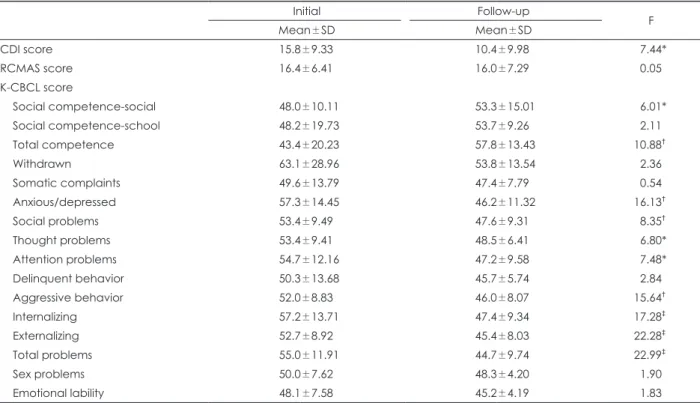
A statistically significant difference was observed in the CDI scores between the baseline and follow-up means (15.8 vs. 10.4; F=7.44, p<0.01). In the RCMAS scores, however, no statistically significant difference was found between the base- line and follow-up means (16.4 vs. 16.0; F=0.05, p>0.05) (Table 1).
K-CBCL
A statistically significant improvement was observed in the score of the positive social competence scale (F=6.01, p<0.05). Statistically significant decreases were observed in the scores of various subscales of the problematic behavior syndrome scale between the baseline and follow-up means assessments: depression/anxiety (F=16.13, p<0.01), immatu- rity (F=8.35, p<0.01), thought problems (F=6.80, p<0.05), at- tention problems (F=7.48, p<0.05), aggressive behavior (F=
15.64, p<0.01), internalizing behavior problems (F=17.28, p<
0.001), externalizing behavior problems (F=22.28, p<0.001), and total problems (F=22.99, p>0.001) (Table 1).
TSCC and TSCYC
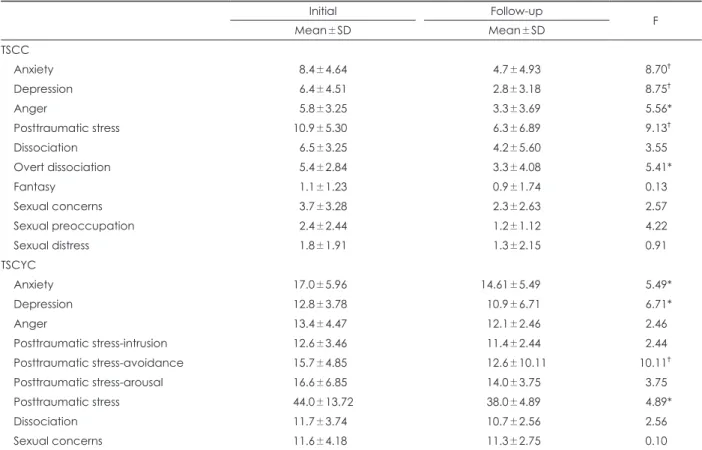
In the TSCC, subscale scores decreased; in particular, the follow-up assessment scores of anxiety (F=8.70, p<0.01), de- pression (F=8.75, p<0.01), anger (F=5.56, p<0.05), trauma symptoms (F=9.13, p<0.01), and dissociation-preoccupation (F=5.41, p<0.05) scales were significantly lower than at base-
line. All subscale scores decreased in the TSCYC as well; in particular, the follow-up assessment scores of anxiety (F=5.49, p<0.05), depression (F=6.71, p<0.05), posttraumatic stress avoidance (F=10.11, p<0.01), and posttraumatic stress total (F=4.89, p<0.05) scales were significantly lower than at base- line (Table 2).
Factors influencing post-trauma adaptation in the victims of sexual abuse
Abuse episode-related variables
The time elapsed from victimization to enrollment in the study and the type of sexual abuse were not found to have any statistically significant association with the scores on the TSCC, TSCYC, K-CBCL, CDI, RCMAS, and Child Health and Illness Profile-Child Edition (CHIP-CE).
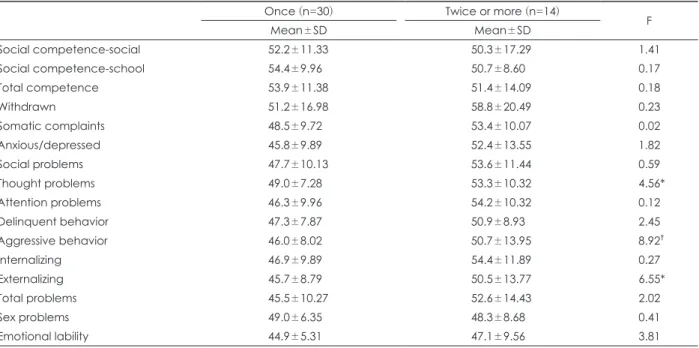
After dividing the participants into two groups according to the frequency of abuse (once, twice+), scores on the TSCC, TSCYC, K-CBCL, CHIP-CE, CDI, and RCMAS were com- pared; as a result, no significant intergroup difference was observed in most of the scales. In the TSCYC measure, how- ever, significantly higher scores were observed in the “twice+”
group compared with the “once” group in the scales of post- traumatic stress avoidance (F=4.34, p<0.05), posttraumatic stress arousal (F=8.09, p<0.01), and dissociation (F=9.45, p<0.01). The same trend was observed in the K-CBCL scales
Table 1. Comparison of score of CDI, RCMAS (n=29) and K-CBCL (n=25) between initial assessment and follow-up assessment
Initial Follow-up
Mean±SD Mean±SD F
CDI score 15.8±9.33 10.4±9.98 7.44*
RCMAS score 16.4±6.41 16.0±7.29 0.05
K-CBCL score
Social competence-social 48.0±10.11 53.3±15.01 6.01*
Social competence-school 48.2±19.73 53.7±9.26 2.11
Total competence 43.4±20.23 57.8±13.43 10.88†
Withdrawn 63.1±28.96 53.8±13.54 2.36
Somatic complaints 49.6±13.79 47.4±7.79 0.54
Anxious/depressed 57.3±14.45 46.2±11.32 16.13†
Social problems 53.4±9.49 47.6±9.31 8.35†
Thought problems 53.4±9.41 48.5±6.41 6.80*
Attention problems 54.7±12.16 47.2±9.58 7.48*
Delinquent behavior 50.3±13.68 45.7±5.74 2.84
Aggressive behavior 52.0±8.83 46.0±8.07 15.64†
Internalizing 57.2±13.71 47.4±9.34 17.28‡
Externalizing 52.7±8.92 45.4±8.03 22.28‡
Total problems 55.0±11.91 44.7±9.74 22.99‡
Sex problems 50.0±7.62 48.3±4.20 1.90
Emotional lability 48.1±7.58 45.2±4.19 1.83
Comparisons made by t-test. *p<0.05, †p<0.01, ‡p<0.001. CDI: Children’s Depression Inventory, K-CBCL: Korean-Child Behavior Checklist, RCMAS: Revised Children’s Manifest Anxiety Scale, SD: standard deviation
of thought problems (F=4.56, p<0.05), aggressive behavior (F=8.92, p<0.01), and externalizing behavior problem (F=6.55, p<0.05) (Table 3 and 4).
The participants were divided into three groups depend- ing on the offender type: stranger group, acquaintance group, and relative/family member group, and inter-group differ- ences in the scale scores were investigated. As a result, signifi- cant inter-group difference was shown only by the TSCYC dissociation scale. Scheffe’s multiple comparison test, which
was performed additionally to analyze the related inter-group differences, revealed that significantly higher scores were yield- ed by the acquaintance group (mean 12.4, SD 2.07) and the relative/family group (mean 12.4, SD 4.33) compared with the stranger group (mean 9.59, SD 0.87) [F(2,33)=5.92, p<0.01].
DIsCUssION
Although the follow-up scores for CDI-based depressive
Table 2. Comparison of score of TSCC (n=20) and TSCYC (n=23) between initial assessment and follow-up assessment
Initial Follow-up
Mean±SD Mean±SD F
TSCC
Anxiety 8.4±4.64 4.7±4.93 8.70†
Depression 6.4±4.51 2.8±3.18 8.75†
Anger 5.8±3.25 3.3±3.69 5.56*
Posttraumatic stress 10.9±5.30 6.3±6.89 9.13†
Dissociation 6.5±3.25 4.2±5.60 3.55
Overt dissociation 5.4±2.84 3.3±4.08 5.41*
Fantasy 1.1±1.23 0.9±1.74 0.13
Sexual concerns 3.7±3.28 2.3±2.63 2.57
Sexual preoccupation 2.4±2.44 1.2±1.12 4.22
Sexual distress 1.8±1.91 1.3±2.15 0.91
TSCYC
Anxiety 17.0±5.96 14.61±5.49 5.49*
Depression 12.8±3.78 10.9±6.71 6.71*
Anger 13.4±4.47 12.1±2.46 2.46
Posttraumatic stress-intrusion 12.6±3.46 11.4±2.44 2.44
Posttraumatic stress-avoidance 15.7±4.85 12.6±10.11 10.11†
Posttraumatic stress-arousal 16.6±6.85 14.0±3.75 3.75
Posttraumatic stress 44.0±13.72 38.0±4.89 4.89*
Dissociation 11.7±3.74 10.7±2.56 2.56
Sexual concerns 11.6±4.18 11.3±2.75 0.10
Comparisons made by t-test. *p<0.05, †p<0.01. SD: standard deviation, TSCC: Trauma Symptom Checklist for Children, TSCYC:
Trauma Symptom Checklist for Young Children
Table 3. Comparison of score of TSCYC according to sexual abuse frequency
Once (n=23) Twice or more (n=14)
Mean±SD Mean±SD F
Anxiety 13.6±3.56 15.6±4.50 0.95
Depression 10.7±1.76 11.8±3.45 3.23
Anger 11.2±2.35 12.9±3.39 2.76
Posttraumatic stress-intrusion 11.0±2.12 11.2±2.01 0.01
Posttraumatic stress-avoidance 11.9±3.91 14.7±6.32 4.34*
Posttraumatic stress-arousal 12.9±2.85 15.1±5.29 8.09†
Posttraumatic stress 35.8±7.85 40.5±11.27 2.46
Dissociation 10.0±1.43 12.7±3.58 9.45†
Sexual concerns 11.4±2.54 11.9±2.21 0.21
Comparisons made by t-test. *p<0.05, †p<0.01. SD: standard deviation, TSCYC: Trauma Symptom Checklist for Young Children
symptom were found to be significantly lower than at base- line, 29.3% of the participants continued to report clinically significant depressive symptoms. This may be considered to be consistent with the finding by Bagley and Ramsay
23)that the prevalence of depression in sexual abuse victims is a lot higher compared with the controls (17% vs. 9%) even after a considerable lapse of time. The RCMAS-based anxiety scores were also observed to have been reduced in the follow-up as- sessment against the baseline scores, and more than half of the children (56.1%) continued to report anxiety symptoms exceeding the clinical level. Briere
24)reported that 54% of the sexual abuse victims experienced severe chronic anxiety as a major long-term impact of child sexual abuse and found that anxiety-related symptoms were consistent long-term sequelae of sexual victimization. In the present study as well, a large proportion of the followed-up children manifested consistent depression and anxiety symptoms exceeding the clinically significant level, which indicates that depression and anxiety are major long-term sequelae in sexually vic- timized children.
25,26)Of the K-CBCL-based problem behaviors assessed in the baseline and follow-up periods, significant improvements were observed in the follow-up scores in the scales of positive social competence, anxiety, immaturity, thought problems, attention problems, aggressive behavior, internalizing be- havior problems, and externalizing behavior problems, but not in the scales withdrawal, somatic complaints, delinquent behavior, sexual problems, and emotional instability. Many studies reported that symptoms did not improve or even
Table 4. Comparison of score of K-CBCL according to sexual abuse frequency
Once (n=30) Twice or more (n=14)
Mean±SD Mean±SD F
Social competence-social 52.2±11.33 50.3±17.29 1.41
Social competence-school 54.4±9.96 50.7±8.60 0.17
Total competence 53.9±11.38 51.4±14.09 0.18
Withdrawn 51.2±16.98 58.8±20.49 0.23
Somatic complaints 48.5±9.72 53.4±10.07 0.02
Anxious/depressed 45.8±9.89 52.4±13.55 1.82
Social problems 47.7±10.13 53.6±11.44 0.59
Thought problems 49.0±7.28 53.3±10.32 4.56*
Attention problems 46.3±9.96 54.2±10.32 0.12
Delinquent behavior 47.3±7.87 50.9±8.93 2.45
Aggressive behavior 46.0±8.02 50.7±13.95 8.92†
Internalizing 46.9±9.89 54.4±11.89 0.27
Externalizing 45.7±8.79 50.5±13.77 6.55*
Total problems 45.5±10.27 52.6±14.43 2.02
Sex problems 49.0±6.35 48.3±8.68 0.41
Emotional lability 44.9±5.31 47.1±9.56 3.81
Comparisons made by t-test. *p<0.05, †p<0.01. K-CBCL: Korean-Child Behavior Checklist, SD: standard deviation
were aggravated years after sexual victimization. Mannari- no et al.
11)reported that only externalizing behavior problems were found to have improved after a long-term follow-up, and Finkelhor and Berliner,
10)who conducted a meta-analy- sis of 29 studies, reported that aggressive behavior and sex- ual problems did not improve even after a long lapse of time.
In the present study, internalizing and externalizing behav- ior problems were found to have only partially improved, which is in good agreement with previous studies. However, the results of this study are not to be generalized because the therapies provided were not controlled and the treatment pe- riods were not long enough.
Significant decreases were observed in the follow-up as- sessments of posttraumatic stress of the TSCC and posttrau- matic stress avoidance of the TSCYC but not in sexual con- cerns of either the TSCC or the TSCYC. The mean number of therapy sessions conducted in this study was 15.4, which is considered insufficient for ensuring improvements in sex- related problems as well as posttraumatic stress symptoms.
Moreover, the majority of the intervention types involved in
this study (85.7%) were those addressing posttraumatic stress
symptoms, such as psychoanalytic play therapy, cognitive
behavioral therapy, and child-centered psychotherapy, where-
as only a small proportion was dedicated to addressing sex-
related symptoms. This lack of appropriate interventions to
address sex-related problems is considered to have contrib-
uted to the above study result. Lanktree and Briere
27)followed
up with sexually victimized children every three months af-
ter the first treatment and found that, while most of the post-
traumatic stress symptoms improved during the first three months, sex-related problems began to improve gradually only after six months. These findings suggest that sex-relat- ed symptoms are not satisfactorily addressed and can mani- fest as long-term sequelae.
10,24,28)When the participants were divided into “once” and “twice+”
groups according to the frequency of abuse, significantly higher scores were demonstrated by the “twice+” group in the dissociation and posttraumatic stress avoidance of the TSCYC and aggressive behavior and so on of the K-CBCL.
This stands in contrast to the report by Kim et al.
29)that the frequency of sexual abuse and symptoms are not correlated.
Nor is there any consensus in the literature regarding the association between the frequency and symptomatology of sexual abuse.
25)In general, if the offender belongs to the ac- quaintance or relatives/family group, the victim is more likely to be exposed to abuse repeatedly and tends to show signifi- cantly higher dissociation score, and those victimized by rela- tives/family members are known to experience severer psy- chological sequelae.
24)However, limited by the small sample size and lack of a systematic evaluation of the frequency of abuse and abuse in a domestic setting, the related findings of the present study cannot be judged against the aforemen- tioned general theory results.
The score differences between the baseline and follow-up assessments of the treatment and non-treatment groups were compared in each of the CDI, RCMAS, TSCC, TSCYC, and K-CBCL scales. Although no significant difference was ob- served, the insignificant between-group difference in the score changes between baseline and follow-up assessments alone is not sufficient to conclude that therapeutic effects are lacking. The non-treatment group usually manifests negli- gible sequelae from sexual abuse and is basically different from the treatment group, which underwent treatment after diagnosis with serious sequelae. Besides, therapy processes have not been standardized for lack of therapeutic guide- lines. It will also have to be considered that evaluating thera- peutic effects after a certain lapse of time is quite a challenge because it is not clear whether certain positive outcomes are attributable to actual therapeutic effects or spontaneous re- covery. Along these lines, it can be a limitation of this study that it was not a controlled study but a retrospective obser- vational study examining the natural course of affairs.
The following may be pointed out as limitations of this study. First, the ratio of final study participants to the entire participants targeted was very low; only 20% of the followed- up participants and parent/caregivers agreed to participate in the study, and, of them, only 40% actually participated in the study, lowering the participation rate with respect to the entire target participants to only 7-8%. This low participa-
tion rate may be explained by the nature of child sexual abuse, reflected in the typical fear of identity disclosure and avoidance of recalling traumatic events. Additionally, the procedure of questionnaire distribution and collection by post and other study design-related inconveniences may have affected the willingness to participate. Second, the vic- tims who presented to Seoul Sunflower Children’s Center cannot represent the nationwide population of child sexual abuse victims. A multicenter research is needed as future research. Third, as mentioned above, it was not a prospective- ly controlled study. Given the characteristics specific to sex- ual abuse, it is necessary to conduct a more systematic fol- low-up management study, i.e., a cohort study with a larger sample size and a longer follow-up period.
Despite these limitations related to study design, this study is significant in that it confirmed that, notwithstand- ing overall improvements in various psychiatric symptoms, a large proportion of children continue showing them even long after the event. The study also ascertained the need to follow up with victimized children over a longer period, even children who did not show any serious symptoms immedi- ately after the event, because there are cases in which such symptoms surface after some latent time. Furthermore, as children can show different symptoms depending on their personality features and event characteristics, it is necessary to set up customized intervention strategies and conduct follow-up management.
CONCLUsION
Of the 682 children who presented to the Seoul Sunflower Children’s Center, a sexual violence victim protection center specializing in child sexual abuse, between 2004 and 2008, 49 were recruited for this study in which baseline and follow- up psychiatric and psychological assessment results were compared, and the variables influencing child’s sequelae were analyzed. It was found that a large proportion of sexu- ally victimized children experience depression, anxiety, post- traumatic stress symptoms, and sex-related problems even after a long time and that such symptoms can manifest in various ways depending on children’s personality features and event characteristics. Considering these factors, it is nec- essary to set up customized intervention strategies and to conduct a systematic follow-up management.
Conflicts of Interest
The authors have no financial conflicts of interest.
REFERENCEs
1) Kim JK, Kim ZS. Psychological effects of childhood sexual abuse.
Korean J Clin Psychol 2000;19:747-769.
2) Ruggiero KJ, McLeer SV, Dixon JF. Sexual abuse characteristics associated with survivor psychopathology. Child Abuse Negl 2000;
24:951-964.
3) Hong KE, Kang KM, Koh BJ, Kwak YS, Kim KH, Kim BN, et al.
Korean textbook of child psychiatry. Seoul: Jungang Moonhwa Co;2005. p.492-502.
4) Deblinger E, Heflin AH. Treating sexually abused children and their nonoffending parents: a cognitive behavioral approach. Thou- sand Oaks: Sage Publications;1996.
5) Beitchman JH, Zucker KJ, Hood JE, daCosta GA, Akman D, Cas- savia E. A review of the long-term effects of child sexual abuse.
Child Abuse Negl 1992;16:101-118.
6) Chard KM. An evaluation of cognitive processing therapy for the treatment of posttraumatic stress disorder related to childhood sex- ual abuse. J Consult Clin Psychol 2005;73:965-971.
7) Choi JY, Shin YJ, Oh KJ. effectiveness of trauma-focused cognitive behavioral therapy for sexually abused children: an exploratory study. Cognitive Behav Ther Korea 2009;9:57-73.
8) Friedrich WN. Psychotherapy of sexually abused children and their families. New York: Norton;1990.
9) Cohen JA, Mannarino AP. Predictors of treatment outcome in sex- ually abused children. Child Abuse Negl 2000;24:983-994.
10) Finkelhor D, Berliner L. Research on the treatment of sexually abused children: a review and recommendations. J Am Acad Child Adolesc Psychiatry 1995;34:1408-1423.
11) Mannarino AP, Cohen JA, Smith JA, Moore-Motily S. Six and twelve month follow-up of sexually abused girls. J Interpers Violence 1991;
6:494-511.
12) Kaufman J, Birmaher B, Brent D, Rao U, Ryan N. Kiddie-schedule for affective disorders and schizophrenia-present and lifetime ver- sion 1.0. Pittsburgh: University of Pittsburgh Medical Center;1996.
13) Kovacs M. The Children’s Depression Inventory: a self-rated de- pression scale for school-aged youngsters. Pittsburgh: University of Pittsburgh Medical Center;1983.
14) Cho SC, Lee YS. Development of the Korean form of the Kovacs’
Childeren’s Depression Inventory. J Korean Neuropsychiatr Assoc 1990;29:943-956.
15) Reynolds CR, Richmond BO. What I think and feel: a revised mea- sure of children’s manifest anxiety. J Abnorm Child Psychol 1978;
6:271-280.
16) Choi JS, Cho SC. Assessment of anxiety in children. J Korean Neu- ropsychiatr Assoc 1990;29:691-702.
17) Briere J. Trauma Symptom Checklist for Children. Odessa, FL: Psy- chological Assessment Resources;1996.
18) Chung US. The Korean version of the Trauma Symptom Checklist for Children: psychometric properties and the connection to trauma among Korean children and adolescents. J Korean Med Sci 2014;29:
837-845.
19) Briere J. Trauma Symptom Checklist for Young Children (TSCYC).
Odessa, FL: Psychological Assessment Resources;2005.
20) Bae JD, Jeong JH, Lee JJ, Chung US. The study of reliability and va- lidity of the Korean version of the Trauma Symptom Checklist for Young Children. J Korean Med Sci 2015;30:1340-1346.
21) Oh KJ, Lee HL, Hong KE, Ha EH. Child and Adolescent Behav- ior Check List. Seoul: Joong Ang Aptitude Publisher;1997.
22) Achenbach TM, Edelbrock CS. Manual for the child behavior check- list and revised child behavior profile. Burlington, VT: Department of Psychiatry, University of Vermont;1983.
23) Bagley C, Ramsay R. Disrupted childhood and vulnerability to sex- ual assault: Long-term sequels with implications for counselling.
Proceeding of the Conference on Counselling the Sexual Abuse Survivor;1985 Feb 14;Winnipeg, Canada.
24) Briere J. The effects of childhood sexual abuse on later psychologi- cal functioning: defining a “post-sexual-abuse syndrome.” Proceed- ing of the third National Conference on Sexual Victimization of Children;1984 Apr 27;Washington, DC.
25) Browne A, Finkelhor D. Impact of child sexual abuse: a review of the research. Psychol Bull 1986;99:66-77.
26) Berliner L. The effects of sexual abuse on children. Violence Update 1991;1:1-10.
27) Lanktree CB, Briere J. Outcome of therapy for sexually abused children: a repeated measures study. Child Abuse Negl 1995;19:1145- 1155.
28) Paolucci EO, Genuis ML, Violato C. A meta-analysis of the pub- lished research on the effects of child sexual abuse. J Psychol 2001;
135:17-36.
29) Kim TK, Kim SH, Choi KS, Choi JY, Lim JY, Eom SY, et al. Psycho- pathology of sexually abused children in Korea. J Korean Neuro- psychiatr Assoc 2006;45:165-173.