- 105 -
Journal of Clinical Neurology / Volume 3 / June, 2007
Case Report
Fulminant Guillain-Barr Syndrome Mimicking Cerebral Death Following Acute Viral Hepatitis A
Bong-Hui Kang, M.D., Kwang-kuk Kim, M.D., Ph.D.
Department of Neurology, University of Ulsan, Asan Medical Center, Seoul, Korea
A 32-year-old man was transferred to an intensive care unit due to respiratory difficulties with a 4-day history of progressive areflexic quadriparesis following acute hepatitis A. A nerve-conduction study revealed inexcitability of most nerves. The cerebrospinal fluid showed albuminocytologic dissociation, suggesting Guillain-Barré syndrome (GBS). The patient appeared brain dead on day 4, showing absent brainstem reflexes, respiratory failure, and fully dilated and fixed pupils. This case is an example of how GBS can evolve and simulate a brain-dead state from fulminant deafferentation following acute hepatitis A.
J Clin Neurol 3(2):105-107, 2007
Key Words : Fulminant Guillain-Barré syndrome, Acute hepatitis A, Brain death
Received : November 15, 2006 / Accepted : March 13, 2007 / Address for correspondence : Kwang-kuk Kim M.D., Ph.D.
Department of Neurology, University of Ulsan, Asan Medical Center, 388-1 Pungnap-2dong, Songpa-gu, Seoul, 138-736, Korea, Tel: +82-2-3010-4845, Fax: +82-2-474-4691, E-mail: [email protected]
CASE REPORT
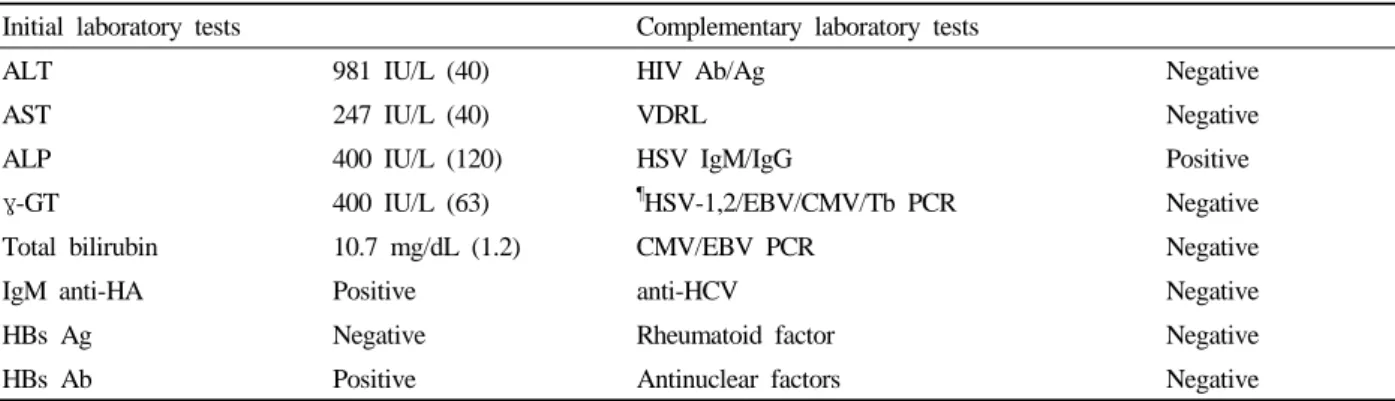
A 32-year-old man was transferred to an intensive care unit (ICU) due to respiration difficulties from a hepatology ward where he had been admitted after a 7-day history of symptoms of acute viral hepatitis A (HA) and a 3-day history of progressive distal and proximal weakness of limbs with additional facial weakness. Initial laboratory tests performed at the ward (results listed in Table 1) suggested acute viral HA infection with high IgM anti-HA antibody titers. Despite improvement in liver function and hepatitis symptoms, nerve conduction was studied and cerebrospinal fluid (CSF) was tapped due to progressive weakness. A diagnosis of Guillain-Barré syndrome (GBS) was supported by albuminocytologic dissociation (1 white blood cell/mm3, 2 red blood cells/mm3, 115.0 mg/dL protein, and 58 mg/dL glucose) and multiple motor-
nerve-conduction defects with decreased compound motor action potentials (Table 2).
On the second day in the ICU the patient was intubated for respiratory arrest and severe autonomic fluctuation. His heart rate was 85~120 beats/min and his arterial blood pressure was up to 200/110 mmHg. Severe diaphoresis was also present. His pupils were dilated to 5 mm and not reactive to light. On day 4, there were no eye movements and spontaneous limb movements noted. Neither vertical or horizontal eye movements could be elicited. All brainstem reflexes and deep tendon reflexes were absent. The results of a CT scan of the head were normal. An electroencephalogram exhibited an alpha rhythm with reactivity to eye opening. A positive pupil response to a 0.1%-pilocarpine test indicated ciliary postganglionic parasympathetic neuropathy with supersensitivity to acetylcholine. These tests and signs indicated the absence of all brain reflexes, suggesting the presence of peripheral deafferentation. In addition,
Journal of Clinical Neurology: Vol. 3, No. 2, 2007
- 106 - Table 1. Data from initial and complementary laboratory tests
Initial laboratory tests Complementary laboratory tests
ALT 981 IU/L (40) HIV Ab/Ag Negative
AST 247 IU/L (40) VDRL Negative
ALP 400 IU/L (120) HSV IgM/IgG Positive
γ-GT 400 IU/L (63) ¶HSV-1,2/EBV/CMV/Tb PCR Negative
Total bilirubin 10.7 mg/dL (1.2) CMV/EBV PCR Negative
IgM anti-HA Positive anti-HCV Negative
HBs Ag Negative Rheumatoid factor Negative
HBs Ab Positive Antinuclear factors Negative
¶CSF, another: blood
ALT; alanine aminotrasferase, AST; aspartate aminotrasferase, ALP; Alkaline phosphatase, γ-GT; γ-glutamyltransferase, HSV;
herpes simplex virus, EBV; Epstein-Barr virus, CMV; cytomegalovirus, Tb; tuberculosis, HIV; human immunodeficiency virus, PCR; polymerase chain reaction, HA; hepatitis A, HBs Ag; hepatitis B surface antigen.
Table 2. Nerve-conduction data
Motor Sensory
Nerve stimulated DML (ms) A (mV) CV (m/s) A (μV)
Day 1
Right median Right ulnar Right tibial Right peroneal
NP 3.5 NP NP
0.391
42 43 44 46
4.066 12.53 15.05 10.94 Day 14
Right median Right ulnar Right tibial Right peroneal
27.0 12.3 NP NP
1.1 1.2
NP NP NP NP DML; distal motor latency, CV; conduction velocity, A; amplitude, NP; no detected potentials.
complementary laboratory tests for vasculitis or other infectious agents were normal except for the presence of latent herpes simplex virus (HSV) infection. A polymerase chain reaction for HSV was negative, and no symptoms of HSV infection were detected. A follow-up nerve-conduction study performed 2 weeks after transfer to the ICU suggested severe demyelinating sensorimotor polyneuropathy (Table 2).
Intravenous gammaglobulin (IVIG) (0.4 g/kg/day) was administered for 5 days, but his neurological status had worsened due to fulminant deafferentation. Therefore, pulse therapy with methylprednisolone (500 mg/day) were given for 3 days. After the initial 5-day course of therapy, IVIG was added twice weekly 2 weeks later.
The patient gradually recovered and he was weaned off the ventilator after 1 month. Three months later he recovered complete power in his upper and lower limbs, except for a residual deficit of left foot weakness (dorsiflexor: grade 4, plantar flexor: grade 4) and bilateral hypopathic sensory change of soles.
DISCUSSION
Our patient suffered from fulminant GBS mimicking cerebral death following acute viral HA. The develop- ment of clinical symptoms of hepatitis, marked increases in bilirubin, aspartate aminotrasferase, alanine amino-
Kang BH, et al. Guillain-Barré Syndrome Mimicking Cerebral Death Following Viral Hepatitis A
- 107 -
trasferase (ALT), and γ-glutamyltransferase levels, and a positive IgM-HA virus antibody test supported the diagnosis of acute HA. Cases exhibiting an association between GBS and HA are extremely rare.1 The reported clinical features of nine reviewed cases of GBS follow- ing HA were as follows: (1) a uniformly good outcome of the neuropathic symptoms, independent of the level of ALT, which corresponds to the severity of liver dys- function; (2) highest occurrence in men; and (3) the interval between the onset of the hepatitis and the development of neuropathic symptoms is less than 14 days.2 The HSV infection in our patient, in spite of neither symptoms nor signs, might have aggravated the severity of GBS.
The initial nerve-conduction study and blink-reflex test in this patient revealed inexcitability of most nerves, which was due to distal pathology of the motor axons:
either a distal conduction block or axonal degeneration.
The nature of this pathology cannot be predicted by the results of an initial electrophysiological evaluation.3 The very prolonged distal motor latencies in the electro- myogram recorded in a subsequent nerve-conduction study suggested the presence of severe demyelinating polyneuropathy and axonopathy. In the case of GBS mimicking cerebral death,4 a sural nerve biopsy indicated that demyelination was the early pathological mechanism.
Therefore, the exact physiopathology and whether our patient had distal demyelination and conduction block with secondary axonal loss or axonal degeneration, or both, remained unclear.
The various treatments used for fulminant GBS mi- micking cerebral death are plasma exchange, IVIG, or plasma exchange and corticosteroids.4 Our patient was treated with IVIG to modulate the immunologic reaction, and with high-dose pulse therapy with methylpredni- solone for suppressing the acute severe inflammation in the peripheral nervous system. There is no evidence that conventional doses of corticosteroids (around 60 mg of prednisone daily) are effective in shortening the course of or reducing residual deficits in acute GBS.5 However, high-dose steroids are perhaps currently best applied to patients who cannot tolerate plasma exchange (e.g., due to severe cardiovascular dysautonomia) or when other treatments are unavailable.6–8
Our patient recovered progressively, and could walk alone with mild weakness of the left foot at 3 months after admission. GBS mimicking brain death usually has a poor recovery rate and a high mortality, particularly in relation to dysautonomia.9 The timely application of combination pulse therapy with both IVIG and methylprednisolone might improve the prognosis of fulminant GBS.
In summary, in rare cases GBS presents with signs of coma and absent brainstem reflexes. The present case may represent the first report of fulminant GBS follow- ing acute HA.
REFERENCES
1. Mares-Segura R, Sola-Lamoglia R, Soler-Singla L, Pou- Serradell A. Guillain-Barré syndrome associated with hepatitis A. Ann Neurol 1986;19:100.
2. Ono S, Chida K, Takasu T. Guillain-Barré syndrome following fulminant viral hepatitis A. Intern Med 1994;33:
799-801.
3. Triggs WJ, Cros D, Gominak SC, Zuniga G, Beric A, Shahani BT, et al. Motor nerve inexcitability in Guillain- Barré syndrome. The spectrum of distal conduction block and axonal degeneration. Brain 1992;115:1291-1302.
4. Vargas F, Hilbert G, Gruson D, Valentino R, Gbikpi- Benissan G, Cardinaud JP. Fulminant Guillain-Barré syndrome mimicking cerebral death: case report and lite- rature review. Intensive Care Med 2000;26:623-627.
5. Samantray SK, Johnson SC, Mathai KV, Pulimood BM.
Landry-Guillain-Barré-Strohl syndrome. A study of 302 cases. Med J Aust 1977;2:84-91.
6. Dowling PC, Bosch VV, Cook SD. Possible beneficial effect of high-dose intravenous steroid therapy in acute demyelinating disease and transverse myelitis. Neurology 1980;3033-36.
7. Mori E, Yoshida T, Ohsumi Y, Tabuchi M, Yamadori A.
Beneficial effects of plasma exchange in acute Guillain- Barré syndrome: comparision with methylprednisolone pulse therapy. Clin Neurol 1988;28;196-203.
8. Ropper AH, Wijdicks EF, Truax BT. Guillain-Barré synd- rome. Contemporary Neurology Series. Philadelphia: F.A.
Davis; 1991;232-234.
9. Winer JB, Hughes RA, Greenwood RJ, Perkin GD, Healy MJ. Prognosis in Guillain-Barré syndrome. Lancet 1985;1:
1202-1203.