• 검색 결과가 없습니다.

Thoracoscopic Needle Aspiration Biopsy for a Centrally Located Solitary Pulmonary Nodule

N/A
N/A
Protected

Academic year: 2021

Share "Thoracoscopic Needle Aspiration Biopsy for a Centrally Located Solitary Pulmonary Nodule"

Copied!
3
0
0

로드 중.... (전체 텍스트 보기)

전체 글

(1)

Korean J Thorac Cardiovasc Surg 2013;46:316-318 □ How to Do It □ http://dx.doi.org/10.5090/kjtcs.2013.46.4.316 ISSN: 2233-601X (Print) ISSN: 2093-6516 (Online)

− 316 −

Department of Thoracic and Cardiovascular Surgery, Korea University Guro Hospital, Korea University College of Medicine Received: April 26, 2012, Revised: February 22, 2013, Accepted: March 7, 2013

Corresponding author: Hyun Koo Kim, Department of Thoracic and Cardiovascular Surgery, Korea University Guro Hospital, Korea University College of Medicine, 148 Gurodong-ro, Guro-gu, Seoul 152-703, Korea

(Tel) 82-2-2626-3106 (Fax) 82-2-866-6377 (E-mail) [email protected]

C

The Korean Society for Thoracic and Cardiovascular Surgery. 2013. All right reserved.

CC
This is an open access article distributed under the terms of the Creative Commons Attribution Non-Commercial License (http://creative- commons.org/licenses/by-nc/3.0) which permits unrestricted non-commercial use, distribution, and reproduction in any medium, provided the original work is properly cited.

Thoracoscopic Needle Aspiration Biopsy for a Centrally Located Solitary Pulmonary Nodule

Ho Kyung Sung, M.D., Hyun Koo Kim, M.D., Ph.D., Young Ho Choi, M.D., Ph.D.

Thoracoscopic needle aspiration is a good alternative for a centrally-located solitary pulmonary nodule (SPN) suspected of being lung cancer without severe pleural adhesion. The authors report the technique of thoracoscopic needle aspira- tion biopsy in a SPN just in the medial aspect of the truncus anterior pulmonary artery and the right upper lobe bronchus.

Key words: 1. Biopsy, needle 2. Lung neoplasms

3. Solitary pulmonary nodule 4. Thoracoscopy

INTRODUCTION

Thoracoscopic needle aspiration biopsy has the greatest utility for the diagnosis of peripheral solitary pulmonary nod- ules (SPNs) that are suspected of being lung cancer.

However, for centrally-located SPNs adjacent to major ves- sels, open thoracotomy is usually performed to obtain patho- logic specimens. The authors report the technique of thoraco- scopic needle aspiration biopsy for a centrally-located SPN.

TECHNIQUE

Chest computed tomography (CT) scans showed an SPN 2.5 cm in size in just the medial aspect of the truncus ante- rior pulmonary artery and right upper lobe bronchus with no evidence of lymph node enlargement in the mediastinum (Fig.

1). A double-lumen endotracheal tube was inserted under general anesthesia, and the patient was placed in the right lat-

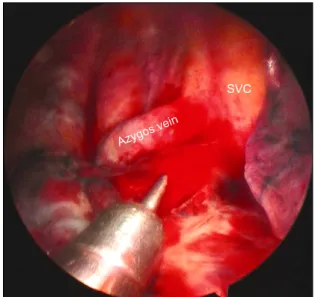
eral position. A 5-mm thoracoscopic port was made at the 6th intercostal space on the mid-axillary line and two 5-mm ports for thoracoscopic forceps and the aspiration needle were made at the 5th intercostal space on the anterior and posterior axillary lines. After a nodule was localized by palpation with the thoracoscopic forceps, a tumor biopsy specimen was ob- tained using a 5-mm endobiopsy aspiration cannula (Wisap, Munchen, Germany) (Fig. 2).

The specimen was Giemsa-stained and examined cytologi- cally, and within 30 minutes the pathologic report revealed adenocarcinoma. His clinical stage was T3N0M0 (stage IIb).

Right upper lobectomy with mediastinal lymph node dis- section was performed through video-assisted thoracoscopic surgery on the spot.

In this case, the patient complained of intermittent blood

tinged-sputum of 2 weeks duration, but bronchoscopy failed

to reveal the lesion and percutaneous needle aspiration could

not be done due to its location. The pathologic diagnosis was

(2)

Thoracoscopic Needle Aspiration for a Central SPN

− 317 −

Fig. 2. A 5-mm endobiopsy aspiration needle was introduced into the mass. SVC, superior vena cava.

Fig. 1. Chest computed tomography scans showing a 2.5-cm nodule (arrow) in just the medial aspect of the truncus anterior pulmonary ar- tery and the right upper lobe with no evidence of lymph node enlarge- ment in the mediastinum.

T3N2M0 (stage IIIa). The patient was discharged unevent- fully on the eighth postoperative day. During 3 months of follow-up he was administered three cycles of adjuvant che- motherapy.

DISCUSSION

The diagnosis of SPN is one of the most common prob- lems encountered by physicians treating diseases of the chest.

Low-suspicion lesions are frequently followed up by serial radiographs. However, SPNs with shapes resembling carcino- ma and arising in patients with a smoking history are highly likely to be lung cancer and require an urgent definitive diagnosis. Larger central lesions lend themselves to broncho- scopic sampling, whereas smaller, peripheral lesions are com- monly approached by percutaneous fine-needle aspiration un- der radiographic guidance [1].

Percutaneous needle aspiration has a relatively low sensi- tivity versus thoracoscopic lung biopsy and it is not helpful at avoiding open lung biopsy because a negative result does not guarantee benignity [2,3]. Thoracoscopic needle aspiration is a procedure intermediate between thoracoscopic lung biop- sy and percutaneous needle biopsy. It can save surgical time, reduce costs, yields more information to pathologist compared

with thoracoscopic lung biopsy [4]. These advantages have encouraged the use of thoracoscopic needle aspiration for the rapid diagnosis of indeterminate peripheral SPNs.

In cases of a centrally-located SPN with a pathology not revealed by bronchoscopy and located too close to major ves- sels or structures to obtain a specimen by percutaneous nee- dle aspiration or thoracoscopic or open lung biopsy, needle aspiration through exploratory thoracotomy provides a means of confirming pathology. Thoracoscopic needle aspiration bi- opsy allowed us to acquire enough tissue for frozen biopsy during the operation because it uses a large bore needle.

Therefore, immediate diagnosis and further procedures are possible without waiting for days for permanent pathology. In addition, there is less risk of postoperative air leakage and bleeding, unlike thoracoscopic incisional biopsy. Having ach- ieved an advanced level of thoracoscopic surgical skill, a sur- geon can directly palpate and control lesions with thoraco- scopic instruments and can easily perform multiple aspirations of suspect nodules under clear vision. With a non-palpable SPN, anatomic localization of the SPN can be corroborated by careful preoperative CT imaging, and intraoperative in- strumental palpation enables further localization. Even if the aspiration needle punctures the wrong place such as a pulmo- nary artery, bleeding is easy to control by compression.

Therefore, thoracoscopic needle aspiration biopsy can be used

(3)

Ho Kyung Sung, et al

− 318 − in selective cases of non-palpable SPN.

In conclusion, the authors successfully attempted thoraco- scopic needle aspiration for a central lesion. Compared with exploratory thoracotomy, this procedure facilitates neoadjuvant chemotherapy, saves surgical time, and reduces the length of stay and postoperative pain. In the absence of severe pleural adhesion, thoracoscopic needle aspiration is a good alternative for centrally-located SPNs suspected of being lung cancer.

CONFLICT OF INTEREST

No potential conflict of interest relevant to this article was reported.

REFERENCES

1. Bousamra M 2nd, Clowry L Jr. Thoracoscopic fine-needle aspiration of solitary pulmonary nodules. Ann Thorac Surg 1997;64:1191-3.

2. Haramati LB. CT-guided automated needle biopsy of the chest. AJR Am J Roentgenol 1995;165:53-5.

3. Levine MS, Weiss JM, Harrell JH, Cameron TJ, Moser KM.

Transthoracic needle aspiration biopsy following negative fi- beroptic bronchoscopy in solitary pulmonary nodules. Chest 1988;93:1152-5.

4. Nakajima J, Furuse A, Kohno T, Ohtsuka T, Matsumoto J,

Oka T. Transthoracoscopic needle biopsy for indeterminate

lung nodules. Surg Endosc 1999;13:386-9.

수치

Fig. 2. A 5-mm endobiopsy aspiration needle was introduced into the  mass. SVC, superior vena cava.

참조

관련 문서

with the experimental C versus t data. If the fit is unsatisfactory, another rate equation is guessed and tested. Integral method is especially useful for fitting simple

Module Initialization function block is used in a program with setting of A/D conversion module located base number, slot number of located module on base, specifying a

 The simplest method of storing a raster layer in the memory of the computer is using a data structure called an array..  We consider alternative methods for searching through

The performance evaluation of a conventional Wave Resonator at the entrance of harbors against solitary wave has been performed using 3D numerical wave flume.. A wave resonator

For my study, this being diagnosed with prostate cancer receiving treatment in patients with complementary and alternative therapies for their experience

Metal foam is a good candidate for hydrogen storage materials by forming hydride..

In the present work, the interaction analysis between tsunami bore and solitary wave and onshore bridge is approached by a numerical method, where the

 This dimension theorem holds only for finite dimensional vec- tor spaces.... rank(T )