Information Behavior on Social Live Streaming Services
Katrin Scheibe *
Dept. of Information Science Heinrich Heine University Düsseldorf, Germany E-mail: [email protected]
Kaja J. Fietkiewicz
Dept. of Information Science Heinrich Heine University Düsseldorf, GermanyE-mail: [email protected]
Wolfgang G. Stock
Dept. of Information Science Heinrich Heine University Düsseldorf, Germany E-mail: [email protected]Open Access
Accepted date: June 3, 2016 Received date: May 5, 2016
*Corresponding Author: Katrin Scheibe
Staff Member
Dept. of Information Science Heinrich Heine University Düsseldorf, Germany E-mail: [email protected]
All JISTaP content is Open Access, meaning it is accessible online to everyone, without fee and authors’ permission. All JISTaP content is published and distributed under the terms of the Creative Commons Attribution License (http:/ creativecommons. org/licenses/by/3.0/). Under this license, authors reserve the copyright for their content; however, they permit anyone to unrestrictedly use, distribute, and reproduce the content in any medium as far as the original authors and source are cited. For any reuse, redistribution, or reproduction of a work, users must clarify the license terms under which the work was produced.
ABSTRACT
In the last few years, a new type of synchronous social networking services (SNSs) has emerged—social live streaming services (SLSSs). Studying SLSSs is a new and exciting research field in information science. What information behaviors do users of live streaming platforms exhibit? In our empirical study we analyzed information production behavior (i.e., broad-casting) as well as information reception behavior (watching streams and commenting on them). We conducted two quan-titative investigations, namely an online survey with YouNow users (N = 123) and observations of live streams on YouNow (N = 434). YouNow is a service with video streams mostly made by adolescents for adolescents. YouNow users like to watch streams, to chat while watching, and to reward performers by using emoticons. While broadcasting, there is no anonymity (as in nearly all other WWW services). Synchronous SNSs remind us of the film The Truman Show, as anyone has the chance to consciously broadcast his or her own life real-time.
Keywords: Social Live Streaming Services, YouNow, Information Behavior, Information Production Behavior, Information Reception Behavior, Social Media
http://dx.doi.org/10.1633/JISTaP.2016.4.2.1
1. INTRODUCTION
In the last few years, a new type of social media has emerged: social live streaming services (SLSSs). Here, every user has the opportunity to produce and to broadcast his or her program in real time. In contrast to other social media, social live streaming services are synchronous, which means that all user activities hap-pen at the same time.
When the social live streaming service YouNow became more popular during the last year, negative publicity about the “dangerous” behavior of teenagers appeared on the news. Possible violations of person-ality rights and especially of privacy were reported. To get a more comprehensive and broader view of the information behavior on live streaming services and to start a new point for further research, this investiga-tion focuses on the informainvestiga-tion behavior on YouNow. It is the first empirical analysis of information behavior concerning general live streaming platforms.
Describing and analyzing SLSSs and their users is a new and exciting research field in information science. What information production behaviors do users of live streaming platforms exhibit? And what informa-tion recepinforma-tion behaviors can we observe? What are the motives of using social live streaming services? In line with these questions we have prepared an online sur-vey with YouNow users as participants. For studying the legal aspects of information production behavior an analysis of potential law infringements on YouNow streams from Germany and the U.S. by Honka et al. (2015) was added to the study.
2. RESEARCH BACKGROUND
SLSSs are social media platforms with the following characteristics:
• they are synchronous,
• they allow users to broadcast their own program in real-time,
• users employ their own mobile devices (e.g., smartphones, tablets) or their PCs and webcams for broadcasting,
• the audience is able to interact with the broadcast-ing users via chats, and
• the audience may reward the performers with, e.g.,
points, badges, or money.
We differentiate between two kinds of social live streaming services:
• general live streaming services (without any the-matic limitation), e.g. YouNow, Twitter’s Periscope, Meerkat Streams, YouTube live, or IBM’s Ustream, and
• topic-specific live streaming services, e.g. Twitch (games), or Picarto (art).
One of the most widely used social live streaming services is the topic-specific streaming service Twitch (Gandolfi, 2016), which is mainly used for streaming video games and electronic sports (e-sports) events (Burroughs & Rama, 2015). There are already several investigations and studies about this platform, but only few scientific studies on general live streaming ser-vices. We could identify a general paper on YouNow (Stohr, Li, Wilk, Santini, & Effelsberg, 2015), an article on technical issues of such services (LeSure, 2015), one about ethical problems (Henning, 2015) and a study on possible law infringements of YouNow users while streaming (Honka, Frommelius, Mehlem, Tolles, & Fietkiewicz, 2015). Fietkiewicz, Lins, Baran, and Stock (2016) found out that especially users from Genera-tion Y (“Millennials,” born between 1980 and 1996) and from Generation Z (born 1996 and later) utilize YouNow. Wilk, Wulffert, and Effelsberg (2015) ana-lyzed the improving of video contributions; and, final-ly, Wilk, Zimmermann, and Effelsberg (2016) studied video upload protocols.
In this article, we apply research about information behavior on social media to general social live stream-ing services, usstream-ing the example of YouNow as a case study (Fig. 1). YouNow’s mission statement highlights the convergence of social media and television as well as user interactions through real-time videos (YouNow, 2016). According to Adi Sideman, founder and CEO of YouNow, this information service broadcasts about 150,000 unique live streams daily (2015). Following Alexa, most users of YouNow come from the Unit-ed States (24.3%), followUnit-ed by people from Turkey (12.1%), Germany (8.4%), Mexico (7.6%), and Saudi Arabia (5.6%) (Monthly unique visitors in February, 2016). The average quota of viewers per broadcaster was (midyear 2015) 11 (Wilk, Zimmermann, &
Effels-berg, 2016, p. 1), but in our experience the distribution of viewers is skewed: Few live streams have hundreds of viewers, while many streams were watched by less than ten people.
3. INFORMATION BEHAVIOR ON SOCIAL
NETWORKING SERVICES
Following Savolainen (2007, p. 109), “information behavior” as well as “information practice” are “um-brella concepts” in information science. In contrast to Savolainen (2007), Case (2012), and other researchers, who link information behavior and information prac-tice mainly to information seeking (e.g., Kumar & Rai, 2013; Majid & Rahmat, 2013), it is possible to broad-en these concepts to all information-related human activities. Here, we are in line with Bates (2010) who defines “information behavior” as every human inter-action with information. “Information behavior is … the term of art used in library and information science to refer to a sub-discipline that engages in a wide range of types of research conducted in order to understand the human relationship to information,” Bates (2010,
p. 2381) concludes. Wilson (2000, p. 49) also defines “information behavior” in a rather broad way:
Information Behavior is the totality of human behav-ior in relation to sources and channels of informa-tion, including both active and passive information seeking, and information use. Thus, it includes face-to-face communication with others, as well as the passive reception of information as in, for example, watching TV advertisements, without any intention to act on the information given.
Fisher, Erdelez, and McKechnie (2005, p. xix) con-ceptualize information behavior “as including how people need, seek, manage, give, and use information in different contexts.” Robson and Robinson (2013, p. 169) propose an information behavior model that “takes into account not just the information seeker but also the communicator or information provider.” For Spink (2010, p. 4), information behavior is “a behavior that evolved in humans through adaption over a long millennium into a human ability, while also developing over a human lifetime.” The phylogeny of information behavior is the evolution of this behavior of the whole human tribe until today; the ontogeny is the develop-Fig. 1Live stream on YouNow. Source: YouNow.com
ment of the information behavior of an individual per-son (Stock & Stock, 2013, p. 465). We will work with this broad concept of “information behavior,” which covers all human information-related activities.
Information behavior depends on the context. For our case study, the context is found in social media or, to define more precisely, in social networking services (SNSs). Social media (or Web 2.0 media) allow users to act both as producers and as consumers (“prosumers”). Prosumers in social media are characterized by shared goals. They form virtual communities (Linde & Stock, 2011, pp. 259 ff.). One kind of social media are social networking services, which are platforms for self-pre-sentation and communication with other members of the community (Boyd & Ellison, 2007). SNSs are either asynchronous (as for instance Facebook; Khoo, 2014, p. 81) or synchronous (as the social live stream-ing services). The main feature of social live streamstream-ing SNSs is the simultaneity of the communication, as all happens in real time.
The broadest term is “social media”; one of its nar-rower terms is (besides other social media as sharing services or weblogs) “social network services” (SNSs).
“SNS” has two narrower terms: “asynchronous SNSs” (e.g., Facebook) and “synchronous SNSs.” Nowadays, social live streaming services (SLSSs) are the only kind of synchronous SNSs.
Social media has found its way into everyday life as well as into working life. It is clear that information behavior research addresses social media as a research object (Meier, 2015, p. 23). Khoo (2014, p. 90) con-cludes,
The rise of social media should herald a new era in information behavior research. Just as the rise of online databases and digital libraries sparked off a generation of research in online searching, so too so-cial media should stimulate a new wave of research and theories focusing on other types of information behavior such as asking, answering and information integration. Research on information behavior on social media can be said to be in a nascent stage. In line with Khoo (2014, p. 90), information behav-ior on social media includes information production and information reception behavior. In our study we emphasize information behavior on SLSSs.
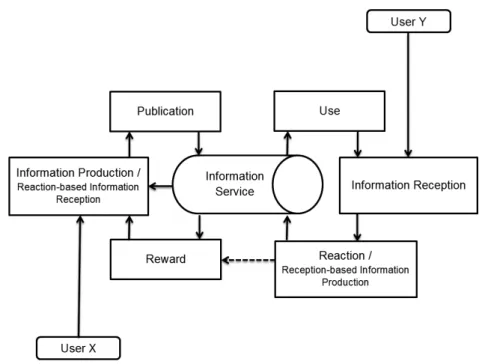
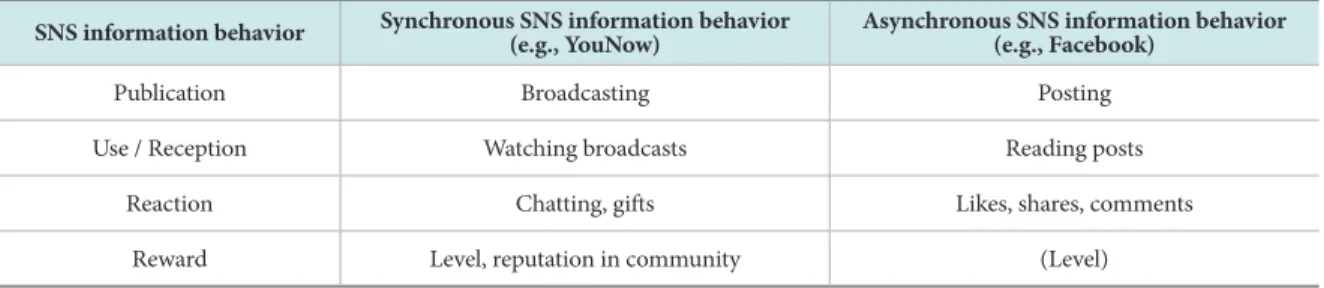
What are the differences in information behavior concerning synchronous and asynchronous SNSs? In contrast to other social media, information behavior on SNSs in general configures a complete cycle (Fig. 2). One user (in our figure it is user X) produces in-formation and publishes it. In an asynchronous SNS like Facebook such a publication is a textual post, an image, or a video; in a synchronous SNS like YouNow it is a broadcast (Table 1). The information service is the platform that enables the communication between the information producer and the information recip-ient. Another user (user Y) utilizes the information service, searches for information, and receives the post or the broadcast. Information reception behavior in an asynchronous SNS will be reading the published posts; in a synchronous SNS this means watching broadcasts in real time. All SNSs allow the recipients to react to a published source, be it by a like, share, or comment on Facebook, or by chat, emoticons, and gifts on YouNow. One can consider the comments of user Y as a kind of information production, but (in contrast to the information production of user X) it is information production in consequence of information reception. Of course user X can or will realize the reactions of the audience. So she or he exhibits information reception behavior in consequence of her/his former informa-tion producinforma-tion behavior. Her or his further produc-tion behavior can depend on such reacproduc-tions. The last step in the cycle is the reward for the information producer. This rewarding function is not adequately developed in asynchronous SNSs (although there are user levels on Facebook), but much elaborated in syn-chronous SNSs. On YouNow, the level of a performer plays an important role for her or his reputation in the community. The user earns virtual currency (“coins”
on YouNow) by broadcasting and by receiving pres-ents from other users. Such coins are needed to endow other performers. Additionally, YouNow offers the currency of “bars” to be bought with real money. The boundaries between reactions and rewards are some-times blurred. For instance, a receiver, say user Y, “likes” a post on Facebook or presents a “heart” on YouNow, so this is Y’s reaction to X’s post or broadcast, but Y can think of it as a reward as well, and X can perceive it as a reward. From these theoretical considerations we derived the framework shown in Figure 2 and Table 1.
Here, our research questions arise. Using the ex-ample of YouNow, we want to know users’ informa-tion behaviors on social live streaming services. In this study, we are going to answer empirically three research questions (RQs), which all consist of three sub-questions:
(RQ 1) What information behavior do users of so-cial live streaming services exhibit?
(RQ 1a) What activities do users practice on such information services?
(RQ 1b) What are the motives for this infor-mation behavior?
(RQ 1c) What influence does rewarding have on users’ motivation?
(RQ 2) What information production behavior can we observe on SLSSs?
(RQ 2a) Do performers prepare for their live streams?
(RQ 2b) How long are the live streams? (RQ 2c) Do performers work with external
music, images, and videos? Are there any legal concerns?
(RQ 3) What information reception behavior can we observe on SLSSs?
Table 1. Information Behavior Categories on Synchronous and Asynchronous Social Networking Services (SNSs)
SNS information behavior Synchronous SNS information behavior (e.g., YouNow) Asynchronous SNS information behavior (e.g., Facebook)
Publication Broadcasting Posting Use / Reception Watching broadcasts Reading posts
Reaction Chatting, gifts Likes, shares, comments Reward Level, reputation in community (Level)
(RQ 3a) What kinds of broadcasts do users view?
(RQ 3b) Which age of performers do they prefer to view?
(RQ 3c) Do users link their live streaming ac-counts to other information services? All research questions are focused on the current usage status of YouNow.
4. METHODS
To answer the research questions, we conducted two empirical investigations, namely an online survey and observations of live streams. Our first investigation is survey-based. It took place from June 3 until June 28, 2015 on Umfrageonline.com and had 123 YouNow us-ers as participants. In the survey, the usus-ers were asked questions about YouNow, their behavior concerning
YouNow, and the acceptance of the service in the com-munity.
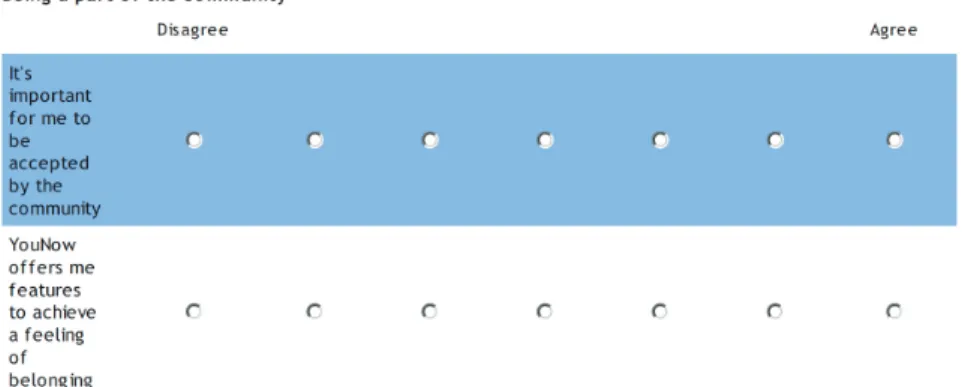
For the majority of the items we pre-formulated answers and defined a 7-point Likert-scale (from “disagree” via “neutral” to “agree”) (Likert, 1932). For instance, in order to answer RQ 1b (on motivations) we prepared for the item of “being part of the commu-nity” two statements (Fig. 3). The participants marked their attitude for every statement in one of the seven boxes. We consciously worked with an uneven num-ber of attitudes, which includes a value for “neutral” in the middle. In our analysis, we summarized the values 1 to 3 as “disagree,” 4 as “neutral,” and 5 to 7 as “agree.” Questions about usage frequencies could be answered with one out of four values, namely “never,” “rarely,” “sometimes,” and “often.” Additionally, for some items (e.g., for answering RQ 3c on links between YouNow and other services) we pre-formulated answers for several questions and the users had the opportunity to add their own entries (Fig. 4). Finally, we asked for
Fig. 3 Measuring the attitude of being part of the community
personal information (demographics).
In order to answer RQ 2c on legal concerns while broadcasting, we did not prefer to bank on user state-ments. Users, especially young users on YouNow, do not and maybe cannot know such legal problems. Therefore, in addition to the survey, we performed a second attempt of data collection and observed streams. This second empirical study concerns po-tential law violations by YouNow users (Honka et al., 2015). Here, the data set was obtained through an ob-servation of a significant amount of streams (N = 434). A similar approach was applied by Casselman and Heinrich (2011), who analyzed YouTube videos and the behavior of their participants. The streams were observed during June 2015 and were limited to ones from Germany and the USA. The socio-demographic data was obtained either from the streamer’s profile or by asking the streamer during his or her broadcast. The observation period was divided into four parts, where different groups of streamers were in focus – females from Germany, males from Germany, females from the USA, and males from the USA. Each group was observed for an entire week. Each day of the ob-servation was divided into four time slots (12 a.m. to 6 a.m., 6 a.m. to 12 p.m., 12 p.m. to 6 p.m., and 6 p.m. to 12 a.m.). In each slot, four streams have been investi-gated for 15 minutes respectively (i.e., total 16 streams or 4 hours per day).
The streams were studied for legally concerning ac-tions. The points of reference were law infringements frequently observed in SLSSs according to German law, which is stricter than U.S. law regarding, for example, copyrights or personal rights. This way we gain a broad-er range of possible legally concbroad-erning actions. De-meanors in the focus of this observation were copyright infringements (concerning music pieces protected by intellectual property rights), youth protection (regard-ing sexual content or underage use of alcohol or drugs), personality rights (rights in one’s own picture, spoken, or written word), and defamation. The classification of a stream as one with potential law infringements was based on a rough assessment by the observer (is music being played in the background, or, are other people being filmed without their explicit consent?) and did not include a complex legal examination or consider-ation of exception regulconsider-ations. Therefore, it is essential to emphasize that the results include only potential
legally relevant actions. We analyzed the observational data quantitatively, i.e. we counted the different types of potential law infringements. All empirical data from both the survey as well as the observations became pro-cessed by Microsoft Excel.
5. INFORMATION BEHAVIOR OF YOUNOW USERS
For all empirical data from our online survey, the number of respondents is N = 123. All in all, 60.6% of the survey participants were male and 39.4% were female. According to Alexa, the amount of male vis-itors to YouNow is higher than the Internet average, which is confirmed by our sample. The median age of our participants was 20 years, and the most frequent age group were 16 year-old adolescents. 51.6% of our sample uses YouNow often, 11.5% sometimes, and 36.9% only rarely. As this analysis is the first step into empirical investigations on SLSSs we have to confine ourselves to descriptive statistics.
What information behaviors do users of SLSSs ex-hibit? There are four main activities on synchronous social networking services, namely publishing infor-mation (i.e., performing real-time), using inforinfor-mation (i.e., watching live streams), reacting on performances (mainly by chatting), and, finally, giving rewards (e.g., by emoticons) (Fig. 2).
YouNow users like to watch streams (59.5% approv-al), to chat while watching (58.4%), and to reward per-formers by using emoticons (60.6%). Less than half of our respondents (45.0%) like to stream actively as well (Table 2).
What are the motives (Lin & Lu, 2011) for using YouNow? In order to formulate adequate questions and to create accurate items on motivations for us-ing SLSSs we consulted the literature on motives on SNSs. Following Nadkarni and Hofmann (2012), there are two main motives for using asynchronous SNSs, namely the need to belong and the need for self-pre-sentation. We want to analyze both motives in more detail. Concerning the need to belong, Brandtzæg and Heim (2009) found a related motivation, namely to find new friends on SNSs. Additionally, we wanted to know whether it is important for a YouNow user to be accepted by the community. Is there a thing
like a “we-intention” (Cheung, Chiu, & Lee, 2011) on YouNow? YouNow gives easy access to publish a stream. Is this a motive to use this service? As the Technology Acceptance Model (TAM) (Davis, 1989) emphasizes the perceived ease of use, a motive for us-ers to use YouNow could be that the system provides an easy opportunity to stream. Greenwald (2013) discusses the motive of fame when using Facebook and Twitter. Are performers going to gain fame on YouNow or at least become a “microcelebrity” (Mar-wick & Boyd, 2011) in their community? If a user is indeed a celebrity (or believes that she/he is), is it a motive for such a user to keep contact with the fan base? Or are YouNow’s users simply bored and search-ing for fun?
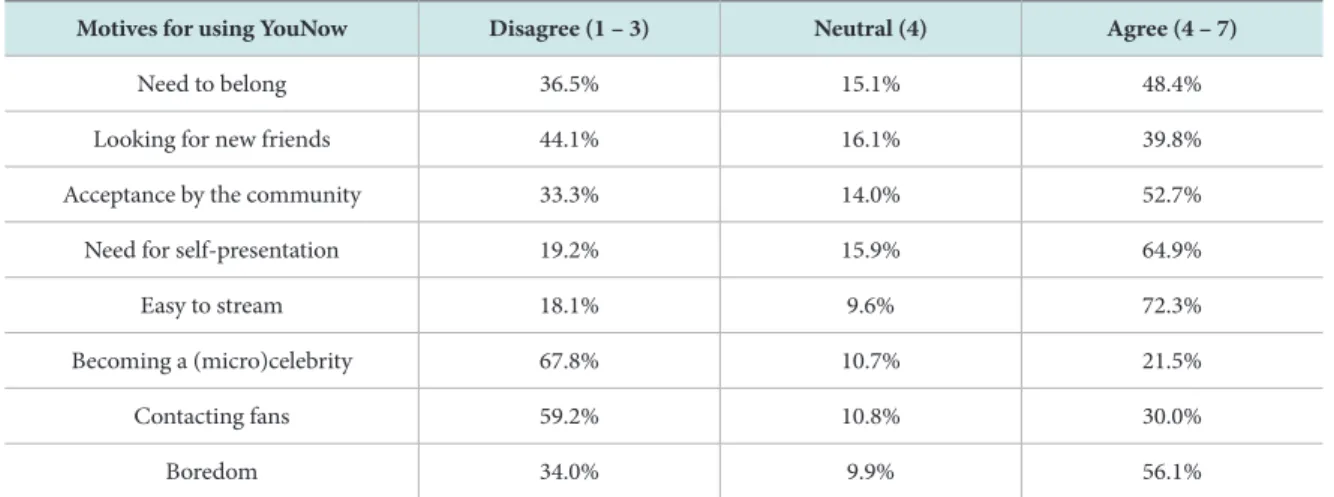
The main motive for using YouNow is the fact that this system is easy to use (72.3% of our respondents agreed with this proposition). Next is the satisfaction of the need of self-presentation (64.9%), followed by boredom (56.1%) and acceptance by the community (52.9%). Around 50% of the test persons use YouNow because of their need to belong (48.4%) and two-fifths because they are looking for new friends (39.8%). Ev-ery fifth of our sample (21.5%) wants to become a (mi-cro)celebrity, and 30.0% are motivated by the contacts with their fan base (Table 3).
In contrast to asynchronous SNSs, YouNow is highly gamified and applies features to reward performers (Wilk, Wulffert, & Effelsberg, 2015). Gamification means the use of game mechanics in non-game con-texts, to motivate users to continue using the system (Zichermann & Cunningham, 2011). Game mechan-ics consist, e.g., of point systems, levels, virtual goods, leaderboards, and gifts. Under certain conditions, the
user has the experience of “flow” (Czíkszentmihályi, 1975), which means that one is engrossed with the sys-tem and loses awareness of other things (e.g. time). Do such game mechanics indeed motivate users to apply social live streaming services? And have they experi-ences of flow?
The majority of YouNow users (58.5%) enjoys re-ceiving digital presents; for about a third (34.0%) it is an important goal to collect all kinds of presents. Mov-ing up in the rankMov-ing of the current streamers’ playlist is important for 50.0%; and reaching the next level is essential for 38.3% of our sample. For most of our par-ticipants, gamification elements like virtual presents or levels are important motivational factors. And 58.5% had experiences of flow while using YouNow (Table 4).
6. INFORMATION PRODUCTION BEHAVIOR
OF YOUNOW USERS
When speaking about Information production on YouNow, it means broadcasting real-time. When it comes to a performance, do users prepare themselves for the live stream? In Table 5, we only considered such test persons who had experiences with streaming. Nearly all (80.0%) checked their equipment (adjusting camera and checking microphone) before broadcast-ing. More than 60% of the users inform their friends or fans before the performance starts. For about 42%, styling themselves (clothes, hair, etc.) was self-evident. Some performers (30.0%) prepare their topics to talk about; and a few do vocal exercises (11.7%).
How long are the live performances (RQ 2b)? The median of all broadcasts is about one hour; however, Table 2. Motives for Using YouNow (N = 122) / RQ 1a
Main activities on YouNow Disagree (1 – 3) Neutral (4) Agree (4 – 7)
Streaming 49.2% 5.8% 45.0%
Watching 31.4% 9.1% 59.5%
Chatting 30.8% 10.8% 58.4%
Rewarding 24.5% 14.9% 60.6%
there are streams lasting several days including periods of eating and sleeping.
Do performers use copyrighted material? The sur-vey participants indeed play music in the background “often” or “sometimes” (47.7%); they show, albeit to a much lesser extent, images (26.1%) and videos (21.6%)
(Table 6).
Do performers violate the law while using copy-righted material? Is there any other problematic be-havior? In our second empirical study we observed streams. We found possible law infringements for both users from Germany and from the U.S. (Table 7), but Table 3. Motives for Using YouNow (N = 122) / RQ 1b
Motives for using YouNow Disagree (1 – 3) Neutral (4) Agree (4 – 7)
Need to belong 36.5% 15.1% 48.4% Looking for new friends 44.1% 16.1% 39.8% Acceptance by the community 33.3% 14.0% 52.7% Need for self-presentation 19.2% 15.9% 64.9% Easy to stream 18.1% 9.6% 72.3% Becoming a (micro)celebrity 67.8% 10.7% 21.5% Contacting fans 59.2% 10.8% 30.0%
Boredom 34.0% 9.9% 56.1%
Items: Need to belong: “YouNow offers me features to achieve a feeling of belonging” Looking for new friends: “I was looking for new friends on YouNow”
Acceptance by the community: “It’s important for me to be accepted by the community” Need for self-presentation: “I feel better when the number of my spectators increases” Easy to stream: “YouNow gives me easy access to streaming”
Becoming a (micro)celebrity: “It’s important for me to become famous” Contacting the fans: “Contact with the fans”
Boredom: “I’m bored and it’s fun”
Table 4. Influences of Rewarding and Gamification Elements (N =94) / RQ 1c
Rewarding / Gamification Disagree (1 – 3) Neutral (4) Agree (4 – 7)
Reaching the next level 46.8% 14.9% 38.3% Moving up in ranking 37.2% 12.8% 50.0% Achieving all virtual presents 52.2% 12.8% 34.0% Enjoying presents 24.5% 17.0% 58.5%
Flow 27.7% 13.8% 58.5%
Items: Reaching the next level: “I spend more time on YouNow in order to reach the next level” Moving up in ranking: “It is my aim to move up on the streamer’s ranking list”
All virtual presents: “It is my aim to achieve all virtual presents” Enjoying presents: “I enjoy receiving presents”
Table 5. Preparation for the Live Stream (N = 63) / RQ 2a
Activities before streaming Relative frequency
Checking equipment 80.0% Informing friends or fans 63.3%
Styling 41.7%
Preparing topics 30.0%
Vocal exercise 11.7%
Table 6. Usage of Music, Images and Videos (N = 111) / RQ 2c
Usage of copyrighted material Relative frequency
Music 47.7%
Images 26.1%
Videos 21.6%
Materials used “often” and “sometimes.”
Table 7. Observed Potential Law Infringements (N = 434 streams) / RQ 2c
Potential law infringements Relative frequencyU.S Relative frequencyGermany
Copyright (music) 44.3% 37.0% Personality rights 8.7% 11.9%
Defamation 1.4% 5.7%
Underage drug or alcohol consumption 2.3% 3.3%
Sexual content 4.1% 0.9%
N (U.S.) = 223; N (Germany) = 211. Source: Honka et al. (2015)
there are only minor differences between streamers from Germany and the U.S. In both countries, the most common potential violation was the copyright infringement of music: a total 37.0% of German and 44.3% of U.S. streams. The second most observed po-tential illegal behavior concerned possible violation of personality rights. The actions chosen for this category were filming third parties, showing pictures of third parties, reading aloud chat-conversations (or similar) with third parties, or putting phone conversations with
third parties on speaker during a stream, all without consent of these parties or even their awareness that their picture or their words are being brought to the public. Here, a total 11.9% of German streams and 8.7% of the U.S. streams included potential violations of personality rights. The category of defamation includes insulting remarks made by the streamer or by the audience, and were observed in 5.7% of German and 1.4% of U.S. streams. Regarding youth protection, two aspects were elaborated, the underage use of alcohol or
Table 8. Watched Streams by Performer Types (N = 122) / RQ 3a
Watched streams by performers Relative frequency
Friends 58.2%
YouTubers 37.7%
New broadcasters 37.7%
Table 9. Watched Streams by Similarity to the Receiver (N = 122) / RQ 3a
Watched streams by similarities Relative frequency
Same age 34.4%
Same interests 33.6%
Same country 30.3%
Same school degree 7.4%
Table 10. Watched Streams by the Age of Performers (N = 122) / RQ 3b
Watched streams by performers’ age Relative frequency
13 – 15 years old 20.5% 16 – 20 years old 42.6% Older than 20 years 37.7%
drugs, and sexual content (revealing appearance of the streamer, or pressuring requests from viewers to the streamer to undress etc.). A total of 3.3% of German and 2.3% of U.S. streams included underage drinking or drug use, whereas 0.9% of German and 4.1% of U.S. streams had sexual content.
7. INFORMATION RECEPTION BEHAVIOR OF
YOUNOW USERS
Users like to watch streams (59.6% approval; Table 2), to chat with the performer as well as with other viewers (58.4%), and to reward the performer (60.6%). What do they mainly watch? Many recipients prefer to watch streams of their friends (58.2%); more than a third of all participants (37.7%) views streams by known
You-Tubers as well; and also 37.7% are open for attending streams published by new broadcasters (Table 8).
There is only a minority of users who chose streams because of similarities between themselves and the performer. About a third of our test persons watches streams by performers with the same age or shared in-terests, or who come from the same country. The same school diploma or degree does not play any noticeable role (7.4%).
About two out of three users of our sample prefer to watch streams by adolescents between the ages of 13 and 20 (Table 10). So YouNow is a service with content mainly made by teenagers for teenagers.
To create an account on YouNow, one has to be a Facebook, Twitter, Instagram, or Google+ user; there is no option to register by email address. Do YouNow users also apply these social media to establish links
between their YouNow account and their accounts on other information services? As Table 11 shows, about half of the sample indeed works with links between YouNow and their sites on Facebook, Twitter, and Instagram. A third of the respondents links to their YouTube channel, while Tumblr, Google+, and Snap-chat only play minor roles. We can state that there is a distinct multi-channel behavior of YouNow users.
8. DISCUSSION
What lessons do we learn from our studies about the information behavior on general social live streaming services? Our case study, YouNow, is a service with streams by adolescents for adolescents. YouNow users like to watch streams, to chat while watching, and to reward performers by using emoticons. 45% of our participants like to stream actively as well. The main motive for using YouNow is the simple fact that this system is easily utilized. Next is the satisfaction of the need of self-presentation, followed by boredom and intended acceptance by the community. For many YouNow users, gamification elements like virtual presents or levels are important motivational factors. Many users even report about experiences of flow while using this service. Information production on YouNow means broadcasting real-time. The medi-an length of all broadcasts is about one hour, but we found streams lasting several days. We could observe potential law infringements while streaming, first of
all copyright and personality rights violations. Many recipients prefer to watch streams of their friends and of people aged between 13 and 20 years. There is a distinct multi-channel behavior of YouNow users, as they link their YouNow accounts to other social media platforms such as Facebook, Twitter, Instagram, and YouTube.
There are some limitations of our empirical study. The number of respondents of the online survey is rather small (123 respondents completed the survey). The results of the investigation would be more accu-rate and would better represent the whole population if there were a higher number of participants. Fur-thermore, most of the survey participants were from Germany, the United States, and the United Kingdom, and none from Turkey, Saudi Arabia, or Mexico, where – according to data from Alexa – a high number of site visitors originate. To get a better understanding of social live streaming services, there is need for further investigations of other live streaming platforms as well as more extensive ones about YouNow itself. Also, the legal aspects of live streaming should be analyzed in more detail. Are there indeed consequences for law in-fringements (e.g., after defamation or violation of per-sonality rights)? Is the use of music really a violation of copyright or is it, especially in the United States, subject to fair use?
Information behavior on synchronous SNSs like YouNow shows some similarities to information be-havior on asynchronous social media, but also major differences in some aspects. On asynchronous social Table 11. Multi-channel Behavior (N = 111) / RQ 3c
Link to other service Relative frequency
Facebook 55% Twitter 55% Instagram 46% YouTube 33% Tumblr 2% Google+ 1% Snapchat 1%
media, information seeking is an essential type of in-formation behavior (Kim & Sin, 2014). There are many hints that people use social media for seeking topic-re-lated information, e.g. health information (Oh & Kim, 2014; Pálsdóttir, 2014; Zhang, 2013). On synchronous SNSs, there is no information seeking behavior be-side the selection of the performer or the genre (via hashtags).
We find similar motives for using synchronous SNSs in comparison to asynchronous social media. Nadkar-ni and Hofmann (2012) reported about the need to belong and the need for self-presentation. Hsu, Chang, Lin, and Lin (2015) identified four motives which af-fect interactivity and in turn satisfaction and continued use, namely entertainment, socialization, information seeking, and self-presentation. Apart from information seeking, all other motives can be found on synchro-nous SNSs as well. The very important entertainment motives on YouNow consist of several components such as relieving one’s boredom, becoming a (micro) celebrity, and staying in contact with fans.
On asynchronous social media (as in many other regions of the World Wide Web), it is possible to cre-ate fake accounts or other selves (Bronstein, 2014). Here, the adage “On the Internet, nobody knows you’re a dog” (Steiner, 1993) is a truism. It is true for the reception side of synchronous SNSs, but definitely not for the production side. The performer may use a nickname, but you see him or her in full attire. If the performer on YouNow is a dog, everyone will realize this fact.
As a first step into the new research area of general live streaming services, this study is limited to descrip-tive statistics of basic empirical data on YouNow. Nec-essary next steps include the elaboration of a theory of information behavior on social live broadcasting services and the integration of our empirical as well as (future) theoretical results into known approaches in social media research. As research on SLSSs shows, it is important for information science to broaden its sometimes limited view only on information seeking behavior towards an entire view on users’ tion-related activities, including all aspects of informa-tion producinforma-tion and informainforma-tion recepinforma-tion behavior.
Synchronous SNSs remind us of The Truman Show, which is an American film from 1998 presenting the life of its protagonist, Truman Burbank (played by
Jim Carrey), in a constructed television reality show, which is live broadcasted to its audience. Truman’s life is monitored 24/7 from his birth until his escape from the studio, when he was 30 years old. However, there is a great difference: In contrast to Truman, broadcasters on YouNow are well aware of their actions. Applying YouNow, users can stream wherever they want to with-out any time limit – and produce their own Truman Show.
REFERENCES
Bates, M.J. (2010). Information behavior. In M.J. Bates & M.N. Maack (Eds.), Encyclopedia of library and information sciences (3rd ed.) (pp. 2381-2391). New
York, NY: CRC.
Boyd, D.M., & Ellison, N.B. (2007). Social network sites: Definition, history, and scholarship. Journal of Computer-Mediated Communication, 13(1), 210-230.
Brandtzæg, P.B., & Heim, J. (2009). Why people use social networking sites. Lecture Notes in Computer Science, 5621, 143-152.
Bronstein, J. (2014). Creating possible selves: Informa-tion disclosure behavior on social networks. Infor-mation Research, 19(1), paper 609.
Burroughs, B., & Rama, P. (2015). The eSports Trojan horse: Twitch and streaming futures. Journal of Vir-tual Worlds Research, 8(2), 1-5.
Case, D.O. (2012). Looking for information: A survey of research on information seeking, needs, and behavior (3rd ed.). New York, NY: Academic Press.
Casselman, I., & Heinrich, M. (2011). Novel use pat-terns of salvia divinorum: Unobtrusive observation using YouTube. Journal of Ethnopharmacology, 138(3), 662-667.
Cheung, C.M.K., Chiu, P.-Y., & Lee, M.K.O. (2011). Online social networks: Why do students use Face-book? Computers in Human Behavior, 27, 1337-1343.
Czíkszentmihályi, M. (1975). Beyond boredom and anx-iety. Experiencing flow in work and play. San Fran-cisco, CA: Jossey-Bass.
Davis, F.D. (1989). Perceived usefulness, perceived ease of use, and user acceptance of information technol-ogy. MIS Quarterly, 13(3), 319-340.
Fietkiewicz, K.J., Lins, E., Baran, K.S., & Stock, W.G. (2016). Inter-generational comparison of social me-dia use: Investigating the online behavior of differ-ent generational cohorts. In Proceedings of the 49th
Hawaii International Conference on System Sciences (pp. 3829-3838). Washington, DC: IEEE Computer Society.
Fisher, K.E., Erdelez, S., & McKechnie, L. (2005). Pref-ace. In K.E. Fisher, S. Erdelez, & L. McKechnie (Eds.), Theories of information behavior (pp. xix-xxii). Medford, NJ: Information Today.
Gandolfi, E. (2016). To watch or to play, it is in the game: The game culture on Twitch.tv among performers, plays and audiences. Journal of Gaming & Virtual World, 8(1), 63-82.
Greenwald, D.N. (2013). Fame, Facebook and Twitter: How attitudes about fame predict frequency and nature of social media use. Psychology of Popular Media Culture, 2(4), 222-236.
Henning, C. (2015). Warum durch Phänomene wie YouNow die Vermittlung von Medienkompetenz immer wichtiger wird. Ein Beitrag aus medienethi- scher Sicht. In T. Junge (Ed.), Soziale Netzwerke im Diskurs (pp. 199-212). Hagen, Germany: FernUni-versität.
Honka, A., Frommelius, N., Mehlem, A., Tolles, J.N., & Fietkiewicz, K.J. (2015). How safe is YouNow? An empirical study on possible law infringements in Germany and the United States. The Journal of MacroTrends in Social Science, 1(1), 1-17.
Hsu, M.-H., Chang, C.-M., Lin, H.-C., & Lin, Y.-W. (2015). Determinants of continued use of social media: The perspectives of uses and gratifications theory and perceived interactivity. Information Re-search, 20(2), paper 671.
Khoo, C.S.G. (2014). Issues in information behavior on social media. Libres, 24(2), 75-96.
Kim, K.-S., & Sin, S.-C.J. (2015). Use of social media in different contexts of information seeking: Effects of sex and problem-solving style. Information Re-search, 20(1), paper isic24.
Kumar, S., & Rai, N. (2013). Online searching behav-ior of social science researchers in IR interfaces of e-journal database systems. Journal of Information Science Theory and Practice, 1(4), 48-66.
LeSure, M. (2015). Adding live streaming apps to your e-resource arsenal. Journal of Electronic Resources
Librarianship, 27(3), 199-201.
Likert, R. (1932). A technique for the measurement of attitudes. New York, NY: Archives of Psychology. Lin, K.-Y., & Lu, H.-P. (2011). Why people use social
networking sites: An empirical study integrating network externalities and motivation theory. Com-puters in Human Behavior, 27, 1152-1161.
Linde, F., & Stock, W.G. (2011). Information markets: A strategic guideline for the i-commerce. Berlin, Ger-many, New York, NY: De Gruyter Saur.
Majid, S., & Rahmat, N. A. (2013). Information needs and seeking behavior during the H1N1 virus out-break. Journal of Information Science Theory and Practice, 1(1), 42-53.
Marwick, A., & Boyd, D. (2011). To see and be seen: Celebrity practice on Twitter. Convergence. The In-ternational Journal of Research into New Media, 17, 139-158.
Meier, F. (2015). Informationsverhalten in Social Media. Information. Wissenschaft & Praxis, 66(1), 22-28. Nadkarni, A., & Hofmann, S.G. (2012). Why do people
use Facebook? Personality and Individual Differenc-es, 52(3), 243-249.
Oh, S., & Kim, S. (2014). College students’ use of social media for health in the USA and Korea. Informa-tion Research, 19(4), paper 643.
Pálsdóttir, A. (2014). Preferences in the use of social media for seeking and communicating health and lifestyle information. Information Research, 19(4), paper 642.
Robson, A., & Robinson, L. (2013). Building on models of information behavior: Linking information seek-ing and communication. Journal of Documentation, 69(2), 169-193.
Savolainen, R. (2007). Information behavior and infor-mation practice: Reviewing the “umbrella concepts” of information-seeking studies. Library Quarterly, 77(2), 109-132.
Spink, A. (2010). Information behavior. An evolutionary instinct. Berlin, Germany: Springer.
Steiner, P. (1993). “On the Internet, nobody knows that you are a dog” [Cartoon]. The New Yorker, July 5, 1993, 61.
Stock, W.G., & Stock, M. (2013). Handbook of infor-mation science. Berlin, Germany, Boston, MA: De Gruyter Saur.
(2015). An analysis of the YouNow live streaming platform. In 40th Local Computer Networks
Confer-ence Workshops. Clearwater Beach, FL, 26-29 Oct. 2015 (pp. 673-679). Washington, DC: IEEE. Wilk, S., Wulffert, D., & Effelsberg, W. (2015). On
in-fluencing mobile live broadcasting users. In IEEE International Symposium on Multimedia, 14-16 Dec. 2015, Miami, FL (pp. 403-406). Washington, DC: IEEE.
Wilk, S., Zimmermann, R., & Effelsberg, W. (2016). Leveraging transitions for the upload of user-gen-erated mobile video. In Proceedings of the 8th
Inter-national Workshop on Mobile Video, May 13 2016, Klagenfurt, Austria (art. no. 5). New York, NY: ACM.
Wilson, T.D. (2000). Human information behavior. In-forming Science, 3(2), 49-55.
YouNow (2016). About YouNow. Retrieved from https:// www.younow.com/about.
Zhang, Y. (2013). College students’ uses and perceptions of social networking sites for health and wellness information. Information Research, 17(3), paper 523.
Zichermann, G., & Cunningham, C. (2011). Gamifica-tion by design. Beijing, China: O’Reilly.