https://doi.org/10.4174/astr.2017.93.2.65 Annals of Surgical Treatment and Research
Reasons for operation cancellations at a teaching hospital: prioritizing areas of improvement
Mahmoud Abu Abeeleh, Tareq M. Tareef1, Amjad Bani Hani, Nader Albsoul2, Omar Q. Samarah1, M. S. ElMohtaseb2, Musa Alshehabat3, Zuhair Bani Ismail3, Omar Alnoubani2, Salameh S. Obeidat4, Sami Abu Halawa4
Departments of Cardiothoracic Surgery, 1Orthopaedic Surgery, and 2General Surgery, Faculty of Medicine, The University of Jordan, Amman, 3Faculty of Veterinary Medicine, Jordan University of Science and Technology, Irbid, 4Department of Anesthesia and Critical Care, Faculty of Medicine, The University of Jordan, Amman, Jordan
INTRODUCTION
Operation cancellation puts a huge burden on health care pro viders and negatively affects patients and their families [1].
Operation cancellation has many definitions in the lite ra ture [2]. For the purpose of this study, it is defined as cases that appeared in the definitive operative room (OR) list that ulti
mately were not performed on that day. International estimates of the incidence of operation cancellation vary with country and type of setting and range from 2% to 30% [3].
Reasons for cancellations are vary widely and may be difficult
to tackle all at once. Ezike et al. [2] reported 226 causes of opera tion cancellation in his study. Cancellation can be due to fac tors related to health care providers and hospital itself or due to patientrelated factors. In a study reported by Garg et al.
[4], hospital and administration related factors were the main reasons for operation cancellation. Other researchers have re
ported that patientrelated factors were more important [5].
Health care institutions always strive to efficiently utilize their resources. It would be useful for each institution to deter
mine the most common avoidable reasons for operation can
cella tion and tackle those first. At Jordan University Hospital Purpose: To report rates of and reasons for operation cancellation, and to prioritize areas of improvement.
Methods: Retrospective data were extracted from the monthly reports of cancelled listed operations. Data on 14 theatres were collected by the office of quality assurance at Jordan University Hospital from August 2012 to April 2016. Rates and reasons for operation cancellation were investigated. A Pareto chart was constructed to identify the reasons of highest priority.
Results: During the period of study, 6,431 cases (9.31%) were cancelled out of 69,066 listed cases. Patient no-shows accounted for 62.52% of cancellations. A Pareto analysis showed that around 80% of the known reasons for cancellation after admission were due to a lack of surgical theatre time (30%), incomplete preoperative assessment (21%), upper respiratory tract infection (19%), and high blood pressure (13%).
Conclusion: This study identified the most common reasons for operation cancellation at a teaching hospital. Potential avoidable root causes and recommended interventions were suggested accordingly. Future research, available resources, hospital policies, and strategic measures directed to tackle these reasons should take priority.
[Ann Surg Treat Res 2017;93(2):65-69]
Key Words: Operation cancellation, Quality improvement
Reviewed January February March April May June July August September October November December
Received December 19, 2016, Revised March 10, 2017, Accepted March 15, 2017
Corresponding Author: Tareq M. Tareef
Research Fellow at Jordan University Hospital, The University of Jordan, Queen Rania St, Amman 11942, Jordan
Tel: +962-7-9852-310, Fax: +962-7-9852-3102 E-mail: [email protected]
Copyright ⓒ 2017, the Korean Surgical Society
cc Annals of Surgical Treatment and Research is an Open Access Journal. All articles are distributed under the terms of the Creative Commons Attribution Non- Commercial License (http://creativecommons.org/licenses/by-nc/4.0/) which permits unrestricted non-commercial use, distribution, and reproduction in any medium, provided the original work is properly cited.
(JUH), 18,000–20,000 operations are performed annually making operation efficiency a necessity. A growing body of research is being conducted worldwide to characterize the issue of operation cancellation in referral hospitals. In Jordan, how ever, despite the regional and international recognition of highquality health care, there have been only 2 studies re
viewing the current situation of operation cancellation [6,7]. To our knowledge, none of those studies attempted to prio ri tize the reasons for operation cancellation to thereby direct efforts of improvement. Therefore, the aim of this study is to report the rate of and reasons for operation cancellation at a single university referral hospital, and to prioritize areas of improve
ment.
METHODS
JUH is a university referral hospital with a capacity of 599 beds. There are 14 operating rooms where major and minor opera tions can be performed. Each surgeon has an assigned day and operative theatre for his elective cases. Emergency cases are listed on an emergency board and are conducted after the elective lists, while urgent cases interrupt the schedule of the next available theatre. Operation lists for elective procedures are prepared and sent to theatres by the preceding afternoon.
Listed cases are evaluated in the ward the evening before the surgery by the anesthesia residents who report potentially difficult cases to a consultant anesthetist.
Daily data on the number of scheduled cases and the number of cancellations are collected by an assigned OR nurse and are re ported monthly to the office of quality assurance at JUH.
These reports were studied retrospectively from August 2012 to April 2016. Data on reasons for cancellation were available starting from January 2014 and were also reported by the
assigned nurse who chose the reason from a list of 10 reasons.
These reasons were selected based on a previous pilot study that identified the 10 most common reasons for operation can cellation at JUH. Reasons that didn’t match any of the 10 reasons were reported as “others” and were described by the assigned nurse.
The reasons for cancellation can be assigned into 3 groups:
patient noshows, patientrelated reasons, and hospitalrelated reasons. Patientrelated reasons included (upper respiratory tract infections [URTI], impaired cardiac function, impaired pulmo nary function, high blood pressure, and uncontrolled blood sugar). Hospitalrelated reasons included (lack of surgical theatre time, incomplete preoperative assessment, shortage of nursing staff, shortage of anaesthesia staff, and equipment or supplies shortage). Rates and reasons for operation cancellation were investigated. A Pareto chart was constructed to identify the reasons of highest priority.
Statistical analyses were performed using IBM SPSS Statistics ver. 19.0 (IBM Co., Armonk, NY, USA) and Pareto analysis was performed using the Pareto tool on the American Society for Quality website.
RESULTS
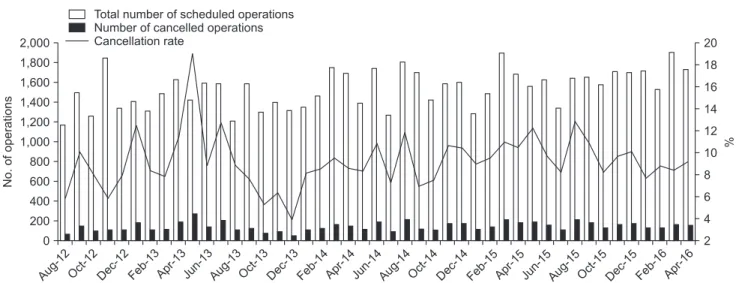
The overall cancellation rate during the period from August 2012 to April 2016 was 9.31% (6,431 cancelations out of 69,066 scheduled operations). Fig. 1 shows a flow chart of cancellation rates where the highest incidence was during May 2013 due to a nursing strike (19.18%).
Since January 2014, a total number of 4,261 scheduled opera
tions were cancelled for different reasons. Of those, 2,664 were due to patient noshows (patient were not admitted to the hospital) accounting for 62.52% of cancellations.
No.ofoperations
Aug-12 Oct-1 2
Dec-12 Feb-13Apr-1 3
Jun-13Aug-13Oct-1 3
Dec-13 Feb-14Apr-1 4
Jun-14Aug-14Oct-1 4
Dec-14 Feb-15Apr-1 5
Jun-15Aug-15Oct-1 5
Dec-15 Feb-16Apr-1 6 Operation cancelation flow chart; JUH
0 2,000 1,800 1,600 1,400 1,200 1,000 800 600 400 200
%
2 20 18 16 14 12 10 8 6 4 Total number of scheduled operations
Number of cancelled operations Cancellation rate
Fig. 1. Cancelation rate flow chart from August 2012 to April 2016. JUH, Jordan University Hospital.
Table 1 presents numbers and rates of cancellation according to the reason after patients were admitted to the hospital.
Other reasons for cancellation included a wide variety of hospital and patient related reasons such as: change of manage
ment plan, unavailability of the surgeon, last minute refusal of patients, failure to present consent by the guardian in pae
diatric patients, fever, patient not fasting, patient not fit for reasons other than those mentioned above, failed intravascular access, death of the patient, and other unspecified reasons.
A Pareto analysis was done to prioritize the identified reasons for cancellation after admission to the hospital according to fre quency. The 4 reasons responsible for 83% of operation can
cellation after admission to JUH were lack of surgical theatre time (30%), incomplete preoperative assessment (21%), URTI (19%), and high blood pressure (13%) (Fig. 2).
DISCUSSION
Operation cancelation rate at JUH is 9.31%, which is within the literature reported range of cancellation 2%–30% [3].
Cancellation due to patient noshows (not admitted to the hospital) accounted for about twothirds of cancellations (62.57%). Although this was the most common overall reason for cancellation in many studies in the literature, including 2 referral hospitals in Jordan, this is an exceptionally high per
centage when compared to the rates from the aforemen tioned studies, 23.0% and 35.6% [6,7]. Failure to show up for surgery includes patients who made but neither kept nor cancelled a reservation, and patients who cancelled their operation late after operative list distribution.
Patient noshows for the scheduled surgery is a multifactorial and challenging problem and there has been no consensus among researchers regarding the acceptable cancellation rate due to patient noshows. For example, the department of health in Australia, set a benchmark of <0.5% for the rate of case cancellation due to patient noshows [8]. Root causes identifying patient noshows were not investigated in this study. Potential root causes may include inconvenient date of surgery, patients forgetting about their appointments, or patients’ fear and doubt. At JUH, there is no protocol to remind patients of their ap point ments. However, to help lower the incidence of patients’
non atten dance, policies should be established by the hospital policy makers to allow dedicated personnel to remind patients through phone calls, text messages, or emails [9,10]. Reminding patients may improve patient compliance with appointment keeping and seems a logical strategy in our setting where most patients have mobile phones.
The Pareto chart shows that the most common reasons for scheduled operation cancellation after admission were lack of surgical theatre time, incomplete preoperative assessment, URTI, and high blood pressure. It appears that these reasons are Table 1. Rate and reasons for cancellation of scheduled op
erations after admission to Jordan University Hospital Reason for cancellation No. of cases (%) Patientrelated reasons
Upper respiratory tract infections 244 (15.28)
High blood pressure 173 (10.83)
Impaired cardiac function 116 (7.26)
Impaired pulmonary function 29 (1.82)
Uncontrolled blood sugar 7 (0.44)
Hospitalrelated reasons
Lack of surgical theatre time 387 (24.23) Incomplete preoperative assessment 265 (16.59) Equipment, supplies or ICU bed shortage 34 (2.13)
Shortage of anesthesia staff 13 (0.81)
Shortage of nursing staff 13 (0.81)
Other reasons 316 (19.79)
Total 1,597 (100)
ICU, intensive care unit.
No.ofcancelledoperations
Lack of surgical theatre time 0
450 400 350 300 250 200 150 100
%
0 120 100 80 60 40 20
Incomplete preoperative assessment
URTI High blood
pressure Unfit
cardiac-wise Equipment or supplie
shortages Unfit pulmonary
wise - Shortage of nursing
staff
Shortage of anesthesia
staff
Uncontrolled blood sugar
100%
98% 99%
95% 97%
93%
83%
70%
51%
30%
Fig. 2. Pareto chart of operative cancellations by identified reasons after admission; URTI, upper respiratory tract infection.
potentially avoidable.
Root causes identifying lack of surgical theatre time were not investigated in this study. Overbooking of operative lists is a poten tial avoidable root cause [11]. Surgeons may feel optimistic in their estimates, pressured from the long waiting lists or even fear of blame for not working hard enough. No policies were found at JUH to outline the process of operative lists scheduling to avoid overbooking. Van VeenBerkx and van Dijk [12] have reported that scheduling the anesthesia and surgeoncontrolled time more accurately leads to fewer case cancellations in a university hospi tal setting. A third component of operative theatre time is the time wasted between scheduled operations [13]. No policies at JUH outline the expected timelines of operative theatre times.
Incomplete preoperative assessment is another reason of priority at JUH. Root causes of this reason were not investi
gated in this study. These cancellations may be due to the pre
operative assessment commencing on the evening preceding sur gery, with some of the assessments shifting to the day of sur gery [14]. No policies present at JUH to outline the expected timelines for completion of preoperative assessments. A pre
opera tive assessment clinic where patients complete their pre opera tive assessments days before their surgery is another po ten tial solution. This has been shown to be an effective mea
sure in minimizing cancellation rates [15]; however, this seems diffi cult to establish at JUH given the available resources and the large number of operations performed per month.
Although guidelines exist for the treatment of elevated blood pres sure, there remains a paucity of literature and accepted guidelines for the perioperative evaluation and care of patients with hypertension who undergo noncardiac surgery [16]. Other possible contributing factors for operation cancelation due to high blood pressure include poor blood pressure monitoring pre operatively and inappropriate/inadequate pharmacologic ther apy. JUH lacks guidelines on management and monitoring of hypertension in preoperative patients.
Cancellations due to URTI is a complex issue. Informed consent, good clinical judgment and experience are crucial factors in the decisionmaking process [17]. JUH also lacks guidelines on cancellations of operations due to suspected
URTIs.
Based on the previous results, future interventions to re
duce operation cancellations need to be directed toward the multi factorial reasons specific for this institution. It has been sug gested that patients themselves should select the date of sur gery, and receive early notice of their operation day [18]. In addi tion, most cancellations can be avoided by redesigning work pathways, improving planning and coordination, and performing earlier clinical preassessment of patients [18,19].
The significance of this study is that it is the largest and long est series reporting on operation cancellation rates in Jordan. It is also the first to prioritize these reasons according to frequency to direct future improvement measures. There are some limitations, however. First, operation cancellation is a com plex and multifactorial process, which subjects this study to bias, especially when assigning a single cause for cancellation when there are several contributing factors or ambiguous causes for cancellation. Future studies can minimize this by relying on a team consensus approach to make the final assessment in ambi guous and multifactorial cases rather than relying on one indi vidual. Another limitation is the documentation bias of the retro spective design.
In conclusion, this study identified the most common rea
sons for operation cancellation at a single teaching hospital.
Future interventions to reduce operation cancellations need to be institutionspecific and should take into account the multi
fac torial dimension of the problem. After identification of the reasons of priority, further focused studies are needed to iden tify the potential avoidable root causes and to recommend inter ventions accordingly. Available resources, hospital policies and strategic measures should be directed to eliminate those causes first. Future studies should also look at the outcome of implemen tation of these policies and strategies on the rate of opera tion cancellation, quality of care, and resources utilization.
CONFLICTS OF INTEREST
No potential conflict of interest relevant to this article was reported.
REFERENCES
1. Appavu ST, AlShekaili SM, AlSharif AM, Elawdy MM. The burden of surgical cancellations and noshows: quality man
age ment study from a large regional hos
pital in Oman. Sultan Qaboos Univ Med J
2016;16:e298302.
2. Ezike H, Ajuzieogu V, Amucheazi A. Rea
sons for elective surgery cancellation in a referral hospital. Ann Med Health Sci Res 2011;1:197202.
3. Dhafar KO, Ulmalki MA, Felemban MA, Mahfouz ME, Baljoon MJ, Gazzaz ZJ, et al.
Cancellation of operations in Saudi Ara
bian hospitals: Frequency, reasons and sug ges tions for improvements. Pak J Med
Sci 2015;31:102732.
4. Garg R, Bhalotra AR, Bhadoria P, Gupta N, Anand R. Reasons for cancellation of cases on the day of surgerya prospective study. Indian J Anaesth 2009;53:359.
5. Caesar U, Karlsson J, Olsson LE, Samuelsson K, HanssonOlofsson E. Inci dence and root causes of cancellations for elective orthopaedic procedures: a single center experience of 17,625 consecutive cases.
Patient Saf Surg 2014;8:24.
6. Mesmar M, Shatnawi NJ, Faori I, Khader YS. Reasons for cancellation of elective operations at a major teaching referral hos pital in Jordan. East Mediterr Health J 2011;17:6515.
7. Al Khawalde M, Al Gudah F, Al Soud N, Al Hroot M. Cancellation of elective sur
gical procedures, a single royal medical ser vices hospital experience. J Royal Med Serv 2015;22:526.
8. NSW Department of Health. PreProce
dure Preparation Toolkit [Internet].
Sydney: NSW Department of Health, revised Nov 2012 [cited 2016 Nov 15], Available from: http://www.health.nsw.
gov.au/policies/gl/2007/GL2007_018.html.
9. Atherton H, Sawmynaden P, Meyer B, Car J. Email for the coordination of health care
appointments and attendance re minders.
Cochrane Database Syst Rev 2012;(8):
CD007981.
10. Macharia W M, Leon G, Rowe BH, Stephenson BJ, Haynes RB. An overview of interventions to improve compliance with appointment keeping for medical ser vices. JAMA 1992;267:18137.
11. Pandit JJ, Carey A. Estimating the dura tion of common elective operations: implica
tions for operating list management.
Anaesthesia 2006;61:76876.
12. van VeenBerkx E, van Dijk MV, Cornelisse DC, Kazemier G, Mokken FC. Scheduling anesthesia time reduces case cancellations and improves operating room workflow in a university hospital setting. J Am Coll Surg 2016;223:34351.
13. Saha P, Pinjani A, AlShabibi N, Madari S, Ruston J, Magos A. Why we are wasting time in the operating theatre? Int J Health Plann Manage 2009;24:22532.
14. Kaddoum R, Fadlallah R, Hitti E, ElJardali F, El Eid G. Causes of cancellations on the day of surgery at a Tertiary Teach ing Hos
pital. BMC Health Serv Res 2016;16:259.
15. Emanuel A, Macpherseon R. The anaes
the tic preadmission clinic is effective in minimising surgical cancellation rates.
Anaesth Intensive Care 2013;41:904.
16. Hartle A, McCormack T, Carlisle J, Anderson S, Pichel A, Beckett N, et al.
The measurement of adult blood pressure and management of hypertension before elec tive surgery: Joint Guidelines from the Association of Anaesthetists of Great Britain and Ireland and the British Hyper
ten sion Society. Anaesthesia 2016;71:326
37.
17. World Federation of Societies of Anaes
the siologists. Anaesthesia Tutorial of the Week; upper respiratory tract infection and paediatric anaesthesia [Internet].
London (UK): World Federation of So
cieties of Anaesthesiologists; c2012 [cited 2016 Nov 5]. Available from: http://
www.wfsahq.org/resources/anaesthesia
tutorialoftheweek.
18. Sanjay P, Dodds A, Miller E, Arumugam PJ, Woodward A. Cancelled elective opera
tions: an observational study from a dis trict general hospital. J Health Organ Manag 2007;21:548.
19. Schofield WN, Rubin GL, Piza M, Lai YY, Sindhusake D, Fearnside MR, et al.
Can cellation of operations on the day of in tended surgery at a major Australian re
ferral hospital. Med J Aust 2005;182:6125.