INTRODUCTION
Video-assisted thoracic surgery (VATS), which is known to be less invasive than conventional thoracotomy, causes less pain and better preservation of pulmonary function (1-4).
However, patients can still experience considerable pain fol- lowing VATS (5, 6). There are several studies to compare the efficacy of different analgesic methods in patients undergoing conventional thoracotomy. It has been demonstrated that tho- racic epidural analgesia is more effective than systemic opi- oids in terms of pain relief (7, 8) or preservation of spiromet- ric function (9). But there are few studies to compare the effi- cacy of different analgesic methods in patients undergoing VATS. It is well known that the thoracic epidural technique has the risk of dura puncture, epidural hematoma, nerve dam- age, and unsuccessful catheter placement (10, 11). Adminis- tration of intravenous (IV) patient controlled analgesia (PCA) is less invasive than epidural PCA, therefore, IV PCA would be preferable if it has similar analgesic effect compared to epi- dural PCA. Therefore, we conducted this prospective study to compare the efficacy of IV PCA and epidural PCA for the management of postoperative pain caused by VATS.
MATERIALS AND METHODS
After receiving approval from the Institutional Review Board and written, informed consent, 52 patients with lung cancer scheduled to undergo VATS lobectomy were enrolled.
Patients with significant pre-operative pulmonary dysfunction, severe cardiovascular, hepatic, renal, musculo-skeletal disease, or more than 75-yr-old patients were excluded.
A computer-generated table was used to randomly assign the patients into two groups of 26: the Epidural PCA group and the IV PCA group. Patients in the Epidural PCA group had an epidural catheter that was inserted between 5th and 6th thoracic vertebra or 6th and 7th prior to the induction of anesthesia. We excluded intravascular or intrathecal catheter placement with a test dose of 3 mL lidocaine (2%) with 1:
200,000 epinephrine.
All patients received the 5 mg/kg of thiopental sodium, IV, followed by 2 μg/kg of fentanyl, and 0.1 mg/kg of vecuro- nium. A left-sided double-lumen endobronchial tube (Bron- cho-CathTM, Mallinckrodt, Athlone, Ireland) was inserted into all patients and anesthesia was then maintained with sevoflu- rane 2-4 vol% in a mixture of 50% oxygen and 50% air. Ex-
930
Jie Ae Kim, Tae Hyeong Kim, Mikyung Yang, Mi Sook Gwak, Gaab Soo Kim, Myung Joo Kim, Hyun Sung Cho, and Woo Seok Sim
Department of Anesthesiology and Pain Medicine, Samsung Medical Center, Sungkyunkwan University School of Medicine, Seoul, Korea
Address for correspondence Mikyung Yang, M.D.
Department of Anesthesiology and Pain Medicine, Samsung Medical Center, Sungkyunkwan University School of Medicine, 50 Irwon-dong, Gangnam-gu, Seoul 135-720, Korea
Tel : +82.2-3410-6590, Fax : +82.2-3410-6626 E-mail : [email protected]
DOI: 10.3346/jkms.2009.24.5.930
Is Intravenous Patient Controlled Analgesia Enough for Pain Control in Patients Who Underwent Thoracoscopy?
This prospective randomized study was conducted to evaluate the efficacy of two common analgesic techniques, thoracic epidural patient-controlled analgesia (Epidu- ral PCA), and intravenous patient-controlled analgesia (IV PCA), in patients under- going lobectomy by the video-assisted thoracic surgical (VATS) approach. Fifty-two patients scheduled for VATS lobectomy were randomly allocated into two groups:
an Epidural PCA group receiving an epidural infusion of ropivacaine 0.2%+fentanyl 5 μg/mL combination at a rate of 4 mL/hr, and an IV PCA group receiving an intra- venous infusion of ketorolac 0.2 mg/kg+fentanyl 15 μg/mL combination at a rate of 1 mL/hr. Pain scores were then recorded using the visual analogue scale at rest and during motion (VAS-R and VAS-M, 0-10) for five days following surgery. In addi- tion, we measured the daily morphine consumption, forced vital capacity (FVC), forced expiratory volume in 1 second (FEV1), satisfaction score, and the incidence of side effects. Thirty-seven patients out of 52 completed the study (18 in the Epidu- ral PCA group, 19 in the IV PCA group). There were no differences in the pain scores, analgesic requirements, pulmonary function, satisfaction score, and the incidence of side effects between groups. This indicates that IV PCA and Epidural PCA are equally effective to control the postoperative pain after VATS lobectomy, which sug- gests that IV PCA may be used instead of Epidural PCA.
Key Words : Analgesia, Patient-Controlled; Pain Measurement; Thoracic Surgery, Video-Assisted
Received : 17 July 2008 Accepted : 1 October 2008
cept for opioids used at induction of anesthesia, initial load- ing of PCA, and continuous infusion of PCA, no additional opioids were administered during the maintenance of anes- thesia. All operations were performed by one surgeon using same technique. The first analgesia dose was administered immediately after induction of anesthesia. In the Epidural PCA group, a 6 mL bolus of ropivacaine (0.2%) with 50 μg fentanyl was administered via the epidural catheter ten min- utes prior to surgical incision. Immediately after this, an epi- dural infusion of 2,500 μg of fentanyl in 500 mL of 0.2%
ropivacaine was started through the epidural catheter at a basal infusion rate of 4 mL/hr with an Abbott infusion pump (Aim�plus, Abbott Laboratories, U.S.A.). In the IV PCA group, a bolus of 1 μg/kg fentanyl (Guju Pharm., Hwaseong, Korea) with 0.2 mg/kg ketorolac was administered prior to surgery. Immediately after this, intravenous infusion of 1,500 μg of fentanyl with 300 mg of ketorolac in 100 mL of nor- mal saline was started at a basal infusion rate of 1.0 mL/hr with an IV infusion pump (AutoMed�3200, Ace Medical, Korea). The analgesic bolus of PCA (using a 3 mL bolus and a lock-out time of 15 min in the Epidural PCA group and using a 1.0 mL bolus and a lock-out time of 15 min in the IV PCA group) was not administered during the operation, and started at postanesthesia care unit (PACU) by the patient after awakening.
The patient’s pain intensity both at rest and during move- ment (VAS-R, VAS-M) was measured using a 10 cm non- graduated visual analogue scale at PACU one hour after oper- ation and then daily for the first five days following surgery.
Breakthrough pain that occurred during this period was treat- ed by intravenous administration of 4 mg of morphine by nurses on demand. Total administered morphine doses were recorded, along with the incidence of nausea, vomiting, som- nolence, dizziness, and pruritus. The incidence of respiratory depression, which was defined as a respiratory rate of <ten breaths/min, was also recorded.
In addition, the forced vital capacity (FVC) and forced ex- pired volume in 1 second (FEV1) were measured at the pre- operative visit and again on the first, second, and third post- operative days using a portable spirometer (Micro, Micro Med- ical Limited, Rochester, U.K.). Three measurements were taken on each day with the patient in a sitting position. The FVC and FEV1recovery rates were expressed by determining the percentage of predicted values that were calculated based on number of resected pulmonary segments (1). Postopera- tive chest radiography were also taken for five days, and the incidence of atelectasis and pneumonia were recorded.
The patients were then asked to rank their satisfaction re- garding their pain management on the fifth postoperative day according to the following scale: 0=very unsatisfactory, 1=unsatisfactory, 2=neutral, 3=satisfactory, 4=very satisfac- tory. All postoperative assessments were performed by one technician who did not know the purpose of this study.
An a priori- power analysis with a power of 80% and a Type
I error of 5% was conducted to determine the number of pa- tients in each group that would be required to detect a 3 mg difference in the morphine requirement with an assumed standard deviation (SD) of 3. The results of this analysis indi- cated that seventeen patients per group would be required to detect such a difference, therefore, 26 patients were enrolled into each group because the dropout rate during the postop- erative follow up was assumed to be 35% in the previous other study.
The patient characteristics between two groups were com- pared using a Student’s t-test. Differences in the incidence of side-effects were compared using the chi-square test or Fish- er’s exact test. The VAS scores, the daily dose of rescue anal- gesic drugs and spirometry data were compared using two- way repeated-measures ANOVA, with the Holm-Sidak test being used for intragroup comparisons. The data are present- ed as mean±SD or number where appropriate. A probabil- ity of <0.05 was considered to be significant and Jandel Sig- ma Stat (version 3.0, Jandel Corporation, San Rafael, CA, U.S.A.) was used for all statistical analyses.
RESULTS
Of the 52 patients enrolled, 37 completed the study (18 in Epidural PCA Group, and 19 in IV PCA Group). Five pati- ents (three in the Epidural PCA group and two in the IV PCA group) were withdrawn because the operation was changed into thoracotomy to control bleeding. Four patients (one in the Epidural PCA group and three in the IV PCA group) were withdrawn because they received talc pleurodesis after oper- ation. In addition, four patients (two in each group) asked to stop PCA because of severe nausea and vomting. One patient in the Epidural PCA group did not complete the study because he underwent postoperative mechanical ventilation. Finally, one patient in the Epidural PCA group did not complete the study because of accidental removal of the epidural catheter.
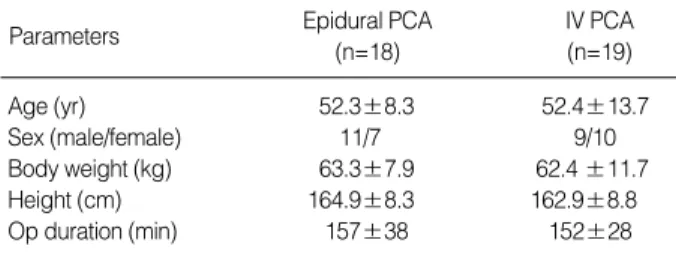
There were no significant differences in the patient char- acteristics and operation data between the two groups (Table 1). The pain scores were not different between the two groups (Fig. 1) and the need for rescue analgesics over the entire ob-
Parameters Epidural PCA
(n=18)
IV PCA (n=19)
Age (yr) 52.3±8.3 52.4±13.7
Sex (male/female) 11/7 9/10
Body weight (kg) 63.3±7.9 62.4 ±11.7
Height (cm) 164.9±8.3 162.9±8.8
Op duration (min) 157±38 152±28
Table 1. Characteristics and surgical data of the patients
Values are mean±SD or number of patients. There are no significant differences between two groups.
IV, intravenous; PCA, patient-controlled analgesia; Op, operation.
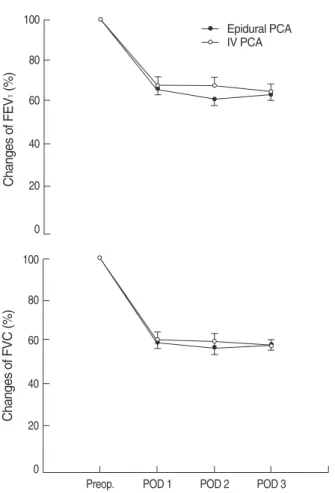
servation period was not different between the two groups (Fig. 2). Additionally, the percentage changes in the FVC and FEV1compared to the predicted values were similar in
the two groups (Fig. 3). Furthermore, the average satisfaction score did not differ significantly (3.1±0.7 in the Epidural PCA group, 3.2±0.6 in the IV PCA group, respectively).
Finally, the incidence of nausea, vomiting, dizziness, somno-
Pain on movement (10 cm VAS)
10
8
6
4
2
0
Pain at rest (10 cm VAS)
10
8
6
4
2
0
0 1 2 3 4 5 6
Postoperative days
Epidural PCA IV PCA
Fig. 1. Mean visual analogue scores (VAS) at rest and during move- ment. Error bars indicate standard error mean. There are no sig- nificant differences between two groups.
IV, intravenous; PCA, patient-controlled analgesia.
Epidural PCA IV PCA
Fig. 2. Mean daily doses of intravenous morphine given as a res- cue medication. Error bars indicate standard error mean. There are no significant differences between two groups.
IV, intravenous; PCA, patient-controlled analgesia.
Rescue dose of morphine (mg)
12 10
8 6
4
2
0 1 2 3 4 5 6
Postoperative days
Changes of FEV1(%)
100
80
60
40
20
0
Epidural PCA IV PCA
Preop. POD 1 POD 2 POD 3
Changes of FVC (%)
100
80
60
40
20
0
Fig. 3. Mean percentage changes in forced vital capacity (FVC) and forced expiratory volume in 1 second (FEV1). Error bars indi- cate standard error mean. There are no significant differences between two groups.
IV, intravenous; PCA, patient-controlled analgesia; POD, post-oper- ative day.
Values are number of patients (percentages). There are no significant differences between two groups.
IV, intravenous; PCA, patient-controlled analgesia.
Epidural PCA (n=18)
Symptoms/signs IV PCA
(n=19) P value
Dizziness 9 (50%) 11 (58%) 0.880
Somnolence 6 (33%) 10 (53%) 0.394
Pruritus 7 (39%) 6 (32%) 0.904
Nausea 4 (22%) 9 (47%) 0.209
Vomiting 2 (11%) 3 (16%) 0.948
Atelectasis 4 (22%) 6 (31%) 0.787
Pneumonia 1 (6%) 0 (0%) 0.977
Respiratory depression 0 (0%) 0 (0%) 1.000 Table 2. Incidence of side-effects and postoperative complica- tions
lence, pruritus, atelectasis, pneumonia, and respiratory depres- sion were similar in the two groups (Table 2).
DISCUSSION
Patient-controlled thoracic epidural analgesia is the most effective mode of postoperative analgesia after thoracotomy (7). However, its use in less invasive VATS has not been wide- ly explored. We investigated whether thoracic epidural anal- gesia has more benefit than IV PCA in postoperative pain management in patients undergoing VATS for primary lung cancer.
Our results suggest that the benefits of IV PCA in terms of the pain score, consumption of analgesics, restoration of pulmonary function, and satisfaction were equal to those of epidural PCA in patients undergoing VATS. Although these results do not agree with those of other studies that compared epidural PCA with IV PCA in patients who received thora- cotomy (7-9), this may be due to different types of surgery.
It is well known that VATS causes less tissue damage and respiratory dysfunction than thoracotomy (12, 13), therefore, the pain caused by VATS may be less severe and effectively controlled by IV PCA.
Based on this assumption, we reviewed previous studies that compared the use of IV PCA and epidural PCA in pati- ents that underwent laparotomy, which is also assumed to cause less pain than thoracotomy. Aygun and colleagues (14) compared the effects of IV tramadol, IV fentanyl, epidural tramadol, and epidural fentanyl in patients that underwent lower abdominal surgery and found that adequate analgesia was achieved in all groups, but that IV tramadol and fentanyl were associated with a high incidence of nausea and vomiting.
In our study, although there were slightly higher tendencies for nausea and vomiting in the IV PCA group, these differ- ences were not significant.
We determined the analgesic regimen of each method re- ferring to the most common and popular recommendations (15). According to a study comparing the efficacy of epidural and intravenous fentanyl administration using patient-con- trolled analgesia, pain scores and fentanyl plasma concentra- tions did not differ between the two routes of administration (16). In addition, Coda et al. (17) concluded that epidural administration of lipophilic opioids might offer no clinical advantage over the intravenous route. The amount of fentanyl administered in our study was not equal in two groups. We administered 20 μg/hr of fentanyl in Epidural PCA group compared to 15 μg/hr of fentanyl in IV PCA group because Geller et al. (18) had reported that more intense degree of sedation and the risk of respiratory depression was associated with intravenous sufentanil than epidural sufentanil. There- fore, we reduced the amount of fentanyl administered by in- travenous route. We do not think the slight difference of the administered amount of fentanyl would affect the conclusion
of our study because the exact comparison of the efficacy of the route of administration was not the aim of our study.
Several methods for pain management after thoracoscopic surgery have been suggested. Perttunen et al. (5) reported that two-day IV infusion of diclofenac or ketorolac was effec- tive to reduce total morphine consumption. Vogt et al. (19) and Hill et al. (20) have reported that a single-injection tho- racic paravertebral block improved postoperative pain. Addi- tionally, Ziser and others (21) attempted to determine the doses of parenteral analgesics administered after VATS retros- pectively and found that 25.8±11.6 mg/m2of morphine equivalent was administered during the first 24 hr, suggest- ing that higher opioid doses than previously anticipated were required. They also reported that patients of younger age, fe- male gender, and use of patient-controlled analgesia received higher doses of analgesics. However, none of the above cited studies compared the recommended methods with the use of thoracic epidural PCA that has been known as most effec- tive method, thus lacking the relative efficacy of the meth- ods they elicited. When Furrer and co-workers (22) evaluat- ed the use of epidural PCA for patients undergoing thoraco- tomy and IV PCA for patients undergoing thoracoscopy, res- pectively, they found that the pain score and restoration of pulmonary function were similar in both groups.
Some contradicting results regarding the efficacy of epidu- ral analgesia after VATS have been reported. Fernandez and colleagues (23) reported that the use of a patient-controlled epidural analgesia in patients undergoing VATS pleurecto- my was as effective as parenteral opioids, but did not confer any additional benefits to other less invasive methods of anal- gesia. This result is comparable to the results of the present study, however, the procedures used in their study involved more minimal access than those used in our study. Converse- ly, Yoshioka and others (24) reported that epidural analgesia is more effective than non-epidural analgesia for pain control until post-operative day (POD) 1 after VATS, especially for pain on movement. Based on their results, they recommend- ed epidural analgesia be used until POD 1, but that other analgesic method should be employed beginning on POD 2 because of the high incidence of nausea and vomiting asso- ciated with epidural analgesia. However, in our study, we did not observe any differences in pain score or analgesic consum- ption between two groups even on POD 1.
The number of ports, the size and location of incision, and the duration of VATS can be varied considerably by the sur- geons, so we included only the patients who received VATS from the most skillful surgeon to eliminate possible confoun- ders. Three ports (4 cm, 10 mm, 5 mm) were used, scattered over two or three intercostal spaces. No ribs were resected and no rib-spread technique was used. The number of ports, size of incision, and duration of VATS were considerably lower than other studies (1, 4, 12). Not to use invasive method of surgery makes us to consider the change the methods of pain management to less invasive one.
Nakata et al. (4) reported that FVC and FEV1of the pati- ents restored 85-90% of predicted values at POD 7. Accord- ing to Furrer et al. (22), FVC and FEV1measured at POD 1 ranged 59-64% and nearly reached preoperative values at the time of discharge. Our patients recovered 60-70% of predict- ed value at POD 1 and did not show further improvement until POD 3. Because we did not check the FVC and FEV1 after POD 3, direct comparison with above studies was im- possible. The reason why we did not check the FVC and FEV1 after POD 3 is that we assumed if the difference in restora- tion of pulmonary function between groups exist, it would appear in acute postoperative period.
Our study has several limitations. First, our study was not blinded because blinding was not practically possible. Sec- ond, we asked the pain scores 1 hr after operation and 24 hr after operation, but not between 1 hr and 24 hr after opera- tion. Senagore and co-workers (25) reported improved pain control in a group that received epidural PCA when com- pared to that of a group that received parenteral opioids at 6 hr and 18 hr after laparoscopic segmental colectomy, but no alteration in the length of the hospital stay between groups.
In addition, Perttunen et al. (5) or Yoshioka and others (24) also reported that patients who received VATS experienced moderate or severe pain immediately after operation and that epidural PCA was more effective at managing pain during this period. Therefore, in our study a difference in the two techniques may have occurred during this period and not been detected. However, we assume the difference was not great because the cumulative morphine consumption on POD 1 did not differ between two groups.
In conclusion, IV PCA is as equally effective as Epidural PCA in patients undergoing VATS lobectomy, therefore, it may replace Epidural PCA.
REFERENCES
1. Nagahiro I, Andou A, Aoe M, Sano Y, Date H, Shimizu N. Pulmo- nary function, postoperative pain, and serum cytokine level after lo- bectomy: a comparison of VATS and conventional procedure. Ann Thorac Surg 2001; 72: 362-5.
2. Landreneau RJ, Hazelrigg SR, Mack MJ, Dowling RD, Burke D, Ga- vlick J, Perrino MK, Ritter PS, Bowers CM, DeFino J, Nunchuck SK, Freeman J, Keenan RJ, Ferson PF. Postoperative pain-related mor- bidity; video-assisted thoracic surgery versus thoracotomy. Ann Tho- rac Surg 1993; 56: 1285-9.
3. Li WW, Lee RL, Lee TW, Ng CS, Sihoe AD, Wan IY, Arifi AA, Yim AP. The impact of thoracic surgical access on early shoulder func- tion: video-assisted thoracic surgery versus posterolateral thoraco- tomy. Eur J Cardiothorac Surg 2003; 23: 390-6.
4. Nakata M, Saeki H, Yokoyama N, Kurita A, Takiyama W, Takashima S. Pulmonary function after lobectomy: video-assisted thoracic sur- gery versus thoracotomy. Ann Thorac Surg 2000; 70: 938-41.
5. Perttunen K, Nilsson E, Kalso E. I.v. diclofenac and ketorolac for pain
after thoracoscopic surgery. Br J Anaesth 1999; 82: 221-7.
6. Kirby TJ, Mack MJ, Landreneau RJ, Rice TW. Lobectomy-video- assisted thoracic surgery versus muscle-sparing thoracotomy. A ran- domized trial. J Thorac Cardiovasc Surg 1995; 109: 997-1001.
7. Sentu_rk M, Ozcan PE, Talu GK, Kiyan E, Camci E, Ozyalcin S, Dil- ege S, Pembeci K. The effects of three different analgesia techniques on long-term postthoracotomy pain. Anesth Analg 2002; 94: 11-5.
8. Miguel R, Hubbell D. Pain management and spirometry following thoracotomy: a prospective, randomized study of four techniques. J Cardiothorac Vasc Anesth 1993; 7: 529-34.
9. Richardson J, Sabanathan S, Shah R. Post-thoracotomy spirometric lung function: the effect of analgesia. A review. J Cardiovasc Surg (Torino) 1999; 40: 445-56.
10. Giebler RM, Scherer RU, Peters J. Incidence of neurologic compli- cations related to thoracic epidural catheterization. Anesthesiology 1997; 86: 55-63.
11. Christie IW, McCabe S. Major complications of epidural analgesia after surgery: results of a six-year survey. Anaesthesia 2007; 62: 335- 41.
12. Tajiri M, Maehara T, Nakayama H, Sakamoto K. Decreased inva- siveness via two methods of thoracoscopic lobectomy for lung can- cer, compared with open thoracotomy. Respirology 2007; 12: 207- 11.
13. Craig SR, Leaver HA, Yap PL, Pugh GC, Walker WS. Acute phase responses following minimal access and conventional thoracic sur- gery. Eur J Cardiothorac Surg 2001; 20: 455-63.
14. Aygun S, Kocoglu H, Goksu S, Karaca M, Oner U. Postoperative patient-controlled analgesia with intravenous tramadol, intravenous fentanyl, epidural tramadol and epidural ropivacaine+fentanyl com- bination. Eur J Gynaecol Oncol 2004; 25: 498-501.
15. Wu CL. Acute postoperative pain. In: Miller RD, editor, Miller’s An- esthesia. 6th ed. Volume 2. Philadelphia: Elsevier Churchill Living- stone 2005; 2732-43.
16. Glass PS, Estok P, Ginsberg B, Goldberg JS, Sladen RN. Use of pati- ent-controlled analgesia to compare the efficacy of epidural to intra- venous fentanyl administration. Anesth Analg 1992; 74: 345-51.
17. Coda BA, Brown MC, Schaffer R, Donaldson G, Jacobson R, Haut- man B, Shen DD. Pharmacology of epidural fentanyl, alfentanil, and sufentanil in volunteers. Anesthesiology 1994; 81: 1149-61.
18. Geller E, Chrubasik J, Graf R, Chrubasik S, Schulte-Mo_nting J. A ran- domized double-blind comparison of epidural sufentanil versus intra- venous sufentanil or epidural fentanyl analgesia after major abdom- inal surgery. Anesth Analg 1993; 76: 1243-50.
19. Vogt A, Stieger DS, Theurillat C, Curatolo M. Single-injection tho- racic paravertebral block for postoperative pain treatment after tho- racoscopic surgery. Br J Anaesth 2005; 95: 816-21.
20. Hill SE, Keller RA, Stafford-Smith M, Grichnik K, White WD, D’A- mico TA, Newman MF. Efficacy of single-dose, multilevel paraver- tebral nerve blockade for analgesia after thoracoscopic procedures.
Anesthesiology 2006; 104: 1047-53.
21. Ziser A, Messick JM, Schroeder DR, Allen MS. Requirements for postoperative analgesics in patients undergoing video-assisted tho- racic surgery. The Internet Journal of Anesthesiology 1999; Vol3 N2 Available at http://www.ispub.com/ostia/index.php?xmlFilePath=
journals/ija/vol3n2/vats.xml
22. Furrer M, Rechsteiner R, Eigenmann V, Signer C, Althaus U, Ris HB.
Thoracotomy and thoracoscopy: postoperative pulmonary function, pain and chest wall complaints. Eur J Cardiothorac Surg 1997; 12:
82-7.
23. Fernandez MI, Martin-Ucar AE, Lee HD, West KJ, Wyatt R, Waller DA. Does a thoracic epidural confer any additional benefit following video-assisted thoracoscopic pleurectomy for primary spontaneous pneumothorax? Eur J Cardiothorac Surg 2005; 27: 671-4.
24. Yoshioka M, Mori T, Kobayashi H, Iwatani K, Yoshimoto K, Terasa- ki H, Nomori H. The efficacy of epidural analgesia after video-assist- ed thoracoscopic surgery: a randomized control study. Ann Thorac Cardiovasc Surg 2006; 12: 313-8.
25. Senagore AJ, Delaney CP, Mekhail N, Dugan A, Fazio VW. Ran- domized clinical trial comparing epidural anaesthesia and patient- controlled analgesia after laparoscopic segmental colectomy. Br J Surg 2003; 90: 1195-9.