A Functional Polymorphism in the CHRNA3 Gene and Risk of Chronic Obstructive Pulmonary Disease in a Korean Population
A genome-wide association study has identified the 15q25 region as being associated with the risk of chronic obstructive pulmonary disease (COPD) in Caucasians. This study intended as a confirmatory assessment of this association in a Korean population. The rs6495309C > T polymorphism in the promoter of nicotinic acetylcholine receptor alpha subunit 3 (CHRNA3) gene was investigated in a case-control study that consisted of 406 patients with COPD and 394 healthy control subjects. The rs6495309 CT or TT genotype was associated with a significantly decreased risk of COPD when compared to the rs6495309 CC genotype (adjusted odds ratio = 0.69, 95% confidence interval = 0.50-0.95, P = 0.023). The effect of the rs6495309C > T on the risk of COPD was more evident in moderate to very severe COPD than in mild COPD under a dominant model for the variant T allele (P = 0.024 for homogeneity). The CHRNA3 rs6495309C > T polymorphism on chromosome 15q25 is associated with the risk of COPD in a Korean population.
Key Words: CHRNA3; Pulmonary Disease, Chronic Obstructive; Polymorphism Jae Yeon Lee1,*, Seung Soo Yoo1,*,
Hyo-Gyoung Kang2, Guang Jin2,3, Eun Young Bae2, Yi Young Choi2, Jin Eun Choi2, Hyo-Sung Jeon2, Jaehee Lee1, Shin Yup Lee1, Seung-Ick Cha1, Chang Ho Kim1, and Jae Yong Park1,2
1Department of Internal Medicine, 2Department of Biochemistry and Cell Biology, Kyungpook National University School of Medicine, Daegu, Korea;
3Cancer Research Center, Yanbian University School of Basic Science, Yanji, Jilin, China
*Jae Yeon Lee and Seung Soo Yoo contributed equally to this work.
Received: 11 July 2012 Accepted: 24 October 2012 Address for Correspondence:
Jae Yong Park, MD
Departments of Internal Medicine, Kyungpook National University Medical Center, 807 Hoguk-ro, Buk-gu, Daegu 702-210, Korea
Tel: +82.53-200-2631, Fax: +82.53-200-2027 E-mail: [email protected]
This study was supported by a grant of the Korea Healthcare Technology R&D Project, Ministry for Health and Welfare, Republic of Korea (Grant no. A090460).
http://dx.doi.org/10.3346/jkms.2012.27.12.1536 • J Korean Med Sci 2012; 27: 1536-1540 Respiratory Diseases
INTRODUCTION
Chronic obstructive pulmonary disease (COPD) is a disease characterized by airflow limitation that is not fully reversible (1).
COPD is a major health problem worldwide, with a high rate of occurrence, and high costs with its management. It is the fourth leading cause of death in the world and the economic burdens associated with COPD is ever increasing (1, 2). Cigarette smok- ing is the most important risk factor for the development of COPD. Inhaled cigarette smoke induces lung inflammation by various inflammatory cells, such as neutrophil, macrophage, and CD4+ T cells. A variety of inflammatory mediators, such as protease, matrix metalloproteinase and tumor necrosis factor- alpha, can enhance lung parenchymal destruction, and cause airway remodeling. These inflammatory processes can result airway narrowing and airflow limitation, finally develops COPD (1, 3). However, only a small fraction of smokers develops symp- tomatic COPD, suggesting that genetic factors also contribute
to the development of COPD (4-6).
Recently, genome-wide association (GWA) studies have iden- tified hundreds of genetic variants influencing the risk of com- plex human diseases, including COPD (7-9). In addition, these GWA studies have aided our understanding of diverse molecu- lar pathways underlying specific human diseases (10, 11). The 15q25 region that contains the nicotinic acetylcholine receptor alpha subunit 5 and 3 (CHRNA5 and CHRNA3) genes was initial- ly identified as a lung cancer susceptibility locus through GWA studies conducted in Caucasian populations (12, 13). Subse- quently, this 15q25 region has been reported to be also associ- ated with risk of COPD in GWA studies (7, 14). However, the sin- gle nucleotide polymorphisms (SNPs), rs8034191 and rs1051730, identified in previous GWA studies for lung cancer and COPD in Caucasians (7-14), are extremely rare in Asians, according to HapMap data. Consistent with HapMap data, Wu et al. (15) reported that these two SNPs are very rare (minor allele fre- quencies < 0.05) in Chinese populations. Notably, they report-
ed that among the SNPs in the CHRNA5-CHRNA3 locus, the rs6495309C > T in the promoter of the CHRNA3 gene affects the binding ability of the transcriptional factor, Oct-1, resulting in alteration of CHRNA3 expression, thereby influencing lung cancer risk (15). This finding suggests that the rs6495309C > T of CHRNA3 may be associated with the risk of COPD in Asian populations. Therefore, to verify the role of the rs6495309C > T of CHRNA3 on the risk of COPD, we have carried out a case-con- trol study in a Korean population.
MATERIALS AND METHODS Study population
The patient group (n = 406) consisted of male patients who vis- ited the respiratory center in Kyungpook National University Hospital (Daegu, Korea) between July 2006 and December 2008.
Diagnosis of COPD was established by the NHLBI/WHO Glob- al Initiative for COPD (GOLD) (1). The criteria for COPD were as follows: chronic respiratory symptoms and signs such as cough and dyspnea; post-bronchodilator forced expiratory volume at one second (FEV1) < 80% of the predicted value, FEV1/forced vital capacity (FVC) < 70% and FEV1 reversibility after inhaling 200 μg salbutamol < 12% of the pre-bronchodilator FEV1. The severity of COPD was classified by the guidelines of GOLD in terms of the percentage predicted FEV1: mild (> 80%), moder- ate (50%-80%), severe (30%-50%) or very severe (< 30%). Con- trol subjects (n = 394) were selected from a pool of healthy men who visited the general health check-up center. The enrollment criteria for the control subjects were as follows: male, age > 45 yr, current or former smoker, no known disease and no history of any disease, and no airflow limitation. All of the cases and con- trols were ethnic Koreans that resided in Daegu City, or in the surrounding regions. A trained interviewer completed detailed questionnaires for each patient and each control subject.
Genotyping
Genotypes of the rs6495309C > T was determined by melting- curve analysis using fluorescence labeled hybridization probes (LightCycler, Roche Diagnostic, Mannheim, Germany). A geno- type success rate of greater than 99% was achieved using the LightCycler. Samples that could not be scored by the LightCy- cler were re-genotyped by direct sequencing using an ABI PRISM 3700 genetic analyzer (Applied Biosystems, Foster City, CA, USA). All genotyping analyses were performed “blind” with re- spect to the case/control status to ensure quality control. Ap- proximately 10% of the samples were randomly selected to be genotyped again by a different investigator, and the results were 100% concordant with the original analysis.
Statistical analysis
The cases and controls were compared using the Student’s t-test
for continuous variables, and a chi-squared test for categorical variables. Deviations of genotype frequencies among controls from those expected under Hardy-Weinberg equilibrium were assessed by chi-squared test (1° of freedom). Unconditional lo- gistic regression analyses were used to calculate the odds ratio (OR) and 95% confidence interval (CI), with adjustment for pos- sible confounders (age, and pack-years of smoking used as con- tinuous variables). In addition to the overall association analy- sis, we performed a stratified analysis according to age, smok- ing status, and severity of COPD to explore the association be- tween genotypes and the risk of COPD in each stratum. A ho- mogeneity test was performed in order to compare the differ- ence between the genotype-related ORs of the different groups.
All analyses were performed using Statistical Analysis System for Windows, version 9.1 (SAS Institute, Cary, NC, USA).
Ethic statement
This study was approved by the institutional review board of the Kyungpook National University Hospital (Approval No., KNUH- BIO_10-1015). Written informed consent was obtained from each participant.
RESULTS
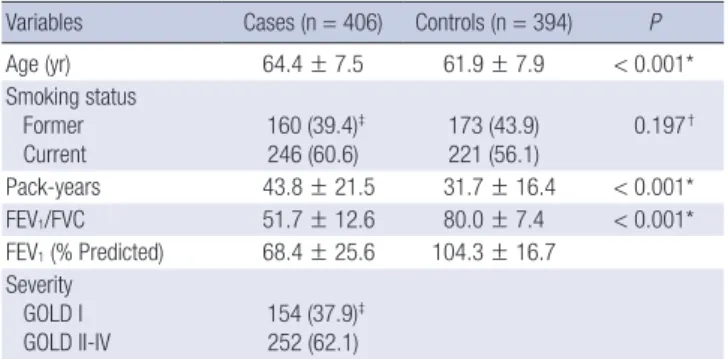
The baseline characteristics of the study population are shown in Table 1. There was no significant difference in the smoking status between cases and controls. Age and pack-years of smok- ing were significantly higher in cases than in controls (64.4 ± 7.5 vs 61.9 ± 7.9 yr, P < 0.001; and 43.8 ± 21.5 vs 31.7 ± 16.4 pack-yr of smoking, P < 0.001, respectively). These differences were con- trolled in the later multivariate analyses. The FEV1 and the FEV1/ FVC ratio were significantly lower in the COPD group than in the control group (P < 0.001, both).
Table 2 shows the genotype distribution of rs6495309C > T among the cases and controls. The genotype distribution of the rs6495309C > T among the controls was in Hardy-Weinberg equilibrium. The frequency of the variant T allele among the
Table 1. Characteristics of the study population
Variables Cases (n = 406) Controls (n = 394) P
Age (yr) 64.4 ± 7.5 61.9 ± 7.9 < 0.001*
Smoking status Former
Current 160 (39.4)‡
246 (60.6) 173 (43.9)
221 (56.1) 0.197† Pack-years 43.8 ± 21.5 31.7 ± 16.4 < 0.001*
FEV1/FVC 51.7 ± 12.6 80.0 ± 7.4 < 0.001*
FEV1 (% Predicted) 68.4 ± 25.6 104.3 ± 16.7 Severity
GOLD I
GOLD II-IV 154 (37.9)‡ 252 (62.1)
*t-test; †Chi-square test; ‡Numbers in parenthesis, column percentage. FEV1, forced expiratory volume in 1 second; FVC, forced vital capacity; GOLD, Global Initiative for Chronic Obstructive Lung Disease.
controls was 0.494, which was comparable with that (0.482) of healthy Chineses (15). The distribution of the rs6495309C > T genotypes was significantly different between the cases and controls (CC, CT, and TT genotypes; 34.5%, 48.8%, and 16.7%, respectively vs 26.6%, 48.0%, and 25.4%, respectively; P = 0.004), with the frequency of the variant T allele being significantly low- er in the cases than in the controls (0.411 vs 0.494, P = 0.001).
The risk of COPD decreased as the number of T alleles increased (Ptrend= 0.002), and the TT genotype was associated with a sig- nificantly decreased risk of COPD when compared to the CC genotype (adjusted OR, 0.50; 95% CI, 0.33-0.76; P = 0.001). In- dividuals with the rs6495309 CT or TT genotype had a 31% (95%
CI, 0.50-0.95; P = 0.023) decreased risk of COPD when com- pared to those with the rs6495309 CC genotype.
The association between the rs6495309C > T genotypes and the risk of COPD was further investigated, after stratification ac- cording to age, smoking status, and severity of COPD (Table 3).
The effects of the rs6495309C > T genotype on the risk of COPD did not differ significantly between younger- and older-individ- uals, and former- and current-smokers (P value of test for homo- geneity [PH], both, > 0.05 in all comparisons). When stratified by the median pack-years of smoking, the effect of the rs6495309C
> T genotype on the risk of COPD was more evident in lighter- smokers than in heavier-smokers under dominant model for the variant T allele (PH= 0.030). When COPD cases were cate- gorized by disease severity, the rs6495309 CT, or TT genotype
was associated with a significantly decreased risk of moderate to very severe COPD (GOLD II-IV; adjusted OR, 0.56; 95% CI, 0.39-0.80; P = 0.001), whereas there was no significant associa- tion between the rs6495309C > T genotypes and the risk of mild COPD (GOLD I; adjusted OR, 1.07; 95% CI, 0.69-1.65; PH= 0.024).
DISCUSSION
In this study we determined the association between the rs649- 5309C > T polymorphism on the 15q25 region and the risk of COPD in a Korean population. The rs6495309T allele was asso- ciated with a significant decreased risk of COPD. This finding was in agreement with results of a previous GWA study which was carried out in Caucasians (7) in which the 15q25 region was a COPD susceptibility locus, thus providing strong evidence that the 15q25 region may play an important role in the devel- opment of COPD. This study is the first report of an association between the CHRAN3 rs6495309C > T and the risk of COPD in Asians.
Acetylcholine receptors are classified into nicotinic acetyl- choline receptors (nAChRs) and muscarinic receptors, and nAChRs are historically classified as neuronal- or muscle-type based on their initial site of identification and composite sub- units (16). Cholinergic parasympathetic activity in the airways induces tracheobronchial smooth muscle contraction and mu- Table 2. Distribution of the rs6495309C > T genotypes in patients with COPD and healthy controls, and the association with the risk of COPD
Genotype Cases (n = 406) Controls (n = 394) P * OR (95% CI)† P† Ptrend
CC 140 (34.5) 105 (26.6) 0.004 1.00 0.002
CT 198 (48.8) 189 (48.0) 0.79 (0.57-1.11) 0.181
TT 68 (16.7) 100 (25.4) 0.50 (0.33-0.76) 0.001
CC 140 (34.5) 105 (26.6) 0.016 1.00
CT + TT 266 (65.5) 289 (73.4) 0.69 (0.50-0.95) 0.023
*Two-sided chi-square test for genotype distributions between the cases and controls; †Odds rations (ORs), 95% confidence intervals (95% CIs) and corresponding P values were calculated by unconditional logistic analysis, adjust for age and pack-years of smoking. COPD, Chronic obstructive lung disease.
Table 3. The associations between the rs6495309C > T genotypes and the risk of COPD according to age, smoking history, and severity of COPD
Variables CC CT TT CT + TT vs CC
PH*
OR (95% CI) P
Age (yr)‡ ≤ 64 > 64
67/65† 73/40
90/118 108/71
28/59 40/41
0.61 (0.40-0.95) 0.77 (0.48-1.24)
0.027 0.277
0.483 Smoking status§
Former Current
59/48 81/57
76/79 122/110
25/46 43/54
0.65 (0.41-1.03) 0.73 (0.49-1.10)
0.067 0.136
0.712 Pack-years of smoking§
≤ 32
> 32 48/54
92/51 57/112
141/77 15/58
53/42 0.47 (0.29-0.76)
0.95 (0.63-1.44) 0.002
0.798 0.030
Severity of COPDll GOLD I
GOLD II-IV 40/105
100/105 89/189
109/189 25/100
43/100 1.07 (0.69-1.65)
0.56 (0.39-0.80) 0.775
0.001 0.024
*P value for homogeneity test; †Number of cases/number of controls. Odds ratios (ORs), 95% confidence intervals (95% CIs) and corresponding P values were calculated by unconditional logistic analysis; ‡adjusted for pack-years of smoking; §for age; and llfor age and pack-years of smoking. COPD, Chronic obstructive lung disease; GOLD, Global Initiative for Chronic Obstructive Lung Disease.
cous secretion (17, 18). However, there is increasing evidence that non-neuronal cholinergic systems that are found in non- neuronal cells, such as airway inflammatory cells, modulate in- flammation of the lung, and thus, contribute to the development of COPD (19). It has been shown that bronchial epithelial cells, and airway fibroblasts and inflammatory cells express nAChRs (20). Nicotine and nicotine-derived nitrosamines in cigarette smoke triggers the nAChRs of inflammatory cells of the lung to release protease and oxidants that are associated with the patho- genesis of COPD (19-21). In addition, it has been demonstrated that the rs6495309T allele significantly reduces promoter activity, which in turn diminishes CHRNA3 expression (15). Therefore, it is plausible that subjects with a lower production of rs6495309T allele for CHRNA3 might have a lower inflammatory response to smoking exposure, thus having a decreased susceptibility to COPD.
The association between the CHRNA3 rs6495309C > T and risk of COPD may be, in part, resulted from the fact that the SNP affects nicotinic dependence. It is known that nAChRs expressed in the key regions of the brain play an important role in control- ling smoking behavior such as nicotine dependence (22-25).
Several studies have reported that genetic variants of chromo- some 15q25, including the CHRNA3 rs6495309C > T, are respon- sible for tobacco nicotine dependence (15, 25). In the present study, however, there were no significant differences in geno-
type and allele frequencies according to smoking status and smoking exposure levels (data not shown).
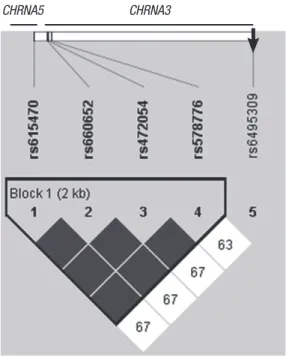
Although the rs6495309 in the promoter of the CHRNA3 gene has been reported to be a functional SNP, the association of the rs6495309 with COPD may be due to linkage disequilibrium (LD) with other functional variant(s) rather than a direct effect of the rs6495309. In order to identify the variant(s) that may be in strong LD with the rs649- 5309 that could be actually respon- sible for the alteration in COPD risk, we screened and estimated the LDs of all the potentially functional SNPs (with a minor allele frequency ≥ 0.05 in Asians) around the CHRNA5/CHRNA3 locus including the rs6495309 using the NIEHS database (http://man- ticore.niehs.nih.gov). As shown in Fig. 1, four SNPs (rs578776, rs472054, rs660652 and rs615470) were captured. However, none of these four SNPs were in strong LD with the rs6495309 based on HapMap JPT data of the public database (http://www.ncbi.
nlm.nih.gov/ SNP). This finding suggests that the association observed in the present study may be due to direct effect of the rs6495309. However, because the four potentially functional SNPs captured from the database may also affect the risk of COPD, future studies of these four SNPs are also needed to fur- ther understand the role of genetic variants in the CHRNA5/
CHRNA3 locus in determining the risk of COPD.
In conclusion, this case-control study demonstrates a signifi- cant association of the CHRNA3 rs6495309C > T on chromo- some 15q25 with the risk of COPD. Because this is the first case- control study investigating the association of the CHRNA3 rs649- 5309C > T with the risk of COPD in Asian populations, addition- al studies are required to confirm our findings.
REFERENCES
1. Rabe KF, Hurd S, Anzueto A, Barnes PJ, Buist SA, Calverley P, Fukuchi Y, Jenkins C, Rodriguez-Roisin R, van Weel C, et al. Global strategy for the diagnosis, management, and prevention of chronic obstructive pulmonary disease: GOLD executive summary. Am J Respir Crit Care Med 2007; 176:
532-55.
2. Mannino DM, Buist AS. Global burden of COPD: risk factors, prevalence, and future trends. Lancet 2007; 370: 765-73.
3. Groneberg DA, Chung KF. Models of chronic obstructive pulmonary disease. Respir Res 2004; 5: 18.
4. Løkke A, Lange P, Scharling H, Fabricius P, Vestbo J. Developing COPD:
a 25 year follow up study of the general population. Thorax 2006; 61:
935-9.
5. Sampsonas F, Karkoulias K, Kaparianos A, Spiropoulos K. Genetics of chronic obstructive pulmonary disease, beyond α1-antitrypsin deficien- cy. Curr Med Chem 2006; 13: 2857-73.
6. Cha SI, Kang HG, Choi JE, Kim MJ, Park J, Lee WK, Kim CH, Jung TH, Park JY. SERPINE2 polymorphisms and chronic obstructive pulmonary disease. J Korean Med Sci 2009; 24: 1119-25.
7. Pillai SG, Ge D, Zhu G, Kong X, Shianna KV, Need AC, Feng S, Hersh CP, Bakke P, Gulsvik A, et al. A genome-wide association study in chronic
CHRNA5 CHRNA3
Fig. 1. Reconstructed linkage disequilibrium (LD) plot using potentially functional sin- gle nucleotide polymorphisms with minor allele frequency ≥ 5% from HapMap JPT data in the CHRNA5/CHRNA3 locus. The black boxes indicate strong LD (confidence interval for strong LD: upper 0.98, low 0.7; fraction of strong LD in informative com- parisons must be at least 0.95). The white boxes indicate strong recombination (up- per confidence interval maximum 0.9). The triangles indicate haplotype blocks. The numbers in the squares are |D´| (× 100) values. Vertical bold arrow indicates the CHRNA3 rs6495309 location.
obstructive pulmonary disease (COPD): identification of two major sus- ceptibility loci. PLoS Genet 2009; 5: e1000421.
8. Ioannidis JP, Thomas G, Daly MJ. Validating, augmenting and refining genome-wide association signals. Nat Rev Genet 2009; 10: 318-29.
9. Frazer KA, Murray SS, Schork NJ, Topol EJ. Human genetic variation and its contribution to complex traits. Nat Rev Genet 2009; 10: 241-51.
10. Manolio TA, Collins FS, Cox NJ, Goldstein DB, Hindorff LA, Hunter DJ, McCarthy MI, Ramos EM, Cardon LR, Chakravarti A, et al. Finding the missing heritability of complex disease. Nature 2009; 461: 747-53.
11. Hirschhorn JN. Genomewide association studies: illuminating biologic pathways. N Engl J Med 2009; 360: 1699-701.
12. Amos CI, Wu X, Broderick P, Gorlov IP, Gu J, Eisen T, Dong Q, Zhang Q, Gu X, Vijayakrishnan J, et al. Genome-wide association scan of tag SNPs identifies a susceptibility locus for lung cancer at 15q25.1. Nat Genet 2008; 40: 616-22.
13. Hung RJ, McKay JD, Gaborieau V, Boffetta P, Hashibe M, Zaridze D, Mukeria A, Szeszenia-Dabrowska N, Lissowska J, Rudnai P, et al. A sus- ceptibility locus for lung cancer maps to nicotinic acetylcholine receptor subunit genes on 15q25. Nature 2008; 452: 633-7.
14. Pillai SG, Kong X, Edwards LD, Cho MH, Anderson WH, Coxson HO, Lomas DA, Silverman EK; ECLIPSE and ICGN Investigators. Loci iden- tified by genome-wide association studies influence different disease-re- lated phenotypes in chronic obstructive pulmonary disease. Am J Respir Crit Care Med 2010; 182: 1498-505.
15. Wu C, Hu Z, Yu D, Huang L, Jin G, Liang J, Guo H, Tan W, Zhang M, Qian J, et al. Genetic variants on chromosome 15q25 associated with lung can- cer risk in Chinese populations. Cancer Res 2009; 69: 5065-72.
16. Caulfield MP, Birdsall NJ. International Union of Pharmacology, XVII.
Classification of muscarinic acetylcholine receptors. Pharmacol Rev 1998; 50: 279-90.
17. Canning BJ. Reflex regulation of airway smooth muscle tone. J Appl Physi- ol 2006; 101: 971-85.
18. Rogers DF. Motor control of airway goblet cells and glands. Respir Physi- ol 2001; 125: 129-44.
19. Gwilt CR, Donnelly LE, Rogers DF. The non-neuronal cholinergic system in the airways: an unappreciated regulatory role in pulmonary inflam- mation? Pharmacol Ther 2007; 115: 208-22.
20. Carlisle DL, Hopkins TM, Gaither-Davis A, Silhanek MJ, Luketich JD, Christie NA, Siegfried JM. Nicotine signals through muscle-type and neuronal nicotinic acetylcholine receptors in both human bronchial epi- thelial cells and airway fibroblasts. Respir Res 2004; 5: 27.
21. Wessler I, Kirkpatrick CJ, Racké K. Non-neuronal acetylcholine, a locally acting molecule, widely distributed in biological systems: expression and function in humans. Pharmacol Ther 1998; 77: 59-79.
22. Saccone SF, Hinrichs AL, Saccone NL, Chase GA, Konvicka K, Madden PA, Breslau N, Johnson EO, Hatsukami D, Pomerleau O, et al. Choliner- gic nicotinic receptor genes implicated in a nicotine dependence associa- tion study targeting 348 candidate genes with 3713 SNPs. Hum Mol Genet 2007; 16: 36-49.
23. Bierut LJ, Stitzel JA, Wang JC, Hinrichs AL, Grucza RA, Xuei X, Saccone NL, Saccone SF, Bertelsen S, Fox L, et al. Variants in nicotinic receptors and risk for nicotine dependence. Am J Psychiatry 2008; 165: 1163-71.
24. Li MD, Xu Q, Lou XY, Payne TJ, Niu T, Ma JZ. Association and interac- tion analysis of variants in CHRNA5/CHRNA3/CHRNB4 gene cluster with nicotine dependence in African and European Americans. Am J Med Genet B Neuropsychiatr Genet 2010; 153B: 745-56.
25. Jin G, Bae EY, Yang E, Lee EB, Lee WK, Choi JE, Jeon HS, Yoo SS, Lee SY, Lee J, et al. A functional polymorphism on chromosome 15q25 associat- ed with survival of early stage non-small cell lung cancer. J Thorac Oncol 2012; 7: 808-14.