호흡부전을 동반한 근위축성 측삭 경화증 환자의 장기적 호흡관리 1례
※이종철1,2, 정호현1,2, 차은혜1,2, 박만용1,2, 김태호3, 송봉근4, 손일홍5, 김성철1,2,*
1원광대학교 부속광주한방병원 침구의학과
2원광대학교 희귀난치성신경근육질환센터
3부천자생한방병원 침구의학과
4원광대학교 부속광주한방병원 내과
5원광대학교 부속산본병원 신경과
[Abstract]
A Clinical Case Study on the Long Term Respiration Management of Amyotrophic Lateral Sclerosis Patient with Respiratory Failure※
Jong Cheol Lee1,2, Ho Hyun Jeong1,2, Eun Hye Cha1,2, Man Yong Park1,2, Tae Ho Kim3, Bong Keun Song4, Il Hong Son5 and Sung Chul Kim1,2,*
1Department of Acupuncture & Moxibustion Medicine, Gwangju Korean Medical Hospital, Wonkwang University
2Amyotrophic Lateral Sclerosis Center, Gwangju Korean Medical Hospital, Wonkwang University
3Department of Acupuncture & Moxibustion Medicine, Bucheon Jaseng Hospital of Korean Medicine
4Department of Internal Medicine, Gwangju Korean Medical Hospital, Wonkwang University
5Department of Neurology, Sanbon Hospital, Wonkwang University
Objectives : Amyotrophic lateral sclerosis(ALS) is a progressive neurodegenerative disorder characterized by a selective death of motor neuron, leading to respiratory insufficiency. The purpose of this study was to assess the long term respiratory management of ALS patient with respiratory failure.
Methods : One ALS patient applying a non-invasive BIPAP ventilator as well as Korean medical treatment such as acupuncture, pharmacopuncture and herbal medicine was measured on SpO2, EtCO2, Vte(expiratorytidalvolume) for 2 years 7 months.
Results : The SpO2, EtCO2of ALS patient were maintained in the normal range for 2 years 7 months. The Vte of ALS patient also wasn’t worse in this study.
Conclusions : In this study, the long term respiration management, combined administration of Korean medical treatment and non-invasive BIPAP ventilator, could be effective in ALS patient with respiratory failure.
Key words : Amyotrophic lateral
sclerosis(ALS);
Respiratory failure;
Non-invasive BIPAP ventilator;
Oriental medical treatment;
EtCO2; SpO2
Received : 2014. 08. 11.
Revised : 2014. 08.28.
Accepted : 2014. 08.28.
On-line : 2014. 09.20.
※ This study was supported by a grant of the Korean Health Technology R & D Project through the Korea Health Industry Development Institute(KHIDI), funded by the Ministry of Health & Welfare, Republic of Korea (grant number : HI11C2142)
✱ Corresponding author : Department of Acupuncture & Moxibustion Medicine, Gwang-Ju Oriental Medical Hospital, Wonkwang University, 1140-23, Hoejae-ro, Nam-gu, Gwangju, 503-832, Republic of Korea
Tel : +82-62-670-6441 E-mail : [email protected]
This is an Open-Access article distributed under the terms of the Creative Commons Attribution Non-Commercial License (http://creativecommons.org/licenses/by-nc/3.0) which permits unrestricted non-commercial use, distribution, and reproduction in any medium, provided the original work is properly cited.
The Acupuncture is the Journal of Korean Acupuncture & Moxibustion Medicine Society. (http://www.TheAcupuncture.org) Copyright © 2014 KAMMS. Korean Acupuncture & Moxibustion Medicine Society. All rights reserved.
Ⅰ. 서 론
근위축성 측삭 경화증(amyotrophic lateral sclerosis, 이하 ALS)은 1870년 Jean-Martin Charcot가 처음으로 설명하였는 데, 운동신경계의 선택적 침범을 일으키는 신경계 퇴행성 질환 이다. 임상적 진단은 상위운동신경과 하위운동신경의 기능이 상과 점차 진행하는 증상에 의해 정의되며, electromyography (EMG)에 의해 확진된다. 대부분의 환자는 발병일로부터 3∼5년 미만에 호흡근의 위약으로 사망한다1,2).
외국 보고에서는 인구 10만 명당 1∼2명의 발병률과 4∼6명의 유병률을 보이며, 남자에서 1.5배 높게 발병하나 50∼60대로 가면 남녀의 비례가 비슷해지는 경향을 보인다. 이는 호르몬 변화가 영향을 미칠 것이라는 배경이 되나 명확히 밝혀져 있지 않다3-5).
ALS의 임상증상은 연수마비 증상으로는 혀의 위축, 구음 장애, 삼킴 곤란이 있고, 경추부는 상완의 위축, 요천추부는 하지의 위축과 경직이며, 흉추부는 호흡근의 위축, 기침능력 의 약화, 기좌호흡과 관련된 호흡장애, 마지막으로 체중감소 등을 보인다1,6).그리고 종국에 ALS환자의 가장 흔한 사망의 원인은 호흡기계 근육의 신경변성으로 인한 호흡부전이다7,8).
ALS의 치료법은 아직 정립된 것이 없고 대증요법이 중심 이며, 현재 유일한 약으로는 1996년에 미국 식품의약국의 승 인을 받은 Riluzole이 약 2개월의 수명을 연장시킨다고 밝혀
졌다9,10). 일반적으로 ALS환자는 호흡능력의 예상가능한 지
속적 감소로 죽음에 이르게 되며, 이를 보조하기 위한 수단으 로 비침습적 양압 환기기(non-invasive bilevel positive airway pressure ventilator)를 활용한다11). 이 기계는 호흡에 드는 힘을 줄여주고, 가스교환을 증가시키며, 수면의 질을 향상시켜 부분적으로 수명을 연장시킨다12,13). 하지만 대부분 의 ALS환자는 비침습적 양압 환기기를 이용하고도 지속적인 호흡 근력의 약화와 체력의 저하로 사망하게 된다.
이처럼 호흡이 악화되는 ALS환자를 상대로 한 한의학적 치료 논문으로는 사암침의 폐정격을 이용한 논문이 유일한 실정이 다14). 이에 저자는 본원의 한방치료와 비침습적 양압 환기기를 병용하여로 약 2년 7개월 동안 매달 측정한 결과 호흡능력의 객 관적 수치가 좋은 상태로 유지되어 그 결과를 보고하는 바이다.
Ⅱ. 증 례
1) 환자
2) 주소증
∙ Dyspnea
∙ Orthopnea
∙ Both arm weakness
∙ Both leg weakness
∙ Both foot edema
∙ Constipation
∙ Fasciculation
3) Onset 2009. 7월경
4) 과거력
∙ HTN(+) 2012. 12. 20부터 amodipin Tab. qdPC. 복용
∙ DM(-), TB(-), Hepa(-)
∙ OP(+) 07’ Lt. 2nd finger 피부이식 OP, 안산 두손 H
∙ AD(+) 상기 OP 시 1M. 상기 C/C로 본원, 타 병원 수차례
5) 가족력 N/S
6) 현병력
∙2009년 7월경 별무계기로 Rt foot weakness developed.
→ 분당 서울대 H. visited, MRI, EMG, LAB 등 제 반 검사에서 “Motor neuron disease” Dx.”
W-med Tx. For 1year
∙2010. 8월 한양대 H. visited, 제반 검사에서 ALS Dx.
W-med Tx
∙2010. 12월 제일한방 H. AD Tx. For 1M
∙2011. 4월 한양대 H. visited, W-med Tx. Inj.
Tx.(1회/ 1M.)
∙2011. 8월 광주 원광대한방 H. visited, AD Tx.(by Wheel chair)
이후 현재까지 본원에서 지속적인 AD Tx.(2011. 8. 23 ∼ 9. 8, 2011. 9. 18 ∼ 2012. 6. 18, 2012. 6. 19 ∼ 8. 17, 2012. 8. 18 ∼ 10. 18, 2012. 10. 25 ∼ 2013. 1. 5, 2013.
1. 6 ∼ 2. 27, 2013. 2. 28 ∼ 3. 30, 2013. 4. 2 ∼ 9, 2013. 4. 27 ∼ 5. 5, 2013. 5. 6 ∼ 8. 6, 2013. 10. 30 ∼ 11.
11, 2013. 11. 13 ∼ 27, 2013. 12. 28 ∼ 2014. 1. 13, 2014. 1. 14 ∼ 24, 2014. 2. 3 ∼ 28, 2014. 3. 3 ∼ 28, 2014. 4. 1 ∼ 26, 2014. 5. 1 ∼ 26, 2014. 6. 2 ∼ 25,
7) 양약치료 Amodipin 1 Tab. qdPC
애피트롤 현탁액 10 ml/p 1포 qdAC
8) 한방치료 (1) 약침치료
본원에 입원한 기간 동안 오공 약침 2 cc, 봉 약침 2 cc 를 경혈에 주 6회 양측으로 자입하였다. 경혈은 2011년부 터 2012년까지는 양측의 合谷ㆍ手三里ㆍ曲池ㆍ梁丘ㆍ足三 里ㆍ懸鐘ㆍ丘墟ㆍ犢鼻ㆍ中脘 위주로 경혈당 0.1∼0.2 cc씩 약 1 cm 정도의 심도로 자입하였고, 2013년부터 현재까지 는 風池ㆍ風府ㆍ啞門ㆍ大椎ㆍ肩井ㆍ腎兪ㆍ志室ㆍ箕門ㆍ章門ㆍ 手三里ㆍ足三里ㆍ合谷ㆍ丘墟ㆍ梁丘, 胸椎部 膀胱經 제1선의 부위를 선혈하여 약침액을 경혈당 0.1 cc씩 1 cm 정도의 심도로 자입하였다. 약침액은 대한약침학회에서 제조한 오 공약침과 봉약침을 이용하다가 2014년 6월경부터 봉약침 은 자생 원외탕전실에 제조한 약침을 이용하였다.
(2) 침치료
2011년부터 2013년 중반까지는 주로 간정격ㆍ폐정격을 병용하였고, 2013년 중반 이후부터 현재까지 별다른 호침 치료는 시행하지 않았다.
(3) 한약치료
2011. 8. 23 ∼ 2011. 9. 7 청파전가미 2011. 9. 7 ∼ 2011. 10. 3 지황음자 2011. 12. 14 ∼ 2011. 12. 22 오공탕 2011. 12. 23 ∼ 2012. 6. 10 오공탕가미 2012. 6. 11 ∼ 2012. 6. 22 오가피탕 2014. 1. 9 ∼ 2014. 1. 30 단삼창출탕 2014. 2. 3 ∼ 2014. 2. 6 작약감초탕가미 2014. 7. 21 ∼ 현재까지 단삼창출천마감초탕
변비증상의 개선을 위해 마자인산 산제, 크리텍식이섬유 포(정화당), 루비락스 산제, 조위승기탕 산제, 생유산균(종 근당) 등을 필요 시 처방하였다.
9) 비침습적 양압 환기기 처치(non-invasive BIPAP ventilator)
환자는 2011년 5월경 한양대병원에서 비침습적 양압 환 기기를 처방 받고 본가에서 3개월 사용한 뒤, 광주 본원에 서 3개월 정도 이용하였다. 그러나 연고지 관계로 관리가
어려워 의료기 업체를 변경하여 본 CARAT II 모델로 바꾸 고 pressure support ventilator(PSV) mode로 mask type 으로 환기되었다. 처음 설정된 값은 pressure support(PS) 7 cmH2O, 12 BPM, PEEP: 0, ExTrigger: auto였으나 지 속적인 호흡곤란 증상으로 광주 상무병원에서 arterial blood gas analysis(ABGA) 후 PS 7 cmH2O → 10 cmH2O, 12 BPM → 14 BPM으로 상향 설정하였다. 이후 2013년 5월 13일 PS 10 cmH2O → 12 cmH2O로 상향설정하고 2013년 8월 13일 14 BPM → 15 BPM으로 설정하였다. 환 자는 비침습적 양압 환기기를 12시간 정도 수면 중에 매일 사용하였고, 낮에는 2시간 정도 1회/2∼3일 사용하였다.
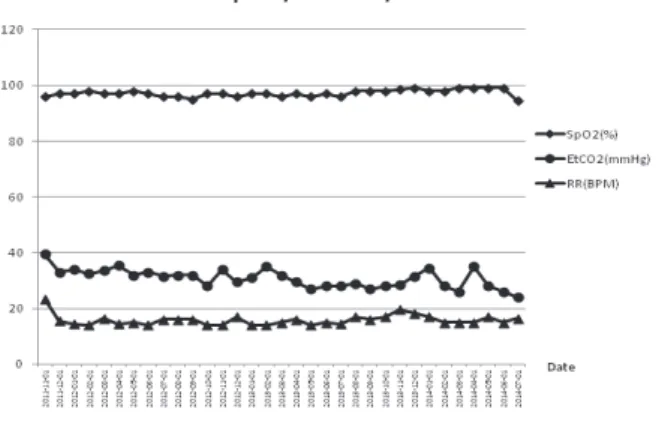
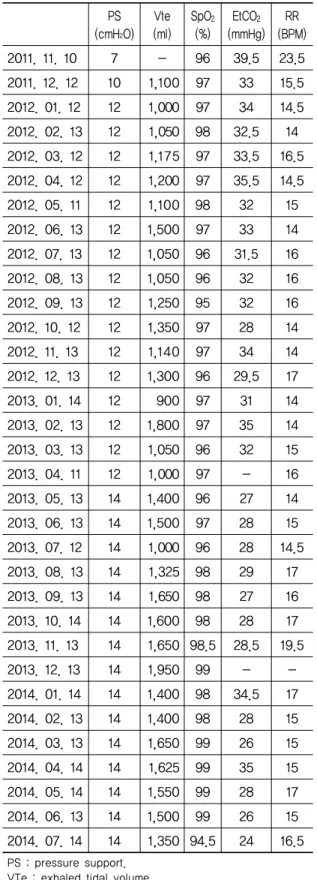
10) 호흡 경과 Fig. 1, 2, Table 1 참고
Fig. 1. The changes in Vte for respiratory management
Fig. 2. The changes in SpO2, EtCO2 and RR for respiratory management
PS (cmH2O)
Vte (ml)
SpO2
(%) EtCO2
(mmHg) RR (BPM) 2011. 11. 10 7 - 96 39.5 23.5 2011. 12. 12 10 1,100 97 33 15.5 2012. 01. 12 12 1,000 97 34 14.5 2012. 02. 13 12 1,050 98 32.5 14 2012. 03. 12 12 1,175 97 33.5 16.5 2012. 04. 12 12 1,200 97 35.5 14.5 2012. 05. 11 12 1,100 98 32 15 2012. 06. 13 12 1,500 97 33 14 2012. 07. 13 12 1,050 96 31.5 16 2012. 08. 13 12 1,050 96 32 16 2012. 09. 13 12 1,250 95 32 16 2012. 10. 12 12 1,350 97 28 14 2012. 11. 13 12 1,140 97 34 14 2012. 12. 13 12 1,300 96 29.5 17 2013. 01. 14 12 900 97 31 14 2013. 02. 13 12 1,800 97 35 14 2013. 03. 13 12 1,050 96 32 15 2013. 04. 11 12 1,000 97 - 16 2013. 05. 13 14 1,400 96 27 14 2013. 06. 13 14 1,500 97 28 15 2013. 07. 12 14 1,000 96 28 14.5 2013. 08. 13 14 1,325 98 29 17 2013. 09. 13 14 1,650 98 27 16 2013. 10. 14 14 1,600 98 28 17 2013. 11. 13 14 1,650 98.5 28.5 19.5 2013. 12. 13 14 1,950 99 - - 2014. 01. 14 14 1,400 98 34.5 17 2014. 02. 13 14 1,400 98 28 15 2014. 03. 13 14 1,650 99 26 15 2014. 04. 14 14 1,625 99 35 15 2014. 05. 14 14 1,550 99 28 17 2014. 06. 13 14 1,500 99 26 15 2014. 07. 14 14 1,350 94.5 24 16.5
PS : pressure support.
VTe : exhaled tidal volume.
SpO2 : peripheral oxygen saturation.
EtCO2 : end-tidal carbon dioxide.
RR : respiration rate.
If the raw data was measured a range form, it was filled
Table 1. Respiratory Progress Ⅲ. 고찰 및 결론
ALS 환자는 전신적으로 근위축 진행을 특징으로 하는 신경퇴행성 질환으로 호흡근육의 위축에서 오는 환기저하 가 주된 사망 원인이 된다15,16). 그리고 진단 당시 연수증상 이 있으면 더 나쁜 생존경과를 보인다17). 아침 두통, 약화 된 기침, 기좌호흡, 수면분절(sleep fragmentation), 낮 시간의 피로, 운동호흡곤란(exertional dyspnea)은 초기 의 호흡부전 증상이다. 증상이 진행됨에 따라 옷 갈아입기 나 식사와 같은 간단한 동작 등을 수행할 때에도 호흡이 짧 아지고, 결국엔 쉬고 있어도 짧은 호흡을 잇게 된다. 횡격 막과 연수근육의 약화에서 오는 약해진 기침능력은 기도에 서 과다해진 분비물로 호흡곤란과 흡인성 증상을 발생시키 며, 이러한 양상의 진행으로 사망에 이른다1).
이때 호흡기능의 평가는 병력청취, 이하학적 검사, 야간 맥박산소측정(overnight pulse oximetry), 노력성 폐활량 검사(forced vital capacity, FVC) 등이 있다. 이중 최대흡 기압(maximal inspinatory pressure)과 최대호기압 (maximal expiratory pressure)은 호흡근 약화와 상응한 다18). 또한 맥박산소측정기의 증가된 CO2 농도도 호흡근 약화에 민감하며 이는 ALS의 생존을 예측할 수 있게 하며19), FVC의 감소도 예후를 결정한다20).
비침습적 양압 환기기는 호흡부전이 있는 환자를 위해 개발되었다11). 이 기계는 두 단계의 양압으로 구성되어 있 으며, 환자가 흡기하려는 시도에 의해서 촉발되고, 호기하 는 중에는 닫히면서 생리적인 호흡을 이용한다. 하루에 4시간 이상 사용할 때 호흡에 드는 힘을 보조하고, O2와 CO2의 교환을 원활하게 하여 수면과 체중, 인지능력을 높
힌다12,13,21). 현재 ALS환자의 호흡기 사용기준은 PaCO2가
45 mm 이상이거나, 폐활량이 정상의 50 % 미만이거나, 비 강흡입압력이 정상의 60 % 미만이거나, 야간에 PaO2가 수 면시간의 5 % 이상에서 90 % 이하로 유지되는 경우이
다18,22). 상기 환자는 PaCO2의 정상초과로 비침습적 양압
환기기를 처방 받았다.
ALS는 한의학적으로 痿證으로 분류된다. 위증은 肢體筋 脈弛緩, 軟弱無力, 手指不能握物, 足不能任身, 久則肌肉萎縮, 不能隨意運動 등의 증상을 가리킨다. 위증의 원인은 대개 火熱邪가 肺津消灼시킴으로 인해 발생되며, 유발요인은 外 邪, 情地失調, 攝生不良, 外傷 등을 들 수 있고, 熱傷肺津, 濕 熱浸淫, 脾胃損傷, 肝腎虧虛, 瘀血阻絡 등으로 병인병기를 나 눌 수 있다23,24). 위증에는 다섯 가지 종류가 있으며(痿證有 五色), 폐가 열하면 위벽이라 하고(肺熱葉焦者爲痿), 심이
라 하며(肝氣熱者爲筋痿), 비가 열하면 육위라 하고(脾氣熱 者爲肉痿), 신이 열하면 골위라 한다(腎氣熱者爲骨痿). ≪圖 解校勘 舍巖道人鍼法ㆍ痿證門≫25), ≪黃帝內經≫에서는 “治 痿獨取陽明”이라 하여, 위증을 치료하는데 양명경을 취혈하 라 하였고, “陽明者, 五臟六腑之海, 主潤宗筋, 宗筋主束骨而 利機關也”라 하였다. 이러한 이유로 약침은 양명경 위주로 選穴하였다. 또한 근위축과 호흡장애가 발생하는 ALS환자 를 筋痿, 痿癖으로 보고 사암침의 간정격과 폐정격을 응용 하였다.
호흡에 주로 작용하는 근육은 횡격막과 외늑간근, 복부 근육들이다. 이중 횡격막의 수축이 흡기의 75 %, 외늑간근 의 수축이 흡기의 25 % 정도를 차지하며 복부근육과 내늑 간근, 경항부의 흉쇄유돌근, 사각근과 흉부의 전거근과 소 흉근 등이 호흡을 보조한다. 횡격막은 횡격신경(phrenic nerve)의 지배를 받는데 이는 C4신경이 주로 지배하며, C3, C5신경이 보조적으로 작용한다. 외늑간근은 늑간신경 의 지배를 받으며 이는 T1부터 T11까지의 흉추부 신경의 앞뿌리에서 기시한다26-31). 이러한 관점에서 경추 흉추부 방광경 1선과 횡격막주변, 복부근육에 약침을 선혈하였다.
ALS의 발병기전은 아직 밝혀져 있지 않으나 다음 몇 가 지 기전이 ALS발병에 연관이 있다고 알려져 있다. 첫 번째 는 산화성 손상으로 알츠하이머병, 파킨슨병 등의 신경계 퇴행성 질환과 비슷하게 산화성 손상기전에 의해 일차적 혹은 이차적 운동신경세포의 손상이 발생한다. 두 번째는 흥분성 세포독성으로 흥분성 신경전달물질인 글루탐산염 의 증가에 따른 신경세포의 손상이 발생하며, 나머지 원인 기전에는 신경영양인자의 결핍, 바이러스 감염, 신경세사 (neurofilament)의 비정상적인 대사, 면역-염증반응 등의 다양한 원인이 제기되고 있다5,32-34).
오공약침은 SOD1 유전자변형 루게릭 쥐모델에서 운동 신경의 파괴를 완화시키고, 미세아교세포와 성상세포의 활 성을 감소시켜 신경염증에 대한 항염증효과를 보였으며, 산화성 손상 또한 줄이는 결과를 보였다35). 봉약침의 성분 인 melittin은 SOD1 유전자 변형 루게릭 쥐모델의 폐와 비 장에서 염증성 물질의 발현을 억제하여 항염증효과를 보임 이 입증되었다36). 이러한 근거로 상기 약침을 응용한 것이 호흡능력 유지에 영향을 미쳤을 것이라 생각되며, 병세의 진행에도 긍정적인 영향을 주었을 것으로 생각된다. 또한 ALS환자에게 사암침의 폐정격의 활용이 SpO2의 증가와 EtCO2 감소에 통계적으로 유의미한 효과를 보였다는 점14)도 상기 환자의 호흡관리에 영향을 주었을 것으로 생각된다.
상기 환자의 호흡 경과를 살펴보면 exhaled tidal volume(Vte)는 일시적 증가와 감소를 보이며 전체적으로 1,300 mL 전후로 유지되고 있다. Vte란 호기 시 폐활량을
나타내는 지표로 공기가 폐를 얼마나 확장시킬 수 있는지 를 나타낸다. 이 결과는 아직 폐포의 용적이 확보되고, 폐 전체의 확장성이 유지됨을 의미한다37). 일반적인 ALS환자 는 시간이 지나면서 호흡근의 약화와 폐포 간의 분비물의 누적으로 Vte는 점차 감소되며, 이는 환자의 FVC, 최대 호 기압(maximal expiratory pressure, MEP)이 생존예후에 영향을 미치는 것18,20)과 비슷한 의미로 볼 수 있다. 이로써 판단할 때 본 증례는 Vte는 유의미한 유지를 오랫동안 하 고 있으며, SpO2도 97 % 이상, EtCO2도 35 % 이하로 유지 되어 악화되지 않는 상태이다. 위와 같은 결과로 판단해볼 때, 비침습적 양압 환기기와 침 치료, 약침치료, 한약투여 의 병용 치료가 ALS의 호흡유지에 효과가 있었을 것이라 사료된다.
상기 증례는 단일증례라는 한계가 있고, 비침습적 양압 환기기와 약침과 침 치료, 한약투여 등의 복합적인 처치가 있었기 때문에 단일 치료군의 효과를 단정 짓기 어려운 단 점이 있다. 그러나 발병 후 2년 만에 호흡장애로 비침습적 양압 환기기를 처방받았고, 진행성 상하지 근력 저하를 보 이던 상황에서 본원의 한방치료와 비침습적 양압 환기기의 병용으로 약 2년 7개월 동안 호흡과 관련된 객관적 지표들 이 정상범위로 유지된 점은 상당히 고무적인 증례로 볼 수 있다. 따라서 본 증례보고는 ALS환자의 호흡관리에 대한 새로운 임상적 지침을 열어줄 것이라 예상하며, 향후 다수 의 환자를 대상으로 각 치료의 독립적인 효과를 평가하는 것이 필요할 것으로 사료된다.
Ⅳ. References
1. Paul H Gordon. Amyotrophic lateral sclerosis: an update for 2013 clinical features, pathophysiology, management and therapeutic trials. Aging and Disease. 2013 ; 4(5) : 295-310.
2. Kim SH. Diagnosis and therapeutic strategies of amyotrophic lateral sclerosis. Hanyang Medical Reviews. 2006 ; 26(1) : 45-51.
3. Haverkamp LJ, Appel V, Appel SH. Natural history of amyotrophic lateral sclerosis in a database population. Validation of a scoring system and a model for survival prediction Brain. 1995 ; 118(3) : 707-19.
4. Caroscio JT, Mulvihill MN, Sterling R, Abrams B.
Amyotrophic lateral sclerosis, its natural history.
Neurol Clin. 1987 ; 5(1) : 1-9.
5. Mulder DW. Motor neuron disease. In: Dyck PJ, Thomas PK, Lambert EH, Bunge R eds. Peripheral neuropathy, ed 2, Vol. 2. Philadelphia PA : WB Saunders. 1984 : 1525-36.
6. Radunovic A, Annane D, Rafiq MK, Mustfa N, Mechanical ventilation for amyotrophic lateral sclerosis/motor neuron disease. The Cochrane Database of Systemic Reviews. 2013 ; published online 28 : 3.
7. Gordon PH, Corcia P, Lacomblez L et al. Defining survival as an outcome measure in amyotrophic lateral sclerosis. Arch Neurol. 2009 ; 66(6) : 758-61.
8. Lacomblez L, Bensimon G, Leigh PN, Guillet P, Meininger V. Dose-ranging study of riluzole in amyotrophic lateral sclerosis. Amyotrophic Lateral Sclerosis/Riluzole Study Group II. Lancet, 1996 ; 347(9013) : 1425-31.
9. Bensimon G, Lacomblez L, Meininger V. A controlled trial of riluzole in amyotrophic lateral sclerosis.
ALS/Riluzole Study Group. N Engl J Med. 1994 ; 330(9) : 585-91.
10. Miller RG, Mitchell JD, Moore DH. Riluzole for amyotrophic lateral sclerosis (ALS)/motor neuron disease(MND). Cochrane Database Syst Rev. 2012 ; published online 14 : 3.
11. Gordon PH, Mitsumoto H. Chapter 20 symptomatic therapy and palliative aspects of clinical care.
Handb Clin Neurol, Netherlands : North-Holland Pub Co. 2008 ; 389-424.
12. Heckmatt JZ, Loh L, Dubowitz V. Night-time nasal ventilation in neuromuscular disease. Lancet.
1990 ; 335(8689) : 579-82.
13. Bourke SC, Tomlinson M, Williams TL, Bullock RE, Shaw PJ, Gibson GJ. Effects of non-invasive ventilation on survival and quality of life in patients with amyotrophic lateral sclerosis: a randomised controlled trial. Lancet Neurol. 2006 ; 5(2) : 140-7.
14. Lee S, Kim S. The effects of Sa-am acupuncture treatment on respiratory phsiology parameters in amyotrophic lateral sclerosis patients: a pilot
published online 11 : 9.
15. Tandan R, Bradley WG, Amyotrophic lateral sclerosis:
part 1. clinical features, pathology, and ethical issues in management. Ann Neurol. 1985 ; 18(3) : 271–80.
16. Rowland LP, Shneider NA. Amyotrophic lateral sclerosis. N Engl J Med. 2001 ; 344(22) : 1688– 700.
17. Del Aguila MA, Longstreth WT Jr, McGuire V, Koepsell TD, van Belle G. Prognosis in amyotrophic lateral sclerosis: a population-based study.
Neurology. 2003 ; 60(5): 813–19.
18. Miller RG, Jackson CE, Kasarskis EJ et al. Practice parameter update: the care of the patient with amyotrophic lateral sclerosis: drug, nutritional, and respiratory therapies(an evidencebased review):
report of the quality standards subcommittee of the American Academy of Neurology. Neurology.
2009 ; 73(24) : 1218-26.
19. Morgan RK, McNally S, Alexander M, Conroy R, Hardiman O, Costello RW. Use of sniff nasal- inspiratory force to predict survival in amyotrophic lateral sclerosis. Am J Respir Crit Care Med. 2005 ; 171(3) : 269-74.
20. Baumann F, Henderson RD, Morrison SC et al. Use of respiratory function tests to predict survival in amyotrophic lateral sclerosis. Amyotroph lateral sclera. 2010 ; 1-2) : 194-202.
21. Newsom-Davis IC, Lyall RA, Leigh PN, Moxham J, Goldstein LH. The effect of non-invasive positive pressure ventilation(NIPPV) on cognitive function in amyotrophic lateral sclerosis(ALS): a prospective study. J Neurol Neurosurg Psychiatry.
2001 ; 71(4) : 482-7.
22. Heiman-Patterson TD, Miller RG. NIPPV: a treat- ment for ALS whose time has come. Neurology.
2006 ; 67(5) : 736-7.
23. Korean acupuncture & Moxibustion Medicine Society Textbook Compailation Commitee. Korean acu- puncture & moxibustion medicine. Ha volume.
Gyeonggi : Jipmoondang. 2008 : 197-200.
24. Heo J. Donguibogam. Seoul : Yeogang Publishing Company. 1994 : 1060-1, 1102-3.
puncture. Busan : Sogang. 2002 : 475-80.
26. Wade OL. Movements of the thoracic cage and diaphragm in respiration. The Journal of physiology. 1954 ; 124(2) : 193.
27. Kim E Barrett, Susan M Barman, Scott Boitano, Heddwen Brooks. "35. Pulmonary Function".
Ganong's review of medical physiology, 23rd edition.
USA : McGraw-Hill Companies, Incorporated.
2009. Cite uses deprecated parameters(587-638 help).
28. Campbell EJ. M. The role of the scalene and sternomastoid muscles in breathing in normal subjects. An electromyographic study. Journal of Anatomy. 1955 ; 89(3) : 378-86.
29. Netter FH. Atlas of human anatomy 3rd ed. Icon learning systems. Teterboro. New Jersey : Icon learning systems. 2003 : 191.
30. Raper AJ, Thompson WT, Shapiro W, Patterson JL. Scalene and sternomastoid muscle function.
Journal of Applied Physiology. 1966 ; 21(2) : 497-502.
31. De Troyer A. Respiratory muscle function. In:
Gibson J, Geddes DM, Costabel U et al ed.
Respiratory medicine. London : Saunders. 2003 : 119-29.
32. Rakhit R, Cunningham P, Furtos-Matei A et al.
Oxidation-induced misfolding and aggregation of
superoxide dismutase and its implications for amyotrophic lateral sclerosis. J Biol Chem. 2002 ; 277(49) : 47551-6.
33. Dal Canto MC, Gurney ME. Neuropathological changes in two lines of mice carrying a transgene for mutant human Cu, Zn SOD, and in mice overexpressing wild type human SOD: a model of familial amyotrophic lateral sclerosis (FALS). Brain Res. 1995 ; 676(1) : 25-40.
34. Nguyen MD, Lariviere RC, Julien JP. Deregu- lation of Cdk5 in a mouse model of ALS: toxicity alleviated by perikaryal neurofilament inclusions.
Neuron. 2001 ; 30(1) : 135-47.
35. Cai MuDan, Choi SM, Song BK, Son IH, Kim SC, Yang EJ. Scolopendra subspinipes mutilans attenuates neuroinflammation in symptomatic hSOD1G93A mice. Journal of Neuroinflammation 2013 : 10(1) : 131.
36. Lee SH, Choi SM, Yang EJ. Melittin ameliorates the inflammation of organs in an amyotrophic lateral sclerosis animal model. Exp Neurobiol.
2014 Mar ; 23(1) : 86-92.
37. Gammage GW, Banner MJ, Blanch PB, et al.
Ventilator displayed tidal volume: what you see may not be what you get. Crit Care Med. 1988 ; 16(4) : 454.