• 검색 결과가 없습니다.

A Case Study on the Use of Trihexyphenidyl, Korean Medical Treatment for the Control of Sialorrhea in Patients with Amyotrophic Lateral Sclerosis(ALS)

N/A
N/A
Protected

Academic year: 2021

Share "A Case Study on the Use of Trihexyphenidyl, Korean Medical Treatment for the Control of Sialorrhea in Patients with Amyotrophic Lateral Sclerosis(ALS)"

Copied!
7
0
0

로드 중.... (전체 텍스트 보기)

전체 글

(1)

A Case Study on the Use of Trihexyphenidyl, Korean Medical Treatment for the Control of Sialorrhea in Patients with

Amyotrophic Lateral Sclerosis(ALS)

Ho Hyun Jeong 1 , Sung Ha Kim 1 , Sang Mi Lee 1 , Jong Chul Lee 1 , Man Young Park 1 , Dong Woung Kim 2 and Sung Chul Kim 1, *

1 Department of Acupuncture & Moxibustion Medicine, Gwang-Ju Oriental Medical Hospital, Wonkwang University

2 Department of Internal Medicine, Gwang-Ju Oriental Medical Hospital,

Wonkwang University

[Abstract]

Objectives : Sialorrhea in amyotrophic lateral sclerosis patients is a cause of death due to aspiration pneumonia as well as reduces the patient's quality of life. We report the changes that appeared in the sialorrhea treated by using trihexyphenidyl and Korean medical treatments.

Methods : We treated amyotrophic lateral sclerosis patient with sialorrhea by using trihexyphenidyl a known antiparkinsonian agent and Korean medical treatments such as acupuncture, pharmacopuncture and herbal medicine. The salivation rate was checked with visual analogue scale(VAS).

Results : There was a more than 50 % decrease in salivation in this case. Owing to the constipation, trihexyphenidyl was stopped after which only Korean medical treatments were provided. Over which a lasting decrease in salivation could be seen.

Conclusions : Existing treatments would cause several considerable side effects and have difficulty in being applied in domestic clinics. In this respect, we suspect that our findings could open up new clinical guideline possibilities. We should solve the limitations of this case study and conduct more studies.

Key words :

Amyotrophic lateral sclerosis(ALS);

Sialorrhea;

Oriental medical tratment;

Trihexyphenidyl

Received : 2013. 03. 01.

Revised : 2013. 04. 04.

Accepted : 2013. 04. 04.

On-line : 2013. 04. 20.

※ This study was supported by a grant of the Korean Health Technology R&D Project(B110076), Ministry of Health & Welfare, Republic of Korea

* Corresponding author : Department of Acupuncture & Moxibustion Medicine, Gwang-Ju Oriental Medical Hospital, Wonkwang University, 1140-23, Hoejae-ro, Nam-gu, Gwangju, 503-832, Republic of Korea

Tel : +82-62-670-6441 E-mail : [email protected]

This is an Open-Access article distributed under the terms of the Creative Commons Attribution Non-Commercial License (http://creativecommons.org/licenses/by-nc/3.0) which permits unrestricted non-commercial use, distribution, and reproduction in any medium, provided the original work is properly cited.

Copyright © 2013 KAMMS. Korean Acupuncture & Moxibustion Medicine Society. All rights reserved.
(2)

Ⅰ. Introduction

Amyotrophic Lateral Sclerosis(ALS) is a pro- gressive and fatal neurodegenerative disorder in- volving primarily the motor neurons in the cerebral cortex, brainstem and spinal cord. With in 2~4 years, it causes progressive and severe muscle weakness, eventually causing death due to respiratory muscle palsy 1) . Symptoms of bulbar dysfunction are common in ALS, presenting as an initial symptom in nearly half(45 %) of the patients, and presenting in almost 81 % of the patients at the time of death 2,3) . ALS patients with bulbar dysfunction frequently develop dysarthria and difficulty in swallowing that cause sialorrhea at a relatively early stage in the disease.

Such sialorrhea reduces the patient’s quality of life due to social problems, such as embarrassment, dis- comfort, difficulty in speaking, as well as increasing the risk of aspiration pneumonia 4) .

Recently, several different treatments for sialorrhea in ALS have been introduced. Treatment options for sialorrhea range from conservative (observation, pos- tural control, biofeedback, spit-cup) to more aggressive measures such as pharmacotherapy, botulinum toxin (BTX) injection, radiotherapy, and surgical treatment.

Salivary gland irradiation and surgical ablation are effective and permanent, but they can result in an irreversibly dry mouth and exacerbation of dysphagia and dysarthria. Some studies reported acute deterio- ration of bulbar function after botulinum toxin treat- ment for sialorrhoea in ALS 5) . As these method have various side effects and there is difficulty in applying them in domestic clinics, additional discussions are needed.

Domestic studies on ALS patients have been conducted by Kim et al 6) , Ryu et al 7) , Choi et al 8) , Cheon et al 9) , Park et al 10) , Ryu et al 11) , Kwon 12) etc.

However, studies on ALS patients with sialorrhea are inadequate. Especially, since there have been no studies so far using Korean medical treatments such as acupuncture, pharmacopuncture, herbal medicine and western medicine treatments. So we need to make effective and practical clinical guidelines as soon as

possible.

We administered trihexyne a known antipar- kinsonian agent with Korean medical treatments to an ALS patient with sialorrhea in our hospital between 8th March and 26th May 2012. After which, we stopped the trihexyne and provided Korean medical treatment only until 2012.6.25. We reported the changes that appeared in the sialorrhea during this period.

Ⅱ. Case study

1. Patient Sohn 〇〇 M/61

2. Chief complaints

dysarthria, sialorrhea, dysphagia, sputum, fasciculation (Rt. leg), both lower limb weakness

3. Onset 2010. 2

4. Past medical history N/S

5. Family history N/S

6. Medication history

Ambrect Tab. 2T#2, Busron Tab. 10 mg 2T#2, Oropherol Soft Cap. 100 mg 2T#2, Platless Tab. 1T#1, Livaro Tab. 2 mg 1T#1, Aronamin C plus Tab. 2T#2

7. Present illness

① 2010. 2

After playing tennis, dysarthria developed.

② 2010. 4

Visiting Korea University Hospital. B-CT,

MRI→ None specific.

(3)

③ 2010. 8

Asan hospital admission. (for 4D) EMG, Genetic testing → ‘Motor neuron disease’ diagnosed.

④ 2011. 4

Visiting Seoul National University Hospital.

EMG, Genetic testing etc. → ‘ALS’ diagnosed.

⑤ 2011. 8

Visiting Asan Hospital. Several test → ‘ALS’

diagnosed.

⑥ 2011. 11. 29~12. 28, 2012. 1. 2~1. 19

Gwang-Ju Oriental Medical Hospital, Wonkwang University admission treatment.

⑦ 2012. 1. 26

Admission(by wheel chair)

8. Examination views

① EKG : normal

② LAB : MCHC 37.4↑, Eos% 14.6↑, Eos# 1.0H, Baso% 1.1↑, ALT 43↑, ALP 79.0↓, Glucose 106.0↑

③ Motor Grade : Shoulder 5-/5-, Elbow 5/5, Wrist 5-/5-, Finger 5-/5-, Hip 3/3, Knee 4/4, Ankle 3/4, 1st toe 3/4

④ Neurological examination Mental state : Alert Pupil reflex : 2+/2+

Knee jerk reflex : →→

Biceps reflex : →→

Babinksi sign : -/-

9. Korean medical diagnosis Wei symptom(痿證)

10. Treatment method a. Trihexyne tabs

Trihexyne a known antiparkinsonian agent and manufactured by Tai guk pharmaceuticals was used, between 2012. 3. 8 and 2012. 3. 19 Trihexyne (0.5 mg) was administered to the patient 30 minutes

Date 12. 3. 8~19 12. 3. 20~

5. 26 12. 5. 27~

Dose 0.5 mg/d 1 mg/d Stop

Table1. Trihexyne Administration

after eating breakfast, however salivation of the patient increased. Trihexyne(1 mg) was administered in the same way between 2012. 3. 20 and 2012. 5. 26.

During this period the patient had complained of slight constipation so the administration of trihexyne was stopped (Table 1).

b. Acupuncture & pharmacopuncture

① Monday, Wednesday, Friday

Sa-am acupuncture lung tonification(太白SP 3 ㆍ太 淵LU 9 ㆍ少府HT 8 ㆍ魚際LU 10 ) was conducted on both sides by single-use 0.25×40 mm needles(DongBang acupuncture, Inc Korea). The SP 3 and LU 9 acupoint needles were electrically charged at 2 Hz and also stimulated using infra red for 15 minutes.

0.1 cc of Scolopendrid pharmaco-puncture(Korean pharmacopuncture institute) was injected equally at acupoints of Hagwan(ST 7 )ㆍJichang(ST 6 )ㆍCheondol (CV 22 )ㆍDaechuGV 14 )ㆍAmun(GV 15 ),ㆍPungbu(GV 16 )ㆍ Gyeonjeong(GB 21 ).

After checking for allergic reactions using a skin test, 0.1cc of bee-venom pharmaco-puncture(Korean pharmacopuncture institute) was administered equally on the acupoints of Joksamni(ST 36 )ㆍSusamni(LI 10 )ㆍ Hapgok(L I4 )ㆍGuheo(GB 40 )ㆍPungsi(GB 31 ).

② Tuesday, Thursday, Saturday

Scalp acupuncture in motor area was conducted by single-use 0.3×40 mm needles(DongBang acupunc- ture Inc, Korea) for 15 minutes. Bulbar palsy treat- ment was conducted by stimulating the soft palate and applying acupuncture in Geumjin, Okaek acuo- points by single-use 0.4×0.75 mm needles(DongBang acupuncture Inc, Korea). After which, bamboo salt was spread over the procedure region.

0.2 cc of Hominis placenta pharmacopuncture(Korean

pharmacopuncture institute) was injected equally at

acupoints of Sinsu(BL 23 ), Jangmun(LR 13 ), Amun(GV 15 ).

(4)

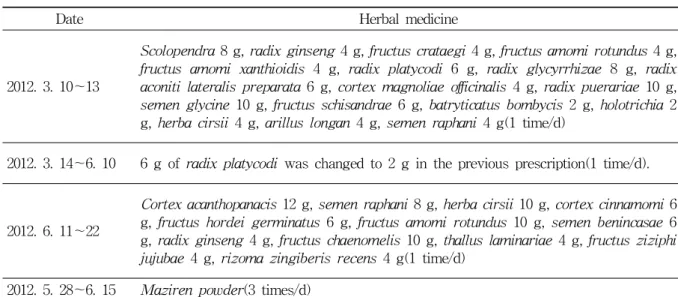
Date Herbal medicine

2012. 3. 10~13

Scolopendra 8 g, radix ginseng 4 g, fructus crataegi 4 g, fructus amomi rotundus 4 g, fructus amomi xanthioidis 4 g, radix platycodi 6 g, radix glycyrrhizae 8 g, radix aconiti lateralis preparata 6 g, cortex magnoliae officinalis 4 g, radix puerariae 10 g, semen glycine 10 g, fructus schisandrae 6 g, batryticatus bombycis 2 g, holotrichia 2 g, herba cirsii 4 g, arillus longan 4 g, semen raphani 4 g(1 time/d)

2012. 3. 14~6. 10 6 g of radix platycodi was changed to 2 g in the previous prescription(1 time/d).

2012. 6. 11~22

Cortex acanthopanacis 12 g, semen raphani 8 g, herba cirsii 10 g, cortex cinnamomi 6 g, fructus hordei germinatus 6 g, fructus amomi rotundus 10 g, semen benincasae 6 g, radix ginseng 4 g, fructus chaenomelis 10 g, thallus laminariae 4 g, fructus ziziphi jujubae 4 g, rizoma zingiberis recens 4 g(1 time/d)

2012. 5. 28~6. 15 Maziren powder(3 times/d) Table 2. Herbal Medicine Treatment

Date Progress VAS

2012. 3. 8∼10 No change 7

2012. 3. 11∼15 Slightly more 8

2012. 3. 16 The most 10

2012. 3. 17∼26

Slightly less than 3. 16 (3. 20 Trihexyne 0.5 mg

→ 1 mg)

9

2012. 3. 27 Same as first 7

2012. 3. 28 Less than beginning for

the first time 6

2012. 3. 29∼31 More decreased 5

2012. 4. 1∼19 More decreased 4

2012. 4. 20∼24 More than before 6

2012. 4. 25∼28 Same as first 7

2012. 4. 29∼5. 2 Less than before 5

2012. 5. 3∼8 More decreased 4

2012. 5. 9∼10 More than before 6

2012. 5. 11 More decreased 5

2012. 5. 12∼26 More decreased

(5. 26 Trihexyne stop) 4

2012. 5. 27 Same as before 4

2012. 5. 28∼6. 25 The least and last 3 Table 3. Prog ress and VAS Change

Fig. 1. Sialorrhea VAS change c. Herbal medicine

2012. 3. 10~6. 10 prescription named ‘Okong de- coction(蜈蚣湯)’ was administered 30minutes after eating breakfast.

2012. 6. 11~6. 22 prescription named ‘Ogapi decoction (五加皮湯)’ was administered in the same way.

2012. 5. 28~6. 15 ‘Mazain powder(麻子仁散)’ was administered three times a day due to constipation (Table 2).

11. Assessment & Result

The salivation rate was checked with visual analogue scale(VAS). The patient rated himself by marking the VAS ruler representing the subjective amounts of sialorrhea (range from 0 to 10, where 0 represents no drooling and 10 represents constant drooling) at 8pm everyday.

We measured VAS(Table 3), (Fig. 1).

(5)

Ⅲ. Discussion

The worldwide incidence of ALS is reported to range between 0.4 and 2.6 / 100,000 individuals per year, reviewed in Beghi et al 13) . There is no differ- ence between race, geography and socioeconomics 14) . The symptoms of ALS include spasticity, muscle weakness and wasting, impaired speaking, swallowing and breathing as well as sialorrhea. Survival time is significantly reduced when the disease starts with bulbar symptoms or at an older age.

Sialorrhea is a disabling problem in bulbar-onset ALS, although it is not a directt cause of death, it causes reduced quality of life such as sanitary problems, discomfort, embarrassment, difficulty in swallowing, speaking and increased risk of aspiration pneumonia.

Trihexyne composed of trihexyphenidyl is an anti- parkinsonian agent of the anti-muscarinic class.

Trihexyphenidyl is used for the symptomatic treatment of Parkinson’s disease in mono and combination therapy.

The exact mechanism of action in parkinsonian syn- dromes is not precisely understood, but it is known that trihexyphenidyl blocks

efferent impulses in parasympathetically innervated structures like smooth muscles, salivary glands, and the eyes. To function, it binds to the M1 muscarinic receptor and possibly the dopamine receptor. It is known that the effectiveness of trihexyphenidyl is treating the extrapyramidal side effects and reducing the frequency and duration of oculogyric crises as well as of dyskinetic movements and spastic con- tractions and excessive salivation etc 15) . Taking ad- vantage of these facts, we make use of it for treating sialorrhea in ALS patient, but on the other hand, we cannot use it consistently and in quantity because of its side effects. It is known that side effects of anticholinergic agent such as trihexyne are divided into two types: peripheral and central. Peripheral side effects include blurred vision, dry mouth, decreased GI motility, decreased secretions, tachycardia, and urinary bladder retention. Central side effects include sedation, decreased concentration, forgetfulness, con- fusion, and psychotic symptoms 16) . Thus, we should

use anticholinergic drugs carefully and find other treatments.

ALS belongs to the category of Wei symptom(痿證) in Korean medicine. The five types of Wei symptom were described as “Wei symptoms include five types (痿證有五色). Heat in the lung dries lung paren- chyma and leads to Wei Pi(肺熱葉焦者爲痿癖). Heat in the heart dries heart Qi and leads to Mai Wei (心熱氣燥者爲脈痿). Heat in the liver leads to Jin Wei(肝氣熱者爲筋痿). Heat in the spleen leads to Rou Wei(脾氣熱者爲肉痿). Heat in the kidney leads to Gu Wei(腎氣熱者爲骨痿).” in ≪圖解校勘舍岩道人 鍼法ㆍ痿證門≫ 17) . We judged that above ALS patient with sialorrhea, dysarthria and dysphagia was similar to type of 痿癖. Based on this, the Sa-am acupunc- ture lung tonification treatment(太白ㆍ太淵 補, 少府ㆍ 魚際 瀉) was selected to treat 痿癖.

Stimulation of the soft palate and application of acupuncture in the Geumjin, Okaek were carried out with the purpose of improving the symptoms of bulbar palsy such as dysarthria, dysphagia, sialorrhea.

Pharmacopuncture such as Scolopendrid, bee-venom, hominis placenta pharmacopuncture was used for enhancing immunity, strength and treating muscle weakness and pain caused by joint contracture.

It is known that characteristic of scolopendrid is sour(辛), warm(溫), and very dry(猛燥). It can be used to treat disorders such as wind(風), cold(寒), dampness (濕) 18) . Sialorrhea is considered a type of dampness.

Taking advantage of dry character of Scolopendrid, we make use of Okong decoction for treating sialorrhea.

In this case study, there appeared to be a reduced sialorrhea in the ALS patient after using trihexyne tab. and Korean medical treatment. There was a more than 50 % decrease in salivation in this case.

In the early stages of the study, salivation increased because the patient didn’t receive a high enough dose of trihexyne, as well as being diagnosed as suffering with another ongoing neurodegenerative disease.

No serious adverse side effects of trihexyne were encountered except slight constipation in the treat- ment period.

Owing to the constipation, trihexyne was stopped

after which only Korean medical treatments were

(6)

provided. After which patient progress was monitored.

Over which a lasting decrease for a month in sali- vation could be seen.

Existing studies show that invasive treatments have many side effects and overdose or long-term use of anticholinergic drugs cause serious side ef- fects 5,16) . Even though we cannot definitively confirm that the Korean medical treatment might directly affects sialorrhea, it shows effect on lasting decrease in salivation. It is important to show that the Korean medical treatment could be a complementary treat- ment to existing treatments which have many side effects.

The limitations of this study include there was only one patient, uncontrolled design, and lack of blinding. As it judges a change of salivation only with VAS, there is also insufficient data to make an objective and/or a subjective evaluation.

Existing treatments would cause several considerable side effects and have difficulty in being applied in domestic clinics. In this respect, despite some limi- tations, we suspect that our findings could open up new clinical guideline possibilities.

Ⅳ. References

1. Ince PG, Lowe J, Shaw PJ. Amyotrophic lateral sclerosis: current issues in classification, patho genesis and molecular pathology. Neuropathol Appl Neurobiol. 1998 ; 24(2) : 104-17.

2. Neppelberg E, Haugen DF, Thorsen L, Tysnes OB. Radiotherapy reduces sialorrhea in amyotrophic lateral sclerosis. European journal of neurology.

2007 ; 14(12) : 1373-7.

3. Benditt JO. Respiratory complications of amyo- trophic lateral sclerosis. Seminars in Respiratory and Critical Care Medicine. 2002 ; 23(3) : 239–

47.

4. Ashok Verma, Julie Steele. Botulinum toxin im- proves sialorrhea and quality of living in bulbar amyotrophic lateral sclerosis. Muscle & nerve 2006 ; 34(2) : 235-7.

5. Meijer JW, van Kuijk AA, Geurts AC, Schelhaas HJ, Zwarts MJ. Acute deterioration of bulbar function after botulinum toxin treatment for sial- orrhoea in amyotrophic lateral sclerosis. American journal of physical medicine & rehabilitation.

2008 ; 87(4) : 321-324.

6. Kim TY, Lee BJ, Jeon JH, Lew JH. A case of amyotrophic lateral sclerosis. The journal of Korean oriental internal medicine. 2000 ; 21(4) : 661-5.

7. Ryu MS, Wi Jun, Bang SP, Lee JE, Kim JH, Yun YC. 2 cases of amyotrophic lateral sclerosis with oriental medical treatment evaluated by K-ALSFRS-R and ALSSS. The journal of Korean acupuncture and moxibustion society. 2009 ; 26 (1) : 173-85.

8. Choi EH, Jeon JH, Kim YM et al. Clinical observation on a case of patient with amyotrophic lateral sclerosis. The journal of Korean acupun- cture and moxibustion society. 2007 ; 24(4) : 225-35.

9. Cheon YW, Moon SK, Ko CN et al. Clinical observation on a case of patients with amyotrophic lateral sclerosis patients in oriental medical hos- pital. The journal of Korean oriental internal medicine. 1997 ; 18(2) : 236-45.

10. Park BW, Lee E, Ko H. A study on the effi- ciency of riluzole and oriental medical treatment in amyotrophic lateral sclerosis. The journal of Korean oriental internal medicine. 2001 ; 22(2) : 279-83.

11.

Ryu YJ, Lee KH, Kwon KR, Lee YH, Sun SH, Lee SJ. Mountain ginseng pharmacopuncture treatment on three amyotrophic lateral sclerosis patients. The journal of Korean pharmacopuncture institute. 2010 ; 13(4) : 119-28.

12. Kwon KR. Clinical studies of amyotrophic lateral sclerosis through Korean medicine. The journal of Korean acupuncture and moxibustion society.

2003 ; 20(3) : 209-16.

13. Beghi E, Logroscino G, Chio A et al. The epidemiology of ALS and the role of population- based registries. Biochimica et Biophysica Acta.

2006 ; 1762 : 1150-7.

(7)

14. Han TR, Bang MS. Rehabilitation. Seoul : Gunja.

2008 : 697-700.

15. Wikipedia. Trihexyphenidyl. Available from : URL:http://en.wikipedia.org/wiki/Trihexyphenidyl 16. Vidyasagar R Vangala, Michael JTueth. Chronic

anticholinergic toxicity, Identification and manage- ment in older patients. Geriatrics. 2003 ; 58(7) :

36-7.

17. Kim DH. Illustrations Kyokam Sa-am Do-in Acupuncture. Busan : Sogang. 2002 ; 475-80.

18. Kim SN, Lim JA, Lee SY et al. A Study on

Genetic Analysis and Extract Cytotoxicity of

Scolopendra subspinipes multilans L. Koch. Journal

of pharmacopuncture. 2006 ; 92(2) : 49-65.

수치

Fig.  1.  Sialorrhea  VAS  changec.  Herbal  medicine

참조

관련 문서

• Despite medical intervention with supportive care (78% of the patients use corticosteroids), patients continued to show disabling symptoms, progressive complications,

A Contrastive Study on the Proverbs of Family Relationship of Korean and Chinese..

Compromised CD4+ CD25(high) regulatory T-cell function in patients with relap sing-remitting multiple sclerosis is correlated with a reduced frequency of

Just as we achieved good control with a joint-based controller that was based on a linearizing and decoupling model of the arm, we can do the same for the Cartesian case.

Objective: The purpose of this study is to use it as a basis for the health care guidelines for the muscle mass and cardiovascular disease of Korean population by

Through a review of electronic medical records, we analyzed the applied BCSs, perioperative hematologic changes, and morbidity and mortality in JW patients

When physical therapists are asked about appling complementary & alternative medicine at medical treatment hospital as supplementary treatments for

This is a study for the entries into international market of Korean ship management service as one of the counterproposal for strengthen its competitiveness of