A Case Study on the Use of Megestrol Acetate and Korean Medical Treatment for the Loss of Appetite
and Weight Loss in Patients with Amyotrophic Lateral Sclerosis(ALS)
※Ho Hyun Jeong1, Sang Mi Lee1, Jong Chul Lee1, Man Yong Park1, Dong Woung Kim2, Bong Keun Song2 and Sung Chul Kim1,*
1Department of Acupuncture & Moxibustion Medicine, Gwang-Ju Oriental Medical Hospital, Wonkwang University
2Department of Internal Medicine, Gwang-Ju Oriental Medical Hospital, Wonkwang University
[Abstract]
Objectives : Weight loss and loss of appetite in amyotrophic lateral sclerosis patients are common symptoms, these are associated with survival as well as nutritional condition. The changes in weight and appetite were reported after treatment using Megestrol acetate and Korean medical treatments.
Methods : Amyotrophic lateral sclerosis patient with weight loss and loss of appetite were treated by administering megestrol acetate a known anti-malignant tumor agent and Korean medical treatments such as acupuncture, pharmacopuncture and herbal medicine. The changes in weight and appetite were checked using body mass index(BMI) and simplified nutritional appetite questionnaire(SNAQ).
Results : There was a more than 17 kg increase in weight. BMI increased from 15.94 kg/㎡ to 21.97 kg/㎡ and SNAQ score increased from 7 to 16. Owing to several side effects, Megestrol acetate was stopped after which only Korean medical treatments were provided. After which the lasting effects in BMI and appetite could be seen.
Conclusion : There are few studies on weight loss and loss of appetite in ALS patients. Using only megestrol acetate can cause several considerable side effects. Which respect to this, the findings in this study could open up new clinical guideline possibilities.
Key words :
Amyotrophic lateral sclerosis(ALS);
Weight loss;
Anorexia;
Oriental medical treatment;
Megestrol acetate
Received : 2013. 08. 12.
Revised : 2013. 11. 21.
Accepted : 2013. 11. 21.
On-line : 2013. 12. 20.
※ This study was supported by a grant of the Korean Health Technology R & D Project(B110076), Ministry of Health & Welfare, Republic of Korea
✱ Corresponding author : Department of Acupuncture & Moxibustion Medicine, Gwang-Ju Oriental Medical Hospital, Wonkwang University, 1140-23, Hoejae-ro, Nam-gu, Gwangju, 503-832, Republic of Korea
Tel : +82-62-670-6441 E-mail : [email protected]
This is an Open-Access article distributed under the terms of the Creative Commons Attribution Non-Commercial License (http://creativecommons.org/licenses/by-nc/3.0) which permits unrestricted non-commercial use, distribution, and reproduction in any medium, provided the original work is properly cited.
The Acupuncture is the Journal of Korean Acupuncture & Moxibustion Medicine Society. (http://www.TheAcupuncture.or.kr) Copyright © 2013 KAMMS. Korean Acupuncture & Moxibustion Medicine Society. All rights reserved.
Ⅰ. Introduction
Amyotrophic Lateral Sclerosis (ALS) is a progres- sive and fatal neurodegenerative disorder involving primarily the motor neurons in the cerebral cortex, brainstem and spinal cord. Within 2~4 years, it causes progressive and severe muscle weakness, eventually causing death due to respiratory muscle palsy1). During the course of the disease prevalence of malnutrition varies between 16 and 55 % in ALS patients. These patients suffer from clinically severe weight loss2). Nutritional status is known as a prognostic factor for survival in ALS patients. A body mass index(BMI) below 18.5 kg/㎡ caused by weight loss results in a 7.7 times higher mortality rate, compared to patients with normal weight3). The causes of weight loss in ALS patients are various but are likely to include hypermetabolism, malnutrition, cachexia and loss of appetite4,5). Loss of appetite is a multifactorial syndrome resulting from a lot of symptoms such as depression, psychological distress, constipation and changes in controlling eating behavior etc6,7).
Until now, treatment for ALS has been actively discussed and studied, but a certain cure has not presented as yet. Current treatment is primarily supportive. Drug therapy with Riluzole known as a glutamate release inhibitor extends survival by two-to-three months8). Several treatments such as BTx therapy, radiotherapy and anti-cholinergic drug therapy have effects on sialorrhea in ALS patients9) also Non invasive positive pressure ventilation(NIPPV) helps ALS patients with dyspnea10). However most of the existing treatments have not focused on weight loss in ALS patients.
Domestic studies on ALS patients have been conducted by Park et al11), Ryu et al12), Kwon13) etc, but studies on ALS patients with weight loss or loss of appetite are inadequate. Especially, since there have been no studies so far using Korean medical treatments such as acupuncture, pharmacopuncture, herbal medicine treatments.
We administered Apetrol Oral Suspension a known
anti-malignant tumor agent with Korean medical treatments to an ALS patient who has weight loss and loss of appetite from 18th September 2011 to 17th August 2012. The changes that appeared in weight and appetite during this period were reported.
Ⅱ. Case study
1. Patient
Kim 〇〇, Man, 53 years
(Height : 168 cm, Weight : 65 kg)
2. Symptoms
Both limb weakness, dyspnea, anorexia, fascicula- tion(both limb)
3. Onset 2009. 7
4. Past medical history Lt 2nd finger skin graft operation
5. Family history N/S
6. Present medication
Xanax Tab. 0.25 mg 3 T #3, Rilutek Tab. 50 mg 1 T
#1, Zolpidem Tartrate 6.25 mg 1 T #1, Beecom Tab. 2 T
#2, Oropherol soft Cap. 100 mg 2 T #2, Decaquinon Cap. 2 T #2, Mago Cap. 500 mg 2 T #2, Lexapro Tab.
10 mg 1 T #2, Pranol Tab. 40 mg 1 T #2, Legalon Cap.
140 2 T #2
7. Present history
ⓐ 2009. 7 : Rt foot weakness onset. Seoul Univer- sity Hospital. EMG etc. ‘Motor neuron disease’
diagnosed. Received medication treatment (for 1 year)
ⓑ 2010. 8 : Hanyang University Hospital. Several test. ‘ALS’ diagnosed.
ⓒ 2010. 12 : Jeil Hanbang Hospital. Admission treatment(for 1M).
ⓓ 2011. 4 : Hanyang University Hospital. Received medication, injection treatment(1 time/month)
ⓔ 2011. 9. 18 : Gwang-Ju Oriental Medical Hospital, Wonkwang University admission(by wheel chair).
8. Examination views
ⓐ EKG : normal
ⓑ LAB : PLT 113.0 L, Lym % 23.2 L, PCT 0.1 L, Glucose 189.0 H, TIBC 237.0 L, UA Glucose 500, Transferrin 199 L
ⓒ Motor grade : shoulder 5-/5-, elbow 5-/5-, wrist 5-/5-, finger 5-/5-, hip 4/4, knee 5-/5-, ankle 3-/3-, 1st toe 3-/3-
ⓓ Neurological examination Mental state : alert Pupil reflex : 2+/2+
Knee jerk reflex : →→
Biceps reflex : →→
Babinksi sign : -/-
9. Korean medical diagnosis Wei symptom(痿證)
10. Treatment method 1) Apetrol oral suspension
Apetrol oral zuspension manufactured by LG life science Ltd. was used from 2011. 10. 20 to 2012. 8. 17 except 2011. 12. 23∼2013. 1. 16, 2012. 2. 20∼2012. 3. 14, when Apetrol oral suspension (10 mg) was administered to the patient 30 minutes after eating breakfast.
2) Acupuncture & pharmacopuncture
① Monday, Wednesday, Friday
ⓐ 2011. 9. 18∼2012. 1. 15
Sa-am acupuncture liver tonification(陰谷KI1ㆍ谷泉 LR8ㆍ經渠LU8ㆍ中封LR4) was conducted on both sides by single-use 0.25×40 mm needles(DongBang acupuncture Inc, Korea). The KI1 and LR8 acupoint needles were electrically charged at 2 Hz and also stimulated using infra red rays for 15 minutes.
0.1 cc of Scolopendrid pharmacopuncture(Korean pharmacopuncture institute) was injected equally at acupoints of Hagwan(ST7)ㆍJichang(ST6)ㆍCheondol (CV22)ㆍDaechuGV14)ㆍAmun(GV15)ㆍPungbu(GV16)ㆍ Gyeonjeong(GB21).
After checking for allergic reactions using a skin test, 0.1 cc of bee-venom pharmacopuncture(Korean pharmacopuncture institute) was administered equally on the acupoints of Joksamni(ST36)ㆍSusamni(LI10)ㆍ Hapgok(LI4)ㆍGuheo(GB40)ㆍPungsi(GB31).
ⓑ 2012. 1 . 16∼8. 17
In existing acupuncture and pahrmacopuncture treatment, scolopendrid and bee-venom pharmaco- puncture were changed to hominis placenta pharm- acopuncture. 0.2 cc of Hominis placenta pharmaco- puncture(Korean pharmacopuncture institute) was injected equally at acupoints of Sinsu(BL23)ㆍJangmun(LR13)ㆍ Amun(GV15).
② Tuesday, Thursday, Saturday
Scalp acupuncture in the motor area was conducted by single-use 0.3×40 mm needles(DongBang acu- puncture Inc, Korea) for 15 minutes.
0.2 cc of hominis placenta pharmacopuncture(Korean pharmacopuncture institute) was injected equally at acupoints of Sinsu(BL23)ㆍJangmun(LR13)ㆍAmun(GV15).
Additionally, every Tuesday or Thursday, 5~10 cc of Hominis placenta pharmacopuncture was injected at several acupoints of Dongmaek meridian.
3) Herbal medicine
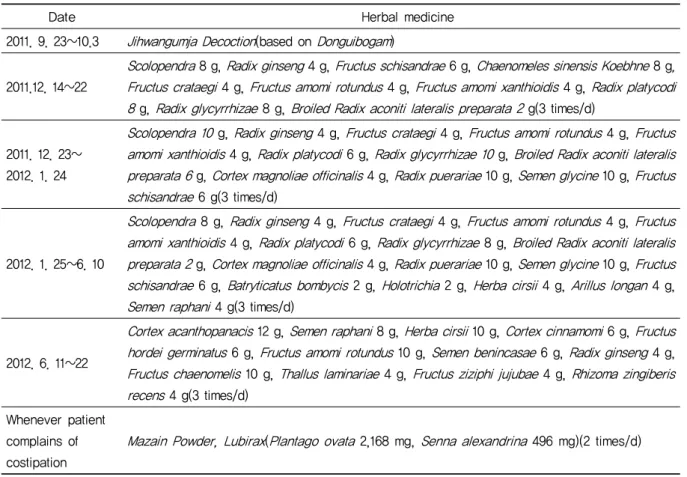
ⓐ 2011. 9. 23~2011. 10. 3 : Jihwangeumja decoction (地黃陰子) was administered 30 minutes after eating meals three times a day.
ⓑ 2011. 12. 14~2011. 12. 22 : Okong decoction(蜈蚣 湯) was administered 30 minutes after eating meals three times a day.
ⓒ 2011. 12. 23~2012. 6. 10 : Okonggami decoction (蜈蚣湯加味) was administered 30 minutes after eating meals three times a day.
ⓓ 2012. 6. 11~6. 22 : Ogapi decoction(五加皮湯) was administered in the same way.
Date Herbal medicine 2011. 9. 23~10.3 Jihwangumja Decoction(based on Donguibogam)
2011.12. 14~22
Scolopendra 8 g, Radix ginseng 4 g, Fructus schisandrae 6 g, Chaenomeles sinensis Koebhne 8 g, Fructus crataegi 4 g, Fructus amomi rotundus 4 g, Fructus amomi xanthioidis 4 g, Radix platycodi 8 g, Radix glycyrrhizae 8 g, Broiled Radix aconiti lateralis preparata 2 g(3 times/d)
2011. 12. 23~
2012. 1. 24
Scolopendra 10 g, Radix ginseng 4 g, Fructus crataegi 4 g, Fructus amomi rotundus 4 g, Fructus amomi xanthioidis 4 g, Radix platycodi 6 g, Radix glycyrrhizae 10 g, BroiledRadix aconiti lateralis preparata 6 g, Cortex magnoliae officinalis 4 g, Radix puerariae 10 g, Semen glycine 10 g, Fructus schisandrae 6 g(3 times/d)
2012. 1. 25~6. 10
Scolopendra 8 g, Radix ginseng 4 g, Fructus crataegi 4 g, Fructus amomi rotundus 4 g, Fructus amomi xanthioidis 4 g, Radix platycodi 6 g, Radix glycyrrhizae 8 g, Broiled Radix aconiti lateralis preparata 2 g, Cortex magnoliae officinalis 4 g, Radix puerariae 10 g, Semen glycine 10 g, Fructus schisandrae 6 g, Batryticatus bombycis 2 g, Holotrichia 2 g, Herba cirsii 4 g, Arillus longan 4 g, Semen raphani 4 g(3 times/d)
2012. 6. 11~22
Cortex acanthopanacis 12 g, Semen raphani 8 g, Herba cirsii 10 g, Cortex cinnamomi 6 g, Fructus hordei germinatus 6 g, Fructus amomi rotundus 10 g, Semen benincasae 6 g, Radix ginseng 4 g, Fructus chaenomelis 10 g, Thallus laminariae 4 g, Fructus ziziphi jujubae 4 g, Rhizoma zingiberis recens 4 g(3 times/d)
Whenever patient complains of costipation
Mazain Powder, Lubirax(Plantago ovata 2,168 mg, Senna alexandrina 496 mg)(2 times/d) Table 1. Herbal Medicine Treatment
Whenever the patient complained of constipation,
‘Mazain powder(麻子仁散)’ or ‘Lubirax’ were administered three times a day(Table 1).
11. Assessment & Result
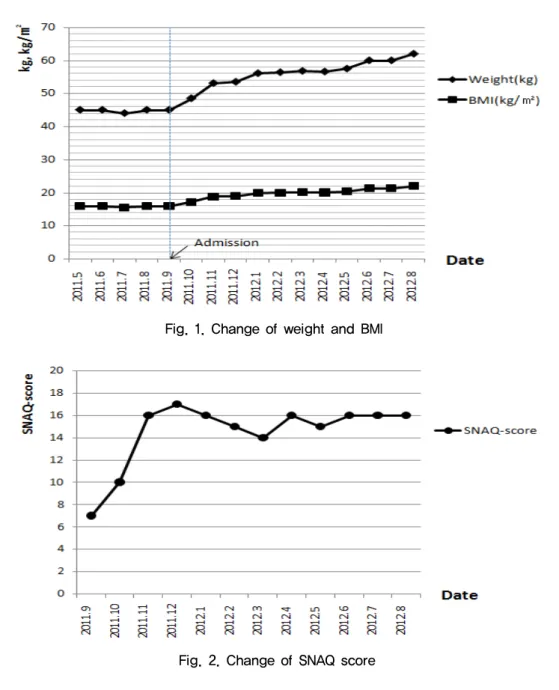
The primary outcome was change of weight and BMI. Weight and BMI were checked on the 1st at every month(Table 2, Fig. 1).
Secondary outcome was a change of appetite assessed by Simplified nutritional appetite ques- tionnaire(SNAQ). The patient was asked to complete the SNAQ, which is a 4-item single-domain ques- tionnaire. The responses are scored by using a 5-point(A to E), verbally labeled, Likert-type scale.
The total SNAQ score is the sum of scores on the 4 items, with lower scores indicating deterioration in appetite. Possible scores range from 4(worst) to 20(best)(Fig. 2).
Date Weight(kg) BMI(kg/㎡)
2011. 5 45 15.94
2011. 6 45 15.94
2011. 7 44 15.59
2011. 8 45 15.94
2011. 9 45 15.94
2011. 10 48.5 17.18
2011. 11 53.1 18.81
2011. 12 53.5 18.96
2012. 1 56.1 19.88
2012. 2 56.4 19.88
2012. 3 56.8 20.12
2012. 4 56.6 20.05
2012. 5 57.5 20.37
2012. 6 60.0 21.26
2012. 7 60.0 21.26
2012. 8 62.0 21.97
Table 2. Weight and BMI Change
Fig. 1. Change of weight and BMI
Fig. 2. Change of SNAQ score
Ⅲ. Discussion
ALS is classified as either bulbar-onset, characterized by progressive dysphagia and dysarthria or spinal- onset, characterized by peripheral neurologic features (muscle atrophy, cramps, and fasciculations) and a pyramidal syndrome(spasticity)14). The common disease course is characterized by progressive irreversible muscle wasting of the limbs, torso, abdomen, oro- pharyngeal and respiratory muscle regions15). The worldwide prevalence of ALS is reported to range between 0.4 and 2.6 / 100,000 individuals per year16). There is no difference between race, geography and
socioeconomics17).
During the course of ALS there is often a decline in weight that is frequently inadequately addressed in clinical practice, even though it is a significant and independent prognostic factor in survival3). So far, most studies on ALS have not focused on weight loss or loss of appetite in patients, but have focused on other symptoms such as muscle atrophy and spasticity, dysarthria, dysphagia, respiratory problems and sialorrhea etc. Weight loss occurs due to not yet fully understood disease-specific reasons. Several hypotheses suggest that causes of weight loss in ALS include not only dysphagia, but also higher waste of energy because of muscle fasciculations, increasing
respiratory efforts, hypermetabolism18), and constipation that results from the weakness of abdominal and pelvic muscles, compounded by limited physical exercise, certain medical treatments, and a diet lacking in fiber also contribute to appetite loss.
Psychological distress cause also development of anorexia 7,19). Weight loss and a lower body-mass- index (BMI) have a bad effect on survival in ALS4).
Megestrol acetate is used for the anorexia of malignant tumor, AIDS or cachexia in mono and combination therapy. Several investigators have reported on the appetite enhancing property of Megestrol acetate and its possible use in cachexia.
However the precise mechanism by which Megestrol acetate produces effects in anorexia and cachexia is unknown at the present time20). Taking advantage of these facts, it is used for treating weight loss in ALS patient, but on the other hand, it cannot be used consistently and in quantity because of its side effects. It is known that the side effects of Megestrol acetate include digestive system disorder, impotence, insomnia and urinary frequency. Actually, during the admission period Megestrol acetate was stopped because the patient complained of insomnia, urinary frequency and abdominal distention. Thus, Megestrol acetate should be used carefully and other alternative treatments should be found.
ALS belongs to the category of Wei symptom(痿證) in korean medicine. The five types of Wei symptom were described as “Wei symptoms include five types (痿證有五色). Heat in the lung dries lung parenchyma and leads to Wei Pi(肺熱葉焦者爲痿 ). Heat in the heart dries heart qi and leads to Mai Wei(心熱氣燥者爲 脈痿). Heat in the liver leads to Jin Wei(肝氣熱者爲筋 痿). Heat in the spleen leads to Rou Wei(脾氣熱者爲肉 痿). Heat in the kidney leads to Gu Wei(腎氣熱者爲骨 痿).” in ≪圖解校勘舍岩道人鍼法ㆍ痿證門≫21). We judged that the above ALS patient with weight loss was similar to type of 筋痿. Based on this, the Sa-am acupuncture liver tonification treatment(陰谷ㆍ谷泉 補, 經渠ㆍ中封 瀉) was selected to treat 筋痿.
Pharmacopuncture such as scolopendrid, bee-venom, hominis placenta pharmacopuncture were used for enhancing immunity, strength and treating muscle
weakness and pain caused by joint contracture. It is known that treatment with bee-venom may be helpful in reducing glutamatergic cell toxicity in neurodegenerative diseases22). Also, it is known that hominis placenta could be a potential therapeutic agent of neurodegenerative diseases which accompanied with microglial activation23).
In the early stages of this study, Jihwangeumja decoction was administered. It is known that it has high suppressive effect of weight loss in diabetic mice24). Scolopendrid has the effect of enhancing immunity, which could help stamina of patient25). Taking advantage of the nature of Scolopendrid, we make use of Okong decoction for treating ALS patient.
SNAQ, the first appetite-monitoring instrument, specifically validated for use amongst older adults in the United States, has been shown to identify persons at risk of significant weight loss. It is known that SNAQ scores <14 may identify people with anorexia at risk of significant weight loss26).
In this case study, there appeared to be an increase in weight and appetite after using Megestrol acetate and Korean medical treatment. There was a more than 17 kg increase in weight and twice more than increase in appetite in this case.
Before admission, the weight of the patient had not considerably changed for 3 months. It had been maintained between 44 kg(BMI 15.59 kg/㎡) and 45 kg (BMI 15.94 kg/㎡). In the early stages of the study, although the patient received only Korean medical treatment, both weight and appetite increased.
Weight had increased from 45 kg to 48.5 kg, and the SNAQ score had increased from 7 to 10. However BMI was still below 18.5 kg/㎡, which means a 7.7 times higher mortality rate, compared to patients with normal weight4). Also, SNAQ score was still below 14 which means anorexia26). When the patient received both Megestrol acetate and Korean medical treatment, there was a considerable increase in both weight and appetite. BMI increased over 18.81 kg/㎡ and SNAQ score increased over 16. However owing to the abdominal distention, insomnia and urinary frequency, Megestrol acetate was stopped and only Korean
medical treatments were administered for about two months. In this period, although SNAQ score slightly decrease, the score was over 14, which means no anorexia and was two times higher than the first score, also the increased weight was maintained.
Long-term or high dose use of Megestrol acetate causes many side effets20). Even though this study cannot definitively confirm that the Korean medical treatment might directly affect weight gain and improvement of appetite, it shows partly effect on increase in weight, improvement of appetite and maintenance of increased weight and appetite. It is important to show that the Korean medical treatment could be a complementary treatment to existing treatments which have many side effects and limits.
The limitations of this study include there was only one patient, uncontrolled design, and a lack of blinding. As it judges a change of weight and appetite only with two methods, there is insufficient data to make an objective and a subjective evaluation. Also, intakes and outputs should have been checked.
Although many studies emphasize the importance of managing weight and appetite in ALS patients, existing treatment for weight loss and loss of appetite is very insufficient. In this respect, despite some limitations, the findings of this study could open up new clinical guideline possibilities.
Ⅳ. References
1. Ince PG, Lowe J, Shaw PJ. Amyotrophic lateral sclerosis: current issues in classification, pathogenesis and molecular pathology. Neuropathol Appl Neurobiol.
1998 ; 24(2) : 104-17.
2. Genton L, Viatte V, Janssens CJP, Heritier AC, Pichard C. Nutritional state, energy ntakes and energy expenditure of ALS patients. Clinical Nutrition. 2011 ; 30(5) : 553-59.
3. Desport JC, Preux PM, Truong TC, V allat JM, Sautereau D, Couratier P. Nutritional status is a prognostic factor for survival in ALS patients.
Neurology. 1999. Sep 22 ; 53(5) : 1059-63.
4. Marin B, Desport JC, Kajeu P et al. Alteration of nutritional status at diagnosis is a prognostic factor for survival of amyotrophic lateral sclerosis patients. J Neurol Neurosurg Psychiatry. 2011.
Jun ; 82(6) : 628-34.
5. Desport JC, Preux PM, Magy L et al. Factors correlated with hypermetabolism in patients with amyotrophic lateral sclerosis. Am J Clin Nutr.
2001. Sep ; 74(3) : 328-34.
6. Muscaritoli M, Anker SD, Argilés J et al. Con- sensus definition of sarcopenia, cachexia and pre-cachexia: joint document elaborated by Special Interest Groups(SIG) “cachexia-anorexia in chronic wasting diseases” and “nutrition in geriatrics”.
Clin Nutr. 2010 Apr ; 29(2) : 154-9.
7. Borasio GD, Voltz R. Palliative care in amyo- trophic lateral sclerosis. J Neurol. 1997 Oct ; 244 suppl 4 : S11–7.
8. Miller RG, Mitchell JD, Lyon M et al. Riluzole for amyotrophic lateral sclerosis(ALS)/motor neuron disease(MND). Cochrane Database Syst Rev. 2007 ; 24(1) : CD001447
9. E Neppelberg, DF Haugen, L Thorsen, OB Tysnes.
Radiotherapy reduces sialorrhea in amyotrophic lateral sclerosis. European journal of neurology.
2007; 14(12): 1373-7.
10. Gruis KL, Brown DL, Lisabeth LD, Zebarah VA, Chervin RD, Feldman EL. Longitudinal assess- ment of noninvasive positive pressure ventilation adjustments in ALS patients. J Neurol Sci. 2006 Aug 15 ; 247(1) : 59-63.
11. Park BW, Lee E, Ko H. A study on the efficiency of riluzole and oriental medical treatment in amyotrophic lateral sclerosis. The journal of Korean oriental internal medicine. 2001 ; 22(2) : 279-83.
12. Ryu YJ, Lee KH, Kwon KR, Lee YH, Sun SH, Lee SJ. Mountain ginseng pharmacopuncture treatment on three amyotrophic lateral sclerosis patients.
The journal of Korean pharmacopuncture institute.
2010 ; 13(4) : 119-28.
13. Kwon KR. Clinical studies of amyotrophic lateral sclerosis through Korean medicine. The journal of Korean acupuncture and moxibustion society.
2003 ; 20(3) : 209-16.
14. Lee JR, Annegers JF, Appel SH. Prognosis of amyotrophic lateral sclerosis and the effect of referral selection. J Neurol Sci. 1995 ; 132(2) : 207–15.
15. Leigh PN, Ray-Chaudhuri K. Motor neuron disease. J Neurol Neurosurg Psychiatry 1994 ; 57(12) : 886–96.
16. Beghi E, Logroscino G, Chio A et al. The epi- demiology of ALS and the role of population- based registries. Biochimica et Biophysica Acta.
2006 ; 1762 : 1150-7.
17. Han TR, Bang MS. Rehabilitation. Seoul : Gunja.
2008 : 697-700.
18. Vaisman N, Lusaus M, Nefussy B et al. Do patients with amyotrophic lateral sclerosis(ALS) have increasedenergy needs? J Neurol Sci. 2009 Apr 15 ; 279(1-2) : 26–9.
19. McDonald ER, Wiedenfeld SA, Hillel A, Carpenter CL, Walter RA. Survival in amyotrophic lateral sclerosis. The role of psychological factors. Arch Neurol. 1994 ; 51(1) : 17–23.
20. Druginfo. Apetrol. Available from : URL : http://
www.druginfo.co.kr/detail/product.aspx?pid=203 340
21. Kim DH. Illustrations Kyokam Sa-am Do-in Acu- puncture. Busan : Sogang. 2002 : 475-80.
22. Lee SM, Yang EJ, Choi SM, Kim SH, Baek MG, Jiang JH. Effects of Bee Venom on Glutamate-Induced Toxicity in Neuronal and Glial Cells. Evid Based Complement Alternat Med. 2012 ; 2012 : 368196.
doi: 10.1155/2012/368196. Epub 2011 Aug 28.
23. Lee KW, Ji HM, Kim DW, Choi SM, Kim S, Yang EJ. Effects of Hominis placenta on LPS-induced cell toxicity in BV2 microglial cells. J Ethnopharmacol. 2013 May 20 ; 147(2) : 286-92.
24. Choi CW, Kim HC. Effects of Saengjihwangeum- ja-gami on STZ-induced Diabetic Mice. The journal of Korean oriental internal medicine.
2005 ; 26(1) : 12-47.
25. Koh KH, Soh KS, Choi HK et al. The Bibliograph- ic studies on Scolopendra subspinipes mutilans L.
Koch. The journal of Korean pharmacopuncture.
2002 ; 5(1) : 53-9.
26. Wilson MM, Thomas DR, Rubenstein LZ et al. Ap- petite assessment: simple appetite questionnaire predicts weight loss in community-dwelling adults and nursing home residents. Am J Clin Nutr.
2005 Nov ; 82(5) : 1074-81.