Abstract
Tape casting ceramics technology has been adopted for the fabrication of solid state electrochemical CO
2sensors and the packaging substrates. The fabricated CO
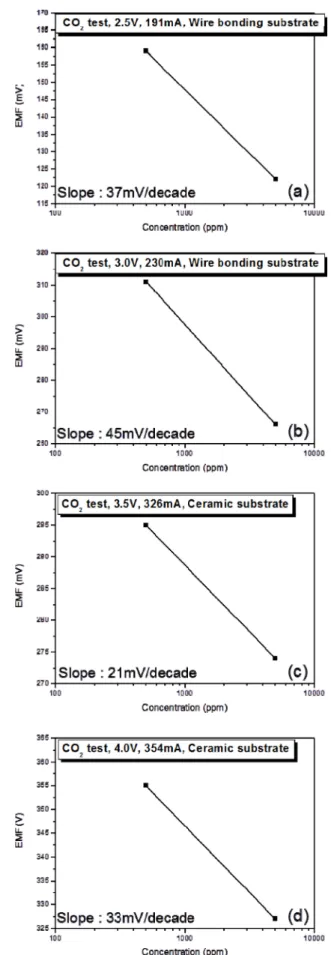
2sensors exhibit a fast response and a good recovery with the almost theoretical sensitivity of 37 mV/
decade, corresponding to a sensor operating temperature of 373 K. The two packaging methods, the wire bonding package and the sur- face-mounted on the ceramic package, were compared with respect to their power consumption and mass production feasibility. In terms of the ease of fabrication, the surface mount packaging technology is superior to the wire bonding technology but its power consumption is approximately twice that of the wired package.
Keywords: CO
2sensor, Packaging, Gas sensor, Sensitivity, Power consumption
1. INTRODUCTION
Solid state electrochemical carbon dioxide gas sensors have been used widely in gas sensing applications because of their productivity, durability, and low costs [1,2]. However, the sensors need a high temperature of 400
oC – 500
oC for operation. For providing such high temperatures, the sensor is attached to an electric heater. For applications, the combined sensor should be attached to an additional substrate to ensure thermal isolation and prevent heat conduction through the connecting paths to the electronic circuits that are mainly formed on PCB.
The wire bonding package using a metal can is the most popular method for commercial sensors. In this structure, air with a thermal conductivity of 0.024 W/m·K (compared to 35 W/m·K for Al
2O
3) is used as a thermal insulator for maximizing the localization of heat [3]. The ceramic substrate is composed of LTCC material that is a thermal insulator with a thermal conductivity of 3.3 W/m·K and is mostly used for high temperature applications because of its stability [4].
The problems reported for these two types of substrates include
the power consumption and the mechanical strength. The wire bonding type is thermally well isolated by air and consuming a low power. However, owing to the limits of the material properties of the Pt or Au wires, frequent failures occur as a result of mechanical shock or creep [5]. In comparison, the ceramic substrate has a high strength and tolerance to hostile conditions but its relatively high thermal conductivity causes a high power consumption.
Therefore, the differences in the stability and power consumption between the two substrates should be analyzed for optimizing these trade-offs. In this study, the power consumption properties are mainly measured by attaching a solid state electrochemical carbon dioxide sensor to both the substrates. The temperature of the sensor is calculated from the slope of the Nernst plot. For example, at the same value of the slope of the sensor, the power consumption can be compared at the same temperature.
2. EXPERIMENTAL
2.1 Preparation of the CO
2sensor substrate
The sensor used in this experiment is a solid state electrochemical carbon dioxide sensor fabricated using the tape casting method from Amotech, Corp. The size of the sensor is 2 x 2 mm with a thickness of 0.8 mm after sintering. It is mounted on wire bonding and ceramic substrates, respectively.
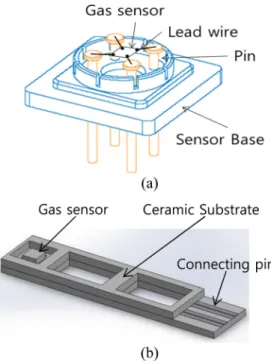
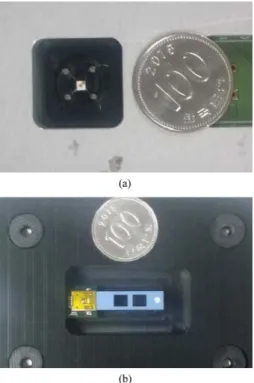
The structures of the two substrates are shown in Fig. 1. The Materials science and Engineering, Korea Advanced Institute of Science and
Technology (KAIST), 291 Daehak-ro, Yuseong-gu, Daejeon 305-338, Korea
+