Cost-of-Illness and Quality of Life in Patients with Ankylosing Spondylitis at a Tertiary Hospital in Korea
The objectives of this study were to estimate the cost-of-illness (COI) and health-related quality of life (HRQOL) in patients with ankylosing spondylitis (AS) in Korea and to evaluate the effects of socio-demographic and clinical factors on the COI and the HRQOL. Face-to- face interview surveys were taken from patients with AS at the Rheumatology Clinic of Seoul National University Hospital. Direct medical and non-medical costs, indirect costs (productivity loss due to job loss and sick leave), and deterioration of HRQOL in patients with AS were measured. Factors associated with COI and HRQOL were analyzed with multiple regression and multivariate logistic regression. A total of 191 patients with AS was enrolled in the study. The COI in patients with AS amounted to 11,646,180 Korean Won (KRW) per patient, and their HRQOL was 0.62. As functional severity worsened, the total costs increased (class I, KRW 7.7 million; class II, KRW 12.9 million; classes III & IV, KRW 25.2 million) and the HRQOL scores decreased (class I, 0.72; class II, 0.61; classes III & IV, 0.24). Functional severity is the major determinant of the COI and HRQOL in patients with AS.
Keywords: Spondylitis, Ankylosing; Arthritis, Rheumatoid; Cost; Quality of Life Tae-Jin Lee,1 Bo-Hyun Park,2
Joon Wan Kim,3 Kichul Shin,3
Eun Bong Lee,3 and Yeong-Wook Song3, 4
1Department of Health Policy and Management, Graduate School of Public Health & Institute of Health and Environment, Seoul National University, Seoul; 2Department of Nursing, Kimcheon Science College, Gimcheon; 3Division of Rheumatology, Department of Internal Medicine, Medical Research Center, Seoul National University College of Medicine, Seoul; 4WCU Department of Molecular Medicine and Biopharmaceutical Sciences, Seoul National University College of Medicine, Seoul, Korea
Received: 11 January 2013 Accepted: 14 November 2013 Address for Correspondence:
Yeong-Wook Song, MD
Division of Rheumatology, Department of Internal Medicine, Seoul National University College of Medicine, 101 Daehak-ro, Jongno-gu, Seoul 110-744, Korea
Tel: +82.2-2072-2234, Fax: +82.2-762-9662 E-mail: [email protected]
This research was funded by a grant of the Korea Healthcare Technology R&D Project, Ministry of Health and Welfare, Republic of Korea (HI10C2020) and by grant No. R31-2008- 000-10103-0 from the World Class University program of the Ministry of Education, Science and Technology and the National Research Foundation of Republic of Korea.
http://dx.doi.org/10.3346/jkms.2014.29.2.190 • J Korean Med Sci 2014; 29: 190-197
INTRODUCTION
Ankylosing spondylitis (AS) is a chronic, progressive inflamma- tory disease characterized by structural changes accompanied by pain and stiffness of the back, peripheral joints and inflam- mation of extra-articular sites such as the eyes, heart and lungs (1, 2). The prognosis for AS varies, and management centers on controlling pain and improving physical function (3). The prev- alence of AS varies between 0.21% and 1.9% worldwide, and 1%
and 2% within Europe (4). The prevalence of AS in Korea is about 0.4% (5), which is a little higher than that (0.2%-0.3%) in China (6). The disease is diagnosed in early adulthood and functional limitations may lead to work capacity impairment and increas- ed consumption of healthcare resources, as well as reduced qual- ity of life (QOL) as a result of disability and pain (7-9).
Increased healthcare utilization or need for formal and infor- mal care, and decreased working capability of patients due to structural changes, pain, stiffness, and functional limitation, have
an impact on not only the patients or their families but also on society as a whole (10). Recently, new drug compounds such as tumor necrosis factor-α (TNF-α) inhibitors have been introduc- ed with strong therapeutic effects on AS to reduce pain and func- tional impairment. However, their use is constrained by high medication costs, around USD 15,000-25,000 per patient per year (11, 12). This implies that consideration of cost-of-illness (COI) has become increasingly important in decisions regard- ing resource allocation, intervention design and use of biologic agents in such individuals with chronic inflammatory disabling conditions.
With regard to functional limitation, QOL and COI, AS is of- ten compared to rheumatoid arthritis (RA), another common type of chronic inflammatory arthritis. It is generally known that patients with RA are more limited in physical function than pa- tients with AS (13), and that physical health-related QOL of pa- tients with RA is lower than that of patients with AS (14) while mental health-related QOL of patients with RA and AS shows Immunology, Allergic Disorders & Rheumatology
mixed results (14, 15). It is also known that COI of patients with RA is higher than that of patients with AS (10, 16, 17), and that the proportion of indirect costs is larger than that of the direct costs in both diseases, reflecting the high burden of the diseases on work participation (10, 17). However, the differences in func- tional limitation, QOL and COI between patients with AS and RA may be affected by potential confounding factors such as age, gender, or disease duration since the two diseases affect different patient populations (13).
Korean studies on the health-related quality of life (HRQOL) of inflammatory arthritides show similar results to studies in other countries: when evaluated using SF-36, the physical HR- QOL of patients with RA was lower than that of patients with AS while the mental HRQOL of patients with the two diseases was similar, and when using Korean version of European Quality of Life-5 Dimension (KEQ-5D), the HRQOL of patients with RA (0.58) was lower than that of patients with AS (0.63) (18, 19). In contrast, there are few studies that examined the COI of patients with AS in the Korean healthcare setting, though there is one recent study on the COI of patients with RA (20).
The results of burden-of-disease studies can be used for pri- oritizing healthcare resources and justifying the needs for spend- ing on disease prevention, management, and social interven- tion. This can be achieved, in particular, through studies com- paring COI and HRQOL between diseases. Given that few such studies have been carried out in Korea, the aims of the current study were to estimate the COI and HRQOL among patients with AS, and to evaluate the effects of socio-demographic and clini- cal factors on the COI and the HRQOL.
MATERIALS AND METHODS
The following data sources were used to estimate the COI and HRQOL of patients with AS: patient surveys, medical chart re- views and reviews of electronic hospital records.
Patients
The patients were enrolled at the Rheumatology Clinic of Seoul National University Hospital located in Seoul, Korea between July 19, 2010 and October 22, 2010. The inclusion criteria were as follows: 1) The patient should meet the 1984 modified New York criteria for AS (21), and 2) the patient must have visited the medical institution at least once before the interview. Function- al status was assessed according to the American College of Rheumatology (ACR) 1991 revised criteria for the classification of global functional status in RA (22).
Socio-demographic and clinical characteristics
Socio-demographic characteristics such as age, gender, marital status, education, household income, employment status and health insurance type were collected from the patient surveys.
Clinical features were collected from the reviews of the medical charts, which included information pertaining to comorbidity and medication including biologic agents. Diseases assessed as comorbidity included diabetes mellitus, hypertension, pulmo- nary tuberculosis, dermatitis, Behcet’s disease.
Cost of illness (COI)
The COI of patients with AS was estimated from a societal per- spective. Taking into consideration of Korean circumstances, direct medical costs included in-hospital costs, prescription drugs, private physiotherapy, oriental medicine and other al- ternative medicine costs, whereas direct non-medical costs in- cluded travel, auxiliary devices, dietary supplements, and home assistance costs. Indirect costs included productivity loss from job loss and sick leave (23, 24). Since it was impossible to esti- mate the mortality rate of patients with AS, lost productivity from pre mature death was not included in this study.
In-hospital costs were estimated from hospital electronic data records including expenses for physician visits, treatments, hos- pitalization, and monitoring. Out-of-hospital medical costs, di- rect non-medical costs, and indirect costs were estimated based on patient surveys from face-to-face interviews. The reference period for out-of-hospital medical costs, direct non-medical costs, and sick leave costs was 1 yr. Productivity loss caused by disease-related job loss was estimated by applying the duration of the patient’s unemployment until the normal retirement age and annual increase in wages to the wage they received prior to the loss of work. It was assumed that the age at retirement was 60 yr for both genders. The annual wage increase rate was ob- tained from the Korean Statistical Information Service (25).
Health-related quality of life (HRQOL)
The HRQOL of the patients was analyzed based on face-to-face interview questionnaires using KEQ-5D. Utility values were ob- tained through a tariff system developed in Korea, which appli- ed a time trade-off method to derive preferences on different health statuses from 287 adults residing in urban areas (26).
Data analysis
Descriptive statistics (frequency, percentage, mean and stan- dard deviation) were used to analyze the patient characteristics, costs and HRQOL. To identify factors affecting the total costs, direct costs and HRQOL, multiple regression analysis was used, and to identify factors affecting the incidence of indirect costs, multivariate logistic regression was used. Among those factors are age, gender, marital status, education and household income of the patients as well as comorbidity and functional status.
Ethics statement
This study was carried out with the approval of the institutional review board of Seoul National University Hospital (IRB No.
H-1007-167-325). Informed consent was confirmed by the board.
RESULTS
Patient demographics and clinical characteristics
In total, 191 patients with AS were consecutively enrolled in this study. The majority of patients with AS were men (164 patients, 85.9%), and the mean age (SD) was 39.3 (12.3) yr. Additionally, 57.6% of the patients received education at a college level or high- er and 37.7% were unemployed. The monthly average house- hold income of the patients with AS was 4.1 million Korean Won (KRW) (Table 1).
In terms of functional status classified by ACR, 50.3% (96 pa- tients) and 38.7% (74 patients) of patients with AS were class I and II, respectively. The mean disease duration of patients with AS was 13.9 yr. About 60% of the patients had at least one co- morbidity. With respect to disease-modifying anti-rheumatic drugs, 25.7% (49 patients) with AS were treated with TNF-α in- hibitors such as etanercept, infliximab, adalimumab etc. (Table 1).
Cost of illness
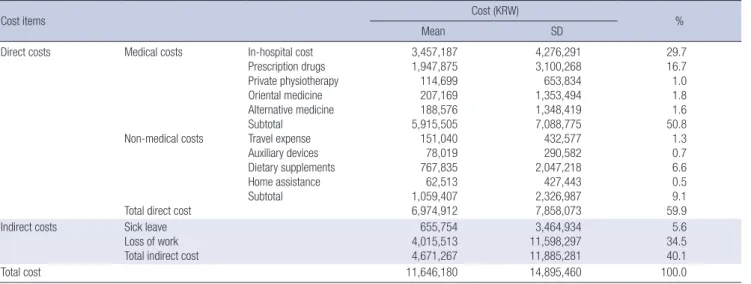
The total COI for patients with AS amounted to KRW 11.6 mil- lion per patient per year. Of the total, direct costs amounted to KRW 7.0 million (59.9%) while indirect costs amounted to KRW 4.7 million (40.1%). Loss of work as an indirect cost accounted for the largest proportion of the total costs (34.5%), followed by two items within the direct cost category, in-hospital costs (29.7%) and prescription drug costs (16.7%) (Table 2).
Analyzing the COI by the characteristics of the patients, the COI for female patients (KRW 13.1 million) was higher than that for male patients (KRW 11.4 million) and the proportion of di- rect costs in male patients with AS was as high as 64.4% of the total COI. The COI of patients with AS increased with age until their 50s, after which it decreased dramatically since indirect costs were less likely to occur. The decrease in the COI of old patients may be related to reduced disease activity. The higher the level of education received by the patients, the lower their COI was. This was due to the decrease in the proportion of indi- rect costs among those patients with higher education. In terms of household income, there were no regular trends observed in the total COI and in the proportion of direct costs. Unemploy- ment contributed to a substantial increase in total COI for pa- tients with AS, which was due to increased indirect costs (Table 3).
With regard to the clinical characteristics of patients with AS, the COI increased with functional deterioration (FC I, KRW 7.7 million; FC II, KRW 12.9 million; FC III & IV, KRW 25.2 million) and the proportion of direct costs was high among class I (75.8%) and II (61.8%) patients while it was low among class III & IV (34.1%) patients. The difference in the COI between patients with and without comorbidity was not evident. In addition, the COI for patients treated with biologic agents including TNF-α
inhibitors (KRW 19.4 million) was twice as high as that of pa- tients who were not treated with biologic agents (KRW 9.0 mil- lion) (Table 3).
Health-related quality of life
The overall HRQOL of patients with AS was estimated to be 0.62.
The HRQOL of patients with AS decreased with age and increas- ed with education and household income. The HRQOL of un- employed patients was lower than that of employed patients.
Moreover, the HRQOL deteriorated as their functional severity worsened (FC I, 0.72; FC II, 0.61; FC III & IV, 0.24). Given that 0 Table 1. Socio-demographic and clinical characteristics of patients with ankylosing spondylitis (n=191)
Characteristics No. (%) of patients
Socio-demographic characteristics
Gender (female) 27 (14.1)
Age (yr) Less than 30 yr 30s 40s 50s 60s 70 yr and older Mean (SD)
45 (23.6) 60 (31.4) 46 (24.1) 27 (14.1) 11 (5.8)
2 (1.0) 39.3 (12.3) Marital status*
Married Widowed
Others (including unmarried)
93 (48.9) 8 (4.2) 89 (46.8) Household monthly income*, 1,000 KRW
Less than 1,500 1,500-2,990 3,000-4,490 4,500 and more Mean (SD)
22 (12.6) 57 (32.8) 34 (19.5) 61 (35.1) 4,099 (3,396)
Unemployment 72 (37.7)
Education*
Middle school or less High school College or more
15 (7.9) 65 (34.2) 110 (57.9) Health Insurance*
National health insurance
Medical aid 180 (94.7)
10 (5.3) Clinical characteristics
Functional status Class I Class II Class III Class IV
96 (50.3) 74 (38.7) 20 (10.5) 1 (0.5) Disease duration, years, mean (SD) 13.9 (9.3) Comorbidity†
None 1 2 3 or more
77 (40.3) 64 (33.5) 30 (15.7) 20 (10.5)
HLA-B27 positivity 159 (83.2)
Patients prescribed with biologic agents 49 (25.7)
KBASFI at evaluation, mean (SD) 2.09 (2.14)
*Individuals with missing values are excluded. †Including diabetes mellitus, hyperten- sion, pulmonary tuberculosis, dermatitis, Behcet’s disease etc. SD, standard devia- tion; KRW, Korean Won; KBASFI, Korean Bath Ankylosing Spondylitis Functional Index.
Table 2. Direct and indirect costs per patient per year in patients with ankylosing spondylitis
Cost items Cost (KRW)
Mean SD %
Direct costs Medical costs
Non-medical costs
Total direct cost
In-hospital cost Prescription drugs Private physiotherapy Oriental medicine Alternative medicine Subtotal
Travel expense Auxiliary devices Dietary supplements Home assistance Subtotal
3,457,187 1,947,875 114,699 207,169 188,576 5,915,505 151,040 78,019 767,835 62,513 1,059,407 6,974,912
4,276,291 3,100,268 653,834 1,353,494 1,348,419 7,088,775 432,577 290,582 2,047,218 427,443 2,326,987 7,858,073
29.7 16.7 1.0 1.8 1.6 50.8 1.3 0.7 6.6 0.5 9.1 59.9 Indirect costs Sick leave
Loss of work Total indirect cost
655,754 4,015,513 4,671,267
3,464,934 11,598,297 11,885,281
5.6 34.5 40.1
Total cost 11,646,180 14,895,460 100.0
KRW, Korean Won; SD, standard deviation.
Table 3. Cost-of-illness (COI) and proportion of direct costs in ankylosing spondylitis by patient characteristics
Characteristics COI per patient
(KRW)
Proportion of direct costs (%)
Gender Male
Female 11,411,283
13,072,959 64.4 35.8
Age Less than 30 yr
30s 40s 50s 60s 70 yr and older
8,622,452 10,326,023 13,937,053 18,727,352 5,455,146 5,049,532
88.4 67.6 49.6 36.3 98.1 100.0 Education Middle school or less
High school College and more
13,505,895 12,779,082 10,830,355
45.0 55.6 65.3 Household monthly
income, 1,000 KRW
Less than 1,500 1,500-2,990 3,000-4,490 4,500 and more
16,010,620 12,401,290 6,898,240 10,992,467
41.3 60.7 97.2 64.0 Employment Employed
Unemployed 8,303,444
17,049,506 87.2 38.4 Functional status Class I
Class II Class III Class IV
7,728,926 12,885,913 25,185,042*
n.a.
75.8 61.8 34.1*
n.a.
Comorbidity Yes
No 11,892,899
11,280,907 61.4 57.6 Prescription of
biologic agents Yes
No 19,399,574
8,970,712 76.7
47.4
Total 11,646,180 59.9
*Including 1 patient with functional class IV. KRW, Korean Won; n.a., not applicable.
Table 4. Health-related quality of life (HRQOL) in ankylosing spondylitis by patient characteristics
Characteristics HRQOL
Gender Male
Female
0.62 0.61
Age Less than 30 yr
30s 40s 50s 60s 70 yr and older
0.67 0.66 0.61 0.56 0.47 0.55
Education Middle school or less
High school College and more
0.42 0.57 0.68 Household monthly income, 1,000 KRW Less than 1,500
1,500-2,990 3,000-4,490 4,500 and more
0.56 0.59 0.69 0.66
Employment Employed
Unemployed 0.67
0.55
Functional status Class I
Class II Class III Class IV
0.72 0.61 0.24*
n.a.
Comorbidity Yes
No 0.57
0.70 Prescription of biologic agents Yes
No
0.63 0.62
Total 0.62
*Including 1 patient with functional class IV. KRW, Korean Won; n.a., not applicable.
indicates death and 1 indicates perfect health (KEQ-5D anchors), the progression of AS resulted in a substantial deterioration in the HRQOL. The HRQOL decreased with comorbidity, whereas it showed no difference between patients treated with and with- out biologic agents (Table 4). Considering that TNF-α inhibitors are not generally administered to the patients with low disease activity, their HRQOL was similar to the HRQOL of patients with
high disease activity to whom TNF-α inhibitors are often admi- nistered.
Factors affecting the COI and HRQOL
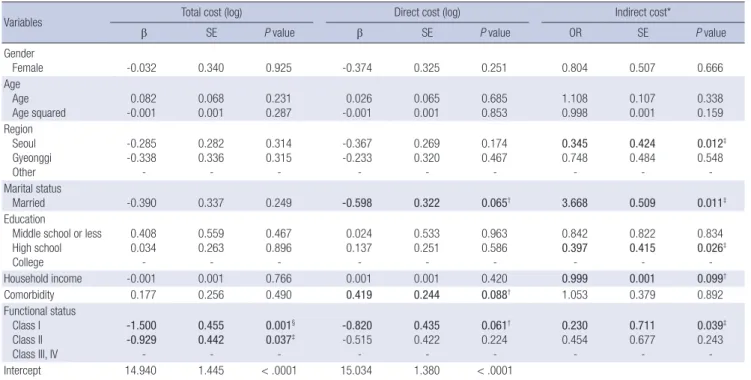
The results of multiple regression and multivariate logistic regression showed that functional severity was the most signifi- cant determinant of the COI; FC I and II showed lower total and direct costs compared to FC III and IV. The probability of patients
Table 5. Multiple regression and multivariate logistic regression models for cost-of-illness in patients with ankylosing spondylitis
Variables Total cost (log) Direct cost (log) Indirect cost*
β SE P value β SE P value OR SE P value
Gender
Female -0.032 0.340 0.925 -0.374 0.325 0.251 0.804 0.507 0.666
Age Age Age squared
0.082 -0.001
0.068 0.001
0.231 0.287
0.026 -0.001
0.065 0.001
0.685 0.853
1.108 0.998
0.107 0.001
0.338 0.159 Region
Seoul Gyeonggi Other
-0.285 -0.338
-
0.282 0.336
-
0.314 0.315
-
-0.367 -0.233
-
0.269 0.320 -
0.174 0.467 -
0.345 0.748
-
0.424 0.484
-
0.012‡ 0.548
- Marital status
Married -0.390 0.337 0.249 -0.598 0.322 0.065† 3.668 0.509 0.011‡
Education
Middle school or less High school College
0.408 0.034
-
0.559 0.263
-
0.467 0.896
-
0.024 0.137
-
0.533 0.251
-
0.963 0.586
-
0.842 0.397
-
0.822 0.415 -
0.834 0.026‡
-
Household income -0.001 0.001 0.766 0.001 0.001 0.420 0.999 0.001 0.099†
Comorbidity 0.177 0.256 0.490 0.419 0.244 0.088† 1.053 0.379 0.892
Functional status Class I Class II Class III, IV
-1.500 -0.929
-
0.455 0.442
-
0.001§ 0.037‡
-
-0.820 -0.515
-
0.435 0.422
-
0.061† 0.224
-
0.230 0.454
-
0.711 0.677 -
0.039‡ 0.243
-
Intercept 14.940 1.445 < .0001 15.034 1.380 < .0001
*Indirect cost occurred, 1; not occurred, 0. †P < 0.1, ‡P < 0.05, §P < 0.01. SE, standard error; OR, odds ratio.
Table 6. Multiple regression model for quality of life in patients with ankylosing spon- dylitis
Variables β SE P value
Gender
Female -0.036 0.058 0.537
Age Age
Age squared 0.017
0.000 0.011
0.000 0.130
0.141 Region
Seoul Gyeonggi Other
-0.088 -0.089 -
0.047 0.057 -
0.067*
0.119 - Marital status
Married -0.009 0.050 0.857
Education
Middle school or less High school College
-0.134 -0.029 -
0.089 0.044 -
0.134 0.511 -
Household income 0.000 0.000 0.429
Comorbidity -0.056 0.043 0.193
Functional status Class I Class II Class III, IV
0.275 0.163 -
0.073 0.071 -
0.000‡ 0.022†
-
Intercept 0.187 0.238 0.433
*P < 0.1, †P < 0.05, ‡P < 0.01. SE, standard error.
with FC I incurring indirect costs was significantly lower than that of patients with FC III and IV in AS (P = 0.039). Comorbidi- ty tended to be associated with direct costs (P = 0.088). Apart from functional severity, residential area (P = 0.012), marital status (P = 0.011) and education (P = 0.026) significantly affect- ed the occurrence of indirect costs among patients with AS while
household income tended to be associated with indirect costs (P = 0.099) (Table 5).
The factors affecting the HRQOL of patients with AS were the functional status and residential area. In terms of functional se- verity, classes I (P < 0.001) and II (P = 0.022) showed a higher HRQOL compared to classes III and IV (Table 6).
DISCUSSION
This study was carried out to estimate the COI and HRQOL of patients with AS, and it would be informative to compare them with those of patients with RA, which is one of the common types of inflammatory arthritis. There is one recent study on the COI and HRQOL in patients with RA in the same clinical setting in Korea, carried out from a societal perspective (20), which made it feasible to compare the two diseases. In comparison with the results of this recent study of patients with RA, the COI of patients with AS was almost twice as high as that of patients with RA (AS, KRW 11.6 million; RA, KRW 6.7 million). The costs of patients with RA were collected throughout 2009 while those of patients with AS were collected in 2010. For a better compari- son of the COI between AS and RA, the costs of patients with RA were adjusted for inflation.
This is in stark contrast with previous studies in other coun- tries, which showed that the annual COI of patients with RA was higher than that of patients with AS (10, 17). If we break down the COI in the current study, the direct cost for patients with AS (KRW 7.0 million) was more than twice as high as that for pa-
tients with RA (KRW 3.2 million), while the indirect cost for pa- tients with AS (KRW 4.7 million) was only about 34% higher than that for patients with RA (KRW 3.5 million). In other words, the difference in the COI between the two diseases was attributable mainly to the difference in direct costs, which was in turn in- curred by the difference in in-hospital costs; the proportion of in-hospital costs amounted to 29.7% in patients with AS while it was only 10.5% in patients with RA (20). The high proportion of in-hospital costs in AS has to do with the relatively high prescrip- tion rate of expensive TNF-α inhibitors, which are mainly in- jected at hospitals in Korea.
In terms of functional status, half of the patients with AS be- longed to FC I and almost 90% belonged to FC I or II. Taking into account their functional status, it was anticipated that pa- tients with AS would show a higher HRQOL and lower COI than patients with RA. On the contrary, the COI of patients with AS was almost two times higher than that of patients with RA in Korea due to the greater use of expensive biologics. This can be explained by the following. First, there are disparities in the so- cio-economic characteristics between patients with AS and RA.
About 86% of the patients with AS were men and the mean age was 39.3 yr while about 81% of the patients with RA were wom- en and the mean age was 62.5 yr (20). Besides, patients with AS had longer schooling years, were less unemployed, and report- ed a higher monthly household income than patients with RA.
These socio-economic characteristics seem to explain partly why AS patients whose functional status was not so poor were prescribed expensive biologics at a tertiary university hospital.
Second, the high COI of patients with AS compared to pa- tients with RA could be partly related to the reimbursement policy for biologics issued by the Health Insurance Review and Assessment Service (HIRA). HIRA has allowed TNF-α inhibi- tors to be used in AS patients with high disease activity once they fail 2 nonsteroidal anti-inflammatory agents in 3 months.
Therefore, severely ill AS patients can have access to expensive TNF-α inhibitors with a copayment rate of 10% at a relatively earlier (6 months for RA patients) time point throughout their treatment. The prescription rate of TNF-α inhibitors was also influenced by the patients’ socio-economic status; as seen in the results of this study, patients with AS whose income and education level were higher than patients with RA were prescribed biologic agents more frequently (20).
The results also showed that the proportion of indirect costs was 40.1% for AS while it was 52.7% for RA (20). This means that, in the case of AS, the proportion of indirect costs was smaller than that of direct costs while the opposite was true in the case of RA. Boonen and Mau (16) reported that the unemployment rate was higher among patients with RA than that of patients with AS, which was particularly the case in females and less ed- ucated patients. This is consistent with the results from the Ko- rean studies. Since less educated patients were more likely to
be involved in manual work, functional deterioration resulting from rheumatic diseases tended to hinder them from maintain- ing their jobs. This is the reason why the proportion of indirect costs among patients with RA of whom the majority were fe- male and less educated was much higher than that of patients with AS in Korea.
Meanwhile, it was revealed that the HRQOL of patients with AS (0.62) was higher than that of patients with RA (0.49) and that this was also the case across functional status. Salaffi et al.
(15) showed that the physical health- and mental health-relat- ed QOL of patients with RA were lower than those of patients with AS in Italy, which is consistent with the findings of the cur- rent study. However, it is not necessarily the case with German patients. Chorus et al. (14) showed that patients with RA had a lower physical health-related QOL and a higher mental health- related QOL than patients with AS in Germany and that there were no significant differences in somatic pain, physical role functioning, social functioning, emotional role functioning, vi- tality or general health perception between patients with RA and AS. Zink et al. (27) also reported that the extent to which patients with RA and AS complained of disability and pain was similar until the age of 70 yr, after which patients with RA com- plained of pain more frequently than patients with AS.
The functional status of patients was the most significant fac- tor associated with the HRQOL of patients with AS as well as the HRQOL of patients with RA (20), which is consistent with findings from previous studies carried out in Korea and other countries (18, 19, 28-31). Salaffi et al. (15) found that comorbid- ity influenced the HRQOL of patients with RA and AS; however, it did not affect the HRQOL of patients with AS in the current study. Further analyses taking into account the number and mix of comorbidities are necessary in future studies.
There are a few limitations to this study. First, the COI and HRQOL of patients with AS were estimated based on data ob- tained from one large university hospital, so the study results need to be generalized with caution. Second, the results from the current study on AS were compared to those from the pre- vious study on RA in the discussion, though there was an eight- month time lag between the two studies. However, there was no noticeable event in between that may have influenced the COI and HRQOL in patients with AS and RA. In fact, recruiting patients from the same clinical setting may have helped further comparison of the two diseases.
In conclusion, this study, when compared with the previous study on RA, indicates that the COI of patients with AS is much higher than that of RA while the HRQOL of patients with AS is higher than that of RA. Further studies that examine the causes and solution of the disparity between HRQOL and medical costs in AS versus RA in the Korean healthcare setting are called for.
ACKNOWLEDGMENTS
We would like to thank Hye-Kyung Son at Hallym Medical Foun- dation who participated in data collection and statistical analysis.
DISCLOSURE
The authors have no conflicts of interest to disclose.
ORCID
Tae-Jin Lee http://orcid.org/0000-0003-2539-3579 Bo-Hyun Park http://orcid.org/0000-0003-0315-2256 Joon Wan Kim http://orcid.org/0000-0002-7845-4382 Kichul Shin http://orcid.org/0000-0002-6749-7598 Eun Bong Lee http://orcid.org/0000-0003-0703-1208 Yeong-Wook Song http://orcid.org/0000-0002-5384-3437
REFERENCES
1. Russell A. Ankylosing spondylitis: history. London: Mosby, 2007, p1-2.
2. Sieper J, Braun J, Rudwaleit M, Boonen A, Zink A. Ankylosing spondyli- tis: an overview. Ann Rheum Dis 2002; 61: iii8-18.
3. Boonen A, de Vet H, van der Heijde D, van der Linden S. Work status and its determinants among patients with ankylosing spondylitis: a sys- tematic literature review. J Rheumatol 2001; 28: 1056-62.
4. Glasnović M. Epidemiology of spondylarthritides. Reumatizam 2011;
58: 24-35.
5. Korea Center for Disease Control & Prevention. 2006 prevalence survey of rare refractory diseases. Available at http:// helpline.nih.go.kr/cdchelp/
cyber.gst?method=detailView&ctype=c&cateCode=11&searchKind=&se archWord=&curPage=1&NO_CYBER_IDX=533 [accessed on 28 April 2010].
6. Zhu TY, Tam LS, Lee VW, Hwang WW, Li TK, Lee KK, Li EK. Costs and quality of life of patients with ankylosing spondylitis in Hong Kong. Rheu- matology (Oxford) 2008; 47: 1422-5.
7. Boonen A, van der Heijde D, Landewé R, Guillemin F, Rutten-van Möl- ken M, Dougados M, Mielants H, de Vlam K, van der Tempel H, Bo- esen S, et al. Direct costs of ankylosing spondylitis and its determinants:
an analysis among three European countries. Ann Rheum Dis 2003; 62:
732-40.
8. Boonen A, van der Heijde D, Landewé R, Spoorenberg A, Schouten H, Rutten-van Mölken M, Guillemin F, Dougados M, Mielants H, de Vlam K, et al. Work status and productivity costs due to ankylosing spondyli- tis: comparison of three European countries. Ann Rheum Dis 2002; 61:
429-37.
9. Ward MM. Health-related quality of life in ankylosing spondylitis: a sur- vey of 175 patients. Arthritis Care Res 1999; 12: 247-55.
10. Franke LC, Ament AJ, van de Laar MA, Boonen A, Severens JL. Cost-of- illness of rheumatoid arthritis and ankylosing spondylitis. Clin Exp Rheu- matol 2009; 27: S118-23.
11. Ara RM, Reynolds AV, Conway P. The cost-effectiveness of etanercept in patients with severe ankylosing spondylitis in the UK. Rheumatology
(Oxford) 2007; 46: 1338-44.
12. Bonafede MM, Gandra SR, Watson C, Princic N, Fox KM. Cost per treat- ed patient for etanercept, adalimumab, and infliximab across adult in- dications: a claims analysis. Adv Ther 2012; 29: 234-48.
13. Louie GH, Reveille JD, Ward MM. Challenges comparing functional lim- itations in rheumatoid arthritis and ankylosing spondylitis. Clin Exp Rheumatol 2009; 27: S83-91.
14. Chorus AM, Miedema HS, Boonen A, van der Linden S. Quality of life and work in patients with rheumatoid arthritis and ankylosing spondy- litis of working age. Ann Rheum Dis 2003; 62: 1178-84.
15. Salaffi F, Carotti M, Gasparini S, Intorcia M, Grassi W. The health-relat- ed quality of life in rheumatoid arthritis, ankylosing spondylitis, and pso- riatic arthritis: a comparison with a selected sample of healthy people.
Health Qual Life Outcomes 2009; 7: 25.
16. Boonen A, Mau W. The economic burden of disease: comparison between rheumatoid arthritis and ankylosing spondylitis. Clin Exp Rheumatol 2009; 27: S112-7.
17. Huscher D, Merkesdal S, Thiele K, Zeidler H, Schneider M, Zink A; Ger- man Collaborative Arthritis Centres. Cost of illness in rheumatoid ar- thritis, ankylosing spondylitis, psoriatic arthritis and systemic lupus ery- thematosus in Germany. Ann Rheum Dis 2006; 65: 1175-83.
18. Kim TJ, Oh GT, Ju EK, Lee HS, Kim TH, Jun JB, Jung SS, Yu DH, Bae SC.
Health-related quality of life in Korean patients with ankylosing spondy- litis spndylitis [in Korean]. J Korean Rheum Assoc 2002; 9: S106-16.
19. Kim CG, Oh KT, Choe JY, Bae SC. Health-related quality of life Korean patients with rheumatoid arthritis. J Korean Rheum Assoc 2002; 9: S60- 72.
20. Lee TJ, Park BH, Son HK, Song R, Shin KC, Lee EB, Song YW. Cost of ill- ness and quality of life of patients with rheumatoid arthritis in South Korea. Value Health 2012; 15: S43-9.
21. Van der Linden S, Valkenburg HA, Cats A. Evaluation of diagnostic cri- teria for ankylosing spondylitis: a proposal for modification of the New York criteria. Arthritis Rheum 1984; 27: 361-8.
22. Hochberg MC, Chang RW, Dwosh I, Lindsey S, Pincus T, Wolfe F. The American College of Rheumatology 1991 revised criteria for the classifi- cation of global functional status in rheumatoid arthritis. Arthritis Rheum 1992; 35: 498-502.
23. Merkesdal S, Ruof J, Huelsemann JL, Schoeffski O, Maetzel A, Mau W, Zeidler H. Development of a matrix of cost domains in economic evalu- ation of rheumatoid arthritis. J Rheumatol 2001; 28: 657-61.
24. Drummund MF, Sculpher MJ, Torrance GW, O’Brien BJ, Stoddart GL.
Methods for the economic evaluation of health care programmes. 3rd ed. Oxford: Oxford University Press, 2005.
25. Korean Statistical Information Service. Available at http://www.kosis.kr [accessed on 30 April 2010].
26. Kang EJ, Shin HS, Park HJ, Jo MW, Kim NY. A valuation of health status using EQ-5D. Korean J Health Econ Policy 2006; 12: 19-43.
27. Zink A, Braun J, Listing J, Wollenhaupt J. Disability and handicap in rheumatoid arthritis and ankylosing spondylitis: results from the Ger- man rheumatological database: German Collaborative Arthritis Cen- ters. J Rheumatol 2000; 27: 613-22.
28. Kojima M, Kojima T, Ishiguro N, Oguchi T, Oba M, Tsuchiya H, Sugiura F, Furukawa TA, Suzuki S, Tokudome S. Psychosocial factors, disease status, and quality of life in patients with rheumatoid arthritis. J Psycho- som Res 2009; 67: 425-31.
29. Alishiri GH, Bayat N, Fathi Ashtiani A, Tavallaii SA, Assari S, Moharam- zad Y. Logistic regression models for predicting physical and mental heal- th-related quality of life in rheumatoid arthritis patients. Mod Rheuma- tol 2008; 18: 601-8.
30. Ariza-Ariza R, Hernández-Cruz B, Navarro-Sarabia F. Physical function
and health-related quality of life of Spanish patients with ankylosing spondylitis. Arthritis Rheum 2003; 49: 483-7.
31. Ozdemir O. Quality of life in patients with ankylosing spondylitis: rela- tionships with spinal mobility, disease activity and functional status.
Rheumatol Int 2011; 31: 605-10.