1. Introduction
Grounding is an essential system that protects equip- ment and human life by providing the reference potential during normal operation and discharging undesired current to the earth rapidly to prevent the potential increase during abnormal operation in distribution lines. The grounding system is being applied to approximately five million elec- tric poles in Korea and is increasing every year with the rise in the number of electric poles. Performance of these grounding systems is dependent upon the useful lifetime of its components including conductors, connectors, elec- trodes, etc. The natural degradation of the grounding com- ponents applied to the grounding system occurs by the soil corrosion due to the pH, salinity and moisture content and the initial defect of the construction, but a reasonable application and management criteria considering the cor- rosion behavior in actual soil environment is not currently available. Hence, there will be problems with the pro- tection of the devices and the human body as well as an
economic loss resulting from the improper application and management of the grounding system. In order to solve these problems, prediction of the lifetime of the grounding components considering the corrosion in soil is necessary.
It has been a conventional method to continuously monitor and analyze the natural degradation process of the ground- ing components for several decades to predict the lifetime of the grounding components. A project of “Underground Corrosion” conducted by the US National Bureau of Standards (NBS) is the most widespread and systematic example of the study on the natural degradation of materi- als in soil [1]. The project studied the degradation of 333 varieties of materials resulting from soil corrosion in 128 testing locations throughout the USA from 1910 to 1955.
The Naval Civil Engineering Laboratory (NCEL) in coop- eration with the National Association of Corrosion Engineers conducted a 7-year program of testing metal rods for the grounding [2]. Besides, several studies on the natural degradation in soil were conducted by the early 2000s [3-5]. However, these long-term studies have prac- tical limitations concerning time and cost, and hence the accelerated corrosion testing method was required to eval-
Corrosion Performance of Cu Bonded Grounding-Electrode by Accelerated Corrosion Test
Sun Kyu Choi1,†and Kyung Chul Kim2
1Smart Power Distribution Laboratory, Korea Electric Power Corporation Research Institute
2Department of Electrical Engineering College of Science and Technology, Hongik University (Received September 20, 2018; Revised October 11, 2018; Accepted October 11, 2018)
Natural degradation of grounding-electrode in soil environment should be monitored for several decades to predict the lifetime of the grounding electrode for efficient application and management. However, long-term studies for such electrodes have many practical limitations. The conventional accelerated corrosion test is unsuitable for such studies because simulated soil corrosion process cannot represent the actual soil environment. A preliminary experiment of accelerated corrosion test was conducted using existing test standards. The accelerated corrosion test that reflects the actual soil environment has been developed to evaluate corrosion performances of grounding-electrodes in a short period. Several test conditions with different chamber temperatures and salt spray were used to imitate actual field conditions based on ASTM B162, ASTM B117, and ISO 14993 standards. Accelerated degradation specimens of copper-bonded electrodes were made by the facile method and their corrosion performances were investigated. Their corrosion rates were calculated to 0.042 μm/day, 0.316 μm/day, and 0.11 μm/day, respectively. These results indicate that accelerated deterioration of grounding materials can be determined in a short period by using cyclic test condition with salt spray temperature of 50 °C.
Keywords: Corrosion accelerated test, Soil corrosion, Grounding rods, Copper-bonded electrode, Life cycle estimation
†Corresponding author: [email protected]
uate the lifetime of the materials from the viewpoint of the soil corrosion. F. D’ Alessandro et al [6] reported re- sults of the corrosion performance of copper bonded and galvanized electrodes by the accelerated corrosion test us- ing a solution containing calcium chloride (CaCl2) and sodium sulfate (Na2SO4) referencing to the European Standard EN 50164-52 [7], and predicted the lifetime of the copper-bonded and galvanized electrodes, respectively.
They resulted in the service life of 30-40 years for the copper bonded electrodes due to the excellent corrosion resistance and the service life of 10-15 years for the galvanized electrodes concerning to the NBS’s results.
In this study, we conducted a preliminary experiment of the accelerated corrosion test refers to the existing im- mersion test method based on EN 50164-52 to evaluate the corrosion performance of the copper bonded ground- ing materials. Also, the improved accelerated corrosion tests with soil environment were developed to simulate the actual soil corrosion based on ASTM B162, B117 and ISO 14993 standards [8-10]. The corrosion performances of the copper-bonded electrodes with several test con- ditions were evaluated using the developed testing method.
2. Experimental Methods
2.1 Naturally degraded copper bonded grounding materials The aged deteriorated copper bonded grounding materi- als over 5-years old buried in the vicinity of the stream were collected from the Gunsan region. The characteristics of the corrosion products were analyzed by Optical micro- scope (OM, Leica DMRM, Germany) and X-ray dif- fraction (XRD, Rigaku MAX 2500V, Japan)
2.2 Immersion test method
Immersion corrosion test was carried out before the im- proved accelerated corrosion test with soil environment.
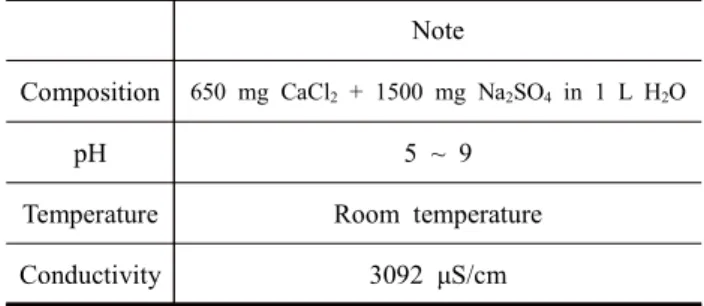
Copper bonded grounding materials were used as the test specimen and cut to size suitable for insertion in the im- mersion cylinder. The initial weight of samples was meas- ured with a calibrated top loader balance (GX-1000, AND, Japan) accurate to 0.001 grams, and those specimens were immersed into de-ionized water containing calcium chlor- ide (CaCl2) and sodium sulfate (Na2SO4). The character- istics of the aqueous solution were measured with water quality meter (Pro1030, YSI, USA) as shown in Table 1. The cylinders containing the specimens were placed in a constant temperature chamber for one month. After a month of exposure, the samples were cleaned with de-ionized water and wire brush to remove the corrosion products on the surface and weighed to calculate the corro-
sion rate compared to the test standard. The surface of the specimens was observed by field-emission scanning electron microscope (FE-SEM) (S-4200, Hitachi, Japan).
2.3 Cycle corrosion tester
The commercialized cycle corrosion tester (CCT, Q-FOG, Q-LAB, USA) has been applied to develop the accelerated corrosion test methods reflecting the soil envi- ronment in Fig. 1. They were installed to be able to imple- ment various soil conditions by installing soil baskets inside. Using the CCT, it is available to adjust the corro- sive ion concentration as chloride and sulfur oxides can be continuously sprayed, and provide the fixed humidity and constant temperature conditions.
Table 1 Characteristics of the aqueous solution of immersion corrosion test
Note
Composition 650 mg CaCl2 + 1500 mg Na2SO4 in 1 L H2O
pH 5 ~ 9
Temperature Room temperature
Conductivity 3092 μS/cm
Fig. 1 Cycle corrosion testers.
Fig. 2 Inside of improved cycle corrosion tester with the soil baskets.
2.4 Reliability of the cycle corrosion tester
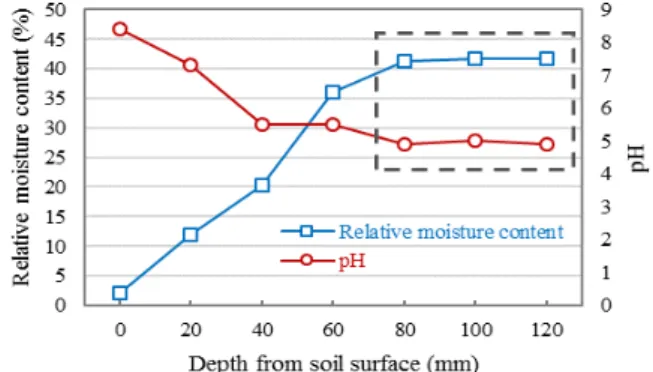
The standard soil of Jumunjin in Korea was used and baskets carrying the soil were installed in the CCT to sim- ulate the corrosion in Fig 2. The reliability of the ex- perimental conditions was verified because the location of the grounding electrodes could affect the test results if salt water were not uniformly sprayed on the soil surface contained in the basket. After running for 432 hours re- garding ASTM B117 standard, relative moisture content and pH with depth from the soil surface were measured with a soil monitoring sensor (WT-2000, RF sensor, Korea). The results for each depth were obtained from the average of 15 measurement points divided in the plane direction of the soil surface and the results are shown in Fig. 3. The relative moisture increased while the pH decreased with an increase of depth due to the inverse relationship between the relative moisture content and the pH under the same salt-spraying condition. It was con- firmed that the relative moisture content and the pH were constant at a depth of 80 mm to 120 mm (marked with a dashed box in Fig. 3), and the samples of the cop- per-bonded electrodes were placed at a depth of 100 mm to prepare the accelerated corrosion test.
2.5 Corrosion test procedures using the CCT
The specimens were prepared by cutting copper-bonded grounding electrodes of 1000 mm to 100 mm to fit the size of the soil basket and were sealed to the cut surfaces to exclude the effect of the corrosion on the cut surfaces.
The initial mass of each specimen was measured, and the prepared samples were placed at a depth of 100 mm from the soil surface. As shown in Table 2, the accelerated corrosion test with the actual soil environment was con- ducted by setting three conditions. Based on the ASTM B162 and ASTM B117 standards, sodium chloride (NaCl) and sodium sulfate (Na2SO4) concentrations were fixed and then the test temperature was set as a parameter.
Experiments were also conducted in the ISO 14993 con- dition with the cycle of the salt-spraying, humidifying and drying, and then the results were compared with each other. After one month of exposure, the specimens were cleaned with de-ionized water and wire brush to remove the soil components and corrosion products on the surface and weighed to calculate the corrosion rate.
3. Results and discussion
3.1 Characteristics of naturally degraded copper bonded grounding materials
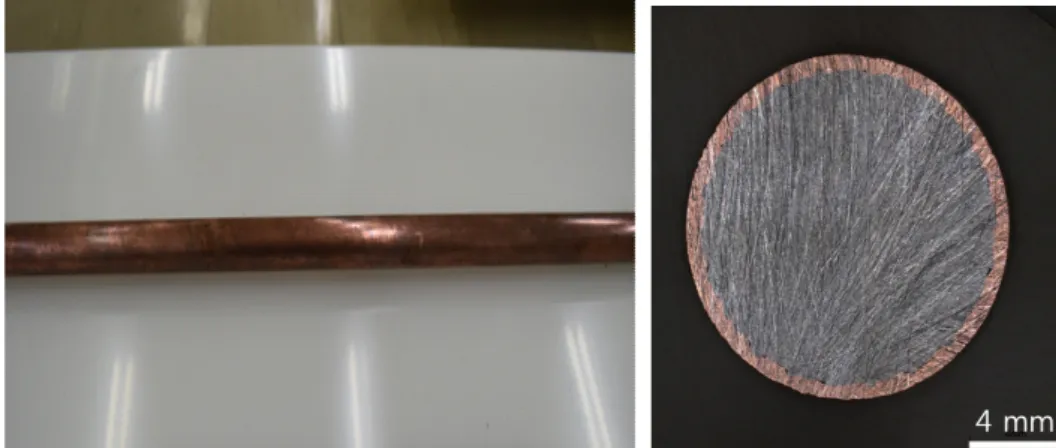
Fig. 4 shows the surface and cross-section images of a naturally 5-year aged copper bonded grounding material in soil environment after surface cleaning to remove remained soil and released corrosion products. The cross-section im- age depicts that the copper layer plays an excellent in protecting the inner carbon steel core from corrosion in long-term exposure. Since the thickness of the copper coating is generally about 0.5 mm, the measured corrosion depth (pitting) of the 5-year aged sample is 0.038 mm, which indicates that the inner core and the surface copper coating area are sufficiently protected from corrosion. In order to evaluate the characteristics of corrosion products Fig. 3 Relative moisture content and pH with depth from the
soil surface.
Table 2 Three conditions of the accelerated corrosion tests
Test No. Mode Temperature (oC) Concentration of NaCl (wt%) Concentration of Na2SO4 (wt%)
1 Continuous salt spray 35 5 0.1
2 Continuous salt spray 50 5 0.1
3 Salt spray (2h) – dry (4h) – wet (2h)
Salt spray: 35 Dry: 60 Wet: 50
5 0.1
on the copper surface, the specimen was cut and washed in de-ionized water using a brush. Crystal structure analy- sis of corroded surface was carried out. Fig. 5 shows the X-ray diffraction pattern of the 5-year aged copper bonded grounding material. The XRD pattern is in a good agree- ment with Cu metal, CuO and Cu2O. These oxides are formed on the surface of the copper bonded ground mate- rial, which can be expected to delay corrosion in the soil environment.
3.2 Immersion corrosion test
Table 3 shows the corrosion performances of the speci-
mens resulting from the immersion corrosion test. The copper bonded grounding materials showed only slight corrosion behavior as the results of F. D’ Alessandro et al. [6].
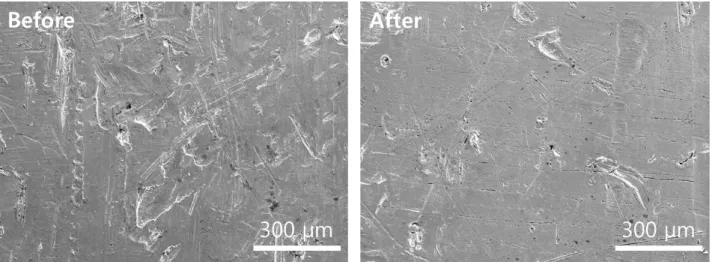
The SEM images of the copper coated material before and after the immersion test are shown in Fig. 6. General corrosion of the copper coated layer was not observed in these images except the scratches which had been made on transporting. However, as the NBS reported, the aged specimens from the actual field (a branch of Korea Electric Power Corporation) showed that the cop- per-bonded electrode is corrosive in the soil. The reason why the difference of the corrosion phenomena between the immersion test results and the actual field results oc- curs is that there are many local corrosion sites in the soil environment where copper oxidation process occurs on the surface of the grounding electrode. But in im- mersion condition, since the whole specimen becomes a single corrosion cell and oxygen concentration decreases over time without the aeration, the copper coating layer’s corrosion is relatively slow. The immersion test is not ap- plicable to simulate the actual soil corrosion in the cop- per-bonded grounding electrode system in a short period.
3.3 Improved corrosion tests using CCT
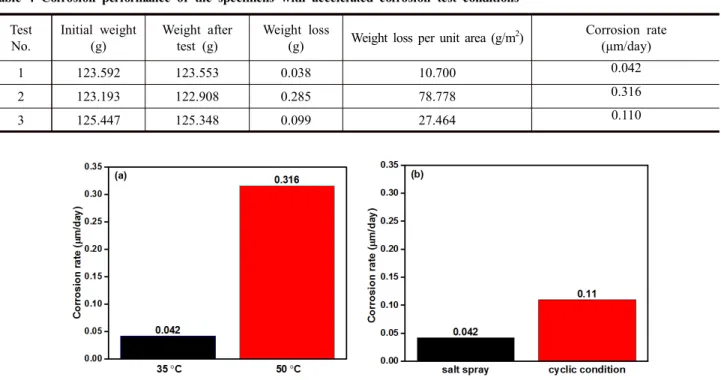
Table 4 shows the corrosion performances of the test specimens with test conditions as shown in Table 2. The weight loss per unit area of the specimen in accelerated Fig. 4 Naturally degraded copper bonded grounding material after cleaning and cross-section image.
Table 3 Corrosion performances of the specimens resulting from the immersion corrosion test*
Sample type Initial weight (g) Weight after test (g) Weight loss per unit area (g/m2) Corrosion rate (μm/day)
Copper-1 122.28 122.26 6.47 0.026
Copper-2 124.07 124.04 6.91 0.028
* Immersion test conditions were as follows: Temperature, 25 oC; Time, 28 days;
Salt concentration, 650 mg CaCl2 + 1500 mg Na2SO4 in 1 L H2O.
Fig. 5 X-ray diffraction pattern of the aged copper bonded grounding material.
test 2 is approximately 12 times higher than that of the previously conducted immersion test as shown in Table 3. This result means that the corrosion test methods devel- oped in this study are useful experiments that reflect the corrosion characteristics in the soil environment. The aver- age corrosion depth of the copper layer of the specimen was calculated using the theoretical density of Cu (8.96 g/cm3).
The appearances of specimens after one month of im- proved accelerated corrosion tests are shown in Fig. 7.
The accelerated degradation specimens were formed under continuous salt-spraying and cyclic (salt spray-dry-wet) conditions using the CCT. The most corrosion was ob- served at the accelerated test 2 due to the effect of the thermal energy on the corrosion reaction. For all the speci- mens, the CuO and Cu2O layers were formed on the sur- face of the specimens and salts associated with corrosive ions were observed on the outer surfaces.
The comparison of the corrosion rates by temperature and spray conditions is shown in Fig. 8. The results of Fig. 6 SEM images of copper layer before and after the immersion corrosion test.
Fig. 7 Specimens after one month of the improved accelerated corrosion test.
accelerated test condition 1, 2 and 3 revealed the corrosion rates of 0.042 μm/day, 0.316 μm/day and 0.11 μm/day, respectively in table 4. Fig. 8a shows the effect of the temperature on continuous salt spray. The corrosion rate was dramatically increased as temperature increased. This result can be meaningful data for understanding the corro- sion phenomena of the grounding materials considering the seasonal temperature changes in the actual field. Fig.
8b shows the effect of the spray conditions on the same salt spray temperature. The salt spray-dry-wet cyclic con- dition is the more accelerated corrosive atmosphere for the copper bonded grounding material compare to the con- tinuous salt spray method due to the effect of accelerated corrosion by salt concentration in the soil environment.
It is suggested that accelerated deterioration test speci- mens can be prepared more quickly if salt spray temper- ature is 50 °C in the salt spray-dry-wet cyclic condition.
The core performance of the grounding electrode is the electrical characteristic which is to protect electrical facili- ties from the potential increase during abnormal operation.
Generally, there is a possibility that the electrical ground- ing performance is decreased as the corrosion is increased, our further studies will focus on the prediction of the life- time of the grounding electrodes by evaluating the correla- tion between the electrical performance and the corrosion progress for the efficient application and management of the grounding electrodes in the distribution lines.
4. Conclusions
It is essential to predict the lifetime of the grounding components for efficient application and management in the distribution system. But it is not applicable to simulate the natural degradation of the copper bonded grounding electrode using the immersion test method which has been used for supporting the lifetime expectation of electrical grounding materials because it does not reflect the soil environment system. In this work, the improved accel- erated corrosion test methods that reflect the actual soil environment have been developed regarding the National Standard ASTM B162, ASTM B117 and ISO 14993 to evaluate the corrosion performance of the copper bonded grounding electrode within a short period. The accelerated degradation specimens of the copper bonded grounding electrodes were made under three test conditions as tem- perature and spray methods. The corrosion rates of them were calculated to 0.042 μm/day, 0.316 μm/day and 0.11 μm/day, respectively. From the results, it is considered that accelerated deterioration grounding materials can be obtained in a short period by using the cyclic test condition in which the salt spray temperature is 50 °C.
References
1. M. Romanoff, Underground Corrosion, National Bureau Table 4 Corrosion performance of the specimens with accelerated corrosion test conditions
Test No.
Initial weight (g)
Weight after test (g)
Weight loss
(g) Weight loss per unit area (g/m2) Corrosion rate (μm/day)
1 123.592 123.553 0.038 10.700 0.042
2 123.193 122.908 0.285 78.778 0.316
3 125.447 125.348 0.099 27.464 0.110
Fig. 8 Comparison of the corrosion rates by (a) temperature (35 °C and 50 °C) and (b) spray conditions (continuous salt spray and salt spray-dry-wet cycle).
of Standards, Circular 579, Washington, DC, USA (1957).
2. Richard W. Drisko, Field Testing of Electrical Grounding Rods, Naval Civil Engineering Laboratory, California, USA (1970).
3. Chris Rempe, A Technical Report on the Service Life of Ground Rod Electrodes, ERICO, Solon, USA (2003).
4. Travis Lindsey, National Electrical Grounding Research Project, The Fire Protection Research Foundation, Colorado, USA (2007).
5. Marek Loboda and Robert Marciniak, Proc. 28th International Conf. on Lightning Protection, p. 644, International Conference on Lightning, Kanazawa, Japan (2006).
6. F. D. Alessandro and B. Baumgartner, IAEI NEWS, Sep- Oct2008, 79 (2008).
7. EN50164-2, Lightning Protection Components (LPC) Part 2: Requirements for Conductors and Earth Electrodes, Annex B (2002).
8. ASTM B162-99, Standard Practice for Conducting and Evaluating Laboratory Corrosion Tests in Soils (2010).
9. ASTM B117-11, Standard Practice for Operating Salt Spray (Fog) Apparatus (2011).
10. ISO14993, Corrosion of Metals and Alloys – Accelerated Testing Involving Cyclic Exposure to Salt Mist, “Dry”
and “Wet” Conditions (2011).