D I A B E T E S & M E T A B O L I S M J O U R N A L
This is an Open Access article distributed under the terms of the Creative Commons Attribution Non-Commercial License (https://creativecommons.org/licenses/by-nc/4.0/) which permits unrestricted non-commercial use, distribution, and reproduction in any medium, provided the original work is properly cited.
Hypoglycemia and Dementia Risk in Older Patients with Type 2 Diabetes Mellitus: A Propensity-Score Matched Analysis of a Population-Based Cohort Study
Young-Gun Kim1,2,*, Dong Gyu Park3,*, So Young Moon4, Ja Young Jeon5, Hae Jin Kim5, Dae Jung Kim5, Kwan-Woo Lee5, Seung Jin Han5
1Department of Medical Sciences, Ajou University Graduate School, Suwon,
2Ministry of Health and Welfare, Gyeonggi Provincial Government, Suwon,
3Department of Neurology, Yeongwolgun Public Health Center, Yeongwol,
Departments of 4Neurology, 5Endocrinology and Metabolism, Ajou University School of Medicine, Suwon, Korea
Background: Type 2 diabetes mellitus (T2DM) is associated with an increased risk for dementia. The effects of hypoglycemia on dementia are controversial. Thus, we evaluated whether hypoglycemia increases the risk for dementia in senior patients with T2DM.
Methods: We used the Korean National Health Insurance Service Senior cohort, which includes >10% of the entire senior popu- lation of South Korea. In total, 5,966 patients who had ever experienced at least one episode of hypoglycemia were matched with those who had not, using propensity score matching. The risk of dementia was assessed through a survival analysis of matched pairs.
Results: Patients with underlying hypoglycemic events had an increased risk for all-cause dementia, Alzheimer’s dementia (AD), and vascular dementia (VaD) compared with those who had not experienced a hypoglycemic event (hazard ratio [HR], 1.254;
95% confidence interval [CI], 1.166 to 1.349; P<0.001 for all-cause dementia; HR, 1.264; 95% CI, 1.162 to 1.375; P<0.001 for AD;
HR, 1.286; 95% CI, 1.110 to 1.490; P<0.001 for VaD). According to number of hypoglycemic episodes, the HRs of dementia were 1.170, 1.201, and 1.358 in patients with one hypoglycemic episode, two or three episodes, and more than three episodes, respec- tively. In the subgroup analysis, hypoglycemia was associated with an increased risk for dementia in both sexes with or without T2DM microvascular or macrovascular complications.
Conclusion: Our findings suggest that patients with a history of hypoglycemia have a higher risk for dementia. This trend was similar for AD and VaD, the two most important subtypes of dementia.
Keywords: Dementia; Diabetes mellitus, type 2; Hypoglycemia
Corresponding author: Seung Jin Han https://orcid.org/0000-0003-4783-6799 Department of Endocrinology and Metabolism, Ajou University School of Medicine, 164 World cup-ro, Yeongtong-gu, Suwon 16499, Korea
E-mail: [email protected]
INTRODUCTION
Type 2 diabetes mellitus (T2DM) is associated with a 1.5 to 2.5-fold increased risk for dementia, and this trend is similar for both Alzheimer’s disease (AD) and vascular dementia (VaD), which are the most common subtypes of dementia [1,2]. With the increasing numbers of elderly people with
T2DM in the general population, dementia is especially im- portant due to its impact on self-management and quality of life. Therefore, identifying modifiable risk factors for dementia is crucial to public health. The mechanisms underlying the as- sociation between T2DM and dementia are not fully under- stood, but they are multifactorial, including poor glucose con- trol, hypoglycemia, inflammatory mediators, and rheological https://doi.org/10.4093/dmj.2018.0260
pISSN 2233-6079 · eISSN 2233-6087
factors [3].
Hypoglycemia is a potentially serious complication during diabetes treatment and it may be an obstacle to optimal glyce- mic control. As glucose is the primary source of energy for the brain, hypoglycemia may cause mild or severe neurological deficits, including coma [4,5]. Although the short-term effects of hypoglycemia on cognitive function have been well docu- mented, it is unclear whether patients with hypoglycemia will develop dementia. A few epidemiological studies have shown that severe hypoglycemia is associated with a greater risk for dementia [6-9], but others have reported no significant associ- ation between hypoglycemia and subsequent dementia [10,11].
In addition, because the pathogeneses of AD and VaD are very different, the same hypoglycemic assault may have different ef- fects on the progression of dementia according to subtype.
However, previous studies have not estimated dementia risk according to dementia subtype.
Therefore, the purpose of the current study was to investi- gate the association between hypoglycemia and subsequent dementia in older adults with T2DM by conducting a propen- sity score matching analysis to minimize selection bias. We also identified the effect of hypoglycemia on dementia accord- ing to each subtype. We used the Korean National Health In- surance Service Senior cohort, which contains 14 years of fol- low-up data for >10% of all older adults in South Korea.
METHODS
Study design and data source
This study was a population-based retrospective observational study and was approved by the Institutional Review Board of the Korea National Institute for Bioethics Policy (http://www.
irb.or.kr/, P01-201811-21-008), which waived the requirement for informed consent because all patient data were de-identi- fied.
Data source
We used the Korean National Health Insurance Service Senior cohort version 3.0 (January 1, 2002 to December 31, 2015), which contains around 550,000 patients (>10% of the entire South Korea senior population in 2002). This dataset was ex- tracted from the Korean National Health Insurance Service, which covers over 99% of the South Korean population, using a stratified random sampling method with 1,476 strata; thus, it is representative of the entire Korean senior population. This
data set included information on the socioeconomic status of Korean National Health Insurance Service recipients; status was based on income and assets, such as property and automo- bile ownership.
Inclusion and exclusion criteria
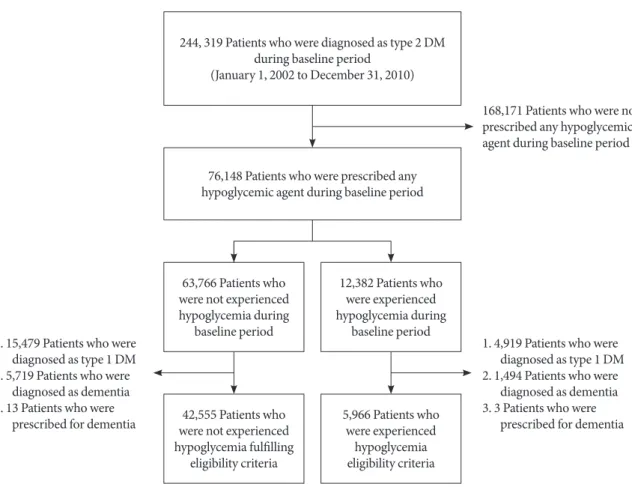
Patients diagnosed with T2DM and prescribed oral hypoglyce- mic agents or insulin were enrolled (Fig. 1). The index date was January 1, 2011, and patients were divided into two groups ac- cording to the presence of hypoglycemia (International Classi- fication of Diseases, 10th revision [ICD-10] codes E11.63, E15, E16.0, E16.1, and E16.2) before the index date. Patients who experienced at least one hypoglycemic episode were placed in the hypoglycemia group, which was then divided into three groups according to the number of hypoglycemic episodes (one episode, two or three episodes, or more than three epi- sodes). Patients with type 1 diabetes mellitus (T1DM; ICD-10 code E10) or dementia diagnoses (ICD-10 codes F00, F01, F02, F03, F04, F05, G30, or G31) or a medication prescribed to treat dementia (donepezil, memantin, rivastigmine, or galan- tamine) before the index date (January 1, 2002 to December 31, 2010) were excluded. The loss of samples is described in Fig. 1. Because the Korean National Health Insurance Service Senior cohort consists of patients ≥60 years old in 2002, all pa- tients were >68 years of age on the index date.
Study outcome and subgroup analysis
The primary outcome was the first diagnosis of all-cause de- mentia (ICD-10 codes F00, F01, F02, F03, F04, F05, G30, or G31). The secondary outcome was the first diagnosis of AD (F00, G30) or VaD (F01). Additionally, we assessed differences in the risk of dementia according to the number of hypoglyce- mic episodes by dividing the sample into three groups. Sub- group analyses were performed according to sex, age (<75 and
≥75 years), and the presence of T2DM microvascular (any di- agnosis of diabetic nephropathy, neuropathy, or retinopathy) or macrovascular complications (any diagnosis of stroke, tran- sient ischemic attack, acute myocardial infarction, other isch- emic heart disease, and peripheral artery occlusive disease).
Statistical analysis
All statistical analyses were performed using R software ver- sion 3.3.3 (R Development Core Team, Vienna, Austria) and SAS version 9.4 (SAS Institute, Cary, NC, USA). All values are presented as mean±standard deviation. The differences be-
tween patients with and without an underlying hypoglycemic event were adjusted with propensity score matching using the nearest-neighbor technique with a caliper of 0.1 on the proba- bility scale. We set age, sex, socioeconomic status (index date), diagnoses (1 year before the index date), and prescribed drugs (180 days before the index date) as confounding variables (all variables presented in Table 1) and those were used to calculate propensity scores. The balance achieved by matching propen- sity scores was assessed using standardized differences, t-tests (age), chi-square tests (all other variables except age and socio- economic status), and Mantel-Haenszel chi-square tests (so- cioeconomic status); an absolute standardized difference be- tween groups <0.1 was considered negligible. After the pro- pensity score matching, a Kaplan-Meier curve and Cox pro- portional hazards model were used to evaluate the dementia risk of hypoglycemia. Because all confounding variables were adjusted in propensity score matching, 1 minus Kaplan-Meier estimate, and a univariate Cox regression analysis were per- formed.
RESULTS
In total, 48,521 patients were included in the cohort and 220,385 person-years were considered. After propensity score matching, 5,966 patients comprised both groups. The baseline characteristics of the matched group are presented in Table 1;
all absolute values of standardized differences were <0.1; thus, all confounding variables were considered properly adjusted by propensity score matching. The mean follow-up period of the matched pairs was 1,591.1 days.
During the study period, 2,934 patients were newly diag- nosed with dementia. The patients with at least one hypoglyce- mia episode showed an increased risk of all-cause dementia compared with those without hypoglycemia (hazard ratio [HR], 1.254; 95% confidence interval [CI], 1.166 to 1.349;
P<0.001) (Table 2, Fig. 2). Patients with underlying hypoglyce- mia were prone to AD and VaD (HR, 1.264; 95% CI, 1.162 to 1.375, P<0.001 for AD; and HR, 1.286; 95% CI, 1.110 to 1.490;
P<0.001 for VaD) (Table 2, Fig. 2).
Fig. 1. Flow chart of the sample selection. DM, diabetes mellitus.
244, 319 Patients who were diagnosed as type 2 DM during baseline period
(January 1, 2002 to December 31, 2010)
76,148 Patients who were prescribed any hypoglycemic agent during baseline period
63,766 Patients who were not experienced hypoglycemia during
baseline period
42,555 Patients who were not experienced hypoglycemia fulfilling
eligibility criteria
5,966 Patients who were experienced
hypoglycemia eligibility criteria 12,382 Patients who
were experienced hypoglycemia during
baseline period
168,171 Patients who were not prescribed any hypoglycemic agent during baseline period
1. 4 ,919 Patients who were diagnosed as type 1 DM 2. 1 ,494 Patients who were diagnosed as dementia 3. 3 Patients who were
prescribed for dementia 1. 1 5,479 Patients who were
diagnosed as type 1 DM 2. 5 ,719 Patients who were diagnosed as dementia 3. 1 3 Patients who were
prescribed for dementia
According to number of hypoglycemic episodes, the HRs of dementia were 1.170, 1.201, and 1.358 in patients with one hy- poglycemic episode, two or three episodes, and more than three episodes, respectively (Table 3).
In the subgroup analysis, patients were divided according to
sex, age, or the presence of T2DM microvascular or macrovas- cular complications. Patients who experienced hypoglycemia showed an increased risk for dementia in all subgroups (Table 4).
DISCUSSION
This population-based retrospective cohort study showed that Table 1. Baseline characteristics of propensity score matched
patients
Characteristic
Patients without underlying hypoglycemia
Patients with underlying hypoglycemia
SMD P value
Number 5,966 5,966
Age, yr 75.82±5.34 75.82±5.41 <0.001 0.947
Male sex, % 37.81 38.50 0.014 0.778
Socio-economic status 0.042 0.427
1st to 4th of 11 quantiles 1,628 (27.29) 1,627 (27.27) 5th to 8th of 11 quantiles 1,822 (30.54) 1,860 (31.18) 9th to 11th of 11 quantiles 2,516 (42.17) 2,479 (41.55)
Hypertension 86.24 85.82 0.012 0.401
Dyslipidemia 58.85 59.65 0.016 0.394
Chronic kidney disease 7.58 7.71 0.005 0.945
End-stage renal disease 3.62 4.22 0.031 0.473
Any malignancy 11.33 11.26 0.002 0.439
Migraine 4.53 4.51 0.001 0.654
Asthma 19.18 19.01 0.004 0.971
Chronic obstructive
pulmonary disease 14.28 13.88 0.012 0.685
Connective tissue disease 5.88 6.22 0.014 0.828
Atrial fibrillation 4.51 4.64 0.006 0.172
Heart failure 8.3 8.41 0.004 0.945
Osteoporosis 25.96 26.22 0.006 0.699
Cerebrovascular disease
Ischemic stroke 15.37 15.39 <0.001 0.533
Hemorrhagic stroke 0.62 0.85 0.027 0.914
Transient ischemic attack 4.24 3.97 0.014 0.608 A cute myocardial
infarction 4.61 4.27 0.016 0.587
O ther ischemic heart
disease 28.43 28.03 0.009 0.768
Other heart disease 22.18 21.77 0.01 0.826
Peripheral artery disease 2.77 2.63 0.008 0.476 Microvascular complica-
tions of diabetes
Neuropathy 22.95 23.21 0.006 0.533
Nephropathy 8.95 9.34 0.013 0.271
Retinopathy 20.62 20.62 <0.001 0.254
Table 1. Continued
Characteristic
Patients without underlying hypoglycemia
Patients with underlying hypoglycemia
SMD P value
Alcohol usea 2.83 2.65 0.011 0.736
Obesitya 0.02 0.03 0.011 0.465
Medication use Anti-diabetic medicine
Metformin 67.83 67.77 0.001 0.583
Sulfonylurea 73.57 72.93 0.014 0.254
Thiazolidinedione 9.1 9.52 0.014 0.105
DPP-4i 9.29 8.73 0.019 0.722
α-Glucosidase inhibitor 23.33 22.9 0.01 0.662
Meglitinide 4.76 5.43 0.03 0.777
Insulin 15.35 16.46 0.03 0.878
Anti-hypertensive agent
Calcium channel blocker 35.89 35.97 0.002 0.446
ACEI 10.46 10.81 0.011 0.463
ARB 52.46 52.03 0.009 0.728
β-Blocker 18.67 18.54 0.003 0.573
α-Blocker 3.1 3.07 0.002 0.532
Diuretics 33.44 33.02 0.009 0.473
Aspirin 45.31 45.31 <0.001 0.956
P2Y12 inhibitor 14.08 13.68 0.012 0.438
Warfarin 1.91 2.15 0.017 0.949
Other antiplatelet 9.45 9.35 0.003 0.925
NOAC 0.08 0.05 0.013 0.705
Lipid-lowering agent
Statin 35.77 35.97 0.004 0.789
Fibrate 3.4 3.3 0.006 0.757
Ezetimibe 1.42 1.51 0.007 0.819
Values are presented as mean±standard deviation, number (%), or percentage.
The mean±standard deviation standardized difference of all covariates was 1.06%±0.09%.
SMD, standardized mean difference; DPP-4i, dipeptidyl-peptidase IV inhibi- tor; ACEI, angiotensin-converting-enzyme inhibitor; ARB, angiotensin II re- ceptor antagonists; NOAC, novel oral anticoagulant.
aConfirmed using the International Classification of Diseases (10th revision) diagnosis codes.
(Continued to the next)
Table 2. The risk of dementia in patients with hypoglycemia compared to patients without hypoglycemia
Variable Number Events HR 95% CI P value
All-cause dementia 11,932 2,934 1.254 1.166–1.349 <0.001
Alzheimer’s disease 11,932 2,186 1.264 1.162–1.375 <0.001
Vascular dementia 11,932 721 1.286 1.110–1.490 <0.001
HR, hazard ratio; CI, confidence interval.
Table 3. The risk of dementia according to number of hypoglycemic episodes in patients with and without previous hypoglycemic episode
No. of previous hypoglycemic episodes Number Events HR 95% CI P value
1 4,622 1,159 1.170 1.043–1.313 0.008
2–3 2,946 550 1.201 1.016–1.421 0.032
>3 4,354 256 1.358 1.060–1.740 0.016
HR, hazard ratio; CI, confidence interval.
Fig. 2. Kaplan-Meier plots for (A) all-cause dementia, (B) Al- zheimer disease, and (C) vascular dementia in patients with or without underlying hypoglycemia.
1.0 0.9 0.8 0.7 0.6 0.5
1.0 0.9 0.8 0.7 0.6 0.5
1.0 0.9 0.8 0.7 0.6
urPrtiaenor demg fvinviPrn stiooroptiaenor demg fvinviurn stioorop vienor demg fvintiaurn stiooropPr 0.5
Index 1 2 3 4 5
Index 1 2 3 4 5
Index 1 2 3 4 5
5,966 5,697 5,403 5,168 4,904 4,639 5,966 5,630 5,248 4,916 4,641 4,359
5,966 5,908 5,852 5,790 5,720 5,649 5,966 5,884 5,812 5,726 5,647 5,562
5,966 5,818 5,608 5,426 5,217 4,986 5,966 5,763 5,502 5,236 5,012 4,760 Without hypoglycemia
With hypoglycemia
Without hypoglycemia With hypoglycemia
Without hypoglycemia With hypoglycemia Patients without hypoglycemia
Patients with hypoglycemia
Patients without hypoglycemia Patients with hypoglycemia
Patients without hypoglycemia Patients with hypoglycemia
No. at risk
No. at risk
No. at risk Follow-up times (yr)
Follow-up times (yr)
Follow-up times (yr) A
C
B
patients with a history of hypoglycemia had a higher risk of dementia using the propensity score matching method with large cohort data. This association was persistent in both the AD and VaD subtypes. Patients who experienced repeated epi- sodes of hypoglycemia had a higher risk of dementia. In the subgroup analysis, hypoglycemia increased the risk for demen- tia in both sexes with or without T2DM microvascular and macrovascular complications.
This is the first cohort study using the propensity score matching method to minimize selection bias. In addition, this is the first study to estimate dementia risk of hypoglycemia ac- cording to the specific dementia subtype. Our study included the largest number of patients who have ever experienced hy- poglycemia compared with previous studies.
Our study showed that hypoglycemia increased the risk of dementia by 25.4%, which conflicts with some previous stud- ies. The Fremantle Diabetes Study found no evidence that hy- poglycemia contributes to cognitive impairment in older adults with T2DM who had normal cognition at baseline [10].
However, the small sample size and relatively short follow-up duration may have limited the power to detect differences. In the Diabetes Control and Complication Trial on younger adults with T1DM, 40% of the patients experienced at least one hypoglycemic coma or seizure but did not decline cognitively [11]. Although this cohort was followed for 18 years, the mean age of the enrolled patients was 27 years, which was too young to show cognitive impairment. The same assault of hypoglyce- mia may have different impacts according to the age of the subject population, as levels of hippocampal neurogenesis steadily decrease with age [12]. The conflicting results may be due to differences in the demographics of the study popula- tions.
Consistent with our results, three retrospective studies showed that at least one hypoglycemic episode increases the risk of de- mentia [6,7,9]. Additionally, repeated episodes of hypoglyce- mia were correlated with a higher risk of dementia [6,9]. Lin and Sheu [7] showed an increased risk of dementia in subjects with a history of hypoglycemia. However, they adjusted only for age, sex, insulin use, and five comorbidities, and included only 289 patients who had had at least one hypoglycemic epi- sode, which is a relatively small sample size [7]. Another retro- spective cohort study using the Kaiser Permanente Northern California Diabetes Registry of around 17,000 patients, with a mean age of 65 years, who were followed for 27 years, showed that one, two, and three or more episodes of hypoglycemia in- creased the risk of dementia, with HRs of 1.26, 1.80, and 1.94, respectively [6]. However, this cohort involved only approxi- mately 1,500 patients with a hypoglycemic experience and did not control for either economic status, which is among the im- portant risk factors for dementia, or medication use, including class of oral hypoglycemic agent or statins, which can affect de- mentia [13-18]. The third study, using the Clinical Practice Re- search Datalink (CPRD), which contains the medical records from 674 general practices in the United Kingdom, showed that hypoglycemia is associated with a higher risk of dementia [9]. Furthermore, the risk of dementia increased with the num- ber of hypoglycemia episodes. However, CPRD is collected from general practice and may be biased relative to our data, which was collected from a primary hospital to a tertiary hos- pital, and this study also did not compensate for socioeconom- ic status, or medication use, such as each oral hypoglycemic agent class or statins. Compared to all of these previous studies using Cox proportional hazards models that compensated for insufficient confounding factors and included small numbers Table 4. Subgroup analyses according to sex, age, and the presence of diabetic microvascular or macrovascular complications
Variable Number Events HR 95% CI P value
Male sex 4,553 921 1.180 1.037–1.344 <0.05
Female sex 7,379 2,013 1.297 1.188–1.416 <0.001
Patients aged ≥75 years 6,210 1,893 1.197 1.093–1.310 <0.001
Patients aged <75 years 5,722 1,041 1.376 1.217–1.556 <0.001
Patients with DM microvascular complications 5,039 1,330 1.312 1.177–1.462 <0.001 Patients without DM microvascular complications 6,893 1,604 1.208 1.095–1.332 <0.001 Patients with DM macrovascular complications 5,089 1,354 1.226 1.102–1.365 <0.001 Patients without DM macrovascular complications 6,843 1,580 1.276 1.155–1.409 <0.001 HR, hazard ratio; CI, confidence interval; DM, diabetes mellitus.
of patients with hypoglycemia, we used the propensity score matching method and more than 40 confounding variables, including socioeconomic status, oral hypoglycemic agent class, statin use, and many underlying diseases, and included the largest number of patients with hypoglycemia.
Several possible mechanisms have been suggested from ani- mal studies for how hypoglycemia can cause dementia. Multi- ple animal and human magnetic resonance imaging studies have reported that severe hypoglycemia with coma can lead to selective neuronal cell death in vulnerable brain regions, such as the cortex and hippocampus [19]. This can lead to a decline in memory. In a rat model, significant learning and memory deficits were identified with behavioral testing 6 weeks after in- ducing 30 minutes of EEG isoelectricity with severe hypogly- cemia, which could be attributed to neuronal death observed in the hippocampus of these animals [20]. In another animal study, prolonged moderate hypoglycemia without coma also caused neuronal damage in the prefrontal medial cortex, piri- form cortex, and orbital cortex in rats [21].
Other explanations related to vascular and AD pathology are plausible. Increased adrenaline levels during hypoglycemic events enhance platelet and leucocyte activities, and increase the formation of fibrinogen [22,23]. Endothelial function may also be compromised during a hypoglycemic attack [24]. All of these factors contribute to micro- or macro-infarcts in the brain, causing vascular cognitive decline. Several studies have shown a possible link between hypoglycemia and AD patholo- gy. In a study with rat primary cortical astroglial cells, hypogly- cemia enhanced the expression of mRNA encoding the β- amyloid precursor protein. In a study with neuroblastoma cells, hypoglycemia induced tau hyperphosphorylation, which can lead to the formation of neurofibrillary tangles [25]. In the present study, a history of hypoglycemia increased both the AD and vascular subtypes of dementia. Although it is com- mon to have a single patient with both AD and VD pathology, these subtypes can be difficult to distinguish. This study sug- gests that hypoglycemia can be related to both pathomecha- nisms and may make the brain more vulnerable to both pa- thologies.
This study had several strengths. First, we investigated the largest senior cohort, which contains all of the claims data for
>10% of the entire elderly population in South Korea for 14 years. Second, we tried to exclude bidirectional effects as much as possible. Dementia is one of the major risk factors for hypo- glycemia; thus, dementia and hypoglycemia have a bi-direc-
tional effect. All subjects in our study were free of dementia at baseline, as we excluded patients who were diagnosed with de- mentia or prescribed dementia medications during the 9-year period before the index date, to assess temporality in the rela- tionship. Third, as described above, we minimized selection bias by using propensity score matching with 48 variables, such as demographics, socioeconomic status, medication use, and comorbidities.
However, several limitations should be considered. This was a retrospective analysis, and the claims database lacked results of any measurements, such as glycated hemoglobin or Mini- Mental State Exam scores, which may have influenced the re- sults. Specifically, patients with mild cognitive impairment are more difficult to identify using a claims database without cog- nitive testing results. Thus, prospective cohort studies that in- clude cognitive function tests to exclude mild cognitive im- pairment before enrollment are needed to confirm our results.
Additionally, we analyzed the incidence of dementia and hy- poglycemia according to ICD-10 diagnostic codes; however, there may have been some discrepancies between the medical diagnoses and the diagnostic codes in the claims data. Howev- er, a previous study showed that the dementia diagnoses in claims data were quite correct when compared with clinically diagnosed dementia [26]. In addition, because >99% of South Koreans are registered with National Health Insurance, and the dementia diagnostic codes are mandatory to earn insurance benefits when being prescribed dementia medication, it is highly unlikely that dementia would be found without the rel- evant diagnostic codes in the claims data. In terms of hypogly- cemia, clinicians tend not to record hypoglycemia in actual practice, especially when it is mild, when entering diagnostic codes. Thus, this study is limited by the possibility that we un- derestimated the incidence of hypoglycemic episodes and were unable to assess the effects of mild hypoglycemia on dementia.
Last, because this study only included the South Korean popu- lation, the results may not be generalizable to all ethnic groups.
The incidence and proportion of dementia subtypes vary among ethnic groups [27,28]. Previous studies have shown that the Asian population has a greater proportion of VaD and a lower proportion of AD [29].
In summary, our study indicates that a history of hypoglyce- mia increases the risk for dementia in older adults with T2DM.
This association is consistent for both AD and VaD. Caution is advised when treating T2DM in older individuals with hypo- glycemia, to prevent deterioration of their cognitive ability.
CONFLICTS OF INTEREST
No potential conflict of interest relevant to this article was re- ported.
AUTHOR CONTRIBUTIONS
Conception or design: Y.G.K., S.J.H.
Acquisition, analysis, or interpretation of data: Y.G.K., D.G.P., S.J.H.
Drafting the work or revising: Y.G.K., D.G.P., S.Y.M., J.Y.J., H.J.K., D.J.K., K.W.L., S.J.H.
Final approval of the manuscript: Y.G.K., D.G.P., S.Y.M., J.Y.J., H.J.K., D.J.K., K.W.L., S.J.H.
ORCID
Young-Gun Kim https://orcid.org/0000-0002-8982-5230 Dong Gyu Park https://orcid.org/0000-0001-8658-3523 Seung Jin Han https://orcid.org/0000-0003-4783-6799
ACKNOWLEDGMENTS
This study utilizes the data of the National Health Insurance Service (REQ0000016362) and results are unrelated to the opinion of the National Health Insurance Service.
This work was supported by the National Research Founda- tion of Korea (NRF) grant funded by the Korea government (MSIT) (No. NRF-2018R1C1B5044056). The funding entities had no role in the conduct of this study or interpretation of its results.
REFERENCES
1. Biessels GJ, Staekenborg S, Brunner E, Brayne C, Scheltens P.
Risk of dementia in diabetes mellitus: a systematic review. Lan- cet Neurol 2006;5:64-74.
2. Gudala K, Bansal D, Schifano F, Bhansali A. Diabetes mellitus and risk of dementia: a meta-analysis of prospective observa- tional studies. J Diabetes Investig 2013;4:640-50.
3. Strachan MW, Reynolds RM, Marioni RE, Price JF. Cognitive function, dementia and type 2 diabetes mellitus in the elderly.
Nat Rev Endocrinol 2011;7:108-14.
4. Warren RE, Frier BM. Hypoglycaemia and cognitive function.
Diabetes Obes Metab 2005;7:493-503.
5. Bree AJ, Puente EC, Daphna-Iken D, Fisher SJ. Diabetes in- creases brain damage caused by severe hypoglycemia. Am J Physiol Endocrinol Metab 2009;297:E194-201.
6. Whitmer RA, Karter AJ, Yaffe K, Quesenberry CP Jr, Selby JV.
Hypoglycemic episodes and risk of dementia in older patients with type 2 diabetes mellitus. JAMA 2009;301:1565-72.
7. Lin CH, Sheu WH. Hypoglycaemic episodes and risk of de- mentia in diabetes mellitus: 7-year follow-up study. J Intern Med 2013;273:102-10.
8. Yaffe K, Falvey CM, Hamilton N, Harris TB, Simonsick EM, Strotmeyer ES, Shorr RI, Metti A, Schwartz AV; Health ABC Study. Association between hypoglycemia and dementia in a biracial cohort of older adults with diabetes mellitus. JAMA In- tern Med 2013;173:1300-6.
9. Mehta HB, Mehta V, Goodwin JS. Association of hypoglycemia with subsequent dementia in older patients with type 2 diabe- tes mellitus. J Gerontol A Biol Sci Med Sci 2017;72:1110-6.
10. Bruce DG, Davis WA, Casey GP, Clarnette RM, Brown SG, Ja- cobs IG, Almeida OP, Davis TM. Severe hypoglycaemia and cognitive impairment in older patients with diabetes: the Fre- mantle Diabetes Study. Diabetologia 2009;52:1808-15.
11. Diabetes Control and Complications Trial/Epidemiology of Diabetes Interventions and Complications Study Research Group, Jacobson AM, Musen G, Ryan CM, Silvers N, Cleary P, Waberski B, Burwood A, Weinger K, Bayless M, Dahms W, Harth J. Long-term effect of diabetes and its treatment on cog- nitive function. N Engl J Med 2007;356:1842-52.
12. Couillard-Despres S, Iglseder B, Aigner L. Neurogenesis, cellu- lar plasticity and cognition: the impact of stem cells in the adult and aging brain: a mini-review. Gerontology 2011;57:559-64.
13. Prince M, Acosta D, Ferri CP, Guerra M, Huang Y, Llibre Ro- driguez JJ, Salas A, Sosa AL, Williams JD, Dewey ME, Acosta I, Jotheeswaran AT, Liu Z. Dementia incidence and mortality in middle-income countries, and associations with indicators of cognitive reserve: a 10/66 Dementia Research Group popula- tion-based cohort study. Lancet 2012;380:50-8.
14. Scazufca M, Menezes PR, Vallada HP, Crepaldi AL, Pastor- Valero M, Coutinho LM, Di Rienzo VD, Almeida OP. High prevalence of dementia among older adults from poor socio- economic backgrounds in Sao Paulo, Brazil. Int Psychogeriatr 2008;20:394-405.
15. Wu CK, Yang YH, Lin TT, Tsai CT, Hwang JJ, Lin JL, Chen PC, Chiang FT, Lin LY. Statin use reduces the risk of dementia in elderly patients: a nationwide data survey and propensity anal- ysis. J Intern Med 2015;277:343-52.
16. Song Y, Nie H, Xu Y, Zhang L, Wu Y. Association of statin use with risk of dementia: a meta-analysis of prospective cohort studies. Geriatr Gerontol Int 2013;13:817-24.
17. Chen PY, Liu SK, Chen CL, Wu CS. Long-term statin use and dementia risk in Taiwan. J Geriatr Psychiatry Neurol 2014;27:
165-71.
18. Bohlken J, Jacob L, Kostev K. Association between the use of antihyperglycemic drugs and dementia risk: a case-control study. J Alzheimers Dis 2018;66:725-32.
19. Languren G, Montiel T, Julio-Amilpas A, Massieu L. Neuronal damage and cognitive impairment associated with hypoglyce- mia: an integrated view. Neurochem Int 2013;63:331-43.
20. Suh SW, Aoyama K, Chen Y, Garnier P, Matsumori Y, Gum E, Liu J, Swanson RA. Hypoglycemic neuronal death and cogni- tive impairment are prevented by poly(ADP-ribose) poly- merase inhibitors administered after hypoglycemia. J Neurosci 2003;23:10681-90.
21. Tkacs NC, Pan Y, Raghupathi R, Dunn-Meynell AA, Levin BE.
Cortical Fluoro-Jade staining and blunted adrenomedullary response to hypoglycemia after noncoma hypoglycemia in rats.
J Cereb Blood Flow Metab 2005;25:1645-55.
22. Fisher BM, Hepburn DA, Smith JG, Frier BM. Responses of peripheral blood cells to acute insulin-induced hypoglycaemia in humans: effect of alpha-adrenergic blockade. Horm Metab Res Suppl 1992;26:109-10.
23. Dalsgaard-Nielsen J, Madsbad S, Hilsted J. Changes in platelet function, blood coagulation and fibrinolysis during insulin-in- duced hypoglycaemia in juvenile diabetics and normal sub- jects. Thromb Haemost 1982;47:254-8.
24. Wright RJ, Newby DE, Stirling D, Ludlam CA, Macdonald IA, Frier BM. Effects of acute insulin-induced hypoglycemia on indices of inflammation: putative mechanism for aggravating vascular disease in diabetes. Diabetes Care 2010;33:1591-7.
25. Lee CW, Shih YH, Wu SY, Yang T, Lin C, Kuo YM. Hypoglyce- mia induces tau hyperphosphorylation. Curr Alzheimer Res 2013;10:298-308.
26. Taylor DH Jr, Ostbye T, Langa KM, Weir D, Plassman BL. The accuracy of medicare claims as an epidemiological tool: the case of dementia revisited. J Alzheimers Dis 2009;17:807-15.
27. Mayeda ER, Glymour MM, Quesenberry CP, Whitmer RA.
Inequalities in dementia incidence between six racial and eth- nic groups over 14 years. Alzheimers Dement 2016;12:216-24.
28. Mayeda ER, Karter AJ, Huang ES, Moffet HH, Haan MN, Whitmer RA. Racial/ethnic differences in dementia risk among older type 2 diabetic patients: the diabetes and aging study. Diabetes Care 2014;37:1009-15.
29. Bulatao RA, Anderson NB, Cohen B. Critical perspectives on racial and ethnic differences in health in late life. Washington, DC: The National Academic Press; 2004.