Fibromyxoma is a synonym for odontogenic myxoma as reported in the World Health Organization (WHO) Classi- fication 2005. It is a rare, benign, and locally aggressive odontogenic tumor of a mesenchymal origin,1,2comprising 3-6% of all odontogenic tumors.3
Fibromyxoma of the jaw, either the mandible or maxilla, has been reported in the literature since the middle of the last century.4-14Most cases occur in young patients mainly those in their 20 s or 30 s, and the condition has a female predilection. The mandible is more commonly affected than the maxilla, mainly in the posterior region. Usually, it causes a painless, slow-growing swelling.9,15
Radiographically, it has been demonstrated as a uniloc- ular or a multilocular radiolucency in the tooth-bearing area with a well-defined border, but sometimes, it does not match this definition. Root resorption is rarely found in cases of fibromyxoma, and the scalloping margin between the roots occurs more frequently.3,6,12 Maxillary lesions may cause invagination of the maxillary sinus and expan- sion of its walls as revealed in cross-sectional imaging modalities such as computed tomography.13,14
Histologically, the tumor is composed of stellate and spindle-shaped cells with a haphazard arrangement in a loose mucinous or myxoid stroma, and its connective tissue may contain few collagen fibrils. Remnants of the odonto- genic epithelium may also be present.13
This report describes a rare case of multiple fibromyxo- mas and highlights their clinical and radiographic features, including panoramic and magnetic resonance images, as well as histopathological features.
Case Report
A 13-year-old female patient visited the university hos- pital due to delayed eruption of some of her teeth. The cause of delayed eruption was not clear, but it might have been due to trauma, as when the patient was five, she had a severe car accident and her jaws were severely trauma- tized, but without any apparent jaw fractures. The decidu- ous teeth fell out, and the gingiva healed normally; how- ever, there was no sign of any eruption of the permanent teeth afterwards. Surgery had previously been conducted to release the central incisors. No pain was reported by the patient except at the molar area while eating. There was no history of paresthesia. An unremarkable medical history was otherwise reported by the patient’s guardian with nor- mal previous laboratory investigations, namely, the com-
Received October 27, 2013; Revised March 22, 2014; Accepted April 15, 2014
*Correspondence to: Dr. Mohamed Khalifa Zayet
Oral Radiology Department, Faculty of Oral and Dental Medicine, Cairo University, 11, El-Saraya St. Al-Manyal, Cairo 11553, Egypt
Tel) 20-2-100-564-5900, Fax) 20-2-2364-6375, E-mail) [email protected]
Copyright ⓒ 2014 by Korean Academy of Oral and Maxillofacial Radiology
This is an Open Access article distributed under the terms of the Creative Commons Attribution Non-Commercial License (http://creativecommons.org/licenses/by-nc/3.0) which permits unrestricted non-commercial use, distribution, and reproduction in any medium, provided the original work is properly cited.
Imaging Science in Dentistry∙pISSN 2233-7822 eISSN 2233-7830
Multiple fibromyxomas of the jaws: A case report
Mohamed Khalifa Zayet1,*, Salma Belal Eiid1
1Oral Radiology Department, Faculty of Oral and Dental Medicine, Cairo University, Cairo, Egypt
ABSTRACT
Fibromyxoma of the jaw is a rare benign mesenchymal odontogenic tumor with locally aggressive behavior. In the present report, a 13-year-old female patient presented to our university hospital with delayed eruption of some of her teeth. A panoramic radiograph taken at the initial examination revealed four pericoronal radiolucencies related to the four third molars. Thereafter, a magnetic resonance imaging (MRI) examination was performed. After the surgical removal of these molars, the microscopic examination diagnosed the four lesions as fibromyxomas. Here, we have discussed the clinical, panoramic radiography, MRI, and histopathological findings of the case. (Imaging Sci Dent 2014; 44: 237-41)
KEY WORDS: Fibroma, Jaw; Magnetic Resonance Imaging
plete blood count and the calcium, phosphorous, and alka- line phosphatase levels. In addition, the overall appearance of the patient was normal with no evidence of the presence of a systemic disease.
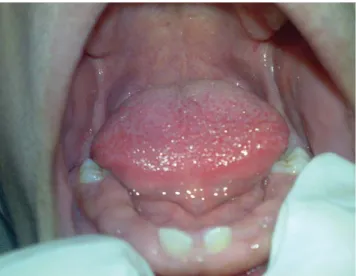
Clinical examination revealed multiple missing teeth with wide edentulous areas in both jaws except the anter- ior region and the first molar regions, and the covering mucosa was normal. Palpation showed slight obliteration of the buccal vestibule in the posterior region. The erupt- ed teeth showed a normal color and architecture (Fig. 1).
Neither facial asymmetry nor palpable lymph nodes were found on the extra-oral examination.
A panoramic radiograph revealed four pericoronal radi- olucencies related to the four third molar regions. The four lesions demonstrated a well-defined border with a corticat- ed margin, but this was more sharply and clearly detected
Fig. 1. Intra-oral photograph shows absence of multiple teeth in the mandible.
Fig. 2.Panoramic radiograph shows four pericoronal radiolucencies re- lated to unerupted third molars as well as multiple impacted teeth with delayed development.
Fig. 3.A. Axial T2-weighted magnetic resonance (MR) image shows bilateral pericoronal lesions with a slightly hyper-intense hetero- geneous signal and a black void representing the impacted tooth on the right side as well as the buccal and lingual expansion of the ramus cortices. B. Axial T1-weighted MR image shows bilateral pericoronal lesions with an intermediate signal invaginating the maxillary sinus.
C. Coronal T2-weighted MR image shows bilateral pericoronal lesions with a slightly hyper-intense heterogeneous signal with the invagination of both maxillary sinuses.
A B C
in the mandibular lesions; the border of the lesions was not related to the cement-enamel junction of the related molars.
The panoramic radiograph also revealed several impacted teeth with delayed development considering the patient’s age (Fig. 2).
Magnetic resonance imaging (MRI) showed a homogen- ous intermediate signal intensity on the T1-weighted images and a heterogeneous slightly hyper-intense signal intensity on the T2-weighted images for the four lesions. Buccal and lingual cortical expansion could be detected with the mandibular lesions. Meanwhile, the maxillary lesions rev-
ealed invagination of the maxillary sinus (Fig. 3).
Dynamic MRI revealed a strong heterogeneous enhance- ment of the lesions. Time-intensity curves revealed rapid early enhancement followed by gradual enhancement and then, a slow and delayed washout (Fig. 4). Upon a diffu- sion MRI, the apparent diffusion coefficient (ADC) map revealed a low-to-intermediate heterogeneous signal, which indicates partially restricted diffusion.
Surgical removal of the four lesions was performed under general anesthesia. A histological examination revealed relatively hypocellular tumor tissues formed of spindle and
Fig. 4.A. Axial colored relative enhancement map of magnetic resonance imaging (MRI) shows a strong heterogeneous enhancement of the mandibular lesions. B. Time-intensity curves of both mandibular lesions show the same behavior: a rapid initial rise in the first few seconds that continues at a relatively slow rate to reach its maximum enhancement at 360 s. Then, it shows a gradual washout in the delayed phase (10 min) and another at a relatively slow rate in the super-delayed phase (15 min).
A B
Fig. 5.Microphotographs show (A) a hypocellular tumor with a focally collagenous background (hematoxylin and eosin (H&E) stain, 10
×) and (B) spindle and stellate cells with bland nuclear features arranged in a myxoid background (H&E stain, 40×).
A B
2200
2000
1800
1600
1400
1200 S
0 60 120 180 240 300 360 420 480 540 600 660 720 780 840 900 960 S.
stellate cells within a predominantly collagenous, focally myxoid background with intervening thin-walled vessels.
The final diagnosis of the four lesions was fibromyxoma (Fig. 5).
Discussion
Although fibromyxoma is widely defined as a benign locally aggressive odontogenic tumor of the mesenchymal origin, but the nature of fibromyxoma is controversial.
WHO Classification 2005 reported it as an equivalent term to odontogenic myxoma; at the same time, some authors have claimed that fibromyxoma is a subtype of odonto- genic myxoma and comprises only a small percentage of it,13,16while others have suggested that it was more related to odontogenic fibroma.17
The obvious issue is that fibromyxoma contains more fibers than odontogenic myxoma;18however, the sequence of formation, whether it represents a myxomatous degen- eration of odontogenic fibroma5or collagen fiber produc- tion in odontogenic myxoma by fibroblast-like secretory cells,12,19is unclear.20
Pericoronal radiolucent lesions are common in the man- dible as well as the maxilla, and their differential diagnosis list includes dentigerous cyst, ameloblastoma, ameloblas- tic fibroma, keratocystic odontogenic tumor, adenomatoid odontogenic tumor, Pindborg tumor, and calcifying cystic odontogenic tumor. Odontogenic myxoma and odontogenic fibroma were recorded as rarities in pericoronal radiolu- cencies.21-24
Panoramic radiography was the way to discover the occult pericoronal lesions in the present case as well as the determination of their extension, shape and periphery, size, number, and effects on surrounding structures.25Although the information acquired from the panoramic radiograph about the internal structure of the lesions that revealed a lack of calcifications and presence of impacted teeth inside was crucial, it could not provide evidence of the nature of the tissues composing these space-occupying lesions.
Aspiration aids in narrowing the differential diagnosis of pericoronal radiolucencies, but in some cases, aspiration may be impossible, particularly in inaccessible areas like the ramus of the mandible and the posterior region of the maxilla. Due to the superior contrast resolution of MRI, the detection of the solid or cystic nature of intra-bony lesions is possible. Unlike aspiration, MRI can reveal the solid or cystic composition in any part of the lesion and in the inaccessible areas.
MRI as a cross-sectional modality provides the chance to reveal the extension of the lesion in the orthogonal planes or any oblique planes as well as the effects on the surround- ing structures. Furthermore, it can reveal the internal struc- ture of the lesion; the intensity of the signal in the T1 and T2 spin echo images as well as the lack of peripheral en- hancement in the dynamic MRI indicate that the lesion is not cystic in nature.
The intermediate and hyper-intense signals revealed by the T1 and T2 images, respectively, are similar to those of previous studies that performed MRI for odontogenic my- xoma.26-28 In contrast to our findings, a study performed by Kawai et al in 199729revealed an intermediate signal on the T2 images of odontogenic myxoma. This disagree- ment might be attributed to variations in the contents of the lesion, such as the ratio of fibrous to myxoid tissues, viscosity, protein concentration, hemorrhage, or hypocel- lularity.13
The results of dynamic MRI are in agreement with those of previous studies that used a contrast agent for the assess- ment of odontogenic myxoma cases regarding the pattern of enhancement.27,28 Our results are also quite similar to those of Asaumi et al in 200230 in that the current study and Asaumi et al showed a strong gradual enhancement followed by a slow washout, but at the same time, there are some differences between them where the current case showed rapid enhancement in the first few seconds before the gradual enhancement as well as the earlier washout de- monstrated in our case. The heterogeneous appearances shown on the T2 images and the dynamic MRI indicate that the lesions were composed of more than one type of tissue, which was confirmed by the histopathological exa- mination, and the partial restriction observed in the diffu- sion weighted images might refer to the fibrous compo- nents of the lesions.
To the best of our knowledge, no cases of multiple fibro- myxomas of the jaws have been reported in the literature;
only solitary cases have been reported. Multiple odonto- genic fibromas are also extremely rare; only a few cases have been reported in the literature, and most of these were associated with enamel dysplasia and hypodontia.20,31,32
In conclusion, more cases and studies are needed to dis- cover and document such unusual cases of multiple fibro- myxomas related to the impacted teeth in the mandible and the maxilla as well as correlating this condition to the pres- ence of multiple impacted teeth and delayed tooth develop- ment.
References
1. Neville BW. Oral and maxillofacial pathology. 3rd ed. St. Lo- uis: Saunders; 2009.
2. Sivakumar G, Kavitha B, Saraswathi T, Sivapathasundharam B. Odontogenic myxoma of maxilla. Indian J Dent Res 2008;
19: 62-5.
3. Shah A, Lone P, Latoo S, Ahmed I, Malik A, Hassan S, et al.
Odontogenic myxoma of the maxilla: a report of a rare case and review on histogenetic and diagnostic concepts. Natl J Maxil- lofac Surg 2011; 2: 189-95.
4. Wawro NW, Reed J. Fibromyxoma of the mandible: report of two cases. Ann Surg 1950; 132: 1138-43.
5. Allen PS. Fibromyxoma of the mandible: case report and radio- graphic considerations. J Am Dent Assoc 1980; 101: 930-1.
6. Abiose BO, Ajagbe HA, Thomas O. Fibromyxomas of the jaw- bones - a study of ten cases. Br J Oral Maxillofac Surg 1987;
25: 415-21.
7. Cervellini P, Crescenzi A, Di Zitti P. Mandibular fibromyxo- ma. Pathologica 1993; 85: 569-72.
8. Piesold J, Meerbach W. Odontogenic fibromyxoma of the man- dible. Mund Kiefer Gesichtschir 1998; 2: 44-7.
9. Mishra A, Bhatia N, Shukla GK. Fibromyxoma maxilla. Indian J Otolaryngol Head Neck Surg 2004; 56: 293-5.
10. Berry S, Puri R. Fibromyxoma of the maxilla. Otolaryngol Head Neck Surg 2006; 135: 330-1.
11. Shahoon H, Esmaeili M, Nikhalat M, Farokhi E. Odontogenic fibromyxoma and odontogenic cyst in an eight year old boy:
three-year follow-up. J Dent Res Dent Clin Dent Prospects 2009; 3: 103-5.
12. Singaraju S, Wanjari SP, Parwani RN. Odontogenic myxoma of the maxilla: a report of a rare case and review of the litera- ture. J Oral Maxillofac Pathol 2010; 14: 19-23.
13. Dietrich EM, Papaemmanouil S, Koloutsos G, Antoniades H, Antoniades K. Odontogenic fibromyxoma of the maxilla: a case report and review of the literature. Case Rep Med 2011;
2011: 238712.
14. Reddy GS, Kumar BS, Muppa R, Regonda SK, Tvs HK. Odon- togenic fibromyxoma of maxilla: a rare case report. Case Rep Dent 2013; 2013: 345479.
15. Manne RK, Kumar VS, Venkata Sarath P, Anumula L, Mundlapudi S, Tanikonda R. Odontogenic myxoma of the mandible. Case Rep Dent 2012; 2012: 214704
16. Mosqueda-Taylor A, Ledesma-Montes C, Caballero-Sandoval S, Portilla-Robertson J, Ruíz-Godoy Rivera LM, Meneses- García A. Odontogenic tumors in Mexico: a collaborative re- trospective study of 349 cases. Oral Surg Oral Med Oral Path- ol Oral Radiol Endod 1997; 84: 672-5.
17. Martínez-Mata G, Mosqueda-Taylor A, Carlos-Bregni R, de Almeida OP, Contreras-Vidaurre E, Vargas PA, et al. Odonto-
genic myxoma: clinico-pathological, immunohistochemical and ultrastructural findings of a multicentric series. Oral Oncol 2008; 44: 601-7.
18. Keszler A, Dominguez FV, Giannunzio G. Myxoma in child- hood: an analysis of 10 cases. J Oral Maxillofac Surg 1995; 53:
518-21.
19. Raubenheimer EJ, Noffke CE. Central odontogenic fibroma- like tumors, hypodontia, and enamel dysplasia: review of the literature and report of a case. Oral Surg Oral Med Oral Pathol Oral Radiol Endod 2002; 94: 74-7.
20. Mosqueda-Taylor A. New findings and controversies in odonto- genic tumors. Med Oral Patol Oral Cir Bucal 2008; 13: E555- 8.
21. Sadeghi EM, Sewall SR, Dohse A, Novak TS. Odontogenic tumors that mimic a dentigerous cyst. Compend Contin Educ Dent 1995; 16: 500-4.
22. Wood NK, Gauze PW. Differential diagnosis of oral and maxil- lofacial lesions. 5th ed. St. Louis: Mosby; 1997. p. 279-94.
23. Thunthy KH. Differential diagnosis of pericoronal radiolucenc- ies with and without radiopacities. Gen Dent 1999; 47: 182-6.
24. Miller CS, Bean LR. Pericoronal radiolucencies with and with- out radiopacities. Dent Clin North Am 1994; 38: 51-61.
25. DelBalso AM, Hall RE. Advances in maxillofacial imaging.
Curr Probl Diagn Radiol 1993; 22: 91-142.
26. Sumi Y, Miyaishi O, Ito K, Ueda M. Magnetic resonance imag- ing of myxoma in the mandible: a case report. Oral Surg Oral Med Oral Pathol Oral Radiol Endod 2000; 90: 671-6.
27. Asaumi J, Konouchi H, Hisatomi M, Kishi K. Odontogenic myxoma of maxillary sinus: CT and MR-pathologic correla- tion, Eur J Radiol 2001; 37: 1-4.
28. Aquilino RN, Tuji FM, Eid NL, Molina OF, Joo HY, Haiter Neto F. Odontogenic myxoma in the maxilla: a case report and characteristics on CT and MR. Oral Oncol Extra 2006; 42: 133- 6.
29. Kawai T, Murakami S, Nishiyama H, Kishino M, Sakuda M, Fuchihata H. Diagnostic imaging for a case of maxillary myxo- ma with a review of the magnetic resonance images of myxoid lesions. Oral Surg Oral Med Oral Pathol Oral Radiol Endod 1997; 84: 449-54.
30. Asaumi J, Matsuzaki H, Hisatomi M, Konouchi H, Shigehara H, Kishi K. Application of dynamic MRI to differentiating odontogenic myxomas from ameloblastomas. Eur J Radiol 2002; 43: 37-41.
31. Feller L, Jadwat Y, Bouckaert M, Buskin A, Raubenheimer EJ.
Enamel dysplasia with odontogenic fibroma-like hamartomas:
review of the literature and report of a case. Oral Surg Oral Med Oral Pathol Oral Radiol Endod 2006; 101: 620-4.
32. Feller L, Wood NH, Anagnostopoulos C, Bouckaert M, Rau- benheimer EJ, Kramer B, et al. Enamel dysplasia with hamar- tomatous atypical follicular hyperplasia: review of the literature and report of a case. SADJ 2008; 63: 96-101.