Korean J Gastroenterol Vol. 60 No. 2, 109-112 http://dx.doi.org/10.4166/kjg.2012.60.2.109
CASE REPORT
Korean J Gastroenterol, Vol. 60 No. 2, August 2012 www.kjg.or.kr
보툴리눔 독소 주입 후 증상 호전을 보인 미만성 식도 경련
한재필, 홍수진, 김훈일, 변진명, 김화종, 고봉민, 이준성, 이문성
순천향대학교 의과대학 부천병원 내과학교실
Symptomatic Improvement of Diffuse Esophageal Spasm after Botulinum Toxin Injection
Jae Pil Han, Su Jin Hong, Hoon Il Kim, Jin Myung Byun, Hwa Jong Kim, Bong Min Ko, Joon Seong Lee and Moon Sung Lee Department of Internal Medicine, Bucheon Hospital, Soonchunhyang University College of Medicine, Bucheon, Korea
Diffuse esophageal spasm, an uncommon esophageal motility disorder, has recently been defined using high-resolution manometry. Patients with distal esophageal spasm usually complain of chest pain or dysphagia. The etiology and pathophysiology of this disorder are poorly known, and treatment options are limited. However, some options to improve symptoms are available, including endoscopic injection of botulinum toxin. Nevertheless, few reports have described the effects of endoscopic injection of botulinum toxin in patients with symptomatic diffuse esophageal spasm with clear endoscopic and high-resolution manometry images. Here, we report a case of diffuse esophageal spasm diagnosed with high-resolution manometry and treated by endoscopic injection of botulinum toxin with good results at the 7-month follow-up. (Korean J Gastroenterol 2012;60:109-112) Key Words: Diffuse esophageal spasm; Botulinum toxins; Manometry
Received May 6, 2011. Revised July 1, 2011. Accepted July 2, 2011.
CC This is an open access article distributed under the terms of the Creative Commons Attribution Non-Commercial License (http://creativecommons.org/licenses/
by-nc/3.0) which permits unrestricted non-commercial use, distribution, and reproduction in any medium, provided the original work is properly cited.
교신저자: 홍수진, 420-767, 부천시 원미구 조마루로 170, 순천향대학교 의과대학 부천병원 내과학교실
Correspondence to: Su Jin Hong, Department of Internal Medicine, Bucheon Hospital, Soonchunhyang University College of Medicine, 170 Jomaru-ro, Wonmi-gu, Bucheon 420-767, Korea. Tel: +82-32-621-5087, Fax: +82-32-621-5080, E-mail: [email protected]
Financial support: None. Conflict of interest: None.
INTRODUCTION
Esophageal spasm (ES) is a rare esophageal motility dis- order characterized by simultaneous esophageal con- traction with intermittent peristalsis on conventional mano- metry.1 Although the pathophysiology and etiology remain uncertain, the suggested pathophysiology of ES includes cholinergic, nitregic, and reflux mechanisms.2 Patients with ES usually complain of dysphagia or chest pain, which are dif- ficult to distinguish from angina pectoris. Many trials have re- ported the efficacy of pharmacological, endoscopic, and sur- gical therapies. Recent studies suggest a benefit of injecting botulinum toxin in the diffuse esophagus for treating sympto- matic ES.3 We report a case of a 69-year-old woman with manometrically proven symptomatic ES treated with intra-
muscular injection of botulinum toxin.
CASE REPORT
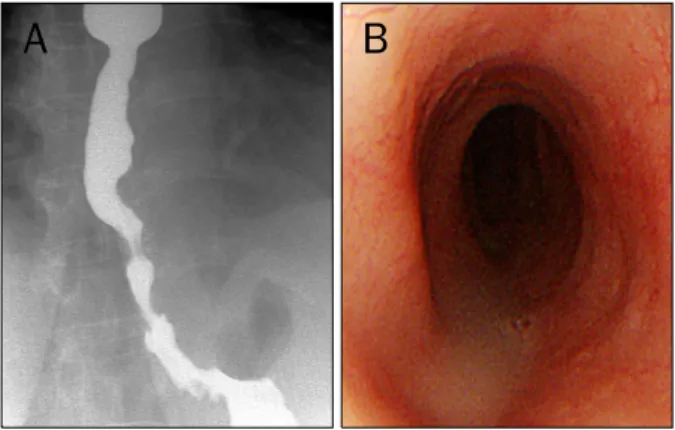
A 69-year-old woman with dysphagia and excessive vomit- ing was admitted to our hospital. She felt chest discomfort while swallowing solid or liquid food for several months. She was taking antihypertensive medicine and had a history of bronchial asthma. Radiographic examinations were done to rule out underlying diseases. There was no active lesion in her chest x-ray or on chest CT. The esophagogram showed re- petitive, multifocal, and simultaneous contractions in the esophageal body (Fig. 1A). She had no evidence of cardiac disease on electrocardiography. Esophagogastroduodeno- scopy showed strong, repetitive contractions in the lower
110 한재필 등. 보툴리눔 독소 주입 후 증상 호전을 보인 미만성 식도 경련
The Korean Journal of Gastroenterology Fig. 1. (A) The initial esophagogram showed repetitive, multifocal,
and simultaneous contraction in the esophageal body. (B) Initial esophagoscopy showed much impacted food in the esophageal lumen, which was not dilated fully during the observations. There was no stricture in the esophageal body or at the esophagogastric junction.
Fig. 2. High-resolution manometry showed rapid contractile front velocity (CFV) attributed to spasm (12 cm/sec) throughout the distal esophageal segments.
Fig. 3. (A) The esophagogram 3 months after botulinum toxin injection showed decreased tertiary movement in the distal esophageal segments and smooth passage of barium through the distal esophagus and gastroesophageal junction without stasis. (B) Follow-up esophagoscopy 14 days after botulinum toxin injection showed no food in the esophageal lumen. The esophageal lumen was relatively dilated compared with before treatment.
esophagus and much food in the esophageal lumen (Fig. 1B).
No obstructive lesion was detected in the esophagus on endoscopy. High-resolution manometry (HRM, ManoScan ver. 2.0.1; Sierra Scientific Instruments, Los Angeles, CA, USA) with 36 solid-state sensors spaced at 1-cm intervals was performed to assess the esophageal motility. This showed swallows with rapid contractile front velocity (CFV) at- tributable to spasm. Five of ten swallows revealed rapid CFV, which corresponded to diffuse ES (DES). In addition, the swallows frequently showed high amplitude in the esoph-
ageal body. On HRM, the lower esophageal sphincter (LES) was relaxed following swallows (Fig. 2). The patient was diag- nosed with DES based on the clinical symptoms and radio- logical and manometric findings. We injected botulinum toxin endoscopically to treat her symptoms. Botulinum toxin 100 IU (BotoxⓇ; Allergan Korea Ltd., Seoul, Korea) was diluted in 10 mL of normal saline (NaCl 0.9%) and injected in the con- traction ring of the lower esophagus at ten levels at 10-mm intervals. The next day, her DES symptoms were reduced sub- stantially, and the patient could swallow liquid and solid food.
Subsequently, the patient has not complained of severe symptoms caused by DES. Her clinical symptoms (chest pain, dysphagia, and regurgitation) were measured before and af- ter treatment using an analogue scale (0=no symptoms, 1=occasional, 2=daily, 3=constant). The total symptom score improved from 8 before treatment to 3 (1 each for chest pain, dysphasia, and regurgitation) after 7 days. The patient was discharged without complications. Follow-up esophago- scopy 14 days after the botulinum injection did not show food in the esophageal lumen or strong repetitive contractions (Fig. 3B). After 3 months, the follow-up esophagogram showed significantly decreased tertiary contractions in the mid to distal esophagus, and contrast passed through the gastroesophageal junction smoothly without stasis (Fig. 3A).
The clinical response was maintained for over 7 months with an improved total symptom score.
Han JP, et al. Symptomatic Improvement of Diffuse Esophageal Spasm after Botulinum Toxin Injection 111
Vol. 60 No. 2, August 2012
DISCUSSION
DES is a rare esophageal motility disorder found in pa- tients with unexplained chest pain or dysphagia, accounting for about 3% of the motility abnormalities seen in such patients.1 In Korea, DES is diagnosed in 0.9-2.2% of the pa- tients with esophageal symptoms.4,5 Chest pain (46-47%) and dysphagia (27-41%) are the primary presenting symp- toms in this population.6 Some patients complain of globus (9-11%), acid regurgitation (9%), and indigestion (9%).7 Non-cardiac chest pain is often difficult to differentiate from cardiac angina, but the chest pain caused by the esophagus is non-radiating, is relieved by swallowing water, and is trig- gered by swallowing a large amount of solid or liquid food.
Although the mechanisms of non-cardiac chest pain are un- certain, some have been suggested, including the presence of acid reflux, esophageal motility abnormalities, and viscer- al hypersensitivity.8,9 Dysphagia for both liquid and solids oc- curs intermittently and is rarely progressive. The degree of dysphagia varies, and it is not always accompanied by chest pain. In this case, the patient’s chief complaints were dyspha- gia, vomiting, and non-cardiac chest pain.
The pathogenesis of DES is unclear, but studies suggest altered endogenous nitric oxide (NO) synthesis or degra- dation.2 Many animal and human studies have suggested that NO plays an important role in maintaining esophageal peristalsis. Based on this mechanism, there are reports on the effects of nitroglycerine and long-acting nitrates in pa- tients with DES.10
Contrast esophagography in DES patients may reveal de- layed passage or a “cork screw” appearance due to prom- inent tertiary waves, but these are non-specific. Esophageal manometry is considered the gold standard for diagnosing DES, and the hallmark is simultaneous contractions (>20%
wet swallows) with intermittent peristalsis. Other abnormal manometric findings include repetitive contraction (>3 peaks), prolonged contraction, retrograde contraction, and isolated incomplete LES relaxation.7,11,12 Conventional man- ometry has some limitations for assessing esophageal motility. HRM with 36 solid-state sensors spaced at 1-cm in- tervals has several advantages over conventional man- ometry and is used widely. The Chicago classification was de- veloped to analyze esophageal motility using HRM data for 75 control subjects and 400 consecutive patients.12,13 This
classification has been modified as the Chicago classi- fication (c 2/2009) of distal esophageal motility disorders to improve its clinical usefulness and accuracy. The HRM Classification Working Group proposed an analysis algorithm using pressure topography parameters. First, patients are characterized by esophagogastric junction (EGJ) pressure morphology (presence of hiatus hernia) and the presence or absence of impaired deglutitive EGJ relaxation. Second, each swallow is further categorized by the characteristics of the distal esophageal contraction. Finally, the results of HRM are interpreted using the Chicago classification of distal esophageal motility disorders.14 DES has normal EGJ relaxa- tion (a mean integrated relaxation pressure [IRP] <15 mmHg) and normal intrabolus pressure (IBP), and it is char- acterized by spasm (CFV >8 cm/sec) in ≥20% of swallows.
Although this new methodology is useful for evaluating esophageal motor function, more studies are required to re- fine the diagnostic criteria and resolve uncertain issues. In our case, the 69-year- old woman was diagnosed with DES based on her clinical symptoms and radiological and HRM findings.
Therapy for symptomatic DES has included medical ap- proaches and surgical intervention. As acid reflux has been suggested as the mechanism of esophageal contractions, empirical trial with proton pump inhibitor (PPI) can be recom- mended initially. Agents such as anticholinergics, nitrates, calcium channel blockers, and antidepressants can be used for patients with inadequate response to PPI.15,16 Although medical treatment can reduce the symptoms of DES, there have been no large double-blind trials of these agents. Other methods of treating DES, including pneumatic dilatation and surgical myotomy, have been used in patients with severe DES.17,18 However, these interventions have a relatively high risk of complications, such as esophageal perforation.17 Endoscopic injection of botulinum toxin into the LES is effec- tive in the treatment of achalasia.19 This method also showed good results in patients with severe DES. The symptoms in DES patients, which resist medical treatment, improved sig- nificantly after the endoscopic injection of botulinum toxin in- to the esophageal muscle, and the clinical response per- sisted for at least 6 to 12 months. Some patients with re- lapsed symptoms underwent repeated injection of botu- linum toxin and were successfully retreated.3 No further side effects have been reported in patients with achalasia or DES
112 한재필 등. 보툴리눔 독소 주입 후 증상 호전을 보인 미만성 식도 경련
The Korean Journal of Gastroenterology
treated with botulinum toxin injection.20 In the present case, we injected botulinum toxin endoscopically to treat sympto- matic DES. After the injection, the esophageal symptoms were relieved, and the clinical response continued for over 7 months without repeated injection of botulinum.
REFERENCES
1. Dalton CB, Castell DO, Hewson EG, Wu WC, Richter JE. Diffuse esophageal spasm. A rare motility disorder not characterized by high-amplitude contractions. Dig Dis Sci 1991;36:1025-1028.
2. Konturek JW, Thor P, Lukaszyk A, Gabryelewicz A, Konturek SJ, Domschke W. Endogenous nitric oxide in the control of esoph- ageal motility in humans. J Physiol Pharmacol 1997;48:201- 209.
3. Storr M, Allescher HD, Rösch T, Born P, Weigert N, Classen M.
Treatment of symptomatic diffuse esophageal spasm by endo- scopic injections of botulinum toxin: a prospective study with long-term follow-up. Gastrointest Endosc 2001;54:754-759.
4. Song CS, Seong EY, Kim GH, et al. The incidence of esophageal disease in patients with Non-Cardiac chest pain. Korean J Gastroenterol 1997;30:141-147.
5. Kim DW, Jung YS, Choi P, et al. Esophageal manometric findings of 1,746 patients with esophageal symptoms. Korean J Gastro- intest Motil 2003;9:18-24.
6. Hong SJ. A 47-year-old woman with Dysphagia and food getting stuck: what is your impression? J Neurogastroenterol Motil 2010;16:440-441.
7. Choi KW, Paik SW, Rhee JC, et al. Clinical characteristics of dif- fuse esophageal spasm. Korean J Gastroenterol 1998;31:717- 723.
8. Siegel CI, Hendrix TR. Esophageal motor abnormalities induced by acid perfusion in patients with heartburn. J Clin Invest 1963;
42:686-695.
9. Clouse RE, Eckert TC. Gastrointestinal symptoms of patients
with esophageal contraction abnormalities. Dig Dis Sci 1986;
31:236-240.
10. Orlando RC, Bozymski EM. Clinical and manometric effects of ni- troglycerin in diffuse esophageal spasm. N Engl J Med 1973;
289:23-25.
11. Kim YK, Kang YW. Clinical and manometric findings of diffuse esophageal spasm. Korean J Med 1995;49:598-603.
12. Pandolfino JE, Ghosh SK, Rice J, Clarke JO, Kwiatek MA, Kahrilas PJ. Classifying esophageal motility by pressure topography char- acteristics: a study of 400 patients and 75 controls. Am J Gastroenterol 2008;103:27-37.
13. Kahrilas PJ, Ghosh SK, Pandolfino JE. Esophageal motility dis- orders in terms of pressure topography: the Chicago Classi- fication. J Clin Gastroenterol 2008;42:627-635.
14. Pandolfino JE, Fox MR, Bredenoord AJ, Kahrilas PJ. High-reso- lution manometry in clinical practice: utilizing pressure top- ography to classify oesophageal motility abnormalities. Neuro- gastroenterol Motil 2009;21:796-806.
15. Grübel C, Borovicka J, Schwizer W, Fox M, Hebbard G. Diffuse esophageal spasm. Am J Gastroenterol 2008;103:450-457.
16. Tutuian R, Castell DO. Review article: oesophageal spasm - diag- nosis and management. Aliment Pharmacol Ther 2006;23:
1393-1402.
17. Ebert EC, Ouyang A, Wright SH, Cohen S, Lipshutz WH. Pneumat- ic dilatation in patients with symptomatic diffuse esophageal spasm and lower esophageal sphincter dysfunction. Dig Dis Sci 1983;28:481-485.
18. París F, Guijarro R, Blasco E, et al. Long term results of surgery in diffuse, idiopathic, symptomatic esophageal spasm. Rev Esp Enferm Apar Dig 1984;66:497-507.
19. Fishman VM, Parkman HP, Schiano TD, et al. Symptomatic im- provement in achalasia after botulinum toxin injection of the lower esophageal sphincter. Am J Gastroenterol 1996;91:1724- 1730.
20. Pasricha PJ, Ravich WJ, Hendrix TR, Sostre S, Jones B, Kalloo AN.
Intrasphincteric botulinum toxin for the treatment of achalasia.
N Engl J Med 1995;332:774-778.