Lab Anim Res 2018: 34(2), 65-74 https://doi.org/10.5625/lar.2018.34.2.65
Effects of dietary lipid-coated zinc on the antioxidant defense system in the small intestine and liver of piglets
Ha-Na Kim
1, Dong-Gyung Jeon
1, Chul Young Lee
2,3, In-Surk Jang
1,3,*
1
Department of Animal Science and Biotechnology, Gyeongnam National University of Science and Technology, Jinju, Korea
2
Department of Animal Resources Technology, Gyeongnam National University of Science and Technology, Jinju, Korea
3
Regional Animal Research Center, Gyeongnam National University of Science and Technology, Jinju, Korea
The purpose of the study was to investigate the effects of lipid-coated ZnO (LCZ) and the level of LCZ compared with ordinary zinc oxide (ZnO) on antioxidant defense system in the intestine and liver of piglets. A total of forty piglets (n=8) were fed a diet supplemented with 100 ppm Zn with ZnO (ZnO-1), 2,500 ppm Zn with ZnO (ZnO-2), 100 ppm Zn as LCZ (LCZ-1), 200 ppm Zn as LCZ (LCZ-2), or 400 ppm Zn as LCZ (LCZ-3) for 14-d, respectively. The LCZ-3 group resulted in higher (P<0.05) mRNA expressions and activities of CuZn-superoxide dismutase (SOD), glutathione peroxidase (GPX), catalase (CAT), and glutathione S-transferase (GST) in jejunal mucosa compared with the ZnO-1 and LCZ-1 groups, while no difference was observed in the mRNA level of antioxidant genes between the ZnO-1 and ZnO-2 groups.
Within the LCZ groups, the LCZ level linearly and quadratically (P<0.01) increased antioxidant enzymes in the jejunum. The maximum response of jejunal antioxidant enzymes to Zn supplementation was achieved by 400 ppm of LCZ. Hepatic mRNA expression of antioxidant enzymes was unaffected by Zn source and level, while hepatic SOD and GST activities were greater ( P<0.05) in the LCZ-3 group than in the ZnO-1 group. No difference was observed in lipid peroxidation of the jejunum and liver and the total antioxidant power of plasma among groups. In conclusion, a supplementation with 400 ppm of LCZ resulted in a maximum increase in antioxidant enzymes, indicating that LCZ may affect antioxidant defense system more profoundly than ZnO.
Keywords: Piglets, lipid-coated Zn, antioxidant enzymes, intestine, liver
Received 5 April 2018; Revised version received 2 May 2018; Accepted 4 May 2018
Zinc (Zn) is an essential trace mineral, which is involved in various biological functions of animals. The supplemental Zn to pig diet is an indispensable nutrient which is required for growth and the activity of metabolic and enzymatic functions [1,2]. In particular, Zn is recognized not only as a cell mediated immune modulator but also as an antioxidant for the prevention of biological oxidation [3]. More recently, dietary Zn is known to exert an important role in antioxidant defense system against oxidative stress induced by infection, heat stress, disease and pollutants [4-7]. The role of Zn as a nutrient is thought to act as a biological antioxidant
by protecting lipids in membranes against oxygen radicals and subsequently maintaining body homeostasis under stressful circumstances of animal production [3].
The beneficial effects of supplemental Zn on the antioxidant capacity seem to be mainly associated with its ability to synthesize CuZn-SOD and metallothionein that act as free radical scavengers [8,9]. It has been demonstrated that dietary supplemental Zn activates CuZn-SOD expression and metallothionein content in the liver of piglets [2]. Thus, antioxidant minerals including Zn and selenium are widely used as feed additives due to their potential and beneficial effects on
*Corresponding author: Jang, In-Surk, Animal Science and Biotechnology, Gyeongnam National University of Science and Technology, Jinju 52725, Korea
Tel: +82-55-751-3236; Fax: +82-55-751-3267; E-mail: [email protected]
This is an Open Access article distributed under the terms of the Creative Commons Attribution Non-Commercial License (http://creativecommons.org/licenses/
by-nc/3.0) which permits unrestricted non-commercial use, distribution, and reproduction in any medium, provided the original work is properly cited.
animal health. The supplemental Zn to pig diet has been documented to increase growth performance by the activation of immunity, digestive enzymes, antioxidant capacity, and favorable gastrointestinal microbes [10- 13]. So far, a pharmacological dose of supplemental Zn up to 4,000 ppm has been commonly used for the prevention of post-weaning diseases including diarrhea in piglets [14]. The most common sources used in animal diets are inorganic zinc oxide (ZnO) and Zinc sulfate (ZnSO
4) as dietary supplemental Zn [15]. Such a pharmacologically high dose of inorganic Zn supplement, however, usually results in a very low bioavailability and subsequently could give rise to the environmental pollution of heavy metal, since up to 75 to 90% of supplemental ZnO is not absorbed [15,16].
The development of high bioavailable Zn additives that are effective at a dosage lower than the pharmacological ZnO is necessary for a reduction of a dietary supplemental Zn level. Encapsulated Zn is a lipid-coated ZnO (LCZ) product, which is designed to maximize the absorption of the Zn to the small intestine without being ionized in the stomach due to the lipid protection. Our previous studies implied that a dietary supplement of 72 ppm of Zn with lipid-coated Zn was comparable to 2,000 ppm Zn as the chemical form of ZnO in its effects on alleviated diarrhea and improved intestinal villus structure in weaned piglets [17-20]. However, whether LCZ as a Zn supplement could affect antioxidant defense system in the small intestine and liver of piglets has not been extensively investigated, although the antioxidant functions of Zn have been documented. Zn is known to be an essential element for immunity and health in the gastrointestinal tract and liver, which play a central role in coordinating dietary supplemented Zn [5,21,22]. It has also been reported that adequate Zn ingestion activated total microsomal cytochrome P450 activity in the liver of rats, which is responsible for the xenobiotic metabolism [23].
Therefore, the present study is one of the first attempts to investigate the effects of dietary LCZ and the level of LCZ compared with those of ordinary ZnO on the antioxidant defense system in the small intestine and liver of piglets.
Materials and Methods
Animal husbandry and experimental designs
The protocols of this experiment were approved by the
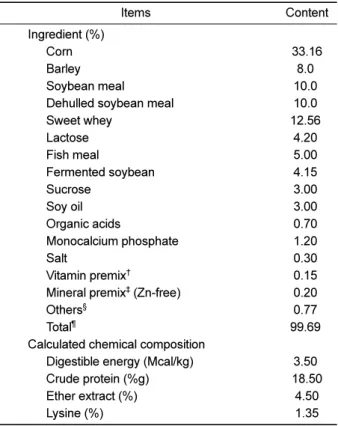
Institutional Animal Care and Use Committee (GNUST IACUC, 2016-04) of Gyeongnam National University of Science and Technology. A total of forty 22-d castrated piglets (average BW, 5.51±0.21 kg) born to Duroc-sired Yorkshire×Landrace dams were randomly divided into five dietary groups, with eight replicates of animals, immediately after weaning at 21-d of age. The piglets were fed a diet supplemented with 100 ppm Zn as ZnO (ZnO-1), 2,500 ppm as ZnO (ZnO-2), 100 ppm Zn as 10% (w/w) lipid-coated ZnO (LCZ-1, CTCBIO Inc., Seoul, Korea), 200 ppm Zn as LCZ (LCZ-2), or 400 ppm Zn as LCZ (LCZ-3), respectively. The basal corn- soybean meal diet was formulated to meet the NRC requirement of all nutrients (NRC, 2012, Table 1), and all animals were allowed ad libitum access to one of the five experimental diets and water for 2 weeks. The body
Table 1. The formulation and nutrient levels of the basal diets (as-fed basis)
Items Content
Ingredient (%)
Corn 33.16
Barley 8.0
Soybean meal 10.0
Dehulled soybean meal 10.0
Sweet whey 12.56
Lactose 4.20
Fish meal 5.00
Fermented soybean 4.15
Sucrose 3.00
Soy oil 3.00
Organic acids 0.70
Monocalcium phosphate 1.20
Salt 0.30
Vitamin premix
†0.15
Mineral premix
‡(Zn-free) 0.20
Others
§0.77
Total
¶99.69
Calculated chemical composition
Digestible energy (Mcal/kg) 3.50
Crude protein (%g) 18.50
Ether extract (%) 4.50
Lysine (%) 1.35
†