• 검색 결과가 없습니다.

Is Multi-Drug Resistant Tuberculosis More Prevalent in HIV-Infected Patients in Korea?

N/A
N/A
Protected

Academic year: 2022

Share "Is Multi-Drug Resistant Tuberculosis More Prevalent in HIV-Infected Patients in Korea?"

Copied!
3
0
0

로드 중.... (전체 텍스트 보기)

전체 글

(1)

1508 www.eymj.org Multi-drug resistant tuberculosis (MDR-TB) is a widespread

public health problem and major challenge for tuberculosis (TB) control programs.

1

The prevalence of human immunode- ficiency virus (HIV) is strongly correlated with an increased incidence of TB, and co-infection with HIV presents another challenge in TB control.

1,2

Co-infection with HIV can acceler- ate the progression of TB prior to anti-TB medication, thus MDR-TB can be a higher risk factor for death in HIV-infected patients.

3,4

The relationship between the two infections is not yet clearly understood.

5

Previous studies on the association between HIV infection and MDR-TB from different settings and countries have been discordant.

5,6

These findings suggest that epidemio- logical factors such as the burden of HIV or TB infection in a cer-

tain area are important aspects that affect the association be- tween HIV and MDR-TB infection.

Most previous studies have been conducted in areas with high HIV prevalence and low MDR-TB prevalence, whereas some studies have been conducted in low HIV prevalent areas.

Nevertheless, most were conducted in situations with institu- tional outbreaks.

6

It is important to know the MDR-TB rate in HIV/TB co-infected patients, because TB progresses more rap- idly in HIV patients, and the turn-around time of the drug sus- ceptibility test is very long. There are few studies that have ade- quately addressed the MDR-TB burden of HIV-infected patients in an area with low HIV prevalence and intermediate TB bur- den. In South Korea, the prevalence of HIV and TB is low and intermediate (incidence rate of TB: 86/100000 population), re- spectively,

1,7

therefore, evaluated the association between HIV and MDR-TB infection in an area with low HIV prevalence and intermediate TB burden.

To determine the association between HIV and MDR-TB in- fection, a retrospective case-control study was performed. All culture positive and susceptibility reported TB patients aged 18 years and older who visited Pusan National University Hospi- tal from January 2006 to October 2014 were enrolled.

The drug resistance rate, MDR, and extensively drug resis- tant tuberculosis (XDR-TB) rates were compared between the

Is Multi-Drug Resistant Tuberculosis More Prevalent in HIV-Infected Patients in Korea?

Shinwon Lee

1

, Sun Hee Lee

1

, Jeong Ha Mok

1

, Su Jin Lee

2

, Kye-Hyung Kim

1

, Jeong Eun Lee

1

, Seung Geun Lee

1

, Joo Seop Chung

1

, and Ihm Soo Kwak

1

1

Department of Internal Medicine, Pusan National University School of Medicine, Medical Research Institute, Pusan National University Hospital, Busan;

2
Department of Internal Medicine, Pusan National University School of Medicine,

Research Institute for Convergence of Biomedical Science and Technology, Pusan National University Yangsan Hospital, Yangsan, Korea.

The epidemiological synergy between human immunodeficiency virus (HIV) and tuberculosis (TB) is a major threat to public health. However, the association between HIV and multi-drug resistant tuberculosis (MDR-TB) is not clear. To explore the associ- ation between HIV and MDR-TB infection, a case-control study was performed in Korea. A total of 1606 culture-proven TB pa- tients (45 HIV vs. 1561 non-HIV) from January 2006 to October 2014 were included in this analysis. MDR-TB rates were 11.1% and 8.2% in the HIV and non-HIV groups, respectively (p=0.42), thus indicating that MDR-TB was not significantly associated with HIV infection in Korea.

Key Words: MDR, HIV, resistance, intermediate TB burden Yonsei Med J 2016 Nov;57(6):1508-1510

http://dx.doi.org/10.3349/ymj.2016.57.6.1508

Brief Communication

pISSN: 0513-5796 · eISSN: 1976-2437

Received: January 13, 2016 Revised: March 2, 2016 Accepted: March 24, 2016

Corresponding author: Dr. Sun Hee Lee, Department of Internal Medicine, Pu- san National University Hospital, 179 Gudeok-ro, Seo-gu, Busan 49241, Korea.

Tel: 82-51-240-7673, Fax: 82-51-247-3213, E-mail: [email protected]

•The authors have no financial conflicts of interest.

© Copyright: Yonsei University College of Medicine 2016

This is an Open Access article distributed under the terms of the Creative Com- mons Attribution Non-Commercial License (http://creativecommons.org/licenses/

by-nc/3.0) which permits unrestricted non-commercial use, distribution, and repro-

duction in any medium, provided the original work is properly cited.

(2)

1509

http://dx.doi.org/10.3349/ymj.2016.57.6.1508 Shinwon Lee, et al.

HIV-infected and non-HIV-infected groups. MDR-TB was de- fined as in vitro resistance to at least both isoniazid (INH) and rifampin (RIF).

8

XDR-TB was defined as resistance to any fluo- roquinolone and at least one of three second-line injectable drugs (capreomycin, kanamycin, and amikacin) in addition to multidrug resistance.

8

New patients were defined as those who had taken anti-TB drugs for less than 1 month or never been treated for TB. Finally, previously treated patients were defined as those who received 1 month or more of anti-TB drugs in the past.

9

Between January 2006 to October 2014, all patients whose culture test was positive for Mycobacterium tuberculosis and accompanied by an antimicrobial susceptibility report were identified from a microbiology database. Demographic data, history of previous TB treatment, antimicrobial susceptibility, and clinical data were retrospectively reviewed. The Institution- al Review Board at Pusan National University Hospital ap- proved the study protocol (No. E-201 5142).

Data were analyzed using SPSS software, version 18.0 (SPSS Inc. and IBM Company, Chicago, IL, USA). Fisher’s exact test or Pearson χ

2

test was used to compare categorical variables, and continuous variables were compared using Student’s t-test. All tests of significance were two-tailed; p≤0.05 was considered to be statistically significant.

Among 1796 culture-positive and susceptibility reported TB patients, 1606 patients whose previous treatment history of TB was available were included in this analysis. A total of 95.5% of Mycobacterium tuberculosis cultures were performed on pul- monary specimens such as sputum or bronchial aspirates, and 4.5% were performed on extrapulmonary specimens such as tissues or body fluid of various sites. The mean age of included patients was 53.2±18.3 years, and 59.4% were male. One hun- dred and thirty-three patients (8.8%) had MDR-TB, and the

overall mortality of MDR-TB was higher than non-MDR-TB.

Previous treatment history of TB was significantly associated with MDR-TB [odds ratio (OR) 3.79, 95% confidence interval (CI) 2.60–5.52, p<0.01]. Forty-five patients were co-infected with HIV, and 1561 were not. Disseminated TB (HIV group 37.8% vs. non-HIV group 2.0%, p<0.01) and central nervous system involvement (HIV group 11.1% vs. non-HIV group 0.7%, p<0.01) were more prevalent in the HIV group. In the HIV group, 11.1, 13.3, 0, and 6.7% were resistant to RIF, INH, ofloxacin, and aminoglycoside, respectively. The resistance rates were not significantly higher in HIV infected patients.

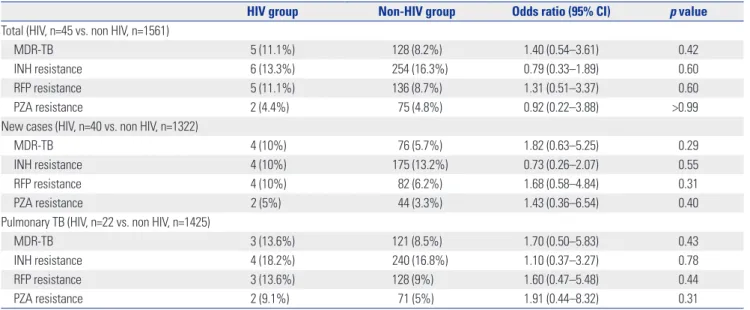
MDR and XDR-TB were 11.1% (5/45) and 0% (0/45) in the HIV group and 8.2% (128/1561) and 1.8% (28/1561) in the non-HIV group, respectively: MDR and XDR-TB were not significantly associated with HIV infection (HIV group vs. non-HIV group, OR 1.40, 95% CI 0.54–3.61, p=0.42). In a subgroup analysis of new patients, MDR-TB was not significantly higher in the HIV group (HIV group vs. non-HIV group OR 1.82, 95% CI 0.63–

5.25, p=0.29) (Table 1).

Our study demonstrated that the rate of MDR-TB in south- east Korea was 11.1%, and it was not significantly associated with HIV infection. In addition, MDR-TB was not associated with HIV infection in a subgroup analysis of new TB patients.

Joh, et al.

10

reported that the MDR-TB prevalence among HIV/

TB co-infected patients was 32.7% at a Korean hospital. How- ever, they did not compare MDR-TB rate of HIV-infected pa- tients with the control group.

10

Therefore, based on the previ- ous study, it is not clear whether MDR-TB rate is more frequent in HIV-infected patients. Furthermore, the previous study was performed at a referral hospital for complicated HIV/AIDS pa- tients,

10

therefore, those patients could have been selectively gathered at that institution. Our study suggests that the MDR- TB burden of HIV-infected patients might be similar to the

Table 1. Comparison of Antimicrobial Resistance and Rate of MDR-TB between HIV and Non-HIV Infected Patients

HIV group Non-HIV group Odds ratio (95% CI) p value

Total (HIV, n=45 vs. non HIV, n=1561)

MDR-TB 5 (11.1%) 128 (8.2%) 1.40 (0.54–3.61) 0.42

INH resistance 6 (13.3%) 254 (16.3%) 0.79 (0.33–1.89) 0.60

RFP resistance 5 (11.1%) 136 (8.7%) 1.31 (0.51–3.37) 0.60

PZA resistance 2 (4.4%) 75 (4.8%) 0.92 (0.22–3.88) >0.99

New cases (HIV, n=40 vs. non HIV, n=1322)

MDR-TB 4 (10%) 76 (5.7%) 1.82 (0.63–5.25) 0.29

INH resistance 4 (10%) 175 (13.2%) 0.73 (0.26–2.07) 0.55

RFP resistance 4 (10%) 82 (6.2%) 1.68 (0.58–4.84) 0.31

PZA resistance 2 (5%) 44 (3.3%) 1.43 (0.36–6.54) 0.40

Pulmonary TB (HIV, n=22 vs. non HIV, n=1425)

MDR-TB 3 (13.6%) 121 (8.5%) 1.70 (0.50–5.83) 0.43

INH resistance 4 (18.2%) 240 (16.8%) 1.10 (0.37–3.27) 0.78

RFP resistance 3 (13.6%) 128 (9%) 1.60 (0.47–5.48) 0.44

PZA resistance 2 (9.1%) 71 (5%) 1.91 (0.44–8.32) 0.31

MDR, multi-drug resistance; TB, tuberculosis; INH, isoniazid; RFP, rifampin; PZA, pyrazinamide; HIV, human immunodeficiency virus.

(3)

http://dx.doi.org/10.3349/ymj.2016.57.6.1508

1510

MDR-TB and HIV in Korea

MDR-TB burden of the general population in areas with low HIV and intermediate TB burden such as South Korea, Japan, Malaysia, Singapore, and Hong Kong.

Busan has the highest incidence of HIV infection and TB in Korea; indeed, our institute has the largest HIV and TB care centers in southeast Korea. A total of 844 HIV-infected patients (about 70% of HIV patients who were notified) in southeast Ko- rea received care at our institute during the study period. This is the first case-control study that compared the MDR-TB rate in HIV-infected patients to that of a control group. Therefore, our finding provides useful epidemiological information regard- ing MDR-TB/HIV co-infection in southeast Korea. Our find- ings could be applied also to all of Korea, although care must be taken when generalizing the finding, because it is a single center study.

MDR-TB was not uncommon among HIV-infected patients in our present study, although the rate was not significantly higher than in the general population. The patients with MDR- TB are more likely to receive inappropriate initial anti-TB treat- ment. Since progression of TB is rapid and fatal, MDR-TB may cause far more devastating consequences in HIV-infected pa- tients. Previous studies have demonstrated that MDR-TB has a worse prognosis in HIV-infected patients than in the general population.

6

Rapid diagnosis of MDR-TB using a new molecu- lar test can reduce time to initiation of MDR-TB treatment, cul- ture conversion, and poor clinical outcomes, and can improve infection control practices.

11

The impact of a rapid MDR-TB di- agnostic test can be greater in HIV/TB co-infected patients.

Therefore, we suggest that all HIV-infected patients in South Korea who are suspected of having co-infection with TB should undergo MDR-TB diagnostic testing as early as possible.

In summary, HIV was not significantly associated with MDR- TB in southeast Korea, an area of low HIV prevalence and in- termediate TB burden. However, MDR-TB was not uncommon in HIV infected patients in Korea. We, therefore, recommend that all HIV-infected patients in South Korea who are suspected of having co-infection with TB should undergo early MDR-TB diagnostic testing.

ACKNOWLEDGEMENTS

This work was supported by clinical research grant from Pu- san National University Hospital in 2015.

REFERENCES

1. World Health Organization. Global tuberculosis report. WHO/

HTM/TB/2015.22. Geneva: World Health Organization; 2015.

2. Corbett EL, Watt CJ, Walker N, Maher D, Williams BG, Raviglione MC, et al. The growing burden of tuberculosis: global trends and interactions with the HIV epidemic. Arch Intern Med 2003;163:

1009-21.

3. Kwan CK, Ernst JD. HIV and tuberculosis: a deadly human syn- demic. Clin Microbiol Rev 2011;24:351-76.

4. Kawai V, Soto G, Gilman RH, Bautista CT, Caviedes L, Huaroto L, et al. Tuberculosis mortality, drug resistance, and infectiousness in patients with and without HIV infection in Peru. Am J Trop Med Hyg 2006;75:1027-33.

5. Mesfin YM, Hailemariam D, Biadgilign S, Kibret KT. Association between HIV/AIDS and multi-drug resistance tuberculosis: a sys- tematic review and meta-analysis. PLoS One 2014;9:e82235.

6. Wells CD, Cegielski JP, Nelson LJ, Laserson KF, Holtz TH, Finlay A, et al. HIV infection and multidrug-resistant tuberculosis: the per- fect storm. J Infect Dis 2007;196 Suppl 1:S86-107.

7. Lee SH, Seo KA, Lee YM, Lee HK, Kim JH, Shin C, et al. Low serum concentrations of moxifloxacin, prothionamide, and cycloserine on sputum conversion in multi-drug resistant TB. Yonsei Med J 2015;56:961-7.

8. World Health Organization. Companion handbook to the WHO guidelines for the programmatic management of drug-resistant tuberculosis. WHO/HTM/TB/2014.11. Geneva: World Health Or- ganization; 2014.

9. World Health Organization. Definitions and reporting framework for tuberculosis - 2013 revision (updated December 2014). WHO/

HTM/TB/2013.2. Geneva: World Health Organization; 2013.

10. Joh JS, Hong HC, Jeong IA, Chin BS, Yang HJ, Choi H, et al. Propor- tion of multidrug-resistant tuberculosis in human immunodefi- ciency virus/mycobacterium tuberculosis co-infected patients in Korea. J Korean Med Sci 2012;27:1143-6.

11. Kipiani M, Mirtskhulava V, Tukvadze N, Magee M, Blumberg HM,

Kempker RR. Significant clinical impact of a rapid molecular diag-

nostic test (Genotype MTBDRplus assay) to detect multidrug-re-

sistant tuberculosis. Clin Infect Dis 2014;59:1559-66.

수치

Table 1. Comparison of Antimicrobial Resistance and Rate of MDR-TB between HIV and Non-HIV Infected Patients

참조

관련 문서

Drug-intoxicated patients were predominantly male, with the highest incidence of intoxication among patients above the seventh decade of age(21.5%) and the

The aim of this study was to provide a optimal drug therapy which secures effectiveness and safeness in elderly patients by analyzing polypharmacy and the

Conclusion: The mean CGRP level in overweight and obese children with headache was not significantly higher than in overweight and obese children without headache. There

This showed that the surgical outcome was successfulin 269 patients (98.89%),butthe revision surgery due to surgicalrelapse was performed in three patients.Of 152 patients

- The Flow Rate is not Sales (which was $514,405) because inventory is measured in the cost to purchase goods, not in the sales revenue that may be earned from the

The locations of aneurysms were middle cerebral artery in 15 patients, cerebral artery in 15 patients, cerebral artery in 15 patients, cerebral artery in

The characteristics of Korea youth class unemployment are as follows. First, in the standpoint of age, the unemployment rate of youth was considerably higher than those of other

The sample for this research are current patients in hospitals or alternative medical centre and were diagnosed to be not in need for special equipments