Pathologic and Oncologic Outcomes in Locally Advanced Gastric Cancer with Neoadjuvant Chemotherapy or Chemoradiotherapy
Ji Yeong An, Hyoung-Il Kim, Jae-Ho Cheong, Woo Jin Hyung, Choong Bae Kim, and Sung Hoon Noh
Department of Surgery, Yonsei University College of Medicine, Seoul, Korea.
Received: September 3, 2012 Revised: October 4, 2012 Accepted: October 15, 2012
Corresponding author: Dr. Sung Hoon Noh, Department of Surgery,
Yonsei University College of Medicine, 50 Yonsei-ro, Seodaemun-gu, Seoul 120-752, Korea.
Tel: 82-2-2228-2111, Fax: 82-2-313-8289 E-mail: [email protected]
∙ The authors have no financial conflicts of interest.
© Copyright:
Yonsei University College of Medicine 2013 This is an Open Access article distributed under the terms of the Creative Commons Attribution Non- Commercial License (http://creativecommons.org/
licenses/by-nc/3.0) which permits unrestricted non- commercial use, distribution, and reproduction in any medium, provided the original work is properly cited.
Purpose: Although neoadjuvant therapy has been accepted as a treatment option in locally-advanced gastric cancer, its prognostic value has been difficult to evaluate.
Materials and Methods: Seventy-four gastric cancer patients who underwent gas- trectomy after neoadjuvant treatment were divided into two groups according to the pathologic response: favorable (ypT0) and others (ypT1-4). The clinicopathologic characteristics, predictive factors for pathologic response, and oncologic outcome were evaluated. Results: Eleven patients (14.8%) demonstrated ypT0 and the re- maining 63 patients (85.2%) were ypT1-4. Chemoradiotherapy (CCRTx) rather than chemotherapy (CTx) was the only predictive factor for a favorable pathologic re- sponse. Chemotherapeutic factors and tumor marker levels did not predict pathologic response. The 1-, 2-, and 3-year disease-free survivals were 83.4%, 70%, and 52.2%.
The 1-, 3-, 5-year overall survivals were 88.5%, 67.5%, and 51.2%, respectively. Al- though a complete pathologic response (ypT0N0M0) was achieved in 7 patients, 28.6% of them demonstrated recurrence of the tumor within 6 months after curative surgery. Conclusion: CCRTx rather than CTx appears to be more effective for achieving good pathologic response. Although favorable pathologic response has been achieved after neoadjuvant treatment, the survival benefit remains controversial.
Key Words: Gastric cancer, neoadjuvant chemotherapy, neoadjuvant chemora- diotherapy, gastrectomy, pathologic response, prognosis
INTRODUCTION
Although complete surgical removal represents the only curative treatment for gas- tric cancer, preoperative chemotherapy (CTx) and chemoradiotherapy (CCRTx) have been increasingly used over the past decades for advanced gastric cancer with the goals of tumor downstaging and increasing the rates of curative surgical resection and survival.
The benefits of preoperative CTx and CCRTx in gastric cancer have been widely reported in Western trials. For locally-advanced gastric cancer, the R0 resection rate was 70% to 80%, and the complete pathologic response rate was 15% to 30%.1-4 However, in Eastern countries, including Korea and Japan, the primary treatment for locally-advanced gastric cancer is surgical resection. Many surgeons prefer the aggressive or extended surgical resection to medical treatment and worry that pa-
For the combination of three regimens, 5-FU, platinum and taxol were used. Patients were divided into three groups ac- cording to the total number of cycles of preoperative CTx:
1) ≤3 cycles; 2) 4-6 cycles; and 3) >6 cycles. Patients re- ceived either CTx (n=55) or CCRTx (n=19), and there was no crossover between groups. The total preoperative radio- therapy dose was 4500 cGy.
Surgical treatment included standard or extended gastrec- tomy with lymph node dissection according to the guide- lines of the Japanese Gastric Cancer Association.5
Because the standard extent of lymph node dissection in advanced gastric cancer is D2, most patients received D2 lymph node dissection. However, some patients with non- curative resection received D1+b lymph node dissection.
Extended gastrectomy included resection of adjacent or- gans, such as the spleen, colon, pancreas, small bowel, and liver, in addition to the subtotal or total gastrectomy. R0 re- section indicates a complete resection with no gross evi- dence of residual tumor. R1 resection refers to tumor in- volvement of the margins of the resected tissue when viewed microscopically, and R2 resection indicates that portions of visible tumor were not removed.
Evaluation
Clinicopathologic characteristics, such as sex, age, Ameri- can Society of Anesthesiologists (ASA) score, tumor loca- tion, histologic type, number of chemotherapeutic regi- mens, number of chemotherapeutic cycles, and laboratory markers, were examined based on ypT status. Laboratory data included carcinoembryonic antigen, cancer antigen 72- 4, cancer antigen, white blood cell count, neutrophil and lymphocyte count. The initial pretreatment values and pre- operative values after CTx or CCRTx were checked. Surgi- cal outcomes including the extent of resection, extent of lymph node dissection, operative time, and postoperative complications were also evaluated.
After R0 resection, the incidence of tumor recurrence and recurrence pattern were evaluated according to the ypT and ypN status. The tumor recurrence patterns were classified as lymphatic, peritoneal, hematogenous, and multiple recur- rences. The evaluation of the pathologic stage was based on the 7th edition of the International Union Against Cancer Classification.6 The overall survival (OS) rate was calculated from the day of surgical resection until the time of death.
Statistical analysis
Statistical analysis was performed using SPSS® version tients can miss the chance for cure during the preoperative
treatment due to disease progression. Therefore, preopera- tive treatment is not widely performed in Eastern countries, and data for oncologic outcomes in patients with neoadju- vant treatment are lacking. Therefore, postoperative patho- logic stages are not able to exactly reflect the preoperative and initial tumor stage because of tumor regression and re- lated histopathologic deformation.
In recent years, more patients have been diagnosed with locally-advanced gastric cancer who underwent gastrecto- my after preoperative treatment such as CTx or CCRTx.
The outcomes were mixed, demonstrating both excellent and poor pathologic responses. Therefore, we evaluated the data from gastric cancer patients who underwent surgical treatment after preoperative CTx or CCRTx to identify fac- tors predictive of a favorable pathologic response and im- proved survival.
MATERIALS AND METHODS
Patients
The surgical and pathologic data of 74 patients who under- went gastrectomy with lymph node dissection after preop- erative CTx or CCRTx between 2000 and 2010 due to local- ly advanced gastric cancer were reviewed. These patients had advanced gastric cancer with regional lymph node me- tastasis and there was no distant metastasis in preoperative evaluation including endoscopic and radiologic imaging.
Their preoperative treatment was done with the intent of neoadjuvant therapy.
Patients were divided into two groups according to the postoperative pathologic results: favorable response (ypT0) or others (ypT1-4). The ypT0 group included patients with no evidence of residual cancer in the stomach regardless of lymph node status. The ypT1-4 group included all patients with residual tumor in the stomach. All patients had histo- logically-confirmed adenocarcinoma in the stomach preop- eratively.
Preoperative CTx or CCRTx and surgical treatment The preoperative CTx regimen consisted of two or three of the following drug combinations: 5-fluorouracil based regi- mens (5-FU, capecitabine, S-1), leucovorin, platinum (cispla- tin, oxaliplatin), taxol (taxotere, docetaxel), and irinotecan.
The combination of two regimens included 5-FU with plati- num, 5-FU with leucovorin, and irinotecan with platinum.
9 patients (12.7%) could not undergo R0 resection: perito- neal seeding (n=8) and positive margins on resection (n=1).
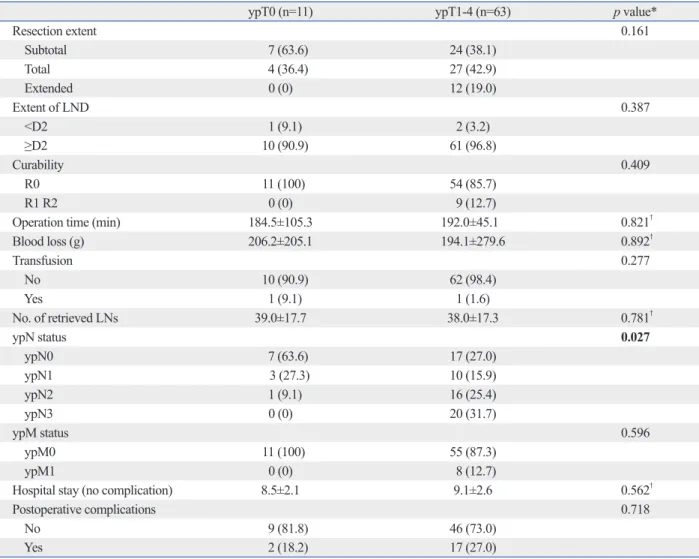
The mean number of retrieved lymph nodes was 39.0±17.7 in the ypT0 group and 38.0±17.3 in the ypT1-4 group.
There were no significant differences in postoperative com- plications and the duration of hospital stay between the two groups.
Survival of patients according to ypT and ypN status Over the median 25-month follow-up, the 1-, 2-, and 3-year disease-free survival rates were 83.4%, 70.0%, and 52.2%, respectively. The 1-, 3-, and 5-year overall survival rates were 88.5%, 67.5%, and 51.2%, respectively. The survival curves were plotted for the ypT and ypN status (Figs. 1 and 2). The survival curve for ypN status reflected patients’
prognoses better than ypT status. The modality of preopera- tive treatment (CCRTx vs. CTx) and the postoperative che- motherapy were not associated with patient survival.
Tumor recurrence after R0 resection
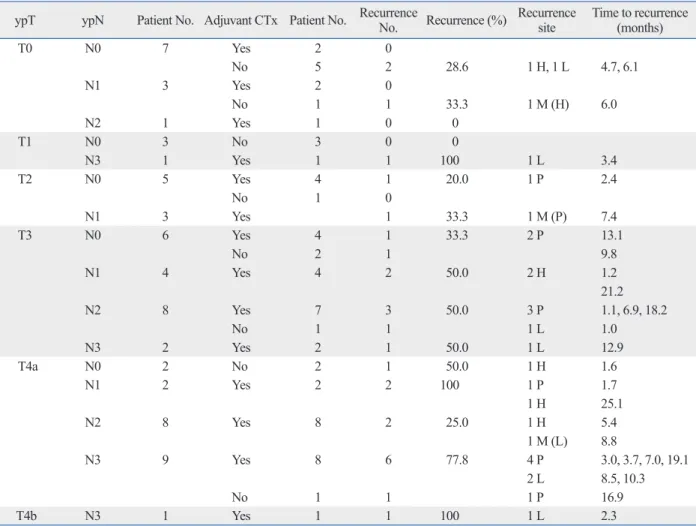
As shown in Table 3, patients were divided according to the ypT and ypN status and evaluated for tumor recurrence.
Among 7 patients with ypT0N0, 2 (28%) patients showed tumor recurrence 4.7 months and 6.1 months after radical gastrectomy. The 2 patients with tumor recurrence were among the 5 patients who did not receive postoperative CTx.
Neither of the 2 patients who received postoperative CTx showed tumor recurrence in patients with ypT0N0. Among the 3 patients with ypT0N1, only the one patient who did not receive postoperative CTx had a tumor relapse.
None of the patients with ypT1N0 (n=3) showed recur- rence, and only 1 of 5 patients with ypT2N0 exhibited tu- mor recurrence. Recurrence rates were 33% to 50% in pa- tients with ypT3 according to the ypN status. Recurrence rates ranged from 25% to 100% in those patients with ypT4. Tumor recurrence following gastrectomy generally occurred within a few months in most patients.
DISCUSSION
Gastrectomy with D2 lymph node dissection and extended surgery for resection of involved organs is the current stan- dard of care for advanced gastric cancer.5,7,8 In recent years, a multidisciplinary treatment approach, including perioper- ative CTx, radiotherapy, and targeted therapy, has emerged for advanced gastric cancer, resulting in increased curability 15.0 for Windows® (SPSS, Chicago, IL, USA). Categorical
variables were analyzed using the chi-square or Fisher’s ex- act test, and continuous data were analyzed using the Mann- Whitney U test. Data are presented as mean±standard devia- tion. OS curves were calculated in months based on the length of time between primary surgical treatment and final follow-up or death using the Kaplan-Meier method. The log-rank test was used to assess the statistical differences be- tween variables. p-values <0.05 were considered significant.
RESULTS
Preoperative clinicopathologic and therapeutic characteristics
Out of the 74 patients, 11 patients (14.8%) showed favor- able response (ypT0) and had no residual cancer in the re- sected stomach. The residual tumor status, clinical features, type of preoperative therapy, and tumor characteristics are displayed in Table 1.
Age, sex, preoperative ASA score, tumor location, and histologic type were not predictive factors for a favorable pathologic response after CTx or CCRTx. In addition, the presence of adjacent organ invasion at the time of initial di- agnosis noted on abdomen-pelvis computed tomography and/or endoscopic ultrasound was not predictive of patho- logic response. The ypT0 rate was higher in patients with CCRTx than in CTx only (p=0.027). The incidence of a fa- vorable response (i.e., ypT0) was 31.6% in the CCRTx group and only 9.1% in the CTx group. The number of preopera- tive chemotherapeutic regimens and total number of che- motherapy cycles were not associated with the pathologic response. The levels of the initial and preoperative tumor markers did not predict the pathologic response.
Surgical outcomes according to the pathologic tumor status
There were no significant differences in surgical outcomes, including the extent of resection, lymph node dissection, curability, operative time, number of retrieved lymph nodes, and postoperative hospital stay, between the ypT0 and ypT1-4 groups (Table 2). The ypT1-4 group was associated with a more advanced ypN status than the ypT0 group.
Four of the 11 patients in the ypT0 group underwent total gastrectomy. Seven patients in the ypT0 group exhibited ypN0, which indicated an approximately 9% (7 out of 74) rate of complete pathologic remission. In the ypT1-4 group,
able response to preoperative treatment. We found that histo- logical type, preoperative chemotherapeutic regimens, and tumor markers were not associated with a favorable re- sponse. The only factor related to the favorable response was the type of preoperative treatment; either CTx or CCRTx. Al- though our curative resection rate was 87.8% (65 out of 74 patients), which is similar to other studies,2-4 our rate of com- plete pathologic response was only 9.4% (7 out of 74 pa- and improved survival. Recent studies have suggested that
neoadjuvant CTx in patients with unresectable, locally-ad- vanced or metastatic gastric cancer can offer a chance for curative resection and improved survival.9,10
In the present study, we focused on identifying clinical fac- tors predictive of an excellent response to preoperative CTx or CCRTx. As shown in Table 1, several clinicopathological factors were analyzed to find the predictive factor for favor-
Table 1. Comparison of Preoperative Clinical, Therapeutic, and Tumor Features
ypT0 (n=11) ypT1-4 (n=63) p value*
Sex 0.740
Male 7 (14.0) 43 (86.0)
Female 4 (16.7) 20 (83.3)
Age (yrs) 61.2±9.4 55.3±11.7 0.105†
ASA score 0.367
1 8 (13.8) 50 (86.2)
2 2 (14.3) 12 (85.7)
3 1 (50.0) 1 (50.5)
Tumor location (in stomach) 0.649
Upper 3 (13.0) 20 (87.0)
Middle 1 (9.1) 10 (90.9)
Lower 7 (19.4) 29 (80.6)
Entire 0 (0) 4 (100)
Histology 0.740
Differentiated 3 (12.0) 22 (88.0)
Undifferentiated 8 (16.3) 41 (65.1)
Initial adjacent organ invasion† 1.000
Absent 6 (14.0) 37 (86.0)
Present 5 (16.1) 26 (83.9)
Preop CTx vs. CCRTx 0.027
CTx only 5 (9.1) 50 (90.9)
CCRTx 6 (31.6) 13 (68.4)
No. of preop CTx regimens 0.331
2 regimens 8 (19.0) 34 (81.0)
3 regimens 3 (9.4) 29 (90.6)
Total cycles of preop CTx 0.543
≤3 6 (54.5) 31 (49.2)
4-6 2 (8.7) 21 (91.3)
>6 3 (21.4) 11 (78.6)
Laboratory data
Initial CEA (ng/mL) 4.5±5.4 40.6±153.9 0.972‡
Preop CEA (ng/mL) 1.7±0.9 5.8±19.1 0.212‡
Initial CA72-4 (U/mL) 4.2±3.6 23.3±57.8 0.688‡
Preop CA72-4 (U/mL) 3.1±2.7 13.9±36.1 0.212‡
Initial CA19-9 (U/mL) 9.7±14.5 366.8±1290.6 0.166‡
Preop CA19-9 (U/mL) 78.9±223.2 112.4±519.6 0.542‡
ASA, American Society of Anethesiologists; CA, cancer antigen; CEA, carcinoembryonic antigen; CT, computed tomography; CTx, chemotherapy; CCRTx, chemoradiotherapy; EUS, endoscopic ultrasound.
*Chi-square.
†Initial adjacent organ invasion was evaluated by abdomen-pelvis CT scan and/or EUS before CTx or CCRTx.
‡Mann-Whitney U test, mean±standard deviation. Significant values are indicated in bold face. Values in parentheses are percentages.
sponse rate was lower than the reported 15% to 30 % in pre- vious prospective studies.1,2,4 Overall, we were able to identi- fy ypT0 patients as those patients likely to have a favorable tients). Because this study was retrospective in nature, the
chemotherapeutic protocols varied among the patients, which might explain why our 9.4% complete pathologic re-
Table 2. Surgical Outcomes and Pathologic Results According to ypT Status
ypT0 (n=11) ypT1-4 (n=63) p value*
Resection extent 0.161
Subtotal 7 (63.6) 24 (38.1)
Total 4 (36.4) 27 (42.9)
Extended 0 (0) 12 (19.0)
Extent of LND 0.387
<D2 1 (9.1) 2 (3.2)
≥D2 10 (90.9) 61 (96.8)
Curability 0.409
R0 11 (100) 54 (85.7)
R1 R2 0 (0) 9 (12.7)
Operation time (min) 184.5±105.3 192.0±45.1 0.821†
Blood loss (g) 206.2±205.1 194.1±279.6 0.892†
Transfusion 0.277
No 10 (90.9) 62 (98.4)
Yes 1 (9.1) 1 (1.6)
No. of retrieved LNs 39.0±17.7 38.0±17.3 0.781†
ypN status 0.027
ypN0 7 (63.6) 17 (27.0)
ypN1 3 (27.3) 10 (15.9)
ypN2 1 (9.1) 16 (25.4)
ypN3 0 (0) 20 (31.7)
ypM status 0.596
ypM0 11 (100) 55 (87.3)
ypM1 0 (0) 8 (12.7)
Hospital stay (no complication) 8.5±2.1 9.1±2.6 0.562†
Postoperative complications 0.718
No 9 (81.8) 46 (73.0)
Yes 2 (18.2) 17 (27.0)
LND, lymph node dissection; LNs, lymph nodes.
*Chi-square.
†Student’s t-test, mean±standard deviation. Values in parentheses are percentage.
Fig. 1. Overall survival curves according to ypT status (p=0.048). Fig. 2. Overall survival curves according to ypN status (p=0.003).
0 0
20 20
40 40
60 60
80 80
100 100
Cumulative survival (%) Cumulative survival (%)
0 25 50 75 100 125 0 25 50 75 100 125
Time after surgery (months) Time after surgery (months)
ypT2, 3YSR: 83.3%
ypT1, 3YSR: 75.0%
ypT0, 3YSR: 70.0%
ypT3, 3YSR: 63.2%
ypT4, 3YSR: 24.1%
ypN0, 3YSR: 76.4%
ypN1, 3YSR: 53.7%
ypN2, 3YSR: 43.0%
ypN3, 3YSR: 15.6%
tions of preoperative CCRTx or CTx were not well estab- lished in our institute, CTx or CCRTx was done arbitrarily according to the surgeons’ or oncologists’ decision in local- ly far advanced gastric cancer. Therefore, our data cannot offer conclusive evidence. It can only provide some clues for achieving better survival in advanced gastric cancer, which should be solved by more prospective studies.
The prognosis of patients with a favorable response was poorer than anticipated in our results, because two of our seven patients (28.6%) with complete pathologic response experienced tumor recurrence within a short time. These two patients did not receive adjuvant CTx; however, two pa- tients with ypT0N0 who received adjuvant treatment did not experience tumor recurrence (Table 3). When the tumor was in the advanced stage, despite neoadjuvant treatment, the prognosis was very poor. Tumor recurrence developed rapidly, with the majority recurring within 12 months even after R0 resection. Therefore, postoperative adjuvant treat- ment may be necessary regardless of the surgical pathology stage. Because of the small number of patients, the survival response to preoperative treatment regardless of ypN status.
Neoadjuvant CCRTx was more effective than neoadju- vant CTx for tumor regression in gastric cancer. The favor- able response rate (ypT0) was 31.6% after CCRTx and only 9.1% after CTx. In addition, the incidence of ypN0 was 47.4% (9 patients) after CCRTx and 27.3% (15 patients) af- ter CTx. The impact of preoperative CTx or CCRTx in esophagogastric junction (EGJ) cancer was observed in several Western studies.11,12 Additionally, one phase III study comparing CTx and CCRTx showed a higher complete pathologic response rate in the preoperative CCRTx group than in the preoperative CTx group.13 Although these West- ern studies focused on esophageal and EGJ cancer, the su- periority of adding radiation therapy to preoperative CTx may be applied to gastric cancer, too.
However, in this retrospective study, the initial tumor sta- tus and the treatment efficacy for CCRTx and CTx in histo- logic tumor regression of gastric cancer could not be direct- ly compared. Moreover, because the preoperative treatment of the neoadjuvant intent was not routine and the indica-
Table 3. Tumor Recurrence and Pathologic Status in Patients with R0 Resection
ypT ypN Patient No. Adjuvant CTx Patient No. Recurrence No. Recurrence (%) Recurrence site Time to recurrence (months)
T0 N0 7 Yes 2 0
No 5 2 28.6 1 H, 1 L 4.7, 6.1
N1 3 Yes 2 0
No 1 1 33.3 1 M (H) 6.0
N2 1 Yes 1 0 0
T1 N0 3 No 3 0 0
N3 1 Yes 1 1 100 1 L 3.4
T2 N0 5 Yes 4 1 20.0 1 P 2.4
No 1 0
N1 3 Yes 1 33.3 1 M (P) 7.4
T3 N0 6 Yes 4 1 33.3 2 P 13.1
No 2 1 9.8
N1 4 Yes 4 2 50.0 2 H 1.2
21.2
N2 8 Yes 7 3 50.0 3 P 1.1, 6.9, 18.2
No 1 1 1 L 1.0
N3 2 Yes 2 1 50.0 1 L 12.9
T4a N0 2 No 2 1 50.0 1 H 1.6
N1 2 Yes 2 2 100 1 P 1.7
1 H 25.1
N2 8 Yes 8 2 25.0 1 H 5.4
1 M (L) 8.8
N3 9 Yes 8 6 77.8 4 P 3.0, 3.7, 7.0, 19.1
2 L 8.5, 10.3
No 1 1 1 P 16.9
T4b N3 1 Yes 1 1 100 1 L 2.3
H, hematogenous; L, lymphatic; P, peritoneal; M, multiple combined metastasis.
WA, et al. Surgical pathology stage by American Joint Commis- sion on Cancer criteria predicts patient survival after preoperative chemoradiation for localized gastric carcinoma. Cancer 2006;107:
1475-82.
2. Ajani JA, Mansfield PF, Janjan N, Morris J, Pisters PW, Lynch PM, et al. Multi-institutional trial of preoperative chemoradiother- apy in patients with potentially resectable gastric carcinoma. J Clin Oncol 2004;22:2774-80.
3. Becker K, Langer R, Reim D, Novotny A, Meyer zum Buschen- felde C, Engel J, et al. Significance of histopathological tumor re- gression after neoadjuvant chemotherapy in gastric adenocarcino- mas: a summary of 480 cases. Ann Surg 2011;253:934-9.
4. Ajani JA, Mansfield PF, Crane CH, Wu TT, Lunagomez S, Lynch PM, et al. Paclitaxel-based chemoradiotherapy in localized gastric carcinoma: degree of pathologic response and not clinical parame- ters dictated patient outcome. J Clin Oncol 2005;23:1237-44.
5. Nakajima T. Gastric cancer treatment guidelines in Japan. Gastric Cancer 2002;5:1-5.
6. Sobin LH, Wittekind CH. TNM Classification of Malignant Tu- mours. 7th ed. International Union Against Cancer (UICC). New York: Wiley; 2009.
7. An JY, Cheong JH, Hyung WJ, Noh SH. Recent evolution of sur- gical treatment for gastric cancer in Korea. J Gastric Cancer 2011;11:1-6.
8. Lee JH, Kim KM, Cheong JH, Noh SH. Current management and future strategies of gastric cancer. Yonsei Med J 2012;53:248-57.
9. Sym SJ, Chang HM, Ryu MH, Lee JL, Kim TW, Yook JH, et al.
Neoadjuvant docetaxel, capecitabine and cisplatin (DXP) in pa- tients with unresectable locally advanced or metastatic gastric cancer. Ann Surg Oncol 2010;17:1024-32.
10. Lordick F, Stein HJ, Peschel C, Siewert JR. Neoadjuvant therapy for oesophagogastric cancer. Br J Surg 2004;91:540-51.
11. Cunningham D, Allum WH, Stenning SP, Thompson JN, Van de Velde CJ, Nicolson M, et al. Perioperative chemotherapy versus surgery alone for resectable gastroesophageal cancer. N Engl J Med 2006;355:11-20.
12. Stahl M, Vanhoefer U, Stuschke M, Walz MK, Müller C, Wilke H.
Pre-operative sequential chemo- and radiochemotherapy in locally advanced carcinomas of the lower oesophagus and gastro-oesoph- ageal junction. Eur J Cancer 1998;34:668-73.
13. Stahl M, Walz MK, Stuschke M, Lehmann N, Meyer HJ, Riera- Knorrenschild J, et al. Phase III comparison of preoperative che- motherapy compared with chemoradiotherapy in patients with lo- cally advanced adenocarcinoma of the esophagogastric junction. J Clin Oncol 2009;27:851-6.
analysis at each stage had some limitations. The rationale for adjuvant CTx in patients with complete pathologic re- mission is not conclusive; however, this study may offer clues toward improvement in the treatment of advanced gas- tric cancer with neoadjuvant therapy.
This retrospective study design resulted in several limita- tions, including the inability to strictly evaluate the initial tu- mor stage before neoadjuvant treatment and the lack of con- sistency with respect to the diagnostic modalities and neoadjuvant treatment protocols. It was difficult to determine whether patient survival was better represented by the initial tumor stage or the final pathologic tumor stage. Additionally, the degree of histologic tumor regression by neoadjuvant treatment was not evaluated in all patients. These drawbacks would be overcome with a prospective randomized study.
In summary, concurrent CCRTx rather than CTx alone appeared to be more effective with respect the pathologic response in locally-advanced gastric cancer and postopera- tive nodal status appeared to reflect patients’ prognoses bet- ter than ypT status. Although favorable pathologic response by neoadjuvant treatment was achieved, survival was not as good even after radical surgery. Overall, these results sug- gest the survival benefit of neoadjuvant treatment regard- less of the fact that resectability remains controversial.
ACKNOWLEDGEMENTS
This research was supported by the Basic Science Research Program through the National Research Foundation of Ko- rea (NRF) funded by the Ministry of Education, Science, and Technology (2011-0011301).
REFERENCES
1. Rohatgi PR, Mansfield PF, Crane CH, Wu TT, Sunder PK, Ross