INTRODUCTION
Alcoholic liver disease represents a spectrum of injuries, ranging from simple steatosis and alcoholic hepatitis (AH) to cirrhosis [1]. AH is a clinical syndrome that affects pa- tients with chronic and active harmful alcohol consump- tion and is associated with high mortality [2,3]. The mod-
ified discriminant function (MDF) score has been widely used to stratify AH severity [1]. Severe AH is defined as an MDF score ≥32 and is associated with a survival rate of 50%–65%, while patients with an MDF score <32 is associ- ated with a survival rate of 90% [4].
To date, the management of severe AH remains a clini- cal challenge with few effective treatment options [5]. The
Outcome of patients with severe alcoholic hepatitis after Model for End-Stage Liver Disease-based allocation system
implementation in Korea
Tae Jin Kwon, Wonseok Kang, Geum-Youn Gwak, Yong-Han Paik, Moon Seok Choi, Joon Hyeok Lee, Kwang Cheol Koh, Dong Hyun Sinn, Seung Woon Paik
Department of Medicine, Samsung Medical Center, Sungkyunkwan University School of Medicine, Seoul, Korea
Background: The Model for End-Stage Liver Disease (MELD)-based allocation system was implemented in Korea in July 2016 without a mandatory abstinence period for liver transplantation (LT) listing. However, the impact of the allocation policy has not been evaluated in patients with severe alcoholic hepatitis (AH).
Methods: A total of 81 consecutive patients with severe AH between January 2014 and December 2018 were analyzed. The clinical course of patients before and after the im- plementation of the MELD-based allocation system was assessed.
Results: More patients received LT (25%–65%) after the MELD allocation system was implemented. The increase in patients receiving deceased donor LT was dramatic (17%–
51%, P=0.001) compared to patients receiving living donor LT (7%–14%, P=0.30). The overall survival was better for those who received LT (88% vs. 44% at 1 year, P<0.001), and after the MELD era (1-year survival rate: 80% vs. 50%, P=0.005). Post-LT mortality was observed in six patients, with one case of mortality related to recidivism. Baseline MELD and steroid response were factors associated with transplant-free survival.
Conclusions: After implementation of the MELD-based allocation system, deceased do- nor LT dramatically increased in patients with severe AH. This translated into increased overall survival, but at a cost of mortality due to recidivism. Urgent evaluation is warrant- ed to identify criteria to justify the use of precious liver grafts from deceased donors for severe AH patients in Korea.
Keywords: Alcoholic hepatitis; Liver transplantation; Model for End-Stage Liver Disease
Received December 4, 2020 Revised January 26, 2021 Accepted January 27, 2021
Corresponding author: Dong Hyun Sinn Department of Medicine, Samsung Medical Center, Sungkyunkwan University School of Medicine, 81 Irwon- ro, Gangnam-gu, Seoul 06351, Korea Tel: +82-2-3410-3409
Fax: +82-2-3410-6983 E-mail: [email protected] Co-Corresponding author:
Seung Woon Paik
Department of Medicine, Samsung Medical Center, Sungkyunkwan University School of Medicine, 81 Irwon- ro, Gangnam-gu, Seoul 06351, Korea Tel: +82-2-3410-3409
Fax: +82-2-3410-6983 E-mail: [email protected]
© The Korean Society for Transplantation This is an Open Access article distributed under the terms of the Creative Commons Attribution Non-Commercial License (http://creativecommons.org/licenses/
by-nc/4.0/) which permits unrestricted non-commercial use, distribution, and reproduction in any medium, provided the original work is properly cited.
pISSN 2671-8790
eISSN 2671-8804
cornerstone therapy for AH is nutrition and abstinence from alcohol [3]; however, this is not often successful. Cor- ticosteroids are the only treatment option shown to reduce mortality from severe AH [6]. However, the benefits of corticosteroid treatment remain controversial [7]. Cortico- steroids administered to patients with severe AH increase the risk of developing serious infections and may increase the risk of mortality in patients who experience infection [8]. Patients with severe AH unresponsive to medical ther- apy have 1-year mortality rates of up to 70%–90% [9,10].
Early liver transplantation (LT) for severe AH is a potential- ly life-saving treatment with established survival benefits [11,12]. However, LT for AH as a rescue therapy is also controversial [13,14], especially in terms of the selection criteria justifying the use of precious liver grafts [15,16].
In Korea, the liver allocation system for deceased do- nor LT (DDLT) has been based on the Child-Turcotte-Pugh score; however, to increase objectivity and equality of allo- cation [17], a Model for End-Stage Liver Disease (MELD)- based allocation system was implemented in June 2016 [18]. The change in the liver allocation system has had a huge impact on potential LT candidates, including patients with severe AH. However, the impact of the allocation system change on the outcomes of patients with severe AH has not been assessed. Therefore, in this study, we compared the clinical outcomes of patients with severe AH before and after the MELD-based allocation system to determine the impact of the change in allocation system on the outcomes of patients with severe AH in Korea.
METHODS
The study protocol was approved by the Ethics Committee of the Samsung Medical Center (IRB No. 2019-07-118).
Since this study used only de-identified data routinely collected during hospital visits, the requirement to obtain informed patient consent was waived.
Study Design and Participants
This study was a single-center, retrospective cohort study conducted at the Samsung Medical Center, Seoul, South Korea. We screened 886 patients who were admitted to our liver unit without malignancy, viral hepatitis, autoim- mune hepatitis, or primary biliary cirrhosis between Janu- ary 2014 and December 2018. Among them, we identified 81 severe AH patients who met the diagnostic criteria of definite or probable AH by the National Institute on Al- cohol Abuse and Alcoholism [19]. In brief, definite AH is defined for patients meeting the clinical diagnosis criteria of AH with biopsy confirmation. Probable AH is defined for patients meeting the clinical diagnosis criteria of AH in the absence of potential confounding factors without biopsy confirmation. The criteria for the clinical diagnosis of AH are as follows: (1) onset of jaundice (serum total bilirubin
>3.0 mg/dL) within the previous 8 weeks; (2) ongoing con- sumption of >40 g (female) or >60 g (males) of alcohol/day for 6 months or more with less than 60 days of abstinence before the onset of jaundice; (3) aspartate aminotrans- ferase (AST) and alanine aminotransferase (ALT) <400 IU/L, AST >50 IU/L, AST/ALT ratio >1.5; (4) absence of other chronic liver diseases (hepatitis B, hepatitis C, auto- immune, or metabolic liver disease); and (5) absence of sepsis, shock, cocaine use, or recent use (within 30 days) of a drug with the potential for drug-induced liver injury.
An MDF score ≥32 was used to define severe AH. The pre- MELD era was from January 2014 to June 2016 and the post-MELD era was from July, 2016 to December, 2018 in this study. In our institution, a physician or surgeon de- termines the necessity of LT for each patient, and when it is deemed necessary, a multidisciplinary team, which in- cludes transplant surgeons, hepatologists, psychologists, cardiologists, infectious disease specialists, and social workers evaluates each patient. After the multidisciplinary evaluation, the respective physician or surgeon has a dis- cussion with the patient and family members regarding registering on the LT waitlist. The transplant coordinator then lists the patient and registers them to the Korean Net- work for Organ Sharing. Living donor LT (LDLT) is explained HIGHLIGHTS
• Since the Model for End-Stage Liver Disease (MELD)- based allocation system was implemented, the overall survival of patients with severe alcoholic hepatitis has improved.
• The main driver of improved prognosis has been an in- crease in deceased donor liver transplantation; howev- er, with the risk of mortality from recidivism.
• The allocation policy for patients with severe alcoholic
hepatitis warrants urgent evaluation in the MELD era in
Korea.
in all situations, and evaluations are performed according to the living liver donor selection criteria if there is a willing donor within the family. In our institution, the selection criteria for living liver donors are as follows: (1) <65 years of age; (2) expected remnant liver volume greater than 30%; and (3) no evidence of chronic liver disease. There are no specific criteria for emergent LDLT in the setting of severe AH. When there is a willing liver donor who fulfills the donor selection criteria, transplant surgeons and hepa- tologists discuss with the patient and family members whether to proceed with emergent LDLT, wait for DDLT allocation, or wait for spontaneous recovery on a case-by- case basis. If there is no willing live liver donor or no liver donor who fulfills the donor selection criteria, the patient waits for DDLT allocation or spontaneous recovery. When a deceased donor is allocated to a patient, transplant sur- geons and hepatologists discuss with the patient and fam- ily members whether to proceed with emergent DDLT, wait for spontaneous recovery, or decline the allocation due to high risk of transplant futility.
Variables, Sources of Data, and Measurements
The primary outcome was overall survival before and after the MELD-based allocation system was implemented. The duration of survival was calculated from the date of initial hospitalization to death or the last date of follow-up. The secondary outcome was transplant-free survival (TFS). For TFS, the duration of survival was calculated from the date of initial hospitalization to death, last date of follow-up, or date of LT, whichever came first. The reference day was May 5, 2019.
The following variables were collected by reviewing the electronic medical records of each patient: age at hospi- talization; sex; previous decompensation history; presence of infection; gastrointestinal bleeding; imaging, endoscop- ic, and laboratory results; medication use; and LT during follow-up. The presence of hepatomegaly, splenomegaly, and ascites were evaluated using computed tomography (CT) or ultrasonography findings. Splenomegaly was de- fined as the largest dimension >11 cm, and hepatomegaly was defined as a longitudinal axis >16 cm at the midcla- vicular line on CT or ultrasonography. Infections were de- fined as follows [20]: (1) spontaneous bacteremia: blood cultures without a source of infection; (2) spontaneous bacterial peritonitis: ascites fluid polymorphonuclear cell count >250/uL; (3) lower respiratory tract infection: new pulmonary infiltration in the presence of (i) at least one respiratory symptom (cough, sputum production, dyspnea,
pleuritic pain) with (ii) at least one finding on auscultation (rales or crepitation) or one sign of infection (core body temperature >38°C or <36°C, shivering or leucocyte count
>10,000/mm
3or <4,000/mm
3) in the absence of antibiot- ics; (4) skin infection: fever with cellulitis; (5) urinary tract infection: urine white blood cell >15/high-power field with either positive urine Gram stain or culture in symptomatic patients; and (6) other source of infection (e.g., intra-ab- dominal infection, secondary peritonitis). Gastrointestinal bleeding was defined as evidence of hematemesis/mele- na/hematochezia, a drop in hemoglobin of 2 g/dL or more from baseline, or the need for a transfusion. Previous de- compensation included jaundice, ascites, variceal hemor- rhage, or hepatic encephalopathy prior to admission. The presence of varix was identified by reviewing endoscopic findings among patients who underwent upper endosco- py and by reviewing CT findings. The following laboratory variables at initial hospitalization were collected: white blood cell count, platelet count, prothrombin time, bili- rubin, ALT, AST, gamma glutamyltransferase, blood urea nitrogen, and creatinine. All patients were assessed using the MELD score (3.78 ln [bilirubin]+11.20 ln [international normalized ratio]+9.57 ln [creatinine]+6.43) [21]. For those who received LT, the MELD score on the day of transplan- tation, waiting time, and alcohol relapse after LT were col- lected. For those who received corticosteroid treatments, the Lille score (3.19–0.101×age+0.147×albumin on day 0+0.0165×evolution in bilirubin level–0.206×renal insuf- ficiency–0.0065×bilirubin on day 0–0.0096×prothrombin time was calculated. Steroid non-responders were defined as a Lille score >0.45 [22].
Statistical Analysis
Baseline characteristics were described using frequency (percentage) and median (interquartile range). Continu- ous variables were analyzed using Student t-test or the Mann-Whitney U-test. Categorical variables were analyzed using the chi-square test or Fisher’s exact test. For the MELD score, patients were divided into two groups ac- cording to MELD score (<25 and ≥25). The cutoff point was chosen based on the area under the receiver oper- ating characteristic analysis. The survival curves were plotted using the Kaplan-Meier method, and the difference between the curves was tested using the log-rank test.
Multivariate Cox regression analysis was performed with
all variables with a P-value <0.10 in univariate analysis to
evaluate predictors of overall survival and TFS. Statistical
significance was set at P<0.05.
RESULTS
Baseline Patient Characteristics and Proportion Receiving LT in the Eras before and after Implementation of the MELD-Based Allocation System
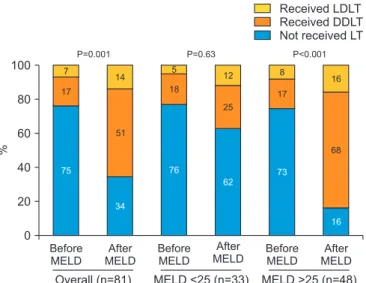
The baseline characteristics of the patients are summa- rized in Table 1. There were no differences in baseline characteristics before and after the MELD-based alloca- tion system was implemented. The proportion of patients receiving LT increased from 25% (10/40) in the pre-MELD era to 65% (27/41) in the post-MELD era (P<0.001). The proportion of patients receiving DDLT increased from 17% (7/40) to 51% (21/41) (P=0.001) in the pre- and post- MELD era, respectively. Although not statistically signif- icant (P=0.30), the proportion of patients receiving LDLT increased from 7% (3/40) to 14% (6/41) in the pre- and post-MELD eras, respectively. When stratified according to MELD score, the DDLT rate did not change significantly (18% to 25%, pre- and post-MELD eras, P=0.53) for those with low MELD scores (<25), while the DDLT rate increased from 17% (pre-MELD era) to 68% (post-MELD era, P<0.001) for those with high MELD scores (≥25) (Fig. 1).
Outcome, Steroid Use and Factors Associated with Overall Survival
During the follow-up period of a median of 8.4 months (range, 0.1–64.0 months), mortality was observed in 30
Table 1. Baseline patient characteristics in the eras before and after implementation of the MELD-based allocation system
Characteristics Overall (n=81) Before MELD (n=40) After MELD (n=41) P-value
Age (yr) 49 (43–55) 51 (45–55) 47 (42–55) 0.07
Male sex 53 (65) 28 (70) 25 (60) 0.48
Previous decompensation 38 (46) 21 (52) 17 (41) 0.37
Infection 20 (24) 6 (15) 14 (34) 0.07
GI bleeding 17 (21) 8 (20) 9 (22) 1.00
Varix 64 (79) 32 (80) 32 (78) 1.00
Hepatomegaly 37 (45) 17 (42) 20 (48) 0.65
Splenomegaly 66 (81) 33 (82) 33 (80) 1.00
Ascites 57 (70) 30 (75) 27 (65) 0.46
MELD score 0.82
<25 33 (41) 17 (42) 16 (39)
≥25 48 (59) 23 (57) 25 (61)
Liver biopsy 19 (23) 9 (22) 10 (24) 1.00
Corticosteroid use 22 (27) 11 (27) 11 (26) 1.00
Corticosteroid response 10/22 (45) 4/11 (36) 6/11 (54) 0.68
LT 37 (45) 10 (25) 27 (65) <0.001
LDLT 9 (11) 3 (7) 6 (14) 0.30
DDLT 28 (34) 7 (17) 21 (51) 0.001
Values are presented as median (interquartile range) or number (%).
MELD, Model for End-Stage Liver Disease; GI, gastrointestinal; LT, liver transplant; LDLT, live donor liver transplant; DDLT, deceased donor liver transplant.
Before MELD
After MELD 100
80
60
40
20
Overall (n=81) P=0.001
MELD <25 (n=33) 0
Received LDLT Received DDLT Not received LT
After
MELD After
MELD Before
MELD
Before MELD
P=0.63 P<0.001
MELD >25 (n=48) 7
17
75
14
51
34
5 18
76
12
25
62
8 17
73
16
68
16
%
Fig. 1. Change in the proportion of patients receiving liver transplantation
(LT) before and after Model for End-Stage Liver Disease (MELD) imple-
mentation. LDLT, live donor liver transplant; DDLT, deceased donor liver
transplant.
patients (37%). Of the 81 patients, 22 (27%) used cortico- steroids, while 59 (73%) did not. The proportion of patients who recovered without LT, received LT, and died without LT were 36%, 36%, and 27%, respectively, among the 22 patients who used steroids, and were 20%, 49%, and 30%, respectively, among the 59 patients who did not use ste- roids (Fig. 2). Overall survival improved in patients with se- vere AH managed after the MELD-based allocation system compared to before (80% vs. 50% at 12 months, P=0.005) (Fig. 3). In the univariate analysis, LT and the MELD-based allocation system era were factors associated with overall survival (Table 2). Age (per year), male sex, and hepato- megaly showed a marginal association with overall surviv- al. In the multivariate analysis, age (hazard ratio [HR], 1.04;
95% confidence interval [CI], 1.00–1.08; P=0.028) and LT (HR, 0.16; 95%, CI, 0.06–0.52; P<0.001) were independent factors affecting overall survival (Table 2). Patients who received LT showed better overall survival than patients who did not receive LT (88% vs. 44% at 1 year, P<0.001) (Supplementary Fig. 1).
Factors Associated with TFS
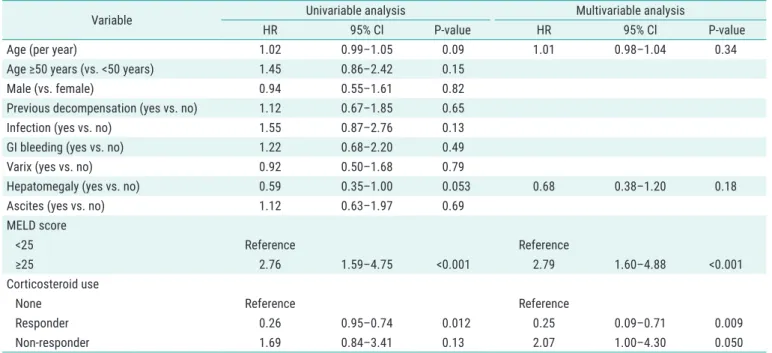
The TFS rates were 42.3% and 32.7% at 3 and 6 months, respectively. In the multivariable analysis, response to corticosteroids (compared to non-users; HR, 0.25; 95% CI, 0.09–0.71; P=0.009), corticosteroid non-response (com- pared to non-users; HR, 2.07; 95% CI, 1.00–4.30; P=0.050), and MELD score ≥25 at initial hospitalization (compared to <25; HR, 2.79; 95% CI, 1.60–4.88; P<0.001) were in- dependently associated with TFS (Table 3). When strati- fied according to MELD score and steroid response, the 3-month TFS was 70% and 24% for MELD scores <25 and
≥25, respectively (P<0.001) (Supplementary Fig. 2A), and 38%, 88%, and 16% for steroid non-users, steroid respond- ers, and steroid non-responders, respectively (P=0.005)
(Supplementary Fig. 2B).
Comparison According to Liver Graft Type
Among the 37 patients who received LT, 9 received LDLT, and 28 received DDLT. The median time from LT listing was not significantly different between the two groups (LDLT, 14 days vs. DDLT, 9 days; P=0.24). The DDLT group had higher MELD scores at transplantation than the LDLT group (40 vs. 29, P=0.035). After LT, alcohol relapse was identified in 5 of the 37 patients (13%). Six deaths oc- curred after LT. The cause of mortality was sepsis in four patients, graft rejection in one patient, and liver failure re- lated to recidivism in one patient (Supplementary Table 1).
40 41
6 12 18 24
1.0
0.8
0.6
0.4
Survivalprobability 0.2
Month 0
P=0.005
Before MELD After MELD Overall survival
19 28
16 17
15 16
14 8 No. at risk
Before MELD After MELD
Fig. 3. Kaplan-Meier estimates of overall survival in the eras before and
after Model for End-Stage Liver Disease (MELD)-based allocation system implementation. Before MELD: Jan 2014–Jun 2016; After MELD: Jul 2016–Dec 2018.
81 Patients with severe alcoholic hepatitis
22 Patients (27%) used corticosteroid
Recovered without LT (n=8, 36%)
Received LT (n=8, 36%)
Death without LT (n=6, 27%)
Death after LT (n=2, 25%)
59 Patients (73%) did not use corticosteroid
Recovered without LT (n=12, 20%)
Received LT (n=29, 49%)
Death without LT (n=18, 30%)
Death after LT (n=4, 15%)
Fig. 2. Flowchart of patients from enroll-
ment concerning corticosteroid use, liver
transplantation (LT), and death or survival.
DISCUSSION
In this study, we observed improved survival in patients with severe AH in the post-MELD era. There was no signif-
icant difference in baseline patient characteristics before and after the MELD allocation system was implemented.
However, more patients received LT, and the number of patients who received DDLT increased dramatically (17%
Table 2. Factors associated with overall survival
Variable Univariable analysis Multivariable analysis
HR 95% Cl P-value HR 95% Cl P-value
Age (per year) 1.04 1.00–1.08 0.050 1.04 1.00–1.08 0.028
Male (vs. female) 2.15 0.92–5.03 0.075 1.34 0.55–3.28 0.51
Previous decompensation (yes vs. no) 0.97 0.47–1.99 0.93
Infection (yes vs. no) 1.04 0.44–2.44 0.91
GI bleeding (yes vs. no) 1.07 0.45–2.51 0.87
Varix (yes vs. no) 0.62 0.28–1.36 0.23
Hepatomegaly (yes vs. no) 0.51 0.24–1.11 0.091 0.58 0.26–1.27 0.17
Ascites (yes vs. no) 0.94 0.43–2.06 0.89
MELD score
<25 Reference
≥25 1.14 0.54–2.36 0.72
Corticosteroid use
None Reference
Responder 0.76 0.22–2.55 0.66
Non-responder 1.36 0.51–3.61 0.53
LT (yes vs. no) 0.16 0.06–0.41 <0.001 0.15 0.06–0.39 <0.001
MELD-based allocation system (before vs. after) 0.33 0.14–0.75 0.008 0.77 0.30–1.96 0.58
HR, hazard ratio; CI, confidence interval; GI, gastrointestinal; MELD, Model for End-Stage Liver Disease; LT, liver transplantation.
Table 3. Factors associated with transplant-free survival