INTRODUCTION
The evaluation for hypertrophic cardiomyopathy (HCM) re- lies principally on echocardiography and electrocardiogra-
phy. Historically, the evolution of echocardiography has dem- onstrated the important morphological characteristics such as asymmetric pattern, systolic anterior motion of the mitral valve, obstructive form, and apical involvement.
1-4Therefore, echocardiography is considered as the gold standard for iden- tifying the clinical phenotype of HCM.
5The electrocardiogra- phy also provides substantial information of HCM including mimic myocardial ischemia or infarction, and thereby creates diagnostic confusion.
6-9However, most data were produced a long time ago and on the basis of relatively small population before the establishment of diagnostic consensus for HCM.
10,11In addition, most data is about asymmetric HCM, while there are limited data on the apical HCM which was introduced lat- er and was a relatively rare form in Western country.
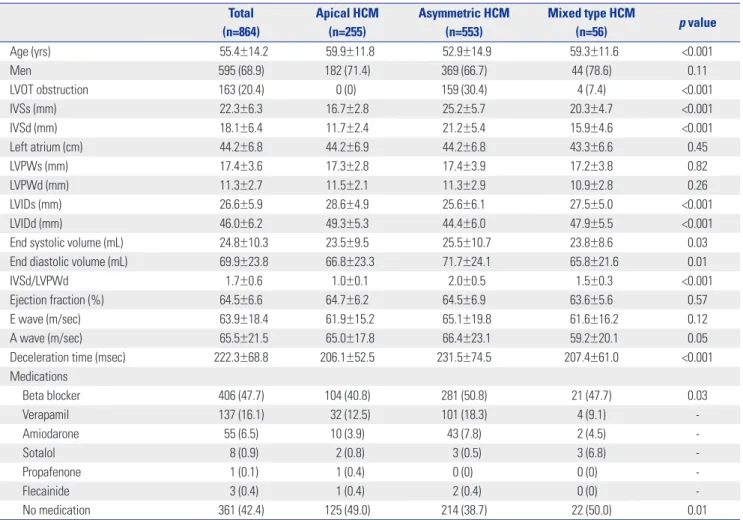
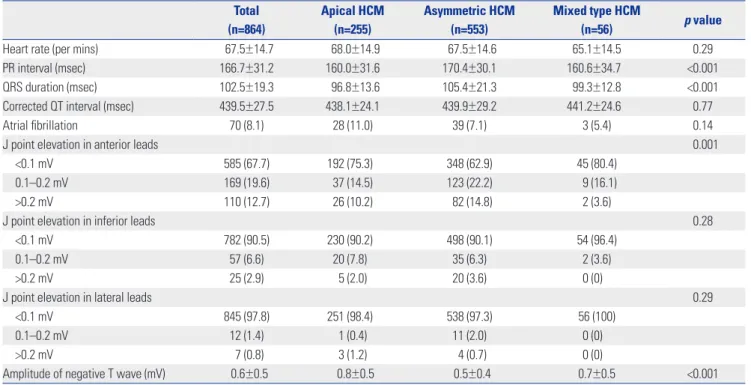
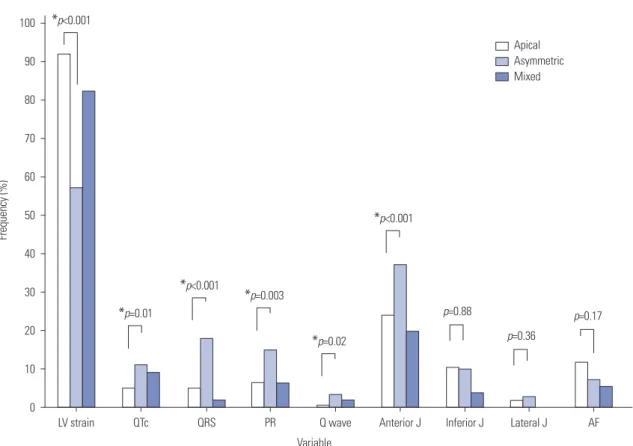
5,6,12,13We, therefore, investigated the morphological and electrical char-
Morphological and Electrical Characteristics in Patient with Hypertrophic Cardiomyopathy:
Quantitative Analysis of 864 Korean Cohort
Sung-Hwan Kim
1, Yong-Seog Oh
1, Gi-Byoung Nam
2, Kee-Joon Choi
2, Dae Hee Kim
2, Jong-Min Song
2, Duk-Hyun Kang
2, Jae-Kwan Song
2, and You-Ho Kim
21
Division of Cardiology, Department of Internal Medicine, Seoul St. Mary’s Hospital, College of Medicine, The Catholic University of Korea, Seoul;
2