DOI:http://dx.doi.org/10.5389/KSAE.2012.54.5.001
Overall Heat Transfer Coefficient Measurement of Covering Materials with Thermal Screens for Greenhouse using the Hot Box Method
핫박스를 이용한 온실 피복재 및 보온재의 조합에 따른 관류열전달계수 측정Diop, Souleymane*
․Lee, Jong Won
*․Na, Wook Ho
*․Lee, Hyun Woo
*,†소레이멘 디옵․이종원․나욱호․이현우
ABSTRACT
본 연구의 목적은 국내에서 상용되고 있는 온실 피복재 및 보온재의 조합에 따른 관류열전달계수를 핫박스를 이용하여 평가하는 것 이다. 온실용 일중 및 이중 피복재와 이중 보온재의 조합에 대하여 야간천공복사 차단여부에 따른 관류열전달계수를 핫박스를 이용하 여 실외에서 측정하였다. 처리조건은 일중피복, 이중피복, 이중피복과 이중 마트보온재 및 이중피복과 이중 다겹보온재의 조합조건과 천공복사 유무에 따른 조건이며 총 8가지이다. 제작된 핫박스는 상시 변화하는 외부의 기상조건하에서도 내부온도를 설정된 온도로 일 정하게 잘 유지할 수 있었다. 온실 피복재 및 보온재의 관류열전달계수를 측정하는 실내용 측정장치는 반드시 야간천공복사를 모의할 수 있는 측정장치가 되어야 할 것이다. 야간복사를 차단함으로서 온실의 열 손실을 줄여 보온효과를 얻을 수 있을 것으로 분석되었다.
모든 피복방식에 대해 야간복사 차단장치 유무에 관계없이 높은 풍속에서의 관류열전달계수가 낮은 풍속에서보다 더 큰 것으로 나타났 다. 본 연구에서 사용된 측정기법을 사용하면 국내에서 생산되는 피복재 및 보온재의 관류열전달 특성을 정량적으로 비교할 수 있을 것으로 기대된다.
Keywords: matt screens; multi layers screens; outside experiment; polyethylene film; shelter from sky radiation
I. INTRODUCTION*
Achieving favorable environment in the greenhouses under cold winter or hot and sunny summer conditions has become one of the major challenges still facing designers and growers (Abdel-Ghany, 2011). The thermal environment of the greenhouse is based on the relative input and outflow of energy. Greenhouse heating is one of the most energy consuming activities during winter periods. The determination of the quantity of heat transmitted through the cover is an important thermal problem of greenhouses and its rational approach represents a valuable tool for many practical applications (Kittas, 1994). The selection of the cover material has a tremendous influence on the crop production capability
* Department of Agricultural Engineering, Kyungpook National University
† Corresponding author Tel.: +82-53-950-5736 Fax: +82-53-950-6752
E-mail: [email protected] 2012년 6월 15일 투고 2012년 7월 13일 심사완료 2012년 7월 16일 게재확정
of the greenhouse system (Giacomelli and Roberts, 1993).
The covering material is a basic factor influencing the energy consumption, the yield and the general economics of the greenhouse. Materials used as greenhouse covers (especially plastic films) are not spatially homogeneous.
Only the measurement of several properties under certain conditions may provide data for assessing the quality of a covering material and for material comparison. In order to save energy by the greenhouse effect, a greenhouse covering material should possess good heat insulating characteristics, be transparent to visible radiation and opaque to the infrared (Geoola et al., 2009; Papadakis et al., 2000; Zabeltitz, 1992).
Further energy saving measures for the construction of greenhouses can be attained by using different types of thermal screens (Geoola et al., 2009; Pirard et al., 1994;
Plaisier, 1996). Screen materials are being used extensively in agriculture for conserving energy by reducing night radiation heat loss, and for reducing solar heat load by day.
Measurements of their thermal properties are needed to determine the influence of screens on the heat loss coeffi- cient. It is difficult for the horticulturists to choose from the
changing with time, the greenhouse type is not similar and the greenhouse environments (inside temperature, air leakage) are different. For many years, hot box facilities have been used for thermal testing of inhomogeneous components, even if they have been applied with different standards throughout the world. Today, hot boxes are reliable instru- ments for various types of measurements (Asdrubali and Baldinelli, 2011).
The objective of the present study was to investigate the overall heat transfer coefficient of greenhouse covering materials with or without thermal screens commonly used in the country under external conditions by using the hot box method.
II. MATERIALS AND METHODS
1. Experimental Apparatus
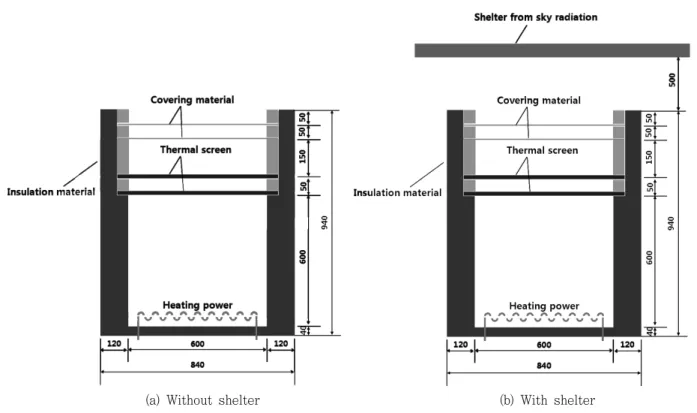
Regarding the measurement methods for the overall heat transfer coefficient, several standards propose the use of the hot box method. These standards were originally esta- blished for measuring rigid materials, but they also allow the measurement of thin film materials such as flexible plastic greenhouse covering materials (Papadakis et al., 2000). Fig. 1 shows the guarded hot box designed and built partially based on ASTM standards C 236-89. Fig. 1 (a) and (b) illustrate the hot box installed without and with shelter from sky radiation respectively. The technique used in the present work was inspired by work using guarded hot box (Feuilloley and Issanchou, 1996) to investigate the overall heat transfer coefficient of greenhouse covering
for the heating input power. The power dissipated by the heater was measured every second. In order to study the overall heat transfer coefficient of the combined covering materials and thermal screens, space was made for placement of specimens at distances of 5, 15, 5 cm as shown in Fig.
2. The experiments were conducted to measure parameters relating to the hot box and the external climate. Temperatures at different locations inside and outside the box were measured and averaged using six HOBO sensors (ONSET, USA). For outside temperature two more HOBO sensors were set and their values also averaged in order to increase the accuracy of the measurements. The amount of heat loss dissipating through the hot chamber’s wall was calculated by using the surface temperatures of the inner and outer of three walls measured by surface temperature sensors (UE- 1530, Korea). Tests were made in dry state under external conditions. The trial was carried out at night, when the system was close to a steady state and the external climatic
(a)Without shelter (b) With shelter Fig. 1 Pictures of hot box
(a) Without shelter (b) With shelter
Fig. 2 Schematic diagram of the hot box (Unit: mm)
conditions were stable (usually between 01:00 h, and 05:00 h) (Feuilloley and Issanchou, 1996). The measurement data were recorded from December 1, 2011 to April 20, 2012.
The wind velocity was measured at the College weather station near the experiment place.
2. Theoretical Consideration
If our experimental apparatus is adiabatic and heat transfer through the cover material or cover material coupled with thermal screen is stable, it follows from thermal equilibrium theory. The overall heat transfer coefficient of U (W ․ m-2
․ K-1) should be calculated from the following equation:
(1)
where Q is energy required for heating (watts), A is area of the sample (m2), Ti is inside air temperature of the hot box below the sample (℃), To is outside temperature (℃).
This equation summarizing the quantity of heat energy passing through a material per unit area and per unit of
temperature difference between the two faces of the tested sample doesn’t include heat loss through box’s walls. Thus it is necessary to estimate the share of energy loss through the covering material by calculating the share of energy lost through the walls because the box is not adiabatic. The heat loss by air leakage was disregarded. Thus the energy balance of the box is given by:
(2)
where Qr is the heating power of the heater (watts) and, Qw
is heat loss through the walls (watts).
The value of U for the covering material is then:
(3)
The heat loss through the walls is:
(4)
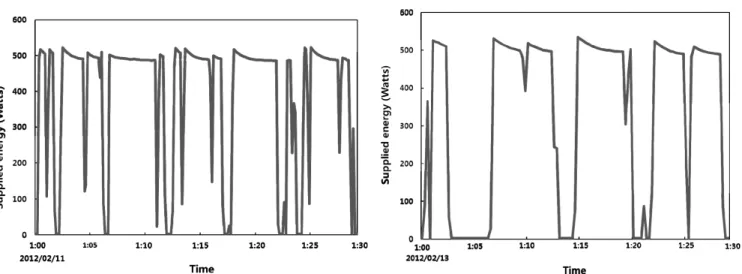
(a) Low outside temperature (-3.9~-0.2 ℃) (b) High outside temperature (1.6-3.3 ℃) Fig. 3 Variation of supplied energy with time
polyethylene film and its thickness was 0.1 mm. Covering method was one layer and two layers by PE film. We applied two kinds of thermal screens installation. One was 2 layers of matt screen (600×300, 300×300 denier); another was two layers of multi layers screen (5 and 6 layers). All tests
Table 1 Test matrix of covering materials with thermal screens and shelter
Treatment Covering material Thermal screen Shelter
1L 1 layer of PE film None None
1LS 1 layer of PE film None Installed
2L 2 layers of PE film None None
2LS 2 layers of PE film None Installed
4LM 2 layers of PE film 2 layers of matt None 4LMS 2 layers of PE film 2 layers of matt Installed
4LX 2 layers of PE film 2 layers of multi layers None 4LXS 2 layers of PE film 2 layers of multi layers Installed
during 1:00 to 1:30 am on February 11 and February 13.
The heating power was varied between 2.3 and 534.5 W.
The 2.3 W of the minimum heating power was needed for maintaining the heating system. The 534.5 W of the maxi- mum heating power was actual supplied energy which was slightly greater than the nominal capacity. The heat supplying interval at the low outside temperature was shorter than that at high outside temperature because the heat loss was different depending on outside temperature.
Fig. 4 shows the variation of inside hot box temperature and outside temperature. The inside hot box temperature during experiment was stable and uniform around the setting temperature of 15 ℃ while the outside temperature was varied between 0.1 to -3.5 ℃. It was concluded that the hot box had a proper operating environment for measuring the overall heat transfer coefficient.
Fig. 4 Variation of inside hot box temperature and outside temperature
2. Variation of Overall Heat Transfer Coefficient
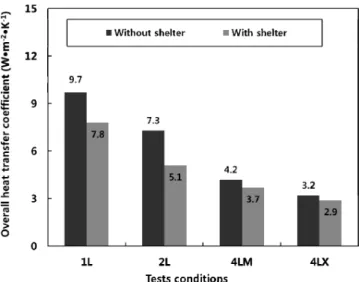
Fig. 5 shows the variation of the overall heat transfer coefficient in the different test conditions by shelter from sky radiation. The insulation effect of two layers covering material was 25 % comparing to one layer covering material, 57 % for two layers covering material coupled with two layers matt screen and 67 % for two layers covering material coupled with two layers multi layers screen. The coefficient measured without shelter was greater than that with shelter by around 20 % for one layer, 30 % for two layers, 12 % for two layers covering material coupled with two layers matt screen and 9 % for two layers covering material coupled with two layers multi layers screen. The ratio of heat loss of covering material coupled with thermal screen by using shelter was less than covering material without thermal screen. When we measure the overall heat transfer coeffi- cients in a laboratory, it’s necessary to establish the measuring system to be able to simulate the sky radiation. It was concluded that the insulation effect of greenhouse could be acquired by reducing the heat loss through blocking sky radiation because the overall heat transfer coefficient measured with shelter was lower than that without shelter for all 4 different covering treatments.
Fig. 6 shows the variation of the overall heat transfer coefficients in the different test conditions with the wind speed. High wind represents wind speed more than 2 m · s-1 and low wind represents wind speed less than 2 m · s-1 in
Fig. 5 Overall heat transfer coefficient in the different test conditions by shelter from sky radiation
Fig. 6 Overall heat transfer coefficients in the different test conditions with the wind speed
Fig. 6. For all cases the overall heat transfer coefficients measured at high wind speed were greater than the coefficients at low wind speed. The coefficient measured at high wind speed was greater than that at low wind speed by around 14 % for one layer, 10 % for two layers, 8 % for two layers covering material coupled with two layers matt screen and 6 % for two layers covering material coupled with two layers multi layers screen. Even if the coefficients could not be compared directly because the actual wind velocities were different each other, the heat loss of covering material without thermal screen by wind was greater than that of covering materials coupled with thermal screens. It was
measured quantitatively by using hot box. If the hot box available for laboratory use is developed by using the technique obtained from this study, it will be possible to compare the insulation efficiencies of greenhouse covering materials and thermal screens commonly used in the country.
Table 2 shows the comparison of overall heat transfer coefficients of polyethylene film between existing research results and present study. Seginer et al. (1988) carried out experiment in a small experimental greenhouse with a dry convective heat source in it but without crop. The wind speed limited to less than 2.5 m ․ s-1. Covering material used was polyethylene plastic film of 0.1 mm thick sheets.
The inside temperature range was between 10.3~37.4 ℃ and outside temperature range was between 10.5~24.1 ℃.
The average values of our research results at high and low wind were much similar to Seginer’s results. Nijskens et al.
(1984) evaluated the overall heat transfer coefficients of single and double layers for a series of materials used as greenhouse covers under clear and overcast sky by theoretical analysis. The wind speed was 4 m ․ s-1. The covering used was polyethylene plastic film 0.1 mm thick sheets. Inside temperature was 20 ℃ and outside temperature -10 ℃.
The radiative temperature of sky was -28 ℃. Even if the wind speed and temperature difference between the inside and outside air were greater than our research, the coeffi- cients were lower than the present study. Geoola et al.
(2009) carried out experiment in a guarded laboratory hot box partially based on ASTM standards C 236 and C 976.
Cladding material used was polyethylene plastic film 0.15 mm thickness. Results were measured at low wind speed of 1.6 m ․ s-1 and high wind speed of 5.1 m ․ s-1, temperature
temperature difference between the inside and outside air.
The coefficient at low temperature difference was similar to our result. It’s necessary to do another experiment in order to compare in more detail. Feuilloley and Issanchou (1996) carried out external experiment by using two iso- thermal hot boxes. A series of 6 films in wet and dry conditions were tested. All the films were made of low density polyethylene and their thickness was 0.2 mm. Results were measured at wind speed of 0.9~7.1 m ․ s-1. Outside air temperature was 1.1~16.0 ℃ and inside temperature of hot box was 13.8~24.7 ℃. The radiative temperature of sky was between -4.8~-15.8 ℃. The measured value was slightly greater than the result of our study. Even though this difference was because the environment conditions for experiment were dissimilar each other, it was difficult to find the more exact cause.
IV. CONCLUSIONS
The objective of the present study was to investigate the overall heat transfer coefficient of greenhouse covering materials with or without thermal screens commonly used in the country under external conditions by using the hot box method. The hot box was designed, built, and exposed to external weather conditions to determine the overall heat transfer coefficient of different plastic film with or without thermal screens depending on shelter. The experiment was made on the test conditions of eight treatments combined covering materials and thermal screens with and without shelter from the sky radiation in dry condition. It was found that the inside temperature of the hot box was well
controlled and stable around the predetermined setting temperature according to the energy supplied. When we measure the overall heat transfer coefficients in a laboratory, it is necessary to establish the measuring system to be able to simulate the sky radiation. The insulation effect of greenhouse could be acquired by reducing the heat loss through blocking sky radiation. The overall heat transfer coefficients measured at high wind speed were greater than the coefficients at low wind speed. If the hot box available for laboratory use is developed by using the technique obtained from this study, it will be possible to compare the insulation performance of greenhouse covering materials and thermal screens commonly used in the country quantitatively.
The overall heat transfer coefficients of our research results were much similar to Seginer’s research results.
This work was carried out with the support of
“Cooperative Research Program for Agriculture Science
& Technology Development (Project No. PJ00852601)”
Rural Development Administration, Republic of Korea.
This research was also supported by Kyungpook National University Research Fund, 2012.
REFERENCES
1. Abdel-Ghany, A. M., 2011. Solar energy conversions in the greenhouses. Sustainable
Cities and Society
1: 219- 226.2. Asdrubali, F., and G. Baldinelli, 2011. Thermal transmittance measurements with the hot box method: Calibration, experimental procedures, and uncertainty analyses of three different approaches.
Energy and buildings
43:1618-1626.
3. ASTM, 1993. Standard test method for steady-state thermal performance of building assemblies by means of a guarded hot box.
ASTM standards C
236-89:52-62.
4. Feuilloley, P., and G. Issanchou, 1996. Greenhouse covering materials measurement and modelling of thermal properties using the hot box method, and condensation effects.
J. Agri. Engng Res.
65: 129-142.5. Geoola, F., Y. Kashti, A. Levi, and R. Brickman, 2009.
A study of the overall heat transfer coefficient of greenhouse cladding materials with thermal screen using the hot box method.
Polymer Testing
28: 470-474.6. Giacomelli, G. A., and W.J. Roberts, 1993. Greenhouse covering systems.
HortTechnology
3(1): 50-58.7. Kittas, C., 1994. Determination du coefficient global de transmission de chaleur à travers la paroi d’une serre.
[Overall heat transfer coefficient of the greenhouse cover].
Agricultural and Meteorolgy
69: 205-221.8. Nijskens, J., J. Deltour, S. Coutisse, and A. Nisen, 1984.
Heat transfer through covering materials of greenhouses.
Agricultural and Forest Meteorology
33: 193-214.9. Ozturk. H. H., 2005. Experimental determination of the overall heat loss coefficient for energy requirement of greenhouse heating.
Int. J. Energy Res.
29: 937-944.10. Papadakis, G., D. Briassoulis, G. S. Mugnozza, G. Vox, P. Feuilloley, and J. A. Stoffers, 2000. Radiometric and thermal properties of, and testing methods for, greenhouse covering materials.
J. Agric. Engng. Res.
77(1): 7-38.11. Pirard, G., J. Deltour, and J. Nijskens, 1994. Controlled operation of thermal screens in greenhouses.
Plasticulture
94(3): 11-22.12. Plaisier, H., 1996. The use of thermal screens in greenhouses in mild climates.
Plasticulture
96(3): 43-48.13. Seginer, I., D. Kantz, U. M. Peiper, and N. Levav, 1988.
Transfer coefficients of several polyethylene greenhouse covers.
J. Agric. Engng Res.
39: 19-37.14. Zabeltitz, C., 1992. Energy-efficient greenhouse designs for Mediterranean countries.