OPEN ACCESS
Citation: Lee SU, Jo JH, Park SK, Choi CW, Jeong J, Chung KY, Chang SS, Li XZ and Choi SH. 2016. Ruminal microbial responses in fermentation characteristics and dry matter degradability to TDN level of total mixed ration.
Korean Journal of Agricultural Science 43:80-86.
DOI: http://dx.doi.org/10.7744/kjoas.20160010 Editor: Jung Min Heo, Chungnam National University, Korea
Received: October 18, 2015 Revised: December 2, 2015 Accepted: December 10, 2015 Copyright: ©2016 Korean Journal of Agricultural Science.
This is an Open-Access article distributed under the terms of the Creative Commons Attribution Non- Commercial License which permits unrestricted non- commercial use, distribution, and reproduction in any medium, provided the original work is properly cited.
ANIMAL
Ruminal microbial responses in fermentation characteristics and dry matter degradability to TDN level of total mixed ration
Seung-Uk Lee1, Jin-Ho Jo1, Sung-Kwon Park2, Chang-Weon Choi3, Jun Jeong4, Ki-Young Chung5, Sun-Sik Chang5, Xiang Zi Li6, Seong-Ho Choi1*
1Department of Animal Science, Chungbuk National University, Cheongju 28644, Korea
2Department of Food Science and Technology, Sejong University, Seoul 05006, Korea
3Department of Animal Resources, Daegu University, Gyeongsan 38453, Korea
4Livestock Research Center, National Agricultural Cooperative Federation, Anseong 17558, Korea
5Hanwoo Research Institute, National Institute of Animal Science, Pyeongchang 25340, Korea
6Department of Animal Science, Yanji University, China
*Corresponding author: [email protected], [email protected]
Abstract
An in vitro trial was conducted to examine the effects of total mixed rations (TMR) on fermentation characteristics and effective degradability (ED) by rumen microbes.
Three TMR diets were growing period TMR (GR-TMR, 67% TDN), early fattening period TMR (EF-TMR, 75.4% TDN) and late fattening TMR (LF-TMR, 80% TDN).
Three TMR diets (3 g of TMRs in each incubation bottles) was added to the mixed culture solution of stained rumen fluid with artificial saliva (1:1, v/v) and incubated anaerobically for 48 hours at 39℃. The pH in all incubation solutions tended to decrease up to 48h, but the opposite results were found in concentration of total gas production, ammonia-N and total VFA in all incubations.The total gas production (p<0.05) in LF-TMR was highest compared with those of other diets. Also, concentration of total VFA was tended to increase in LF-TMR compared with other TMR diets in all incubations. The EDDM in both EF-TMR and LF-TMR was tended to high compared with GR-TMR (p=0.100). In this in vitro trials, concentration of propionate in all incubation solution was not affected by increased concentration of TDN. The results of the present in vitro study indicate that TMR may provide more favorable condition for nutrient digestion both in the rumen.
Keywords: fermentation, rumen microbes, ruminal degradation, TDN, TMR
Introduction
The term total mixed ration (TMR) or complete ration is used with complete feed, total blended ration. It is a quantitative mixture of all dietary ingredients, blended thoroughly to prevent separation and sorting, and formulated to specific nutrient content.
Feeding dietary components as TMR is a frequently used feeding strategy among high-yielding dairy cow herds worldwide. Corn and grass silage are main components of the forage portion of TMR. They are fed as single forage components, or together, depending mainly on the region, availability, and feeding purpose (Tafaj et al., 2005).
TMR system promotes a steady state of conditions in the rumen environment (pH) and regulates ingesta flow rates. Jin et al. (2012) reported that it is possible to use late fattening period of Hanwoo steer with TMR.
Barley or ryegrass TMR was not differ in meat quality and meat yield of Hanwoo steers compared with Hanwoo steers fed concentrate diet (Jin et al., 2012). To increase TDN in TMR, It must be added fat source as a supplemented energy. Song et al. (2010) reported that 7% of fat in feed was not affect to feed intake, feed efficiency and meat qualities of Hanwoo steers. Then, it is possible to add fat up to nearby 7% in diet of Hanwoo steers.
In vitro ruminal fermentations are widely used as a means of evaluation ruminal digestibility of feed stuffs, particularly when large numbers of samples or experimental treatments are under study (Minson and McLoed, 1972), or when it is desired to evaluate individual feedstuffs (Kaiser and Weniger, 1994).
Therefore, the present studies were conducted to estimate the effects of TDN value in TMR on ruminal fermentation characteristics and effective dry matter degradability by rumen microbes.
Materials and Methods
In Vitro Procedure
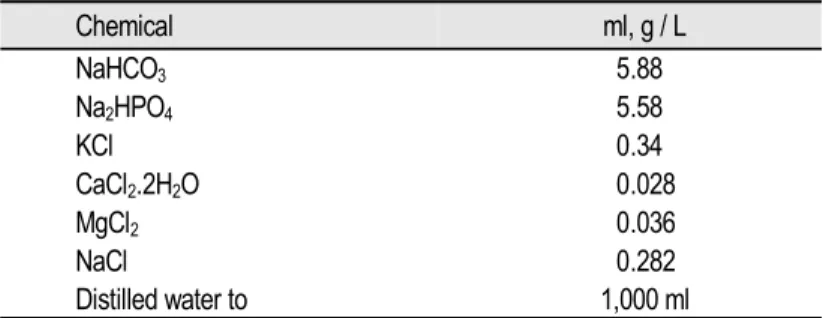
Rumen contents were obtained 2 h after the morning feeding (09:00) from three ruminally-cannulated non-lactating Holstein cows fed 8 kg/d total diets daily (5.6 kg concentrate and 2.4 kg rice straw, as fed basis), twice (09:00 and 18:00 h) per day, in an equal volume. The rumen fluid was strained through 12 layers of cheesecloth to remove the feed particles. Carbon dioxide (CO2) was flushed into the strained rumen fluid for 30 seconds. Culture solution was prepared by mixing 80ml strained rumen fluid with 80 ml McDougall`s artificial saliva (McDougall, 1948, Table 1; Wang et al., 2005) in 250 ml incubation bottle. Three grams of treatment on DM basis were placed in a nylon bag, and were placed in the flask containing the mixed solution (160 ml). The flask were then sealed with rubber stoppers fitted withe 3-way stopcocks and were incubated anaerobically in a shaking incubator (VS-8480 SR, VISON Science, Bucheon, Korea) at a speed of 135 rpm up to 48 h an 39℃.
Table 1. Buffer solution (Mcdougall’s artificial saliva).
Chemical ml, g / L
NaHCO3 5.88
Na2HPO4 5.58
KCl 0.34
CaCl2.2H2O 0.028
MgCl2 0.036
NaCl 0.282
Distilled water to 1,000 ml
Measurement and analysis
Incubation was stopped by removing the bottles from the shaking incubator at 1, 3, 6, 12, 24 and 48 h, and pH of
culture solution was immediately measured. At the same time an aliquot of culture solution was collected from each bottle for ammonia (1 ml) and volatile fatty acid (VFA, 0.8 ml) analysis. Ammonia concentration was determined by the method of Fawcett and Scott (1960) using a spectrophotometer. The 0.8 ml culture solution was mixed with 0.2 ml 25%
phosphoric acid and 0.2 ml pivalic acid solution as the internal standard for the VFA analysis as described by Li et. al., (2010). Total gas production was also measured at each incubation time through the 3-way stopcock connected to culture bottles. The nylon bag containing feed residue was washed with tap water and dried at 60℃ for 48 h in the drying oven to measure dry matter (DM) degradation. Crude protein (CP) were analyzed according to AOAC (1995).
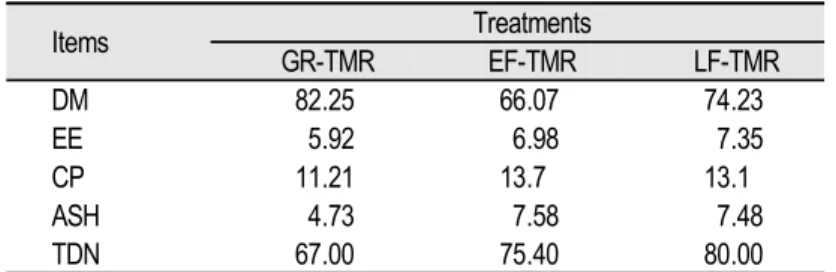
Chemical composition and TDN value of three TMRs presented in Table 2.
Table 2. Chemical composition and TDN value of various TMRs (%, DM basis).
Items Treatments
GR-TMR EF-TMR LF-TMR
DM 82.25 66.07 74.23
EE 5.92 6.98 7.35
CP 11.21 13.7 13.1
ASH 4.73 7.58 7.48
TDN 67.00 75.40 80.00
Estimation of effective degradability in vitro
Percent disappearance of DM at each incubation time was calculated from the portion remaining after incubation in the rumen. Disappearance rate was fitted to the equation of Orskov and McDonald (1979):
T(t) = a + b (1 - e-ct)
Where Y(t) is the proportion of the incubated material degraded at time t; ‘a’ is the water soluble and instantly degradable fraction; ‘b’ is the potentially degradable fraction; ‘c’ is the fractional rate of degradation of fraction b (h-1).
Non-linear parameters a, b and c was estimated by an iterative least square procedure to calculate effective degradability of DM (EDDM) according to the following equation (Orskov and McDonald, 1979)
Effective degradability = a + (b × c) / (c+r)
Where ‘r’ is the fractional outflow rate and a hypothetical fractional outflow rate (kp) of 0.05 / h was used for estimation of effective degradability.
Statistical analysis
The result obtained were subjected to least squares analysis of variance according to the general linear models procedure of SAS (1991) and significance were compared by Tukey`s HSD Test.
Results and Discussion
TMR has been used with a great interest by farmers because of its expected benefits in nutrition and production. The effects of TMRs on rumen and its degradability of whole tract digestibility were evaluated by current experiments.
The DM content was lowest for EF-TMR (66.07%) but it was highest for GR-TMR (82.25%). The CP content in TMRs was almost similar for GR-TMR and LF-TMR (13.1-13.7%, DM) but it was slightly high for GR-TMR. Lowest EE content was shown from GR-TMR (5.92%) among TMRs.
In vitro trial was made to examine the effect of various TMRs on fermentation characteristics, total gas production and degradation. The pH in incubation solution tended to decrease up to 48 h and no difference was found in pH among TMRs (Fig. 1).
Fig. 1. Effect of TDN level in TMR on pH by rumen microbes.
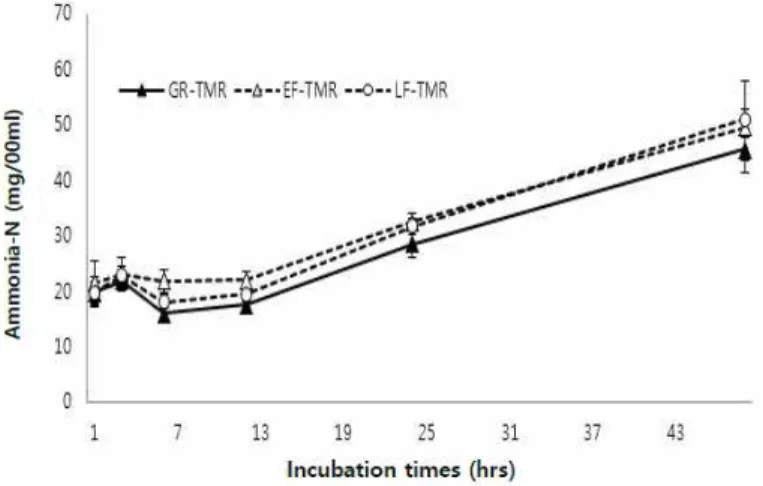
No difference was found in ammonia-N concentration among all treatments. The ammonia-N concentration in the all treatments was decreased at 6 h sampling time but became increased as the sampling time advanced in all TMRs (Fig.
2). The highest ammonia-N concentration was observed from EF-TMR at 1h sampling time but LF-TMR was highest at 48 h sampling time.
Fig. 2. Effect of TDN level in TMR on Ammonia-N concentrate by rumen microbes.
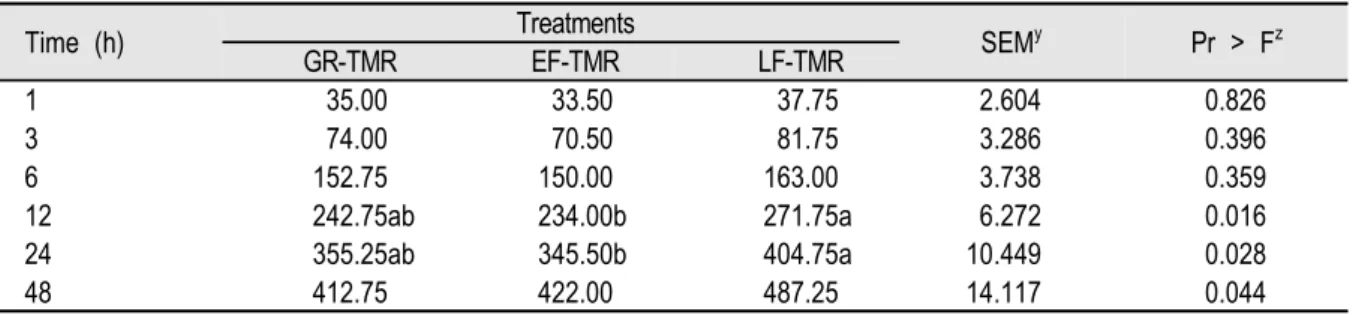
Gas productions for 48 h in vitro incubation was measured for the three TMRs (GR-TMR, EF-TMR, LF-TMR, Table 3). Rate of gas production was highest for LF-TMR, followed by GF-TMR and LF-TMR. Similar trends were observed in the rate of gas production by incubation times for the rapid fermentation period, where highest production from the LF-TMR and lowest from the EF-TMR in every incubation time up to 12 h. The amount of total gas produced by incubation time for the TMRs was shown in Table 3. Highest total gas production (P<0.05) was obtained from
LF-TMR, followed by EF-TMR, lowest amount was observed from GR-TMR during the relatively on incubation (12 to 48 h).
Table 3. Effect of TDN level in TMR on total gas production (ml) by rumen microbes.
Time (h) Treatments
SEMy Pr > Fz
GR-TMR EF-TMR LF-TMR
1 35.00 33.50 37.75 2.604 0.826
3 74.00 70.50 81.75 3.286 0.396
6 152.75 150.00 163.00 3.738 0.359
12 242.75ab 234.00b 271.75a 6.272 0.016
24 355.25ab 345.50b 404.75a 10.449 0.028
48 412.75 422.00 487.25 14.117 0.044
ySEM: Standard error of means.
zPr>F: probability level.
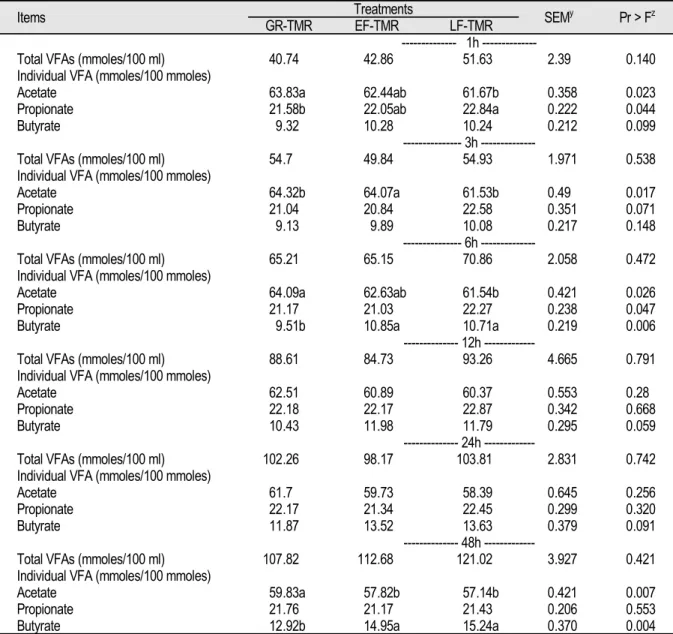
Total VFAs concentrate was no significant difference but LF-TMR was overall highest for incubation time. Acetate proportion was increased while those of propionate were decreased for all incubation time in all treatments. Butyrate proportion were increased after 3h incubation time (Table 4).
Degradation of TMRs was indicated in Table 5. Rapidly soluble fraction of DM in the rumen (a) was higher (p<0.05) in EF-TMR and LF-TMR. Potentially degradable fraction (b) of DM in the rumen was no significant difference all treatments. But EF-TMR was highest. No difference in the fractional rate of “b” per time (c) in DM was observed among treatments. The effective degradation of DM (EDDM) was no significant difference all treatments. But EF-TMR and LF-TMR was higher than GR-TMR.
Ruminal parameters such as pH and VFA have been responded to the diet. In general, higher the starch in the diets faster in fermentation, and thus pH can be lower while total VFA concentration can be increased. It also highly possible that proportion of propionic acid in the rumen fluid increase as starch in the grain is degraded by the rumen microbes. It is true that great processing the grains make them be degraded rapid in the rumen. Slightly lowered pH with increased ammonia-N in the rumen fluid may indicates the highly degraded protein sources in the diet, respectively as observed from the treatments.
The rate of gas production has been closely related with the rate of fermentation by ruminal microbes, and generally, grains have their own specific rate of fermentation patterns. The rate and extent of starch digestion in the rumen differed with the species of cereal grain.
Conclusion
Based on the results obtained from the present study, Rumen metabolites (including gases) were increased by high CP, ether extract (EE) and TDN in TMR for fattening period of Hanwoo steers and it is concluded that TMR may provide more favorable condition for nutrient digestion in the rumen by rumen microbes.
Acknowledgements
Supported by the Rural Development Administration (PJ01091003), Republic of Korea
Table 4. Effect of TDN level in TMR on VFA production by rumen microbes.
Items Treatments
SEMy Pr > Fz
GR-TMR EF-TMR LF-TMR
--- 1h ---
Total VFAs (mmoles/100 ml) 40.74 42.86 51.63 2.39 0.140
Individual VFA (mmoles/100 mmoles)
Acetate 63.83a 62.44ab 61.67b 0.358 0.023
Propionate 21.58b 22.05ab 22.84a 0.222 0.044
Butyrate 9.32 10.28 10.24 0.212 0.099
--- 3h ---
Total VFAs (mmoles/100 ml) 54.7 49.84 54.93 1.971 0.538
Individual VFA (mmoles/100 mmoles)
Acetate 64.32b 64.07a 61.53b 0.49 0.017
Propionate 21.04 20.84 22.58 0.351 0.071
Butyrate 9.13 9.89 10.08 0.217 0.148
--- 6h ---
Total VFAs (mmoles/100 ml) 65.21 65.15 70.86 2.058 0.472
Individual VFA (mmoles/100 mmoles)
Acetate 64.09a 62.63ab 61.54b 0.421 0.026
Propionate 21.17 21.03 22.27 0.238 0.047
Butyrate 9.51b 10.85a 10.71a 0.219 0.006
--- 12h ---
Total VFAs (mmoles/100 ml) 88.61 84.73 93.26 4.665 0.791
Individual VFA (mmoles/100 mmoles)
Acetate 62.51 60.89 60.37 0.553 0.28
Propionate 22.18 22.17 22.87 0.342 0.668
Butyrate 10.43 11.98 11.79 0.295 0.059
--- 24h ---
Total VFAs (mmoles/100 ml) 102.26 98.17 103.81 2.831 0.742
Individual VFA (mmoles/100 mmoles)
Acetate 61.7 59.73 58.39 0.645 0.256
Propionate 22.17 21.34 22.45 0.299 0.320
Butyrate 11.87 13.52 13.63 0.379 0.091
--- 48h ---
Total VFAs (mmoles/100 ml) 107.82 112.68 121.02 3.927 0.421
Individual VFA (mmoles/100 mmoles)
Acetate 59 .83a 57.82b 57.14b 0.421 0.007
Propionate 21.76 21.17 21.43 0.206 0.553
Butyrate 12.92b 14.95a 15.24a 0.370 0.004
Table 5. Effect of TDN level in TMR on in vitro degradation parameters and in vitro effective degradability of DM (EDDM) by rumen microbes.
Parametersx Treatments
SEMy Pr > Fz
GR-TMR EF-TMR LF-TMR
a 32.06b 36.32a 36.79a 0.823 0.008
b 39.32 44.70 40.76 1.295 0.271
c 6.83 6.44 7.73 0.617 0.73
EDDM 54.75 61.48 61.54 1.204 0.249
xa: Intercept representing rapidly soluble fraction in the rumen; b: Fraction of degradable at time infinity;, c: rate constant of disappearance “b”
ySEM: Standard error of means
zPr > F: probability level
References
AOAC. 1995. Official methods of analysis (13th Ed.). Association of Official Analytical Chemists, Washington, DC.
Fawcett JK, Scott JE. 1960. A rapid precise method for the determination of urea. Journal of Clinical Pathology 13:156-163.
Jin GL, Kim JK, Qin WZ, Jeong J, Jang SS, Shon YS, Choi CW, Song MK. 2012. Effect of feeding whole crop barley silage- or whole crop rye silage based-TMR and duration TMR feeding on growth, feed cost and meat characteristics of Hanwoo steers. Journal of Animal Science and Technology 54:111-124.
Kaiser D, Weniger JH. 1994. In vivo and in vitro investigations for nutrient digestibility and heat production of ruminants under heat stress and different nutritional levels. V. Comparison of in vitro and in vivo investigations with respect to energy metabolism and energy content of rations. Archiv. Tierzucht 37:535-545.
Li XZ, Long RJ, Yan CG, Choi SH, Jin GL, Song MK. 2010. Rumen microbial responses in fermentation characteristics and production of CLA and methane to linoleic acid in associated with alate or fumarate. Animal Feed Science and Technology.
155:132-139.
Mcdougall EI. 1948. Studies on ruminant saliva. 1. The composition and Output of sheep`s saliva. Biochemistry Journal 43:99-109.
Minson DJ, McLoed MN. 1972. The in vitro technique; its modification for estimating digestibility of large numbers of tropical pasture samples. Division of Tropical Pastures Technical Paper No. 8. Commonwealth Scientific and Industrial Research Organization, Melbourne, Australia.
Orskov ER, McDonald I. 1979. The estimation of protein degradability in the rumen from incubation measurements weighted according to the rate of passage. Journal of Agricultural Science 92:499-503.
SAS. 1991. SAS / STAT User`s Guide (Release6). SAS Inst., Inc., Cary, NC.
Song MK, Jin GL, Ji BJ, Chang SS, Jeong J. Smith SB, Choi SH. 2010. Conjugated linoleic acids content in M. longissimus dorsi of Hanwoo steers fed a concentrate supplemented with soybean oil, sodium bicarbonate-based monensin, fish oil. Meat Science 85:210-214.
Tafaj M, Zebeli Q, Junck B, Steingass H, Drochner W. 2005. Effects of particle size of a total mixed ration on in vivo ruminal fermentation patterns and inocula characteristics used for in vitro gas production. Animal Feed Science and Technology 123:139-154.
Wang JH, Choi SH, Yan CG, Song MK. 2005. Effect of monensin and fish oil supplementation on bio-hydrogenation and CLA production by rumen bacteria in vitro when incubated with safflower oil. Asian-aust. Journal of Animal Science 18:221-225.