This is an Open Access article distributed under the terms of the Creative Commons Attribution Non-Commercial License (http: //creativecommons.org/licenses/by- nc/4.0/) which permits unrestricted non-commercial use, distribution, and reproduction in any medium, provided the original work is properly cited.
Copyright: © 2018 Korean Journal of Agrcultural Science
https://doi.org/10.7744/kjoas.20180082
ANIMAL
Nutritional evaluation of total mixed rations containing rice grain in an in vitro rumen fermentation system
Sung Jae Yang
1, Han Been Kim
1, Joon Beom Moon
1, Na Eun Kim
1, Joong Kook Park
2, Byung Ki Park
3, Se Young Lee
4, Jakyeom Seo
1,*1
Life and Industry Convergence Research Institute, Department of Animal Science, Pusan National University, Miryang 50463, Korea
2
Institute of Livestock, Nonghyup Co., Ltd., Ansung 17558, Korea
3
Nonghyup Feed Co., LTD., Seoul 05398, Korea
4
Department of Animal Science, Yonam College, Cheonan 31005, Korea
*
Corresponding author: [email protected]
Abstract
This study was conducted to evaluate the nutritional value of total mixed rations (TMR) containing rice grain in an in vitro rumen fermentation system. Three types of grains (corn, wheat, and rice), timothy, and soybean meal (SBM) were used to prepare the experimental TMR: Corn TMR, Wheat TMR, and Rice TMR. The rumen fermentation characteristics of all the experimental TMRs were evaluated by an in vitro anaerobic system using rumen fluid for 24 and 48 h. The digestibility of the nutrients (dry matter [DM], crude protein [CP], and neutral detergent fiber [NDF]), pH, ammonia (NH
3-N), and volatile fatty acids (VFA) were determined.
Rice TMR showed a higher DM digestibility than that of the Corn TMR at 48 h (p < 0.05). In all treatments, the CP digestibility was more than 80% at 48 h, but no significant differences were observed among the treatments. The NDF digestibility tended to be the lowest in the Wheat TMR (p = 0.06), and the pH tended to be the lowest in the Rice TMR (p = 0.09) among the treatments for the 48 h incubation. The Wheat TMR had the highest NH
3-N concentration among the treatments (p < 0.01). Rice TMR had a lowest total VFA concentration among the treatments (p = 0.05) at 24 h, but no significant differences were observed at 48 h. Based on this in vitro result, it was considered that a rice grain has the potential to replace conventional grain ingredients when the TMR was formulated.
Keywords: in vitro, rice grain, rumen fermentation, total mixed ration
Introduction
Total mixed ration
(TMR
)은 조·농 완전혼합사료로서 조사료와 농후사료의 균형적 섭취, 사료 섭 취량 및 영양소 이용효율의 향상, 반추위내 발효를 안정시키는 등 여러 장점을 가지고 있다(Kleiber et al
.,1952
;Mcgilliard et al
.,1983
;Nocek et al
.,1985
). 또한 국내연구에서TMR
의 급여가 산육성 및 육OPEN ACCESS
Accepted: October 22, 2018 Revised: October 10, 2018 Received: August 10, 2018 DOI:
Citation: Yang SJ, Kim HB, Moon JB, Kim NE, Park JK, Park BK, Lee SY, Seo JK. 2018. Nutritional evaluation of total mixed rations containing rice grain in an in vitro rumen fermentation system.
Korean Journal of Agricultural Science.
https://doi.org/10.7744/kjoas.20180082
질등급을 높이는 데 효과가 있는 것으로 보고되면서(
Kim et al
.,2003
) 한우농가에서의TMR
급여량이 증가하고 있으며 최 근에는 한우 비육우 전체사료 급여량의20
%를 차지하는 것으로 보고되었다(KOSTAT
,2018
). 한편, 최근 축우 사양기술 및 신규 원료 탐색에 대한 지속적인 노력에도 불구하고 한우사양에서 사료비는 생산비의40
% 정도로 여전히 많은 부분 을 차지하고 있으며(KOSTAT
,2017
), 이는 국내 사료산업에서 사료원료의 높은 해외 의존도 때문인 것으로 보인다. 특히 사료곡물에 대한 국내 사료산업의 해외 의존도는 매우 높은데, 예를 들어 가축의 주 에너지 공급원인 옥수수의 경우 우리 나라가 세계에서2
번째로 많은 양을 수입하고 있다(FBOCNU
,2015
;Kim et al
.,2017
). 따라서 향후 안정적인TMR
의 제조 와 보급을 위해서는 국내 자급 가능한 사료 원료를 찾기 위한 지속적인 연구가 필요하다.2015
년 정부의 정책으로(MAFRA
,2015
)3
년 이상 저장된 현미 형태의 재고미를 사료용 원료로 사용할 수 있게 됨에 따 라 반추가축용 원료로서의 현미의 사료가치평가에 대한 필요성이 대두되었고, 이에 따라 수행된 현미의 영양적 가치평 가 연구에서는 반추위 발효성상과 경제성 측면에서 무처리 분쇄 현미가 사료원료로 적절하다고 보고된 바 있다(Yang et al
.,2018
). 그러나 기존 국내에서 수행된TMR
연구들을 살펴보면 인진쑥을 사용하거나(Moon et al
.,2011
), 동계사료작물 사일리지를 사용하는 등(Jung et al
.,2009
) 국내 조사료원료를TMR
에 적용하는 단계에서 연구가 주로 이루어져 왔고, 곡 물원료로서 재고미를TMR
사료원료로 사용한 연구는 수행된 적이 없었던 것으로 추정된다.따라서 본 연구의 목표는 현미를 곡류 원료로 사용한 실험용
TMR
을 제조하고 그 영양적 가치를 일반성분분석과in vitro
반추위 발효성상 변화로 평가하는데 있으며, 최종적으로TMR
배합의 주요 곡류 원료인 옥수수와 소맥의 대체 가능성을 평가하는데 있다.Materials and Methods
공시 재료 및 공시동물
본 연구를 수행하기 위해 사용된 현미, 소맥, 옥수수, 티모시, 대두박은 국내 배합사료회사 중 한 곳(
AT Immune Inc
.,Ochang
,Korea
)로부터 제공받았다. 현미와 대두박은 균일하게 파쇄된 형태로, 소맥과 옥수수는 파쇄하지 않은 형태로 제 공받았고, 티모시는 절단되지 않은 형태로 제공받았다. 모든 원료들은 실험에 사용되기 전, 각각1 mm
체가 부착된cyclone mill
(Foss
,HillerØd
,Demark
)로 분쇄되었고, 이후0
.3 mm
의 체를 통해 입자크기가0
.3
-1 mm
것만을 이용하였다. 실험에 사용된TMR
은 건물(dry matter
,DM
) 기준으로 다음과 같은 배합비로 제조되었으며, 가소화영양소 총량(TDN
)75
%를 충 족시킬 수 있도록 하였다.곡류원료(현미, 소맥, 옥수수):
70
% 조사료원료(티모시):23
%단백질 원료(대두박):
7
%본 연구에서 사용된 시험용
TMR
은 주원료에 따라Rice TMR
,Wheat TMR
,Corn TMR
의 세 처리구로 구분하였다. 실험 에 사용된 공시동물은 반추위 케뉼라가 장착된 건유기 홀스타인 젖소로(450
±30 kg
),6
:4
의 조농비율을 만족시키는 사 료를1
일2
회 급여 받았으며, 조사료원으로는 티모시를, 농후사료원으로는 상용 배합사료(Hafeed
,Co
.,Ltd
.,Busan
,Korea
;12
% 조단백질[crude protein
,CP
],3
.5
% 조지방[ether extract
,EE
],26
% 중성세제불용섬유소[neutral detergent fiber
,NDF
],10
% 조회분[Ash
])를 사용하였다. 공시동물은 자동급수기와mineral block
을 이용하여 물과 광물질을 자율 섭취하였다.영양소 분석
공시 사료 원료
5
종의DM
(#934
.01
), 조단백질(CP
, #976
.05
), 조지방(EE
, #920
.39
), 조회분(Ash
, #942
.05
)은AOAC
(2005
)에 제시된 방법에 따라 분석되었다.
CP
는 총 질소 함량의6
.25
배로 계산된 값을 측정하였고, 사료의 총 질소 함량은Nitrogen Combustion Analyzer
(Leco FP
-528 Leco
,MI
,USA
)를 이용하여 측정되었다. 섬유소 함량 평가를 위한 중성세제불 용섬유소(NDF
)와Lignin
은Van Soest et al
. (1991
)에 의해 분석되었으며,NDF
분석을 위해heat stable α
-amylase
를 사용하여 분석하고, 잔여ash
를 포함하여 표현하였다. 또한 상기의 분석항목을 이용하여 사료의 에너지가를TDN
으로 평가하기 위 해NRC
(2001
)의 젖소사양표준을 사용하였다. 본 연구에서 사용된 원료 및 시험용TMR
의 성분분석은Table 1
에 나타내 었다.in vitro 발효 실험
배양액을 분주하기 전, 각각의 공시사료는
1 g
씩Nylon bag
(R510
,Ankom Technology
,NY
,USA
)에 처리구 별로10
개씩 담겨 처리구 당2
개씩5
개의500 mL duran bottle
에 보관되었다. 반추위액은 당일 오전 사료급여 전 캐뉼라를 통해 채취되 었으며,2 L
보온병에 보관되어 즉시 연구실로 옮겨졌다. 이후8
겹의cheese cloth
에 걸러진 뒤1
:3
의 비율로in vitro buffer
(Goering and Van Soest
,1970
)에 희석되었고,O
2free
-CO
2에bubbling
시켜 완전 혐기 상태를 유지한 상태로 유지되었다. 이를nylon bag
이 담긴500 mL duran bottle
에240 mL
씩 분주하고bottle cap
을 이용하여 완전sealing
처리하였다.sealing
된duran bottle
은39
℃incubator
에서24
,48 h
동안 배양 처리를 거친 다음 해당 시간에 개봉하여DM
소화율,pH
,ammonia nitrogen
(NH
3-N
), 휘발성지방산(volatile fatty acid
,VFA
) 발생량을 각각 측정하였다.배양이 종료된 후, 소화물이 포함된 반추위액은
3000 rpm
×15 min
의 원심분리 과정을 거친 다음, 상등액의 각1 mL
씩 을NH
3-N
와VFA
측정을 위해 분리 채취하였다.NH
3-N
측정용 배양액에는0
.2 M H
2SO
4200 μL
를,VFA
측정용 배양액에 는25
%metaphosphoric acid 200 μL
를 각각 첨가하여vortexing
후 분석 전까지 -80
℃에 냉동 보관하였다. 시료가 담긴nylon bag
은 증류수를 이용하여6
-7
회 깨끗이 씻은 후55
℃dry oven
에서48
시간 건조, 방랭 후 무게를 측정하여DM
소화율을 측정하였다(Goering and Van Soest
,1970
).DM
소화율을 측정하고 난 뒤, 소화 잔량의CP
,NDF
함량을 측정하여CP
,NDF
소화율을 측정하였다.pH
는3000 rpm
×15 min
의 원심분리 과정을 거친 반추위액을pH meter
(FP20
,Mettler toledo
,OH
,USA
)를 이용하여 측정 하였다.NH
3-N
측정은Chaney and Marbach
(1962
)가 제시한 방법을 이용하여 측정하였다. 냉동 보관해둔 배양액Sample
을4
℃에서 녹이고,20
,000 rcf
×15 min
의 원심분리과정을 후 상층액200 μL
를1
.5 mL tube
에 분주하였다.NH
3-N standard
와 각각의 시료2 μL
씩을,phenol color reagent
(phenol 50 g
,sodium nitroferricyanide 0
.25 g
,distilled water 1 L
)와alkali
-hypochlorite
(sodium hydroxide 25 g
,sodium hypochlorite 16
.8 mL
,distilled water 1 L
) 각100 μL
씩을96 well cell plate
에 분주 하고, 항온 수 조(37
℃)에서15
분간 반응시켜microplate reader
(iMARK
,Biorad
,CA
,USA
)를 이용하여630 nm
의 파장에서 흡광도를 측정 하였다.VFA
의 측정은Erwin et al
. (1961
)이 제시한 방법에 따라 측정하였다. 보관해둔sample
을4
℃에서 녹이고,20
,000 rcf
×15 Table 1. Chemical composition (%DM or as fed basis) of feed ingredient and experimental TMR.
Items Rice Wheat Corn Timothy Soybean meal Rice TMR Wheat TMR Corn TMR
DM, as fed 88.5 90.1 89.2 93.4 89.6 89.7 90.8 90.2
CP 9.00 12.7 8.60 6.40 53.4 11.5 14.1 11.2
NDF 2.70 14.1 8.20 69.2 10.8 18.6 26.5 22.4
Lignin 0.97 1.54 2.78 7.30 1.28 2.40 2.80 3.70
EE 2.13 1.75 3.62 1.12 1.99 1.89 1.62 2.93
Ash 1.85 1.83 2.04 6.72 6.41 3.29 3.28 3.42
TDN 88.0 83.2 85.9 52.1 81.6 79.3 75.9 77.8
TMR, total mixed rations; DM, dry matter; CP, crude protein; NDF, neutral detergent fiber; EE, ether extract;
TDN, total digestible nutrients.
min
의 원심분리과정 후 상층액200 μL
를D
.W 800 μL
로 희석하여VFA
분석을 위한flame ionization detector
와capillary column
(NukolTM Fused silica capillary column 30 m
×250 μm
×0
.25 μm
,Supelco Inc
.,PA
,USA
)이 장착된gas chromatograph
(Agilent 7890A
,Agilent Technology
,CA
,USA
)를 이용하여 측정하였다. 측정을 위한oven
,injector
,detector
의 온도는 각각,90
,90
-200
,230
℃로 유지되었고, 질소는 이동상gas
로30 mL
/min
의flow rate
를 유지하며 사용되었다.통계 분석
in vitro
실험에서 측정된 모든data
는SAS package 9
.3
(SAS Institute Inc
.,Carey
,NC
,USA
)의GLM procedure
에 의해 분석되 었다.TMR
의 따른 처리구 간 유의적 차이는Tukey
검정에 의해95
% 유의수준으로 분석되었다.Results & Discussion
원료사료 및 TMR의 영양소 성분 분석
본 연구에서 사용된 공시사료의 및 원료사료의 영양소 성분분석 결과는
Table 1
에 나타내었다. 세 가지TMR
처리구에 대한 영양소 성분분석은 주원료(현미, 소맥, 옥수수)와 티모시, 대두박의 배합비율(주원료70
%, 티모시23
%, 대두박7
%) 에 따라 계산되었다.Rice
,Wheat
,Corn TMR
각각의 건물 함량은89
.7
,90
.8
,90
.2
%로 세 처리구 모두 비슷한 수치를 나타내었고,CP
함량은Wheat TMR
(14
.1
%DM
)에서Rice TMR
(11
.5
%DM
),Corn TMR
(11
.2
%DM
) 보다 상대적으로 높았다.NDF
와lignin
의 경 우에는Rice TMR
이18
.6
%DM
,2
.40
%DM
으로 세 가지TMR
처리구 중 가장 낮은 수치를 보였다.TDN
은Rice TMR
(79
.3
%DM
)>Corn TMR
(77
.8
%DM
)>Wheat TMR
(75
.9
%DM
) 순서로 높게 나타났다. 이는 원료로 사용된 현미의 낮은CP
,NDF
,lignin
함량이 소맥과 옥수수를TMR
원료에서 대체함에 따라 나타난 결과로 사료되며, 각 원료의 일반성분분석 을 고려해볼 때(Table 1
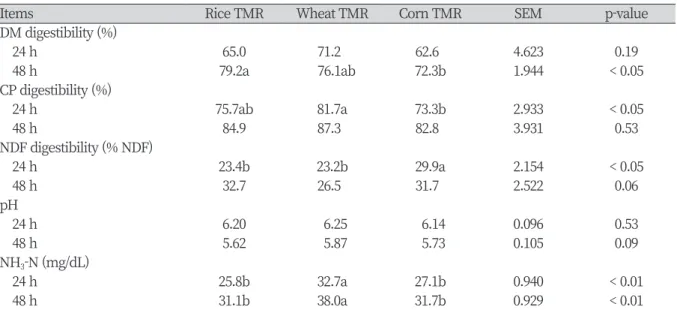
), 현미는 소맥보다 옥수수와 유사한 양의 각각의 영양소를 함유하고 있는 것으로 보인다.Table 2. In vitro fermentation of TMR with different treatments.
Items Rice TMR Wheat TMR Corn TMR SEM p-value
DM digestibility (%)
24 h 65.0 71.2 62.6 4.623 0.19
48 h 79.2a 76.1ab 72.3b 1.944 < 0.05
CP digestibility (%)
24 h 75.7ab 81.7a 73.3b 2.933 < 0.05
48 h 84.9 87.3 82.8 3.931 0.53
NDF digestibility (% NDF)
24 h 23.4b 23.2b 29.9a 2.154 < 0.05
48 h 32.7 26.5 31.7 2.522 0.06
pH 24 h 6.20 6.25 6.14 0.096 0.53
48 h 5.62 5.87 5.73 0.105 0.09
NH
3-N (mg/dL)
24 h 25.8b 32.7a 27.1b 0.940 < 0.01
48 h 31.1b 38.0a 31.7b 0.929 < 0.01
TMR, total mixed rations; SEM, Standard error of the mean; DM, dry matter; CP, crude protein; NDF, neutral detergent fiber.
a, b: Means within a row with different superscript letters indicate significant differences between treatments (p
< 0.05).
공시 재료의 in vitro 발효 평가
공시재료의
in vitro
발효 성상 결과는Table 2
와Table 3
에 제시하였다. 세TMR
처리구의 건물 소화율은 배양시간이 지 남에 따라 증가하였다(Table 2
).24 h
의 소화율은Rice TMR
(65
.0
%),Wheat TMR
(71
.2
%),Corn TMR
(62
.6
%) 간 유의적 차 이를 나타내지 않았다. 배양48 h
에서는Rice TMR
의 소화율(79
.2
% )이Corn TMR
의 소화율(72
.3
% )에 비해 유의적으로 높았다(p
<0
.05
). 이는Oh et al
. (2006
)이in situ
연구에서 현미가 옥수수에 비해 높은 소화율을 나타냈다고 보고한 결과와 동일한 경향으로서, 주원료인 현미와 옥수수의 소화율이 각각Rice TMR
과Corn TMR
소화율에 직접적인 영향을 미친 것 에 따른 결과로 보인다. 또한 반추위 환경에서 다른 곡류들에 비해 상대적으로 빠르게 분해되는 소맥의 특성이(Herrera
-Saldana et al
.,1990
;Opatpatanakit et al
.,1994
)24 h Wheat TMR
소화율의 유의적 차이에 영향을 줄 것으로 예상하였으나, 실 제 측정된 값에는 유의적 차이가 없었으며, 상기의 유의적 차이를 확인하기 위하여24 h
이전의 초기 배양 시간(e
.g
.,3
,6 h
)의 소화율 측정이 필요할 것으로 사료된다. 또한Rice TMR
과Corn TMR
의 건물소화율은Miyaji et al
. (2012
)의 현미와 옥 수수를 이용한TMR
연구와 동일한 경향을 보였으나 다른 발효성상들은 다소 차이를 보였다. 이는 측정방법의 차이 이외 에도TMR
의 농후사료(옥수수 또는 현미) 대 조사료 비율, 원료에 대한silage
,flake
처리 등TMR
의 구성성분 및 제조방법 의 차이에 의한 것으로 생각된다.CP
소화율은 배양24 h
에서Rice TMR
이75
.7
%,Wheat TMR
이81
.7
%,Corn TMR
이73
.3
%로Wheat TMR
이 가장 높은 결 과를 보였고(p
<0
.05
),Rice TMR
과Corn TMR
간의 유의적 차이는 나타나지 않았다.48 h
에서는Rice TMR
,Wheat TMR
,Corn TMR
의CP
소화율이 모두80
% 이상이었으나 처리구 간 유의적 차이는 보이지 않았다. 기존 연구에서 보고된TMR
의CP
소화율은in situ
상에서Rice TMR
이 약90
% (24 h
),Wheat
,Corn TMR
이90
% 이상(48 h
)이었고(Herrera
-Saldana et al
.,1990
;Miyaji et al
.,2010
), 이에 비해 본 연구의CP
소화율은 전반적으로 낮았는데, 이는 본 연구에서 사용된 분해율 평가법 (in vitro
)과 기존연구의 평가법(in situ
)의 차이에 의한 것으로 추정된다.시험용
TMR
의NDF
소화율은 배양24 h
에서Corn TMR
이29
.9
%NDF
로 가장 높은 결과를 보였다(p
<0
.05
). 또한 배양48 h
에서는 세TMR
처리구간NDF
소화율이 유의적 차이는 보이지 않았지만,Rice TMR
(32
.7
%NDF
)이Wheat TMR
Table 3. Volatile fatty acids production of TMR with different treatments.
Item Rice TMR Wheat TMR Corn TMR SEM p-value
TVFA (mM)
24 h 70.6 77.8 78.1 3.183 0.05
48 h 99.4 102.2 94.8 3.550 0.16
Acetate (mmol/mol)
24 h 574.8 578.6 578.0 6.195 0.79
48 h 547.2 563.4 555.4 9.898 0.30
Propionate (mmol/mol)
24 h 231.6 229.0 227.5 6.021 0.79
48 h 248.2 232.6 237.2 7.893 0.17
Butyrate (mmol/mol)
24 h 143.0a 135.8b 143.8a 1.638 < 0.01
48 h 155.2 145.9 155.0 4.713 0.12
A : P ratio
24 h 2.48 2.53 2.55 0.090 0.77
48 h 2.21 2.43 2.34 0.116 0.19
TMR, total mixed rations; SEM, Standard error of the mean; TVFA, total volatile fatty acid; A : P ratio, acetate : propionate ratio.
a, b; Means within a row with different superscript letters indicate significant differences between treatments (p
< 0.05).
(
26
.5
%NDF
)보다NDF
소화율의 높은 경향을 나타내었다(p
=0
.06
).pH
는 일반적으로 반추위에서 발생하는 소화에 의해 감소하게 되는데(Russell
,2002
), 본 연구에서도 배양시간이 증가함 에 따라 모든TMR
처리구의pH
가 감소한 수치를 보였다.48 h
에서Rice TMR
이Wheat TMR
보다 낮은 경향을 보였으나(p
=
0
.09
), 그 외에 두 배양시간 모두에서 처리구 간 유의적 차이는 나타나지 않았다.NH
3-N
발생량은 시간이 지남에 따라 모두 증가하였다.24
,48 h
모두에서Wheat TMR
의NH
3-N
발생량이 가장 높았고(p
<
0
.01
),Rice TMR
과Corn TMR
은 처리구 간 유의적 차이를 보이지 않았다.NH
3-N
발생량이 소맥에서 가장 높았던 것은 건물소화율과 조단백질 소화율을 고려해 보았을 때, 소화율에 의한 차이보다는Wheat TMR
의 조단백질 함량이Rice TMR
과Corn TMR
보다 높았기 때문으로 여겨진다.총
VFA
발생량(Table 3
)은24 h
에서Rice TMR
이Wheat TMR
과Corn TMR
에 비해 낮은 경향성을 보였으나(p
=0
.05
), 배 양48 h
에서 총VFA
의 유의적 차이는 발견되지 않았다(p
>0
.05
). 모든 배양 시간에서acetate
,propionate
의 비율은 처리구간 유의적인 차이를 나타내지 않았으며, 배양24 h
에서Wheat TMR
의butyrate
비율은 다른 처리구에 비해 유의적으로 낮았다 (p
<0
.01
). 현미를 단일원료로 사용한 기존의in vitro
연구에 비해 본 연구에서 측정된Rice TMR
처리구의acetate
발생 비 율은 높고,propionate
비율은 낮았다(Yang et al
.,2018
).acetate
의 발생비율은 섬유질 사료가acetate
생산 박테리아 종을 성장 시켜 증가하고,propionate
는 농후사료에 의해propionate
생산 박테리아종이 발달하여 증가하므로(France and Dikstra
,2005
), 본 연구에서TMR
제조 시 섬유질 공급원인 티모시를 일정 함량(23
%) 공급한 것이 기존 연구와 본 연구간,acetate
,propionate
비율에 차이를 가져온 것으로 보인다.Conclusion
본 연구에서는 현미를 이용한
TMR
의 사료가치 평가 및TMR
에서의 곡류사료원료의 대체 가능성 평가를 위해Rice TMR
,Wheat TMR
,Corn TMR
의 영양소 분석 및in vitro
소화율을 분석하였다. 건물소화율은48 h
에서Rice TMR
이Corn TMR
에 비해 높은 결과를 보였으나(p
<0
.05
)CP
소화율과NDF
소화율은 세TMR
처리구 간 유의적 차이가 없었고,VFA
생성량,acetate
,propionate
의 비율에서도 처리구 간 유의적 차이를 나타내지 않았다. 상기의 결과를 바탕으로 현미는TMR
제조 시 사용되는 주요 곡물 원료인 옥수수와 소맥을 충분히 대체 가능할 것으로 사료되며 현미 대체TMR
을 적용한 사 양실험이 필요할 것이다. 옥수수를 현미로 대체한TMR
을 사용한 기존 사양 평가에서(Miyaji et al
.,2014
) 현미의40
% 이 상 사용은 건물 섭취량과 유생산량에 부정적인 영향을 미친 것으로 보고하고 있으므로, 비육우를 대상으로 한 사양실험 에서TMR
내 현미의 적정 사용비율에 대한 추가적인 연구가 필요할 것으로 사료된다.Acknowledgements
본 연구는 부산대학교 자유학술과제 연구비(
2
년)에 의하여 연구되었습니다.References
AOAC (Association of Official Analytical Chemists). 2005. Official methods of analysis of AOAC International. AOAC international, Gaithersburg, MD, USA.
Chaney AL, Marbach EP. 1962. Modified reagents for determination of urea and ammonia. Clinical chemistry 8:130-132.
Erwin ES, Marco GJ, Emer EM. 1961. Volatile fatty acid analyses of blood and rumen fluid by gas chromatography. Journal of dairy science 44:1768-1771.
FBOCNU (Foundation of research and Business of Chungnam National University). 2015. Development of program for calculating the retail price of Hanwoo’s formulated feed and plan of cost reduction. p. 2.
FBOCNU, Daejeon, Korea.
France J, Dikstra J. 2005. Violatile fatty acid production. In Quantitative aspects of ruminant digestion and metabolism (2nd) edited by Dijkstra J, Forbes JM, France J. p 159. CABI Publishing, Cambridge, MA.
Goering HK, Van Soest PJ. 1970. Forage fiber analysis: (apparatus, reagents, procedures, and some applications). Agricultural Research Service, U.S. Department of Agriculture, Maryland, USA.
Herrera-Saldana RE, Huber JT, Poore MH. 1990. Dry matter, crude protein, and starch degradability of five cereal grains1. Journal of Dairy Science 73:2386-2393.
Jung GW, Jo IH, Hwangbo S, Lee SH. 2009. Effects of feeding total mixed rations containing different winter forage crop silages on feed intake, nutrient digestibility and blood characteristics in Korean black goats. Journal of The Korean Society of Grassland and Forage Science 29: 389-398. [in Korean]
Kim DH, Park HY, Choi CW. 2017. Comparison of in vitro ruminal fermentation between different originated corn grains. Korean Journal of Agricultural Science 44:541-548. [in Korean]
Kim KH, Kim KS, Lee SC, Oh YG, Chung CS, Kim KJ. 2003. Effects of total mixed rations on ruminal characteristics, digestibility and beef production of Hanwoo steers. Journal of Animal Science and Technology 45:387-396. [in Korean]
Kleiber M, Smith AH, Black AL, Brown MA, Tolbert BM. 1952. Acetate as a precursor of milk constituents in the intact dairy cow. Journal of Biological Chemistry 197:371-379.
KOSTAT (Statistics Korea). 2017. Survey on production cost of agricultural and livestock products in 2016.
Statistics Korea, Daejeon, Korea. [in Korean]
KOSTAT (Statistics Korea). 2018. Current state of Hanwoo beef cattle breeding. Statistics Korea, Daejeon, Korea. [in Korean]
MAFRA (Ministry of Agriculture, Food and Rural Affairs). 2015. Mid to long term supply-demand stability measures of rice. MAFRA, Sejong, Korea. [in Korean]
McGilliard ML, Swisher JM, James RE. 1983. Grouping lactating cows by nutritional requirements for feeding. Journal of Dairy Science 66:1084-1093.
Miyaji M, Nonaka K, Matsuyama H, Hosoda K, Kobayashi R. 2010. Effects of cultivar and processing method of rice grain on ruminal disappearance characteristics. Japanese Journal of Grassland Science 56:13-19. [in Japanese]
Miyaji M, Matsuyama H, Hosoda K, Nonaka K. 2012. Effect of replacing corn with brown rice grain in a total mixed ration silage on milk production, ruminal fermentation and nitrogen balance in lactating dairy cows. Animal Science Journal 83:585-593.
Miyaji M, Matsuyama H, Hosoda K. 2014. Effect of substituting brown rice for corn on lactation and digestion in dairy cows fed diets with a high proportion of grain. Journal of dairy science 97:952-960.
Moon YH, Yang JB, Jung IC. 2011. Effect of feeding mugwort (artemisia capillaris) TMR fodder on physicochemical and sensory characteristics of Hanwoo rump meat. Journal of the East Asian Society of Dietary Life 21:345-352. [in Korean]
Nocek JE, Steele RL, Braund DG. 1985. Effect of mixed ration nutrient density on milk of cows transferred from high production group. Journal of Dairy Science 68:133-139.
NRC (National Research Council). 2001. Nutrient requirements of dairy cattle (7ed). National Academic Press, Washington D.C., USA.
Oh YK, Kim KH, Choi CW, Kang SW, Chung IB, Nho WG. 2006. Evaluation of feeding value of brown rice in Korean native beef steers (Hanwoo). Journal of Animal Science and Technology 48:393-400. [in Korean]
Opatpatanakit Y, Kellaway RC, Lean IJ, Annison G, Kirby A. 1994. Microbial fermentation of cereal grains in vitro. Australian Journal of Agricultural Research 45:1247-1263.
Russell JB. 2002. Rumen microbiology and its role in ruminant nutrition. p. 10. Cornell University, Ithaca, NY, USA.
Van Soest PJ, Robertson JB, Lewis BA. 1991. Methods for dietary fiber, neutral detergent fiber, and nonstarch polysaccharides in relation to animal nutrition. Journal of dairy science 74:3583-3597.
Yang SJ, Jung ES, Kim HB, Shin TS, Cho BW, Cho SK, Kim BW, Seo JK. 2018. Nutritional evaluation of rice with different processing treatments on in vitro rumen fermentation characteristics and in situ degradation. Korean Journal of Organic Agriculture 26:281-296. [in Korean]