This is an Open Access article distributed under the terms of the Creative Commons Attribution Non-Commercial License (http: //creativecommons.org/licenses/by- nc/4.0/) which permits unrestricted non-commercial use, distribution, and reproduction in any medium, provided the original work is properly cited.
Copyright: © 2018 Korean Journal of Agrcultural Science
https://doi.org/10.7744/kjoas.20180026
ANIMAL
Comparison of in vitro ruminal fermentation incubated with different levels of Korean corn grains with total mixed ration as a basal
Muhammad Mahboob Ali Hamid
1, Ha Young Park
2, Chang Weon Choi
1*
1
Department of Animal Resources, Daegu University, Gyeongsan 38453, Korea
2
Department of Pathology, Busan Paik Hospital, Inje University College of Medicine, Busan 47392, Korea
*Corresponding author: [email protected]
Abstract
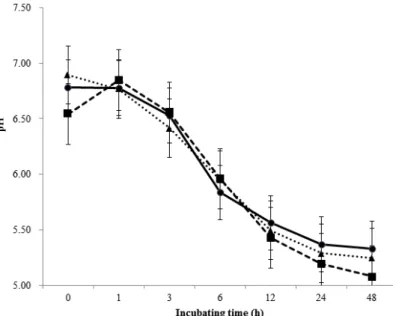
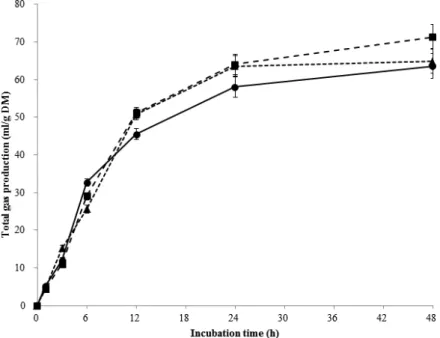
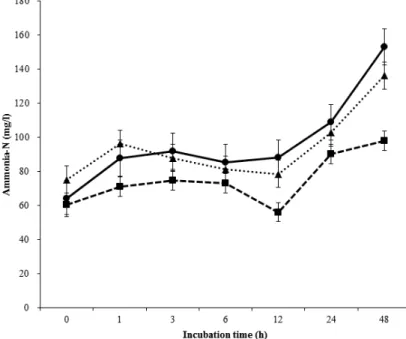
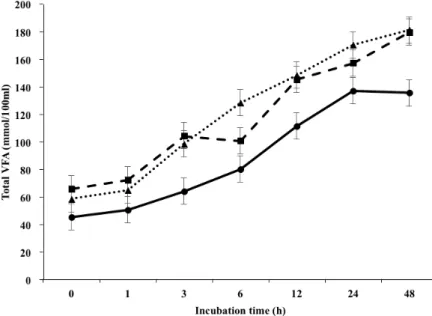
The present study was conducted to investigate the effect of different levels of Korean corn grain on in vitro ruminal fermentation with total mixed ration (TMR) as a basal feed. Three ruminal cannulated Holstein steers (Body Weight 479 ± 33.0 kg) were used as rumen fluid donors. Treatments for in vitro fermentation were TMR only (control, 3.0 g), TMR substituted partially with high level (HC, TMR 1.5 and corn 1.5 g), and with low level of Korean corn grain (LC, TMR 2.25 and corn 0.75 g), respectively. To measure in vitro ruminal pH, gas production, ammonia N and volatile fatty acids (VFA), the in vitro fermentation incubation was triplicated at 39℃, 120 rpm for 0, 1, 3, 6, 12, 24 and 48 h, respectively. Mean ruminal pH was significantly lower (p < 0.05) for HC than control. Changes in rumen pH was rather similar between the groups till 6 h after incubation, but the lowest pH for HC (pH 5.10) appeared at 48 h compared with control and LC. Total gas production was tended (p < 0.09) to be higher and ammonia N was significantly lower (p < 0.05) for HC than control and LC. Total VFA was higher (p < 0.05) for HC and LC than control but no differences appeared between HC and LC. Overall, the present data indicate that feeding different levels of Korean domestic corn grain may lead to high and sustainable starch degradation in the rumen.
Keywords: different level, in vitro rumen fermentation, Korean corn grain, ruminal pH
Introduction
Corn grains are considered to be the most adaptable feed energy sources for livestock but the optimization of corn feeding levels as an energy source remains under discussion amongst the ruminant nutritionists (Huntington, 1997; Lee et al., 2002; Van Zwieten et al., 2008; Kim et al., 2017a). Acceptability of corn grain as an energy source is because of its chemical composition, which has 72% dry matter (DM) as starch as compared to barley and oats are approximately 57% to 58% (Huntington, 1997).
By increasing rumen available energy contents in the diets of cattle has the OPEN ACCESS
Accepted: April 25, 2018 Revised: January 30, 2018 Received: November 20, 2017 DOI:
Citation: Hamid MMA, Park HY, Choi CW.
2018. Comparison of in vitro ruminal fermentation incubated with different levels of Korean corn grains with total mixed ration as a basal. Korean Journal of Agricultural Science. https://
doi.org/10.7744/kjoas.20180026
potential for improved efficiency of nutrient utilization in the rumen and also increased microbial activity along with metabolizable nutrient supply (Gozho and Mutsvangwa, 2008). Generally in high- producing ruminants, energy supplied via starch is useful for them and major sources are maize, barley, wheat, rye, triticale, sorghum and oats. All of the cereal grains show large variations in their amounts of ruminally degradable protein and starch (Seifried et al., 2016; Seifried et al., 2017).
Although, highly fermentable diets are quickly converted to organic acids within the rumen and they can easily dissociate to decrease rumen pH. It can increase the risk of sub-acute and acute acidosis inhibiting fiber utilization by bacteria (Plaizier et al., 2001).
In Korea, imported concentrates is estimated to be more than 11 million metric tons (MT) per year;
specifically corn (Seo, 2005). Over 99% of corn used in Korea is imported so that only below 0.1% of Korean domestic corn is used as a feed. For the year 2016, corn production was 75,550 MT, though it is more than mean of the previous 10 years but needs attention (ROKGFAR, 2017).
For increased production of high marbling beef and milk yield, corn is the main feed ingredient for energy supply. Although many studies in terms of digestibility, rumen metabolism and reviews of grains including corn were reported (Galyean et al., 1981; Huntington, 1997; Van Zwieten et al., 2008; Kim et al., 2017a). However, few data from rumen studies including rumen fermentation characteristics of Korean domestic corn as a main feedstuff are available. In vitro systems have provided less expensive, more rapid alternatives and valuable data on kinetic aspects of starch digestion (Huntington, 1997). Therefore, this study conducted to investigate the effect of different levels of Korean corn grain on in vitro ruminal fermentation with total mixed ration (TMR), providing fundamental data of Korean corn in terms of rumen nutrition.
Material and Methods
Experimental design and treatments
Three ruminally cannulated Holstein steers (Body Weight 479 ± 33.0 kg) were used as rumen fluid donors and adapted to TMR diet for 21 days. TMR was being fed (09:00 and 17:00) daily. Water and mineral-vitamin block were allowed ad libitum. For in vitro rumen fermentation, treatments were TMR only (control, 3.0 g), TMR substituted partially with high level (HC, TMR 1.5 and corn 1.5 g), and low level of Korean corn grain (LC, TMR 2.25 and corn 0.75 g), respectively.
Ruminal inoculation and in vitro incubation
Rumen digesta was collected after two hours of morning feeding and filtered with 4 layers of
cheesecloth. Rumen fluid buffer mixture, comprising McDougall buffer (McDougall, 1948) and the
rumen liquor in the ratio of 2 to 1, was dispensed anaerobically into 150 mL glass bottle containing
one of the treatments as substrate. All bottles were filled and capped with a rubber stopper and held
in a shaking incubator (Jeio Tech, SI-900R, Daejeon, Korea). Each of the in vitro fermentation
incubation was triplicated at 39℃, 120 rpm for 0, 1, 3, 6, 12, 24 and 48 h, respectively. Incubated
samples were collected and gas production measurement was done according to the assay outlined by (Theodorou et al., 1994). Gas pressure in the headspace was read from the display unit after insertion of the hypodermic syringe needle through the butyl rubber stopper above the culture medium. After that samples were filtered through four-layer cheesecloth and then liquor was used to measure pH using digital pH meter. For ammonia-N determination 0.3 mL of 50% H
2SO
4was added to 15.0 mL of rumen fluid. For volatile fatty acid (VFA) determination, 1.0 mL of saturated HgCl
2solution and 4.0 mL of 1 M NaOH solution were added to 10.0 mL of rumen fluid. Samples were stored frozen at - 20ºC until analysed. Ammonia-N and VFA were determined according to (Choi and Oh, 2011).
Feed composition analysis
All the treatment samples were frozen and dried in a 60ºC forced air oven. Samples were ground to pass a 6 mm sieve in a Wiley mill (Model 4; Thomas scientific, Swedesboro, NJ, USA) and analyzed for DM, crude protein (CP), ether extract, crude fiber and crude ash according to the procedure of (AOAC, 1990). The concentration of neutral detergent fiber corrected for residual ash was determined with heat-stable amylase and sodium sulfate according to the method of (Van Soest et al., 1991).
While the concentration of acid detergent fiber corrected for residual ash was determined according to the procedure of (AOAC, 1990). The chemical composition of experimental feeds is given in Table 1.
Statistical analysis
Data for pH, gas production, ammonia N and VFA were analyzed using the general linear model procedure of the Statistical Analysis System Institute, Inc. (SAS, 2002). Differences among means were tested for significance (p < 0.05) using the least significant difference.
Results and Discussion
Differences in ruminal pH were observed among different levels of Korean corn grains (Table 2 Table 1. Chemical composition of experimental feeds (% of dry matter basis).
Items Total mixed ration
zDomestic corn
Dry matter (%) 62.75 81.21
Crude protein 17.24 10.95
Ether extract 5.85 5.62
Crude fiber 13.85 2.23
Crude Ash 7.92 1.31
Calcium 0.62 0.0070
Phosphorus 0.53 0.32
Neutral detergent fiber 32.30 7.81
Acid detergent fiber 15.75 2.13
Calorie (kcal/g of dry matter) 4.41 4.49
z
Total mixed ration consisted of commercial corn based concentrate (48.5%), barley brewer’s grain (25.5%), rice
straw silage (13.4%), perilla meal (6.7%), corn flake (2.8%), soybean curd process (2.8%) and limestone (0.3%).
and Fig. 1). Mean ruminal pH was significantly lower (p < 0.05) for HC than control. Changes in rumen pH was rather similar between the groups till 6 h after incubation, but the lowest pH for HC (pH 5.10) appeared at 48 h compared with control and LC. Generally low ruminal pH can affect feed intake, microbial metabolism and feed digestion (Dijkstra et al., 2012). Previous study
Table 2. Effect of different levels of Korean corn grains with total mixed ration on in vitro rumen fermentation parameters.
Items Treatments
zControl HC LC SEM
Ruminal pH 6.03a 5.95b 6.01ab 0.026
Gas production (mL/g DM) 92.9 98.9 96.2 2.370
Ammonia N (mg/l) 101.6a 74.7b 100.3a 4.750
Total VFA (mmoles/100mL) 89.1b 124.6a 121.3a 6.200
Individual VFA (mmoles/100mL)
Acetate 51.2b 50.9b 52.1a 0.210
Propionate 25.7a 25.3b 25.09b 0.104
Iso-butyrate 0.91a 0.86b 0.86b 0.009
Butyrate 17.4c 18.9a 17.9b 0.120
Iso-valerate 1.51b 1.58a 1.55b 0.020
Valerate 1.72a 1.57b 1.64ab 0.010
Capronic acid 0.73 0.72 0.76 0.009
Acetate/Propionate 2.02b 2.05b 2.11a 0.015
SEM, Standard error of the mean; VFA, Volatile fatty acid; TMR, total mixed ration.
z