Citation: Choi EJ, Lee JH, Jeong HC, Kim SH, Lim JS, Lee DK, Oh TK. 2017. Analysis of research trends in methane emissions from rice paddies in Korea. Korean Journal of Agricultural Science 44:463-476.
DOI: https://doi.org/10.7744/kjoas.20170055 Editor: Jwakyung Sung, National Institute of Agricultural Sciences, Korea
Received: October 10, 2017
Revised: October 23, 2017 Accepted: October 24, 2017 Copyright: © 2017 Korean Journal of Agricultural Science.
This is an Open Access article distributed under the terms of the Creative Com- mons Attribution Non-Commercial License (http:
//creativecommons.org/licenses/by-nc/4.0/) which permits unrestricted non-commercial use, distribution, and reproduction in any medium, provided the original work is properly cited.
OPEN ACCESS
REVIEW ARTICLE
Analysis of research trends in methane emissions from rice paddies in Korea
Eun-Jung Choi
1†, Jae-Han Lee
2†, Hyun-Cheol Jeong
1, Su-Hun Kim
2, Ji-Sun Lim
2, Dong-Kyu Lee
2, Taek-Keun Oh
2*1
Division of Climate Change & Agroecology, Department of Agricultural Environment, National Academy of Agricultural Science, Wanju 55365, Korea
2
Department of Bio-environmental Chemistry, Chungnam National University, Daejeon 34134, Korea
*Corresponding author: [email protected]
†
These authors contributed equally to this work as the first authors.
Abstract
Climate change is considered as the greatest threat to our future and descendants. The Korean government has set a target for 2030 to reduce emission of greenhouse gases (GHGs) by 37% from the business-as-usual levels which are projected to reach 851 million metric tons of CO
2eq (Carbon dioxide equivalent). In Korea, GHGs emission from agriculture account for almost 3.1% of the total of anthropogenic GHGs. The GHGs emitted from agricultural land are largely classified into three types: carbon dioxide (CO
2), methane (CH
4), and nitrous oxide (N
2O). In Korea, rice paddies are one of the largest agricultural CH
4sources. In order to analyze domestic research trends related to CH
4emission from rice paddies, 93 academic publications including peer reviewed journals, books, working papers, reports, etc., published from 1995 to September 2017, were critically reviewed. The results were classified according to the research purposes. CH
4characteristics and assessment were found to account for approximately 65.9% of the research trends, development of CH
4emission factors for 9.5%, CH
4emission reduction technology for 14.8%, and CH
4emission modeling for 6.3%, etc. A number of research related to CH
4emission characteristics and assessment have been studied in recent years, whereas further study on CH
4emission factors are required to determine an accurate country-specific GHG emission from rice paddies. Future research should be directed toward both studies for reducing the release of CH
4from rice paddies to the atmosphere and the understanding of the major controlling factors affecting CH
4emission.
Keywords: greenhouse gas, methane, paddy soil, research trend
Introduction
농업부문에서 배출되는 대표적인 온실가스(Greenhouse gas)는 배출원에 따라 분류하면 벼 재 배 부분에서의 메탄(CH
4) 발생과 농경지 토양에서의 아산화질소(N
2O) 배출로 구분할 수 있다.
온실가스 배출에 따른 기후변화(Climate change)는 미래 세대를 포함한 우리 사회에 환경 문제를
통한 큰 위협이 되고 있으며, 이러한 위협에 대응하기 위해 국제 사회는 기후변화 핵심 매뉴얼인
교토의정서(Kyoto Protocol, 1998)와 신 기후 체제의 출범을 알린 파리협정(Paris Agreement, 2015)을 이끌어냈다.
우리나라는 2009년 11월에 2020년 온실가스 배출량 전망치(Business as usual) 776.1 백만 톤 CO
2eq. (Carbon dioxide equivalent) 대비 30% 감축을 처음 발표 하였으며, 이후 2015년 6월에는 2030년의 온실가스 배출량 전망치 851 백만 톤 CO
2eq. 대비 37%를 감축하는 것으로 발표하였다.
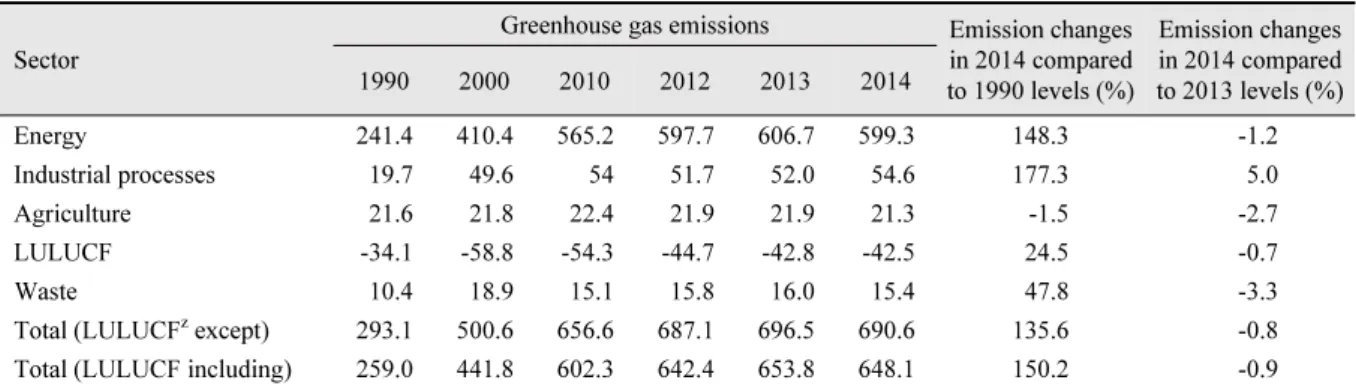
국가 온실가스 정보센터에서 2016년에 발간한 국가 온실가스 인벤토리 보고서(GIR, 2016)에 의하면 2014년 국 내 온실가스 배출량(LULUCF 제외)은 690.6 백만 톤 CO
2eq. 이며, 2013년 대비 0.8% 감소하였지만, 1990년 대비 135.6% 증가한 양이다(Table 1). 2014년 국내 발생 6대 온실가스 각각의 배출량은 CO
2가 628.8 백만 톤 CO
2eq.
(91.1%), CH
4이 26.6 백만 톤 CO
2eq. (3.9%), N
2O 가 14.9 백만 톤 CO
2eq. (2.2%), HFCs 가 8.5 백만 톤 CO
2eq. (1.4%), PFCs 는 2.4 백만 톤 CO
2eq. (1.2%), SF
6는 9.4 백만 톤 CO
2eq. (0.4%) 의 순으로 나타났다(Fig. 1). 2014년 농업분야 온실가스 배출량은 총 21.2 백만 톤 CO
2eq. 이었으며(Fig. 2), 이는 국내 온실가스 배출량의 약 3.1%를 차지하는 것 으로 경종분야(벼재배, 농경지토양, 작물잔사소각)에서 12.4 백만 톤 CO
2eq., 축산분야(장내발효, 가축분뇨처리) 에서 8.8 백만 톤 CO
2eq. 발생하였다(Lee et al., 2016b; Hwang et al., 2017). 주로 농업분야 온실가스 배출량 중 가장 큰 비중을 차지하는 것은 벼 재배 시 논에서 발생하는 CH
4이며, 2014년 기준 6.8 백만 톤 CO
2eq
.배출되었다. 이는 전체 농업분야 온실가스 배출량의 32.1%를 차지하며, 농업분야에서의 CH
4배출량으로 보면 55.5%의 비중을 차지 한다(GIR, 2016). 따라서 본 연구의 목적은 1995년부터 2017년 9월까지 우리나라의 CH
4배출계수 개발과 관련된 연구 결과를 중심으로 연구의 시기별과 목적별로 지금까지의 연구동향과 최신 결과를 조사 및 분석을 통하여 향후 국가별 온실가스 배출량 산정을 위한 연구의 기초자료 제공 및 후속 연구의 방향성을 제시하는 데에 있다.
Table 1. Greenhouse gas emission by sector from 1990 to 2014 (Unit: Million tons CO
2eq.).
Sector
Greenhouse gas emissions Emission changes in 2014 compared to 1990 levels (%)
Emission changes in 2014 compared to 2013 levels (%)
1990 2000 2010 2012 2013 2014
Energy 241.4 410.4 565.2 597.7 606.7 599.3 148.3 -1.2
Industrial processes 19.7 49.6 54 51.7 52.0 54.6 177.3 5.0
Agriculture 21.6 21.8 22.4 21.9 21.9 21.3 -1.5 -2.7
LULUCF -34.1 -58.8 -54.3 -44.7 -42.8 -42.5 24.5 -0.7
Waste 10.4 18.9 15.1 15.8 16.0 15.4 47.8 -3.3
Total (LULUCF
zexcept) 293.1 500.6 656.6 687.1 696.5 690.6 135.6 -0.8
Total (LULUCF including) 259.0 441.8 602.3 642.4 653.8 648.1 150.2 -0.9
z