농경지 온실가스 배출 산정을 위한 챔버법: 고찰
주옥정1,2⋅김준1,3,4,5*⋅박중수2⋅강창성21)
1서울대학교 협동과정 농림기상학전공, 2경기도농업기술원 환경농업연구과,
3서울대학교 생태조경 지역시스템공학부, 4서울대학교 농업생명과학연구원,
5서울대학교 그린바이오과학기술원
(2018년 3월 26일 접수; 2018년 3월 27일 수정; 2018년 3월 27일 수락)
Chamber Method for the Estimation of Greenhouse Gas Emissions in Agricultural Land: A Review
Okjung Ju
1,2, Joon Kim
1,3,4,5*, Jung-Soo Park
2and Chang-Sung Kang
21Interdisciplinary Program in Agricultural & Forest Meteorology, Seoul National University
2Environmental Agriculture Research Division, Gyeonggido Agricultural Research and Extension Services
3Department of Landscape Architecture & Rural Systems Engineering, Seoul National University
4Research Institute for Agriculture and Life Sciences, Seoul National University
5Institute of Green Bio Science and Technology, Seoul National University (Received March 26, 2018; Revised March 27, 2018; Accepted March 27, 2018)
ABSTRACT
Climate change has become a major risk factor for the co-evolving ecological and societal systems that are interconnected through biogeochemical cycles. As the increasing emission of anthropogenic greenhouse gases (GHG) has been attributed to the principal cause of climate change, more attention has been given to the exchange between terrestrial sources/sinks of GHG and the atmosphere. In this review, we abridged a brief history of the background of GHG monitoring and the development of chamber method for the GHG measurement particularly from agriculture. Based on the reviews of prior domestic studies that analyzed the emission characteristics of GHG using chamber method, we discussed the concerns and the ways to improve chamber measurement to establish better scientific database for climate change adaptation.
Key words: Chamber method, Greenhouse gas, Flux measurement, Agriculture
* Corresponding Author : Joon Kim ([email protected])
DOI: 10.5532/KJAFM.2018.20.1.34
ⓒ Author(s) 2018. CC Attribution 3.0 License.
I. 서 론
유엔기후변화협약(United Nations Framework Convention on Climate Change, UNFCCC)의 궁극적 목표는 기후 시스템에 위협적인 인위적인 간섭을 막기 위해 대기 중 온실가스 농도를 안정화 시키는 것이다. 산출된 온실가스 배출량을 기반으로 온실가스 감축목 표를 설정하고 이를 달성하기 위한 정책이 수립되므로 온실가스에 대한 인벤토리 작성이 반드시 필요한데, 이러한 맥락에서 기후변화 연구는 온실가스에 대한 정 확한 모니터링에서부터 시작된다. 우리나라는 2014년 1월에 국가 온실가스 감축목표 달성을 위한 로드맵을 수립하였고, 2015년 배출권 거래제 시행과 각국이 결 정한 기여(Intended Nationally Determined Contri butions, INDC)를 제출함에 따라 신뢰성 있는 국가 인벤토리 산정의 중요성이 더욱 증대되고 있다.
우리나라의 2014년 온실가스 총 배출량은 691백만 톤 CO2 eq.로서 경제협력개발기구(Organization for Economic Co-operation and Development, OECD)의 34개 회원국 중에서 미국, 일본, 독일, 캐나다, 멕시코 에 이어 6번째로 배출량이 많다(GIR, 2016). 기후변화 에 관한 정부간 협의체(Intergovernmental Panel on Climate Change, IPCC)는 온실가스 배출량의 정확한 평가를 위한 1995년, 1996년 지침(guideline), 2000년 모범사례(Good Practice Guideline, GPG), 2003년 토 지사용⋅토지사용변화 및 산림관리를 위한 GPG (Land Use, Land-Use Change and Forestry, LULUCF), 2006년 지침 순으로 지침을 지속적으로 보완, 발전시 켜 왔다. 2006년 IPCC 지침에서 제공하는 온실가스 주요 배출원 분석에 따르면, 우리나라 온실가스 주요 배출원은 17개이며, 이 중 농업분야에서는 벼 재배 논 에서 발생하는 메탄과 농경지 밭토양에서 발생하는 아 산화질소이다.
농경지에서 배출되는 온실가스를 직접 측정하는 방 법에는 미기상학적 방법과 챔버(chamber)를 이용한 방법, 추적자(tracer)를 이용한 플룸(plume) 측정 방법 등이 있으나(IPCC, 2006; Kim, 2015; Kang et al., 2015), 이 중 95% 이상이 수동 챔버법에 의해 이루어 지고 있다(Rochette and Ericksen-Hamel, 2008; Jeong et al., 2016a). 이러한 방법들로 측정된 다양한 결과들 을 기반으로 IPCC에서 제시한 벼 재배논의 메탄 배출 량 산정은 기본 배출계수와 재배면적, 재배기간, 물관 리 방법, 작기 전 담수일수, 유기물 시용량, 토성이나
품종계수 등을 고려하여 산정하도록 되어 있다(Choi et al., 2016). 이 외에도, 메탄 배출량 산정식에 포함되 지 않은 요인으로서, 토양으로부터의 온실가스 발생에 영향을 주는 지온(Crill et al., 1988; Morrisey and Livingston, 1992; Dunfield et al., 1993; Valentine et al., 1994; Fechner-Levy and Hemond, 1996; Grobe, 1996), 지하수위(Dise, 1993; Bubier, 1995; Moore and Roulet 1994; Kettunen et al., 1996; Bellisario et al., 1999; Pelletier et al., 2007; Treat et al., 2007), 토양의 산도(Dunfield et al., 1993; Valentine et al., 1994; Hanson and Hanson, 1996; Garcia et al., 2000;
Dedysh, 2002; Kamal and Varma, 2008), 미네랄 (Tsuyuzaki, 1997; Basiliko and Yavitt, 2001) 등이 보고되어 있다. 또한 토양으로부터 아산화질소 발생에 영향을 줄 수 있는 요인으로는 지온과 강우량(Cantarel et al., 2011; Kanerva et al., 2007), 토양의 수분함량 (Kanerva et al., 2007), 질화세균의 탈질작용(Wrage et al., 2001) 등이 있다.
기후변화에 따른 농업 환경의 변화를 이해하기 위 해서는 온실가스의 방출 특성을 정량적/정성적으로 분 석하여 그 방출 기작을 이해함으로써 그에 맞는 대책 을 수립하는 것이 중요하다. 따라서 본 통신문에서는 온실가스 측정법의 역사와 함께 국내⋅외에서 농경지 온실가스 배출량 산정을 위한 측정법으로 가장 많이 사용되고 있는 챔버법에 대한 고찰 및 국내 선행연구 의 검토를 통하여 우리나라 농경지 온실가스 배출량 산정에 대한 정확성과 대표성 확보 및 관리기준 설정 에 도움이 되고자 하였다.
II. 온실가스 측정법의 역사
2.1. 배경
1988년 세계기상기구(WMO)와 유엔환경계획 (UNEP)이 공동 설립한 국제기구 IPCC는 기후변화에 관한 과학적 규명에 기여하기 위해 발표된 과학기술 문헌에 근거하여 기후변화에 수반되는 위험과 과학⋅
기술⋅사회경제 전반에 걸친 정보를 평가하였다.
IPCC 보고서는 UNFCCC 협상을 위한 근거자료로서 중요한 역할을 했으며, 기후변화가 인위적인 온실가스 배출량 상승에 의한 것으로 지적됨에 따라 온실가스 배출원과 대기 간의 에너지 및 물질 교환과 상호 작용 에 대한 관심이 고조되었다. 온실가스 증가에 따른 지 구 대기의 변화가 생태계에 영향을 주고 이에 대해
생태계가 다시 대기에 영향을 미치는 되먹임 (feedback) 과정을 이해하기 위해, 지구의 식생과 대기 간에 교환되는 에너지, 물, 온실가스 등에 대한 지표 플럭스를 정량적으로 파악하는 연구들이 활발히 진행 되어 오고 있다(MAFRA, 1999; FLUXNET, https://fluxnet.ornl.gov/).
1990년 제네바에서 열린 2차 세계기후회의에서는 기후변화 영향 요소 평가에 대한 불확실성을 줄이기 위한 지역적이며 국가적인 노력이 강조되었고, 1991 년 OECD에서 제출한 온실가스 배출량 자료에서 농업 부문의 온실가스 배출량에 대한 부분이 중요시됨에 따 라 농업부문 국가 온실가스 배출량과 저감에 대한 평 가가 강조되었다.
2.2. 농업부문 배출량 산정
1992년 식량농업기구(Food and Agriculture Organization, FAO)와 국제원자력기구(International Atomic Energy Agency, IAEA)는 신뢰성 있는 온실 가스 배출량 산정을 위한 정보와 방법을 제시하기 위 하여 농업에서의 메탄과 아산화질소 측정에 대한 설명 서(이하 FAO-IAEA 설명서, FAO and IAEA, 1992) 를 발간하였다. FAO-IAEA 설명서에는 각 가축에서 배출되는 온실가스 방출량 산정법과 가축 무리에서의 측정법, 가축 배설물에서의 메탄 측정법, 토양과 식물 시스템에서의 메탄과 아산화질소 측정을 위한 챔버법 과 미기상학적 방법을 제시하였다. 토양에서 대기로 방출되는 메탄과 아산화질소는 일정한 부피를 가진 상 자로 지표면을 동봉하여 짧은 시간 동안의 농도변화를 측정하여 산출하며 이러한 측정법을 ‘닫힌 챔버법’이 라 한다. 챔버를 사용한 온실가스의 표면발생량 측정 법은 1970년대부터 사용되었는데(Denmead, 1979;
Cicerone and Shetter, 1981; Seiler et al., 1984; Schutz et al., 1989), 영국 환경청(Environment Agency, EA)과 미국 환경보호청(Environmental Protection Agency, EPA) 등에서 개발된 측정방법 중 가장 보편적으로 많 이 사용되고 있으며(IPCC, 2006), 특히 국가별 온실가 스 인벤토리 작성이 시작된 1990년대 이후로 활발한 연구가 이루어져 왔다.
2.3. 챔버법
챔버법은 작동 형태에 따라 크게 닫힌 챔버법과 열 린 챔버법으로 나뉜다. 닫힌 챔버법은 토양으로부터
배출되는 이산화탄소, 아산화질소, 메탄 등의 지표면 배출량 측정(Kim et al., 2000)과 매립지나 늪지에서 발생하는 가스 플럭스를 조사하는데 사용되었다 (Ishimori, 2009; Kim, 2015). 측정방법은 챔버를 측정 지점(토양표면, 수체표면 등)에 설치한 후, 가스 농도 가 시간에 따라 선형적으로 증가하는 동안 챔버로부터 시료가스를 일정한 시간 간격으로 채취하고 분석하여 시간 간격에 따른 농도의 변화량으로부터 플럭스를 산 정한다(FAO and IAEA, 1992). 이 방법은 단순하지만 경제적이며, 비교적 좁은 지역에서 생지화학적 특성을 지표 변화와 효과적으로 관련 지을 수 있는 장점을 가지고 있다(NIER, 2012). 그러나 농경지에서 온실가 스 플럭스를 측정할 때는 작물에 대한 인위적 간섭을 최소화하고 최대한 자연에 가까운 환경에서 관측되어 야 하기 때문에 닫힌 챔버법의 단점을 보완한 열린 챔버법을 활용하기도 한다.
열린 챔버법의 경우, 일정 유량의 대기 중 공기 또는 청정한 공기를 흐르게 한 후 챔버 유출구로부터 배출 되는 시료가스를 채취하여 농도의 변화를 측정한다.
이 방법은 온실가스 플럭스 측정시 기상요인에 의한 간섭을 최소화하고 연속적인 측정과 작물의 생태계 순 생산량의 실시간 모니터링이 가능하다(RDA, 2010).
또한 이 방법은 주로 NOx와 같이 반응성이 강한 기체 의 플럭스를 측정할 때 이용되는 경우가 많다(Kim, 2001; Kim, 2015).
2.4. 미기상학적 방법
지표층에서 일어나는 에너지와 물질의 교환과정은 주로 난류 운동에 의해 지배되며, 이를 이해하기 위해 사용하는 미기상학적 방법으로는 경도(gradient)법과 에디 공분산(eddy covariance)법이 주로 사용되고 있 다(MAFRA, 1999). 에디 공분산법은 에디 확산, 안정 도 보정 또는 바람의 연직구조 등의 프로파일의 모양 에 대하여 가정을 필요로 하지 않고 직접 플럭스를 측정할 수 있는 미기상학적 방법으로서 주변 생태계에 미치는 영향이 가장 적고 넓은 지역을 연속적으로 장 기간 모니터링이 가능하다(Choi et al., 1999). 특히 온 실가스의 순 생태계 교환율(net ecosystem exchange) 을 정확히 측정할 수 있는 큰 장점을 갖는다(Wesely, 1970). 과거에는 많은 양의 자료를 고속으로 집록하고 실시간으로 자료를 처리하거나 복잡한 품질 관리를 해 야 하는 등의 어려움이 많았다. 컴퓨터 기술의 발전과 상용화된 자료처리 및 품질관리 프로그램의 개발과 가
용화로 빠르게 개선되고 있으나, 관측시스템의 설치비 용이 여전히 상대적으로 비싸고, 전문 인력의 지속적 인 관리가 필요하다(Kim et al., 1997; Kwon et al., 2007; Kang et al., 2018). 에디 공분산 방법으로 CO2 나 CH4와 같은 온실가스 플럭스를 관측할 때 수반되 는 자료처리 및 품질관리에 대한 사항은 Kang et al.(2018)과 Lee et al.(2018)에서 찾아 볼 수 있다.
추적자를 사용하는 플룸 측정방법은, 예를 들어 매 립지에서의 온실가스 배출량 측정의 경우, 매립지 횡 단면의 풍하(downwind)측과 풍상(upwind)측의 메탄 농도의 차이를 측정한다. 발원지에서 발생되는 메탄의 농도 증가와 함께 추적자 가스의 농도 비교를 통해 평가하며, 분산모델을 이용하여 산정한다. 측정된 값 과 함께 매립지의 지형 특성과 매립지 내의 배출유형 등이 분산모델에 반영되며, 이를 통해 매립지 전체의 메탄 배출량이 산정된다. 공간적인 변이성을 설명할 수 있고, 전체 매립지의 배출량 추정이 가능하고, 비교 적 정확하다. 그러나 바람이 지나가는 지역으로 대상 이 제한되며, 장비가 고가이고 연속 측정을 할 경우에 인력이 많이 소요된다(Yoo, 2013; IPCC, 2006).
III. 챔버를 활용한 온실가스 배출량 산정: 국내 선행연구
온실가스 배출량 산정과 관련된 국내연구로는 에너 지⋅산업분야, 경작지, 산림, 목초지, 습지, 가축 등에 서의 방출 기작 연구가 진행되고 있다. 배출량 산정을 위한 시료채취 방법은 좁은 지역에서 토양이나 물에서 배출되는 기체의 플럭스를 측정하기 용이한 닫힌 챔버 법이 주로 사용되고 있다. 우리나라는 일본 농업환경 과학연구소(National Institute for Agro- Environ mental Sciences, NIAES)에서 수행된 선행연구(Yagi and Minami, 1990; Yagi et al., 1991; Minami, 1993) 등을 참고로 하여 챔버법을 활용한 농경지 온실가스 배출량을 산정하였다(Shin et al., 1995).
3.1. 경작지 온실가스 배출
온실가스 배출량에 영향을 미치는 요소들에 대한 평가로는, 벼 건답직파 재배 하에서 물 관리와 볏짚 및 퇴비가 배출에 미치는 영향(Ko et al., 1996), 논토 양에서 질소비종 및 벼 재배양식이 메탄 발생에 미치 는 영향(Lee et al., 2000), 논토양에서 벼의 기상생태 형(조생종, 중생종, 만생종)에 따른 메탄 배출의 특성
(Lee et al., 1999), 벼 재배 시 경운 시기와 물 관리 방법에 따른 효과(Shin et al., 2003; Won et al., 2010;
Kim et al., 2012a), 유기물 시용 및 투입 시기에 따른 메탄 발생량의 변화 평가(Shin et al., 2003; Kim et al., 2012b; Ju et al., 2013; Lee and Kim, 2017), 논토 양 종류가 메탄 배출에 미치는 영향(Seo et al., 2011), 비료의 종류에 따른 메탄가스 배출량 평가(Kim et al., 2011a; Kim et al., 2011b; Moon et al., 2012;
Muhammad and Kim, 2015), 벼 품종이 메탄 발생에 미치는 영향(Kim et al., 2011a; Jessie et al., 2013), 녹비 처리와 시기에 따른 토양과 식물로부터의 메탄 배출 경향(Jessie et al., 2011; Haque et al., 2012;
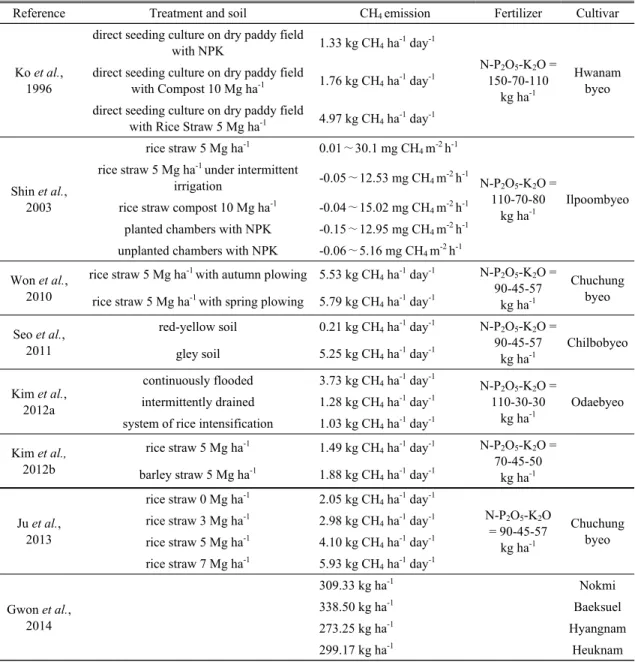
Haque et al., 2013), 메탄 생성균 활동에 의한 배출량 평가(Gwon et al., 2014), 벼 뿌리 신장이 메탄 발생과 산화에 미치는 영향(Gwon et al., 2016; Sarah et al., 2012), 등의 선행연구가 수행되었다. 각 처리에 따라 산정된 메탄 배출량 결과를 Table 1에 정리하였다(단, 원문에서 배출량 산정기간 등이 제시되지 않은 경우 보고된 배출량의 단위로 인용, 제시되지 않은 정보들 은 빈칸으로 둠). 메탄 배출량은 처리, 토양, 비료 시비 량, 벼 품종에 따라 차이를 보이며 0.21∼5.93 kg CH4
ha-1 day-1의 범위를 갖는다.
3.2. 경작지 외 온실가스 배출
경작지 외의 조사구에서 온실가스 수지(budget)를 평가하기 위해, 현장에서 챔버를 활용한 연구로는, 산 림의 탄소순환에서 중요한 광합성과 토양호흡 측정 (Chae et al., 2005; Kim and Kim, 2013), 대기 중 노출과 해수 침수가 매일 2회 반복되는 복잡한 생지화 학적 메커니즘을 통해 퇴적물내 유기물을 생성, 집적 및 분해하는 연안 습지 갯벌에서의 메탄 방출원 및 흡수원의 추정(Lee et al., 2014; Lee et al., 2015; Lee et al., 2017), 에너지 소비와 처리공정에 따라 온실가 스가 배출되는 하수처리장에서 챔버를 활용한 아산화 질소 및 유해물질의 분석(Kang, 2005; Yang et al., 2008), 환경부문 중 온실가스 배출 비중이 가장 높은 매립지에서 챔버를 활용한 메탄 배출량 측정(Kim et al., 1999; Kim et al., 2000; Kim, 2015; Jeong, et al., 2016b), 매립 부문에 비해 온실가스 배출량은 낮지 만 산업폐수처리 분야에서의 실질적인 배출량 연구가 필요한 폐수처리장의 온실가스 플럭스 측정(Roh and Sa, 2015) 등이 있다.
챔버는 현장(in situ)이 아닌 실험실에서도 온실가스
를 비롯한 다양한 분야의 배출량 산정 연구에 활용된 다. 먼저, 이탄 토양에 축적되어 있는 탄소의 방출이 지구온난화를 가속화시킬 것이라는 국외 연구결과 발 표에 따라 우리나라의 대표적 이탄습지에서 토양시료 를 채취, 이를 실험실에서 챔버법으로 측정한 결과를 기반으로한 아산화질소 가스 발생 양상에 대한 연구가 진행된 바 있다(Kim, 2013). 그리고 안정적인 육묘 및 작물 별 환경관리를 위한 생장 챔버를 활용한 온실가 스 배출량 연구로서 온도와 이산화탄소의 농도를 조절
하여 각 작물의 생육시기 및 온도에 따른 이산화탄소 발생 특성을 조사한 연구 등이 있다(Jung et al., 2014).
식생과 주변 환경 간의 상호 작용 외, 방출 시험 챔버를 활용하여 건축 자재에서 방출되는 휘발성유기화합물 (volatile organic compounds, VOC)과 알데히드를 측 정하는 연구도 수행되었으며, 관련 국제 주요 규격 (ISO 16000-9(2005.10), EPA-2001, ASTM D5116 등)과 챔버의 크기 및 적용범위 규정(Green Guard, USA)에 따라 챔버를 활용한 배출량 시험방법을 표준 Reference Treatment and soil CH4 emission Fertilizer Cultivar
Ko et al., 1996
direct seeding culture on dry paddy field
with NPK 1.33 kg CH4 ha-1 day-1
N-P2O5-K2O = 150-70-110
kg ha-1
Hwanam byeo direct seeding culture on dry paddy field
with Compost 10 Mg ha-1 1.76 kg CH4 ha-1 day-1 direct seeding culture on dry paddy field
with Rice Straw 5 Mg ha-1 4.97 kg CH4 ha-1 day-1
Shin et al., 2003
rice straw 5 Mg ha-1 0.01∼30.1 mg CH4 m-2 h-1
N-P2O5-K2O = 110-70-80
kg ha-1
Ilpoombyeo rice straw 5 Mg ha-1 under intermittent
irrigation -0.05∼12.53 mg CH4 m-2 h-1 rice straw compost 10 Mg ha-1 -0.04∼15.02 mg CH4 m-2 h-1 planted chambers with NPK -0.15∼12.95 mg CH4 m-2 h-1 unplanted chambers with NPK -0.06∼5.16 mg CH4 m-2 h-1 Won et al.,
2010
rice straw 5 Mg ha-1 with autumn plowing 5.53 kg CH4 ha-1 day-1 N-P2O5-K2O = 90-45-57
kg ha-1
Chuchung rice straw 5 Mg ha-1 with spring plowing 5.79 kg CH4 ha-1 day-1 byeo
Seo et al., 2011
red-yellow soil 0.21 kg CH4 ha-1 day-1 N-P2O5-K2O = 90-45-57
kg ha-1
Chilbobyeo gley soil 5.25 kg CH4 ha-1 day-1
Kim et al., 2012a
continuously flooded 3.73 kg CH4 ha-1 day-1 N-P2O5-K2O = 110-30-30
kg ha-1
Odaebyeo intermittently drained 1.28 kg CH4 ha-1 day-1
system of rice intensification 1.03 kg CH4 ha-1 day-1 Kim et al.,
2012b
rice straw 5 Mg ha-1 1.49 kg CH4 ha-1 day-1 N-P2O5-K2O = 70-45-50
kg ha-1 barley straw 5 Mg ha-1 1.88 kg CH4 ha-1 day-1
Ju et al., 2013
rice straw 0 Mg ha-1 2.05 kg CH4 ha-1 day-1
N-P2O5-K2O
= 90-45-57 kg ha-1
Chuchung byeo rice straw 3 Mg ha-1 2.98 kg CH4 ha-1 day-1
rice straw 5 Mg ha-1 4.10 kg CH4 ha-1 day-1 rice straw 7 Mg ha-1 5.93 kg CH4 ha-1 day-1
Gwon et al., 2014
309.33 kg ha-1 Nokmi
338.50 kg ha-1 Baeksuel
273.25 kg ha-1 Hyangnam
299.17 kg ha-1 Heuknam
Table 1. Estimation of CH4emission using closed chamber in rice paddies with different treatments
화 한 바 있다(Air Cleaning Technology, 2004; Yoon, 2006).
IV. 챔버법을 활용한 선행 연구로부터의 교훈
챔버법을 활용한 농경지에서 발생하는 온실가스 시 료채취 방법은 장비의 구조가 비교적 단순하여 제작과 운영이 편리하고 실용적이며 경제적인 비용으로 다양 한 처리와 시료분석이 가능하다. 닫힌 챔버법을 이용 한 온실가스 배출 인자들과 배출량에 대한 선행 연구 들을 검토하여 챔버법을 이용한 온실가스 배출량 산정 시 고려해야 할 구체적인 내용을 세부 항목별로 아래 에 설명하였다.
4.1. 온실가스 배출량 평가 시 고려해야 할 공간적 비균질성
선행연구에서 제시된 온실가스 배출량과 배출인자 의 평가와 관련하여, 정량적 결과에 영향을 줄 수 있는 조사구 및 측정 지점의 대표성과 토양층에 대한 공간 적 비균질성에 대한 선행 조사가 필요하다. 농경지 생 태 환경의 공간적 비균질성에 따른 변동 범위, 예를 들어 측정 지점 현장에 대한 공간적 균질 또는 비균질 성에 대한 분석을 포함하여, 적절한 샘플링 측정 위치 와 측정 지점 수의 결정에 대한 과학적 고찰이 요구된 다. 챔버법은 비교적 간단하고 빠르게 공간적 변동성 을 평가하기에 적합하다. 그럼에도 불구하고, 대부분 농경지 생태환경의 시⋅공간적 비균질성에 따른 변동 범위에 대한 정량적 평가없이 온실가스 배출량을 산정 하기 때문에 측정값에 대한 정확성과 대표성의 확보가 어렵다. 이를 개선하기 위해서는, 현장 측정 지점에 대한 전체 조사구와 챔버를 설치한 위치에 대한 상세 한 설명, 예를 들어 반복구 챔버 간의 거리, 토양의 물리적 특성 등에 대한 설명이 필요하다. 이를 통해 어느 구간까지 공간변동성을 설명할 수 있는 지에 대 한 제시가 필요하다. 측정 지점의 비균질성에 대한 분 석이 선행되고 이에 대한 적절한 감시가 더해진다면, 측정값에 대한 대표성 확보는 물론 온실가스 배출량에 영향을 주는 요소들에 대한 적절한 특성 범위를 제시 할 수 있을 것이다.
4.2. 온실가스 배출인자 평가에 고려해야 할 영향 요소들
FAO-IAEA 설명서에서는 측정값에 영향을 주는 중요한 요소로서, 토성, pH, 유기물 함량, 수분함량, 질산염 및 암모늄 함량, 산화 환원 특징, 식생 피복, 기온, 일사량, 상대습도 및 강우량과 같은 기상요소를 제시하였다(FAO and IAEA, 1992). GRA (2015) 지 침에서는 챔버를 활용한 측정에서 요구되는 최소사항 을 제시하고 있는데, 예를 들어 시료를 채취할 때에는 토양 수분량을 동시에 함께 측정해야 하며, 주변과 챔 버 내부의 토양 수분 함량이 다른 경우에는 챔버를 이동해야 한다.
토양 온도는 토양 미생물 활동에 영향을 주는 중요 한 요인으로 알려져 있고 토양 수분과 밀접한 관계가 있다. 수분 함량이 적은 토양이 많은 토양보다 열 보전 력과 전도율이 낮으며, 메탄 생성은 담수 충적토에서 토양온도가 35℃에서 최고에 도달하며(Yamane and Sato, 1961), 온도가 20℃ 이하에서의 메탄 생성량은 아주 적다는 선행연구가 있으나, 이 역시 배출인자의 영향 평가에서 고려된 바가 없다. 벼 재배지에서의 메 탄 발생량의 계절 변동으로 7-8월에 메탄 배출량이 최 대가 됨이 보고되어 있으나, 키 큰 식물에서 메탄 발생 이 많다고 지적한 선행연구(von Fisher et al., 2010)와 같이, 배출량의 변화가 벼의 성장에 의한 것인지, 기온 상승에 의한 것인지, 지온 변화에 의한 것인지, 또는 강우에 의한 것인지 등등 개별적 영향 요소에 대한 분석이 다루어 지지 않았다. 온도에 따라 메탄 배출량 이 다른 이유는 메탄생성 기질이 메탄으로 바뀌는 전 환율과 토양에서 대기로 확산하는 과정이 온도의 영향 을 받기 때문이다(RDA, 2010). 온실가스 배출량에 변 화가 있을 때 어느 요소에 의한 영향인지를 분석하기 위해 측정 지점에서의 기온, 상대습도, 강우량, 일사량, 지온, 수온, 물 높이, 토양수분, pH, 토양의 산화환원전 위(Eh) 등이 함께 모니터링 되어야 한다. 또한 정기적 인 토양의 질소와 탄소에 대한 분석이 필요하며, 전체 자료 중 몇 개의 자료에서 유의한 상관관계가 있는지, 반복구에 대한 통계적 처리로 유의한 범위에 대한 제 시가 필요하다.
담수 토양에서 메탄 생성의 주요 메커니즘은 수소 공여체(donor)로서 지방산 또는 알콜, 수소에 의한 이 산화탄소의 환원과 메탄 생성 박테리아에 의한 아세트 산 또는 메탄올의 trans-methylation 과정으로(Takai, 1970; Conrad, 1989) 물질의 산화환원반응이 중요한
역할을 한다. 이에 토양의 Eh는 메탄을 생산하는 가장 중요한 요인 중의 하나이다. Yamane and Sato (1964) 는 담수된 논에서 Eh가 –150mV 이하로 떨어질 때까 지는 메탄이 발생하지 않는다고 하였다. Lee et al.(2005)은 벼 재배 시 Eh를 –200mV에서 –300mV로 낮추었을 때 메탄 생성이 약 10배 증가함을 제시한 바 있으나, 국내 주요 선행연구에서 Eh의 변화와 연결 하여 분석한 예는 드물다. 또한 메탄 생성 박테리아 활동의 시기가 어느 때인지, 낮과 밤에 따른 변화가 있는지, 메탄 생성 세균의 수명, 생산, 소비, 배출이 계속되는지 등에 대한 평가가 수반되어야 한다.
4.3. 챔버 설치에 따른 측정 지점의 교란에 대한 고려 챔버 설치 과정에서 교란된 토양 표면으로 인한 영 향은 있을 수는 있으나 매우 작다고 보고된 바 있다 (Kim et al., 2000). 그러나 Shin et al.(1995)은 평형상 태를 위해 6시간이 필요하다고 했고, Chae et al.(2003)은 그 영향을 최소화하기 위해 측정 전 한 시간 반 정도 두어야 한다고 했다. GRA (2015)에 따르 면, 시료채취 24시간 전에 챔버를 설치하여야 하는데, 이는 토양의 상태, 챔버의 크기, 샘플링 방법에 따라 달라질 수 있다. 챔버가 설치된 후에는, 매질 표면을 통해 배출되는 가스의 확산, 선형적인 농도 증가 및 농도 변화율을 계산하는 시간 구간 설정의 타당성과 챔버 내의 시료 채취값과 시료채취 높이에 대한 대표 성 등의 문제가 있다. 닫힌 챔버법에 관한 비교적 상세 한 국내 선행연구인 Shin et al.(1995)에 따르면, 챔버 안의 팬을 가동했을 때의 메탄 농도의 변동성이 팬을 가동하지 않았을 때 보다 더욱 크게 나타나 팬을 가동 하지 않았을 때 메탄의 상대적 분포 지표(index of relative distribution of methane, IRDM)가 더 안정하 다고 보고하였다. 그러나 팬을 가동하는 경우, 30분 후 챔버 내부 온도가 4.5℃ 상승한 반면에, 가동하지 않는 경우에는 9.5℃ 상승하여 벼의 생육에 영향을 미 칠 수 있음을 지적하였다. 내경 0.6×0.6×1.0m 크기의 챔버에서 6개 층위별로 시료를 채취한 결과, 0.65m 높이에서 IRDM이 가장 안정하기에 이를 대표성을 가 진 시료채취 높이로 제시하였다. 적절한 시료채취 시 간을 위해 15분 단위로 측정하였을 때 화학비료(NPK) 를 표준 시비한 챔버에서는 시간에 따른 농도변화가 선형적으로 나타났으나 화학비료에 생 볏짚을 시비한 챔버에서는 30분 후에 농도 증가율이 커지고 챔버 내 기온도 일정하게 유지되어 30분 간격의 시료채취가
적합하다고 제안하였다.
4.4. 챔버의 물리적 형태에 관한 고려 사항 Mosier et al.(1989)은 벼 4본이 들어갈 수 있는 0.33m 내경, 0.6m 높이의 스테인리스강 실린더형 챔 버를 고안하였고, Lindau et al.(1991)의 경우는 0.3m 의 정사각형 챔버를 이단으로 놓고 챔버 뚜껑에 팬과 압력조절기를 달았다. 국외 챔버 지침(FAO and IAEA, 1992; GRA, 2015; NIAES, 2015)에 의하면, 챔버의 모양은 원통형, 사각형, 직사각형이 있고 소재 는 플라스틱, 알루미늄, 다른 금속, 아크릴, PVC 등으 로 제시되어 있으며, 챔버의 투명성 여부는 여전히 논 란의 여지가 있는 사항이다. 크기가 비교적 큰(0.5m2) 챔버가 작은 챔버(0.008m2) 보다 변동성이 적다는 연 구 결과가 있는 반면, 영향을 받지 않는다는 연구 결과 도 있다. 챔버 크기에 대한 권장규격이 부재한 상태이 지만 메탄과 아산화질소의 경우 공간적으로 변동성이 매우 크기 때문에 20번 이상의 반복 실험을 제시하고 있다. 그 외 챔버의 크기와 부피에 따른 샘플링 공간부 분(headspace)의 변화와, 최소/최대 샘플링 공간 높이 등에 대한 분석이 부족한 실정이며, 외기유입 여부를 평가할 수 있는 기밀성, 회수율 및 흡착 손실 효과 등 에 대한 평가와 채취한 시료의 보존 방법 및 시기 등이 고려되어야 할 요소들이다.
4.5. 측정 자료의 품질 보증과 관리
챔버법으로 측정되는 온실가스 자료는 편차가 크고 품질 관리가 쉽지 않다. IPCC 2006 지침에서 제시한 품질보증 및 품질관리(QA/QC) 방법에 따라 자료의 투명성과 일관성을 확보할 수 있도록, 유의미한 통계 처리를 위한 QA/QC에 대한 상세 지침과 불확도 (uncertainty) 등의 개념을 도입함으로써 보다 효율적 인 자료의 품질 관리 방안의 보완이 필요하다(Eun et al., 2007). 온실가스 배출량 평가 방법은 세계 대부분 의 국가에서 적용 가능한 표준화된 방법을 사용하여야 하며, 현재 국내⋅외 온실가스 측정 절차는 선진국에 서 사용하는 여러 가지 측정 방법 중 가장 보편적인 방법을 준용하고 있다. 앞으로 이러한 방법들의 변화 와 발전을 꾸준히 모니터링하면서 보다 정확하며 우리 나라의 특성을 잘 반영한 측정 방법과 자료 처리 및 품질 보증/관리 방법을 개발하고 지속적으로 갱신해 나가야 할 것이다.
V. 요약 및 맺는 말
복잡생태계를 구성하는 다양한 구성요소들 간의 상 호작용과 되먹임 과정들, 특히 생지화학 순환을 이해 하기 위한 측정법들이 많은 연구자들의 노력을 통해 발전해 왔다. 온실가스 배출량 산정을 위해 개발된 챔 버법은 장치의 설치와 이동이 용이하며, 제작과 운영 이 편리하고 실용적, 경제적인 비용으로 다양한 처리 와 시료분석이 가능하여 온실가스 배출인자들과 배출 량에 대한 평가에 널리 사용되어 왔다. 많은 선행연구 자들의 노력으로 각 부문별 신뢰성 있는 온실가스 인 벤토리가 산정이 되었고, 온실가스 배출량에 미치는 여러 영향요소의 평가를 통해 기후변화 완화를 위한 온실가스 저감 정책이 수립되었다. 그러나 본질적으로 생태계에 존재하는 시⋅공간적인 비균질성, 자연 변동 성과 인위적 요소의 상호작용과 이들이 관측 및 자료 처리에 미치는 영향에 대한 이해가 부족한 실정이다. 비균질성과 대표성에 관련된 문제의 경우, 에디 공분 산법과 같은 타워 기반의 미기상학적 플럭스 관측법을 함께 활용함으로써 상호보완적으로 개선할 수 있다 (예, Kang et al., 2018). 대상 농경지가 작아서 충분한 취주거리(fetch)가 확보되기 어려운 경우에는 질량수 지법과 같은 미기상적 방법을 챔버법과 병용하여 사용 할 수도 있다(예, Ju et al., 2017). 챔버법을 활용한 농경지 온실가스 배출 산정과 관련된 국내 선행 연구 의 고찰에서 나타난 문제점과 개선 방향의 제시가 향 후 온실기체 방출 완화 및 기후변화 적응, 더 나아가 지속가능한 생태-사회시스템을 위한 발전방향 수립에 도움이 되기를 바란다.
적 요
온실가스 배출로 인한 기후변화는 되먹임 고리의 형 태로 연결되어 공진화 하는 자연생태계와 사회시스템의 지속가능성을 저해하는 위험요소가 되었다. 기후변화 가 인위적인 온실가스 배출량의 상승에 의한 것으로 지 적됨에 따라, 온실가스 배출원과 대기 간의 에너지 및 물 질 교환과정에 대한 관심이 고조되었다. 본 고찰에서는 온실가스 모니터링의 배경에 대한 역사와 특별히 농업 에서 배출되는 온실가스 관측을 위한 챔버법의 개발에 대해 요약하였다. 챔버를 이용하여 온실가스의 방출 특 성을 분석한 국내 선행 연구들의 검토를 기반으로, 기후 변화 적응을 위해 보다 나은 과학적 기초자료를 구축할
수 있도록 국내 챔버 관측의 문제점과 개선 방향을 간략 히 논의하였다.
감사의 글
본 연구는 농촌진흥청 연구사업(세부과제번호:
PJ012489032018)의 지원에 의해 수행되었으며, 이에 감사 드립니다. 원고의 품위를 크게 높여 주신 특별호 편 집위원분들께 깊이 감사드립니다.
REFERENCES
Air Cleaning Technology, 2004: Environment-friendly building materials group quality certification test method -Small Chamber method-. Korea Air Cleaning Association, 55-66. (in Korean with no English abstract)
Basiliko, N., and J. B. Yavitt, 2001: Influence of Ni, Co, Fe and Na additions on methane production in Sphagnum-dominated Northern American peatlands.
Biogeochemistry 52(2), 133-153.
Bellisario, L. M., J. L. Bubier, T. R. Moore, and J. P.
Chanton, 1999: Controls on CH4 emissions from a northern peatlands. Global Biogeochemical Cycles 13(1), 81-91.
Bubier, J. L., 1995: The relationship of vegetation to methane emission and hydrochemical gradients in northern peatlands. Journal of Ecology 83(3), 403-420.
Cantarel, A. M., M. G. Bloor, N. Deltroy, and J. F.
Soussana, 2011: Effects of climate change drivers on nitrous oxide fluxes in an upland temperate grassland.
Ecosystems 14, 223-233.
Chae, N.-Y, J. Kim, D. G. Kim, D.-W. Lee, R.-H. Kim, J.-Y. Ban, and Y.-W. Son, 2003: Measurement of soil CO2 efflux using a closed dynamic chamber system.
Korean Journal of Agricultural and Forest Meteorology 5(2), 94-100. (in Korean with English abstract)
Chae, N.-Y, R. H. Kim, S. U. Suh, T.-H. Hwang, J. S.
Lee, Y.-W. Son, D.-W. Lee, and J. Kim, 2005:
Intercomparison of chamber methods for soil respiration measurement in a phytotron system.
Korean Journal of Agricultural and Forest Meteorology 7(1), 107-114. (in Korean with English abstract)
Choi, S.-W., H. Kim, Y. Kim, M. Kang, and J. Kim, 2016: Estimation and mapping of methane emission from rice paddies in Gyunggi-do using the modified
water management scaling factor. Korean Journal of Agricultural and Forest Meteorology 18(4), 320-326.
(in Korean with English abstract)
Choi, T.-J., J. Kim, and J.-I. Yun, 1999: On using the eddy covariance method to study the interaction between agro-forest ecosystems and the atmosphere.
Korean Journal of Agricultural and Forest Meteorology 2(3), 80-86. (in Korean with English abstract)
Cicerone, R. J., and J. D. Shetter, 1981: Sources of atmospheric methane: measurements in rice paddies and a discussion. Journal of Geophysical Research 86, 7203-7209.
Conrad, R., 1989: Control of methane production in terrestrial ecosystems. Ain: Exchange of Trace Gases between Terrestrial Ecosystems and the Atmosphere, M. O. Andreae and D. S. Schimel(Eds.), 39-58.
Crill, P. M., K. B. Bartlett, R. C. Harriss, E. Gorham, E.
S. Verry, D. I. Sebacher, L. Mazdar, and W. Sanner, 1988: Methane flux from Minnesota peatlands. Global Biogeochemical Cycles 2, 371-384.
Dedysh, S. N., 2002: Methanotrophic bacteria of acidic Sphagnum peat bogs. Microbiology 71(6), 638-650.
Denmead, O. T., 1979: Chamber systems for measuring nitrous oxide emissions from soils in the field. Soil Science Society of America Journal 43, 89-95.
Dise, N. B., 1993: Methane emission from Minnesota peatlands: Spatial and seasonal variability. Global Biogeochemical Cycles 7, 123-142.
Dunfield, P., R. Knowles, R. Dumont, and T. R. Moore, 1993: Methane production and consumption in temperate and subarctic peat soils: Response to temperature and pH. Soil Biology and Biochemistry 25(3), 321-326.
Eun S. H., E. W. Choi, J. G. Lee, B. B. Jin, and Y. R.
Son, 2007: The proposal for Standard Operating Procedure(SOP) on measurement of landfill gas(CH4).
Proceedings of Korean Society for Atmospheric Environment, 11-15. (in Korean with no English abstract)
FAO and IAEA, 1992: Manual on measurement of methane and nitrous oxide emissions from agriculture.
IAEA-TECDOC-674, 91.
Fechner-Levy, E. J., and H. F. Hemond, 1996: Trapped methane volume and potential effects on methane ebullition in a northern peatland. Limnology and Oceanography 41(7), 1375-1383.
Garcia, J. L., B. K. C. Patel, and B. Ollivier, 2000:
Taxonomic, phylogenetic, and ecological diversity of methanogenic Archaea. Anaerobe 6(4), 205-226.
GIR (Greenhouse gas Inventory and Research center),
2016: National Greenhouse Gas Inventory Report of Korea, 390pp. (in Korean with no English abstract) GRA (Global Research Alliance on Agricultural
Greenhouse Gases), 2015: Nitrous Oxide Chamber Methodology Guidelines.
Grobe, W., 1996: The mechanism of thermal transpiration(=thermal osmosis). Aquatic Botany 54, 101-110.
Gwon, H. S., Y. H. Hyun, and P. J. Kim, 2014:
Regulating factors of rice plant growth components on methanogenesis activity during cropping seasons.
Proceedings of Korean Society of Soil Science and Fertilizer, 260. (in Korean with no English abstract) Gwon, H. S., M. H. Park, G. Y. Kim, and P. J. Kim,
2016: Evaluation of root effect on methane production and oxidation during cultivation. Proceedings of Korean Society of Soil Science and Fertilizer, 196.
Hanson, R. S., and T. E. Hanson, 1996: Methanotrophic bacteria. Microbiological Reviews 60(2), 439-471.
Haque, M. M, S. Y. Kim, G. Jessie, and P. J. Kim, 2012:
Optimum application level of barley and hairy vetch mixture as green manure on considering methane emission and rice productivity in paddy soil, Proceedings of Korean Society of Soil Science and Fertilizer, 307.
Haque, M. M., S. Y. Kim, and P. J. Kim, 2013: Direct contributions from soil and rice plant on CH4 emission during rice cultivation in green manure-amended paddy soil. Proceedings of Korean Society of Soil Science and Fertilizer, 325.
IPCC, 2006: Guidelines for National Greenhouse Gas Inventories.
Ishimori, H., K. Endo, and M. Yamada, 2009: Reliability evaluation for static chamber method at landfill sites.
Proceedings of the COMSOL Conference 2009 Boston.
Jeong, H. C., E. J. Choi, J. S. Lee, G. Y. Kim, and K. H.
So, 2016a: The differences of Nitrous Oxide(N2O) emissions as crop presence and location of gas sampling chambers in upland. Journal of Climate Change Research 7, 427-432. (in Korean with English abstract)
Jeong, J. H., S. J. Kang, J. M. Lim, and J. H. Lee, 2016b:
Comparison and optimization of flux chamber methods of methane emissions from landfill surface area. Journal of Korean Society of Environmental Engineers 38(10), 535-542. (in Korean with English abstract)
Jessie, G., S. Y. Kim, Y. B. Lee, and P. J. Kim, 2011:
Effects of winter cover crop amendment on Methane and nitrous oxide emissions in paddy soil during rice
cultivation. Proceedings of Korean Society of Soil Science and Fertilizer, 160-161.
Jessie G., L. A. Sarah, and P. J. Kim, 2013: Influence of rice types on CH4 emission characteristics in paddy soil. Proceedings of Korean Society of Soil Science and Fertilizer, 326.
Ju, O.-J., N. G. Kang, J. S. Park, and C. S. Kang, 2017:
Automated real-time analysis of greenhouse gases from rice paddies. Proceedings of 9th International Gas Analysis Symposium and Exhibition (http://www.gasanalysisevent.com/en/programme/proc eedings/).
Ju, O.-J., T. J. Won, K. R. Cho, B. R. Choi, J. S. Seo, I-T.
Park, and G. Y. Kim, 2013: New estimates of CH4
emission scaling factors by amount of rice straw applied from Korea paddy fields. Korean Journal of Environmental Agriculture 32(3), 179-184. (in Korean with English abstract)
Jung D. H., C. K. Kim, K. H. Oh, D. H. Lee, M.-S. Kim, J. H. Shin, and J. E. Son, 2014: Analyses of CO2
Concentration and Balance in a Closed Production System for King Oyster Mushroom and Lettuce.
Korean Journal of Horticultural Science and Technology 32(5), 628-635. (in Korean with English abstract)
Kanerva, T., K. Regina, K. Ramo, K. Ojanpera, and S.
Mannine, 2007: Fluxes of N2O, CH4, and CO2 in a meadow ecosystem exposed to elevated ozone and carbon dioxide for three years. Environmental Pollution 145, 818-828.
Kamal, S., and A. Varma, 2008: Peatland microbiology.
Microbiology of Extreme Soils. Springer, Berlin, Heidelberg, 177-203.
Kang, K. H., 2005: HAPs emission characterization for sewage treatment facilities using an emission isolation flux chamber. Dissertation, University of Seoul. (in Korean with English abstract)
Kang, N.-G., J. Yun, M. S. A. Talucder, M. Moon, M.
Kang, K.-M. Shim, and J. Kim, 2015: Corrections on CH4 fluxes measured in a rice paddy by Eddy covariance method with an open-path wavelength modulation spectroscopy. Korean Journal of Agricultural and Forest Meteorology 17(1), 15-24.
Kang, M., J. Kim, S.-H. Lee, J. Kim, J.-H. Chun, and S.
Cho, 2018: Changes and improvements of the standardized eddy covariance data processing in KoFlux. Korean Journal of Agricultural and Forest Meteorology (to be published) (in Korean with English abstract)
Kettunen, A., V. Kaitala, J. Alm, J. Silvola, H. Nykanen, and P. J. Martikainen, 1996: Cross-correlation analysis
of the dynamics of methane emissions from a boreal peatland. Global Biogeochemical Cycles 10(3), 457-471.
Kim, D. S., Y. K. Jang, and E. C. Jeon, 1999: Static chamber for measurements greenhouse gas emissions from landfill surface. Proceedings of 29th Meeting of Korean Society for Atmospheric Environment, 277-279. (in Korean)
Kim, D. S., Y. K. Jang, and E. C. Jeon, 2000: Surface flux measurements of methane from landfills by closed chamber technique and its validation. Journal of Korean Society for Atmospheric Environment 16(5), 499-509. (in Korean with English abstract)
Kim, D. S., 2001: Measurements of gases emissions from agricultural soils and their characteristics with chamber technique: Emission of NO and N2O. Journal of Korean Society for Atmospheric Environment 17(2), 203-212. (in Korean with English abstract)
Kim, D. S., and S. Kim, 2013: N2O and CH4 emission from upland forest soils using chamber methods.
Journal of Korean Society for Atmospheric Environment 29(6), 789-800. (in Korean with English abstract)
Kim, G. Y., S. B. Lee, J. S. Lee, E. J. Choi, J. H. Ryu, W.
J. Park, and J. Choi, 2012a: Mitigation of greenhouse gases by water management of SRI(System of Rice Intensification) in rice paddy fields. Korean Journal of Soil Science and Fertilizer 45(6), 1173-1178. (in Korean with English abstract)
Kim, H.-K., B. Kim, S. Kim, H. Kim, J. Park, K. Choi, and H. J. Jeong, 2012b: The evaluation of methane emitted at paddy soil applied to organic matter while rice cultivated organically. Proceedings of Korean Society of Soil Science and Fertilizer, 273. (in Korean) Kim, J. E., W. Park, Y. R. Kim, J. I. Yun, H. M. Cho, and
J. W. Kim, 1997: Measurement of eddy fluxes of trace gases using a tunable diode laser spectrometer(TDLS) in Korea. Proceedings of International workshop on background monitoring of greenhouse gases and ozone, 47-54.
Kim, J. H., 2015: A study on the development of parameter based on the investigation of methane emission characteristics in a landfill site. Dissertation, Sejong National University, 46pp. (in Korean with English abstract)
Kim, S. H., 2013: Releasing patterns of nitrous oxide from the soil of alpine wetland according to temperature change. Dissertation, Kyungpook National University, 25pp. (in Korean with English abstract)
Kim, S. Y., Y. G. Park, Y. B. Lee, and P. J. Kim, 2011a:
Comparison of livestock manures on methane emission in paddy soil during rice cultivation.
Proceedings of Korean Society of Soil Science and Fertilizer, 154-155. (in Korean)
Kim, T. J., G. Jessie, P. Pramanik, and P. J. Kim, 2011b:
Effect of ammonium sulfate as an electron acceptor on reducing methane emission in paddy soil during rice cultivation. Proceedings of Korean Society of Soil Science and Fertilizer, 254.
Ko, J. Y., H. W. Kang, and K. B. Park, 1996: Effects of water management rice straw and compost on methane emission in dry seeded rice. Korean Journal of Soil Science and Fertilizer 29(3), 212-217. (in Korean with English abstract)
Kwon, H. S., S. Park, M. Kang, J. Yoo, R. Yuan, and J.
Kim, 2007: Quality control and assurance of eddy covariance data at the two KoFlux sites. Korean Journal of Agricultural and Forest Meteorology 9(4), 260-267. (in Korean with English abstract)
Lee, G. B., D. B. Lee, J. G. Kim, S. B. Lee, J. D. Kim, and S. S. Han, 2000: Effects of application of nitrogen fertilizers on methane emission in a paddy soil.
Korean Journal of Soil Science and Fertilizer 33(3), 212-219. (in Korean with English abstract)
Lee, G. B., J. G. Kim, C. W. Park, Y. K. Shin, D. B. Lee, and J. D. Kim, 2005: Effects of irrigation water depth on greenhouse gas emission in paddy field. Korean Journal of Soil Science and Fertilizer 38(3), 150-156.
(in Korean with English abstract)
Lee, J. H., K.-S. Jeong, H. J. Woo, J. Kang, D.-H. Lee, S.
Jang, and S.-R. Kim, 2014: Evaluation of Basin-Specific CH4 emission flux from Intertidal Flat Sediments of Sogeun-ri, Taean, Mid-west Korea.
Journal of Wetlands Research 16(2), 281-291. (in Korean with English abstract)
Lee, J. H., K. C. Rho, H. J. Woo, J. Kang, K.-S. Jeong, and S. Kim, 2015: Evaluation of CH4 flux for continuous observation from intertidal flat sediments in the Eoeun-ri, Taean-gun on the Mid-western coast of Korea. Economic and Environmental Geology 48(2), 147-160. (in Korean with English abstract) Lee, J. H., and P. J. Kim, 2017: Effect of rice straw
incorporating season on methane emission during rice cultivation. Proceedings of Korean Society of Soil Science and Fertilizer, 206.
Lee, J. H., H. J. Woo, K. S. Jeong, J. U. Choi, and K. S.
Park, 2017: Evaluation of methane(CH4) gas emissions and sink sources according to the mean size of sediment in the tidal flat at Taean, Midwest Korea.
Journal of International Area Studies 21(2), 123-147.
(in Korean with English abstract)
Lee, K. B., D. B. Lee, S. B. Lee, J. G. Kim, and Y.-W.
Kim, 1999: Methane emission among rice ecotypes in Korean paddy soil. Korean Journal of Environmental Agriculture 18(1), 1-5. (in Korean with English abstract)
Lee, S.-H., M. Kang, Y. M. Indrawati, S.-W. Choi, N.
Kang, and J. Kim, 2018: Measurement of energy, water, CO2, and CH4 fluxes in a rice paddy with dry direct-seeding. Korean Journal of Agricultural and Forest Meteorology (to be published) (in Korean with English abstract)
Lindau, C. W., P. K. Bollich, R. D. De Laune, Jr. W. H.
Patrick, and V. J. Law, 1991: Effect of urea fertilizer and environmental factors CH4 emissions from a Louisiana USA rice field. Plant and Soil 136, 195-203.
MAFRA (Ministry of Agriculture, Food and Rural Affairs), 1999: Development of an Agrometeorological Crop Forecasting System Based on the Atmospheric Environment Monitoring, 234pp.
Minami, K., 1993: Methane from rice production.
Research Division of Environmental Planning 9, 243-258.
Moon, Y. H., B. K. Ahn, I. Y. Choi, C. J. Jang, S. S.
Cheong, and D. S. Kim, 2012: Amount of CH4
emissions on the basis of fertilizer in rice culture.
Proceedings of Korean Society of Soil Science and Fertilizer, 279pp. (in Korean)
Moore, T. R., A. Heyes, and N. T. Roulet, 1994: Methane emissions from wetlands, southern Hudson Bay lowland. Journal of Geophysical Research 99, 1455-1467.
Morrisey, L. A., and G. P. Livington, 1992: Methane emissions from Alaska Arctic tundra : An assessment of local spatial variability. Journal of Geophysical Research 97(D15), 1661-16670.
Mosier, A. R., S. L. Chapman, and J. R. Frency, 1989:
Determination of dinitrogen and nitrous oxide from irrigated crops in North-East Colorado. Soil Science Society of America Journal 50, 831-833.
Muhammad, A. A., and P. J. Kim, 2015: Effect of electron acceptor containing silicate fertilizer on reducing methane emission in paddy soil during rice cultivation. Proceedings of Korean Society of Soil Science and Fertilizer, 80.
NIAES, 2015: Guidelines for Measuring CH4 and N2O Emissions from Rice Paddies by a Manually Operated Closed Chamber Method.
NIER (National Institute of Environmental Research), 2012: A Study on the Emission of Nitrogen Oxides and Methane form Soil in Forest Areas Using Closed
Chamber, 129pp. (in Korean)
Pelletier, L., T. R. Moore, N. T. Roulet, M. Garneau, and V. Beaulieu-Audy, 2007: Methane fluxes from three peatlands in the La Grande Riviere watershed, James Bay lowland, Canada. Journal of Geophysical Research 112(G1), G01018.
RDA (Rural Development Administration), 2010:
Assessment of Greenhouse Gas Emissions in Agricultural Land in Korea, 146pp. (in Korean)
Rochette, P., and N. Eriksen-Hamel, 2008: Chamber measurements of soil nitrous oxide flux: Are absolute values reliable?. Soil Science Society of America Journal 72, 331-342.
Roh, G.-H., and J.-H. Sa, 2015: Estimation rate and greenhouse gas flux from wastewater treatment plants using closed chamber method. Journal of Korea Society of Environmental Administration 21(1), 15-22.
(in Korean with English abstract)
Sarah, L. A., G. Jessie, G. W. Kim, and P. J. Kim, 2012:
Importance of rice root oxidation potentials on CH4
emission under paddy soil condition. Proceedings of Korean Society of Soil Science and Fertilizer, 128-129.
Schutz, H., A. Holzapfel-Pschorn, R. Conrad, H.
Rennenberg, and W. Seiler, 1989: A three year continuous record on the influence of daytime, season, and fertilizer treatment on methane emission rates from an Italian rice paddy field. Journal of Geophysical Research 94, 16405-16416.
Seiler, W., A. Holzapfel-Pschorn, R. Conrad, and D.
Scharfle, 1984: Emission of methane from rice paddies. Journal of Atmospheric Chemistry 1, 241-268.
Seo, Y. J., J. H. Park, C. Y. Kim, J. S. Kim, D. H. Choi, S. D. Park, H. C. Jung, D. B. Lee, K. S. Kim, and M.
Park, 2011: Effects of soil types on methane gas emission in paddy during rice cultivation. Korean Society of Soil Science and Fertilizer 44(6), 1220-1225. (in Korean with English abstract)
Shin, Y. K., Y. S. Lee, S. H. Yun, and M. E. Park, 1995:
A simplified closed static chamber method for measuring methane flux in paddy soils. Korean Society of Soil Science and Fertilizer 28(2), 183-190.
Shin, Y.-K., Y.-S. Lee, M.-H. Koh, and K.-C. Eom, 2003: Diel change of methane emission through rice plant under different water management and organic amendment. Korean Journal of Soil Science and Fertilizer 36(1), 32-40.
Takai, Y., 1970: The mechanism of methane fermentation in flooded paddy soil. Soil Science and Plant Nutrition 16, 238-244.
Treat, C. C., J. L. Bubier, R. K. Varner, and P. M. Crill, 2007: Time scale dependence of environmental and plant mediated controls on CH4 flux in a temperate fen. Journal of Geophysical Research 112(G1), G01014.
Tsuyuzaki, S., 1997: Wetland development in the early stages of volcanic succession. Journal of Vegetation Science 8, 353-360.
Valentine, D. W., E. A. Holland, and D. S. Schimel, 1994: Ecosystem and physiological controls over methane production in northern wetlands. Journal of Geophysical Research 99(D1), 1563-1571.
Von Fischer, J. C., R. C. Rhew, G. M. Ames, B. K.
Fosdick, and P. E. von Fischer, 2010: Vegetation height and other controls of spatial variability in methane emissions from the Arctic coastal tundra at Barrow, Alaska. Journal of Geophysical Research 115(G4), G00103.
Wesely, M. L., 1970: Eddy correlation measurements in the atmospheric surface layer cover agricultural crops.
Dissertation, University of Wisconsin Madison WI.
Won, T. J., K. R. Cho, G. J. Lim, and S. J. Kim, 2010:
Effects of plowing time and water management in rice cultivation on methane emission. Proceedings of Korean Society of Soil Science and Fertilizer, 2016.
(in Korean)
Wrage, N., G. L. Velthof, M. L. Beusichem van, and O.
Oenema, 2001: Role of nitrifier denitrification in the production of nitrous oxide. Soil Biology and Biochemistry 33, 1723-1732.
Yagi, K., and K. Minami, 1990: Estimation of global methane emission from paddy fields. Research Division Environmental Planning NIAES 6, 131-142.
Yagi, K., H. Tsuruta, and K. Minami, 1991: Manual of CH4 and N2O flux measuring. Research Division Environmental Planning NIAES 7, 143-158.
Yamane, I., and K. Sato, 1961: Effect of temperature on the formation of gases and ammonium nitrogen in the water-logged soils. Science Reports of the Research Institutes, Tohoku University 12(1), 31-46.
Yamane, I., and K. Sato, 1964: Decomposition of glucose and gas formation in flooded soil. Soil Science and Plant Nutrition 10, 127-133.
Yang, H. J., J. M. Park, and M. J. Kim, 2008: Estimate of nitrous oxide emission factors from municipal wastewater treatment plants. Journal of Korean Society of Environmental Engineers 30(12), 1281-1286. (in Korean with English abstract)
Yoo, H.-N., 2013: Property of greenhouse gas emission factor for regional landfill. Dissertation, Chungbuk University, 79pp. (in Korean with English abstract)
Yoon, D. W., 2006: Evaluation method for the chemicals emitted from furnitures and electronic products using full scale test chamber. Proceedings of the 41st
Meeting of KOSAE, Korean Society for Atmospheric Environment, 249-252. (in Korean)