• 검색 결과가 없습니다.

Effect of By-Product Gypsum Fertilizer on Methane Gas Emissions and Rice Productivity in Paddy Field

N/A
N/A
Protected

Academic year: 2021

Share "Effect of By-Product Gypsum Fertilizer on Methane Gas Emissions and Rice Productivity in Paddy Field"

Copied!
6
0
0

로드 중.... (전체 텍스트 보기)

전체 글

(1)

Effect of By-Product Gypsum Fertilizer on Methane Gas Emissions and Rice Productivity in Paddy Field

Jun-Hong Park, Yeon-Kyu Sonn

1

, Myung-Suk Kong

1

, Yong-Seon Zhang

1

, Sang-Jo Park, Jong-Gun Won, Suk-Hee Lee, Dong-Hwan Seo, So-Deuk Park, and Jang-Eok Kim

2

*

GyeongSangBuk-Do Agriculture Reserch and Extention Services, Daegu 41404, Korea

1

National Academy of Agricultural Science, Wanju, 55365, Korea

2

School of Applied Biosciences, Kyungpook National University, Daegu 41566, Korea

(Received: February 15 2016, Revised: February 24 2016, Accepted: February 25 2016)

Rice cultivation in paddy field affects the global balance of methane (CH 4 ) as a key greenhouse gas. To evaluate a potential use of by-product gypsum fertilizer (BGF) in reducing CH 4 emission from paddy soil, CH 4 fluxes from a paddy soil applied with BGF different levels (0, 2, 4 and 8 Mg ha -1 ) were investigated by closed-chamber method during rice cultivation period. CH 4 flux significantly decreased (p<0.05) with increasing level of BGF application. 8 Mg ha -1 of BGF addition in soil reduced CH 4 flux by 60.6% compared to control. Decreased soil redox potential (Eh) resulted in increasing CH 4 emission through a CO 2 reduction reaction. The concentrations of dissolved calcium (Ca) and sulfate ion (SO 4 2-

) in soil pore water were significantly increased as the application rate of BGF increased and showed negatively correlations with CH 4

flux. Decreased CH 4 flux with BGF application implied that SO 4 2-

ion led to decreases in electron availability for methanogen and precipitation reaction of Ca ion with inorganic carbon including carbonate and bicarbonate as a source of CH 4 formation under anoxic condition. BGF application also increased rice grain yield by 16% at 8 Mg ha -1 of BGF addition. Therefore, our results suggest that BGF application can be a good soil management practice to reduce CH 4 emission from paddy soil and to increase rice yield.

Key words: Methane emission, By-product gypsum, Rice, Paddy soil

Total methane emissions and rice yield with by-product gypsum fertilizer during rice cultivation. Error bars mean standard deviation.

1)

*Corresponding author: Phone: +82539505720, Fax: +82539507233, E-mail: [email protected]

§

Acknowledgement: This study was conducted with the support of soil testing for major crops in local provinces (Project No. PJ00919795),

Rural Development Administration, Republic of Korea.

(2)

Table 1. Physico-chemical properties of paddy soil used in the experiment.

pH OM Avail.

P

2

O

5

Exch. cations

EC Soil texture

K Ca Mg

1:5 g kg

-1

mg kg

-1

--- cmol

c

kg

-1

--- dS m

-1

7.9 21 89 0.3 7.6 2.9 0.40 SiCL

Table 2. Chemical properties of by-product gypsum fertilizer used in the experiment.

T-N T-S P

2

O

5

K

2

O CaO MgO

--- % ---

0.11 3.27 0.08 0.23 12.74 0.47

Introduction

국내외적으로 농업환경을 고려하지 않고 생산성 증대에 초점을 맞춘 집약적 농업의 추진으로 농경지 토양과 농업생 태계의 악화, 온실가스 배출량 증가 등 부정적 영향이 커지 고 있다. 온실가스 배출 증가는 기후변화 및 지구온난화를 야기하는 주된 원인으로써 온실가스 저감을 위한 전세계적 인 차원의 노력이 필요하다는 인식이 확산되고 있다 (Ju et al., 2013).

농업부문에서 배출되는 온실가스는 크게 메탄 (CH

4

)과 아산화질소 (N

2

O)로 구분되며 (Rodhe, 1990), 메탄은 이산 화탄소에 이어 2번째로 지구온난화 효과가 높은 온실가스 이며 (Karl et al., 2003), 지구 전체 메탄 배출량의 약 5~29%

에 해당하는 25~150 Tg yr

-1

이 벼 재배과정에서 대부분 배 출되고 있어 논은 주요한 메탄 배출원으로 간주되고 있다 (Le Mer and Roger, 2001; Ryu et al., 2012).

담수토양에서 메탄은 수소 공여체로서 지방산 또는 알콜, 수소에 의한 이산화탄소의 환원과 메탄 생성 박테리아에 의 한 아세트산 또는 메탄올의 trans-methylation 과정을 거 쳐 주로 생성된다 (Takai, 1970; Conrad, 1989). 토양의 산 화환원전위는 메탄을 생산하는 가장 중요한 요소중 하나이 다. 토양의 산화환원전위 또는 전자 활성은 담수 후에 점차 적으로 감소하게 된다. Patrick (1981)은 메탄이 생성되기 위한 토양의 산화환원 전위는 대략 -150 mV 이며, 토양온 도는 토양미생물 활동에 영향을 주는 중요한 요소로서 토양 온도가 20°C에서 25°C로 증가함에 따라 메탄 배출량은 2배 가 되며 (Holzapfel-Pschorn and Seiler, 1986), 담수충적토 에서 토양온도가 35°C일 때 최고에 도달하는 것으로 알려져 있다 (Yamane and Sato, 1961). 이와 같이 메탄 배출량은 지역과 측정 시기에 따라 변동이 크며, 토양 특성과 온도, 물관리, 유기물이나 화학비료의 사용량, 토양 pH, 기후, 벼 품종, 수확 횟수나 재배기간 등에 따라서도 차이가 큰 것으 로 보고되고 있다 (Neue and Sass, 1994; Yan et al., 2005).

국내에서 인산질비료 생산과정에서 만들어지는 부산석고 는 연간 150만톤에 달하며, 그 중 120만톤은 석고보드, 시멘

트 제조 등에 활용되고 있다. 나머지 30만톤은 매년 적체되 어 환경오염원으로 지적을 받아왔으나 2003년 부산석고비 료로 등록되어 비료로써 이용이 가능하게 되었다 (Sohn et.

al., 2007). 부산석고는 벼 재배에서 칼슘과 황을 공급하는 토양개량제이며, 다량 함유된 황산염 (SO

42-

)은 메탄생성균 (methanogens) 보다 수소 (H

2

)와 아세트산 (acetate)에 대한 친화력이 크므로 메탄 배출 뿐만 아니라 메탄 생성을 크게 저해시킬 수 있는 것으로 보고되고 있다 (Hori et al., 1990).

따라서 본 연구는 벼 재배 논에서 부산석고비료 시용에 따른 메탄 배출 저감효과를 평가하고 토양화학성 및 벼 수 량에 미치는 영향을 조사하고자 수행되었다.

Materials and Methods

시험포장 설계 및 벼 재배 본 연구는 대구광역시 북

구 칠곡중앙대로길 136길 47번지에 위치하고 있는 경상북 도농업기술원 포장 (북위 : 35°57′02″, 경도 : 128°33′52″, 해발고도 50 m)에서 수행하였다. 시험토양은 하성평탄지에 분포된 신흥통 (fine loamy, mixed, mesic family of Aeric Fluvaquentic Endoaquepts)으로 배수가 약간 불량한 논토 양이며 현재까지 벼를 계속 재배하고 있는 논토양이었고 시 험전 토양이화학성은 pH 7.9, 유기물함량 21 g kg

-1

, 유효 인산함량 89 mg kg

-1

이며 토성은 미사질식양토 (SiCL)이었 다 (Table 1).

시험에 처리한 부산석고비료는 ㈜남해화학에서 구입하였 고, T-N, T-S 및 CaO 함량이 각각 0.11%, 3.27%, 12.74%

이었다 (Table 2). 벼 이앙전에 부산석고비료를 0, 2, 4, 8

Mg ha

-1

로 논토양 전면에 살포하고 경운, 담수 및 로터리를

병행하여 작토층에 충분히 혼합되도록 하였다. 화학비료는

3요소를 벼 재배 표준시비량인 N-P

2

O

5

-K

2

O = 90-45-57

kg ha

-1

을 동일하게 시용하였다. 시험구 면적은 3 m × 3 m

로 난괴법 3반복으로 배치하였으며, 벼 품종은 낙동벼로써

30 × 15 cm의 이앙거리로 손으로 이앙하였다. 물관리는 수

확 2주전까지 상시담수를 유지하였다.

(3)

Fig. 1. Change in Eh and CH

4

emission in paddy soils as affected by by-product gypsum during rice cultivation.

메탄 시료채취 및 분석 메탄가스 채취와 분석은 Ko et al. (2011)의 방법에 준하여 실시하였다. 메탄가스 시료 는 polyacrylic plastic 재질의 밀폐식 chamber (60 cm × 60 cm × 100 cm)를 이용하여 오전 10시경부터 30분간 포집하였 으며 삼방밸브가 장착된 60 mL polypropylene 주사기로 채취 하여 시료 채취 당일에 불꽃이온화검출기 (Flame Ionization Detector, FID)가 장착된 가스크로마토그래프 (Agilent GC6890, USA)를 사용하여 분석하였다. CH

4

은 Porapak Q column (Stainless steel, 1/8″×2 m) 칼럼을 사용하였으며 column oven 온도는 40°C, injector 온도는 50°C, detector 온도는 250°C로 분석하였다.

GC로 분석된 시료의 농도로부터 농경지 온실가스의 단위 시간당 배출량은 아래의 Eq. 1에 따라 구하였다.

F= ρ× 273

× H × C/h

273+( 처음온도+나중온도)/2 (Eq. 1)

F : 단위시간당 가스배출량 (mg CH

4

m

2

h

-1

) ρ : 밀도 (0.714 mg cm

-3

)

H : 상자내 수면으로부터 상자 위쪽 끝부분까지의 높이 (cm)

 C : 시료채취 전후의 농도 차 (ppm) h : 시료채취시간

토양분석 및 벼 수량 조사 토양화학성 분석은 국립농

업과학원의 토양 및 식물체 분석법 (NIAST, 2000)에 준하 여 토양 pH는 초자전극법, 유기물함량은 Tyurin법, 유효인 산은 Lancaster법으로 분석하였고, 치환성 양이온 함량은 1 M NH

4

OAc 용액 (pH 7.0)으로 추출하여 원자흡광분석기 (Analyst 400, Perkin Elmer, USA)로 분석하였으며, 토성은 비중계법으로 측정하였다. 산화환원전위는 Rowell (1994)의 방법에 따라 분석하였으며 백금전극을 이용하여 측정하였 다. 토양용액은 이앙후 40일인 7월 중순에 polyethylene porous cup (pore size 35~75 ㎛)으로 10 kPa의 일정한 압력을 가 하여 20 mL의 양이 되도록 채취하였다. 채취한 토양용액의 무기성분은 유도결합쌍플라즈마분광광도계 (Optima 8300, Perkinelmer, USA)와 이온분석기 (881 compact IC, Metrohm, Switzerland)로 분석하였다.

벼 수량은 농촌진흥청 농사시험연구조사기준 (RDA, 1995) 에 준하여 수확기의 간장, 수장, 수수, 등숙율 등을 조사하 였다.

통계분석 통계분석은 SAS 프로그램 (Ver. 9.2, SAS, Cary, NC, USA)을 이용하였으며, 5% 수준에서 처리간 차이 의 통계적 유의성을 검토하였다.

Results and Discussion

논토양의 메탄 (CH

4

) 발생은 극한 혐기조건 (토양 산화환 원전위 -150 mV 이하)에서 제한적으로 메탄 생성균에 의한 유기물의 분해과정으로부터 생성되는 것으로 보고되고 있 어 (Garica et al., 2000), 메탄발생량은 산화환원전위와 밀 접한 관련이 있다. 이앙 후 경과일수에 따라 산화환원전위 는 감소하는 경향을 나타내어 이앙 후 20일경부터 산화환원 전위가 -150 mV 이하로 유지되었고 수확기 물떼기 이후부 터는 급격하게 증가하는 경향이었다 (Fig. 1). 부산석고비료 처리량이 증가함에 따라 벼 재배기간 동안 산화환원전위는 높게 유지되었다. 이는 부산석고 투입을 통한 황산염의 증 가가 토양의 산화환원전위를 높게 유지시킨 것으로 판단된 다 (Lim et al., 2011).

부산석고비료 처리에 따른 CH

4

발생량은 무처리에 비해 유의적으로 감소하였다. 이앙후 50~56일 사이에 메탄 배출 량은 무처리에서 338~347 mg m

-2

day

-1

로서 가장 높게 나 타났으며, 그 이후부터는 감소하는 경향을 나타내었다 (Fig.

1). 부산석고 처리량이 증가할수록 메탄 발생량은 크게 감

소하여 벼 재배기간 동안 총 메탄 발생량은 부산석고비료

(4)

Fig. 2. Total CH

4

emission as affected by by-product gypsum fertilizer during rice cultivation. Error bars mean standard deviation.

Table 3. Inorganic components in soil solution by different levels of by-product gypsum fertilizer application.

Treatment

(Mg ha

-1

) K Ca Mg Na Cl

-

SO

42-

--- mg kg

-1

---

0 7.7a

91.7c 40.9a 96.8a 30.9a 11.4d

2 5.7a 94.0c 35.5a 87.5a 28.3a 136.4c

4 7.8a 179.3b 33.2a 97.7a 28.6a 275.9b

8 10.2a 367.1a 47.5a 108.3a 38.4a 1020.3a

† Numbers followed by the same letter with a column are not significantly different (Duncan test, p < 0.05).

시용량이 증가함에 따라 유의적으로 감소하였다. 메탄 발생 량은 무처리구의 1.27 kg CH

4

ha

-1

day

-1

에 비해 부산석고 비료 2, 4, 8 Mg ha

-1

처리시 각각 1.03, 0.75, 0.5 kg CH

4

ha

-1

day

-1

로 유의적으로 감소하여 최대 60.6%까지 감소하 는 것으로 확인되었다 (Fig. 2). Lindau et al. (1993)은 벼 재배기간 동안 석고 처리로 총 메탄 발생을 29∼46%까지 저감한 것으로 보고하였고, Denier Van der Gon과 Neue (1994)는 55∼70%까지 총 메탄 발생량을 감소시킬 수 있는 것으로 보고하였다. 특히 석고 처리량이 증가함에 따라 토 양용액중 내 황산염의 함량은 크게 증가하는 경향이었으며, 석고처리량이 가장 높은 2.0% 처리구에서 토양용액중 황산 염 농도가 가장 높은 수준에서 오랫동안 유지되었다. 결국 오랜 기간 높은 농도로 유지되는 황산염은 토양 내에서 전 자수용체로 작용하여 황환원균의 활성을 증가시키는 반면 메탄생성균의 활성을 감소시켰으며, Ca이온은 토양용액 중 탄산이온의 탄산염 (CaCO

3

)화 반응에 의한 CO

2

침전에 의 해 탄소 기질농도를 낮추는 효과로 벼 생육기간 동안 메탄 발생을 저감시킨 것으로 판단되었다 (Ali et al., 2007; Lim et al., 2012).

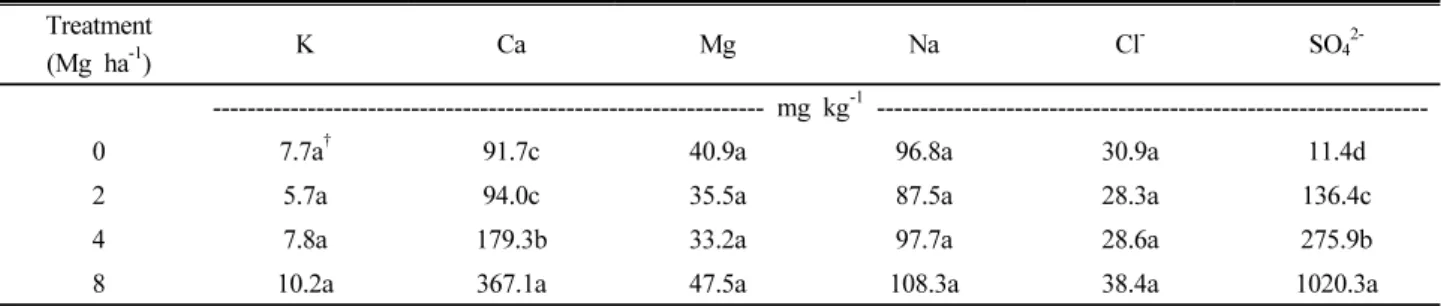
부산석고비료 시용에 따른 토양용액 중 무기성분함량은 Table 3과 같다. 부산석고 시용량이 증가함에 따라 토양용 액중의 Ca, SO

42-

함량이 크게 증가하는 것을 확인할 수 있

었고 K, Mg, Na, Cl

-

함량은 처리간 큰 차이가 없었다. 토 양용액중 무기성분과 메탄 발생간의 상관관계를 조사한 결 과 (Fig. 3), Ca와 SO

42-

함량은 메탄발생과 부의 상관관계 가 있는 것으로 분석되어, Lim et al. (2011)이 간척지 논 토 양 개량제로써 석고처리에서 메탄 발생과 SO

42-

함량은 고도 의 역의 상관관계가 있는 것으로 보고한 결과와 일치하였다.

부산석고비료 처리에 따른 토양 화학적 특성 변화를 살 펴본 결과 (Table 4) 처리량이 증가함에 따라 토양의 pH는 유의적으로 감소하는 경향을 보였으며, 치환성 칼슘함량도 무처리 5.9 cmol

c

kg

-1

에 비해 시용량이 증가함에 따라 8 Mg ha

-1

에서는 7.7 cmol

c

kg

-1

으로 1.8 cmol

c

kg

-1

증가하였 다. 이는 알칼리성 논토양에 석고를 시용할 경우 토양의 pH를 적절하게 낮춤으로써 산도 교정효과가 클 것으로 판단된다.

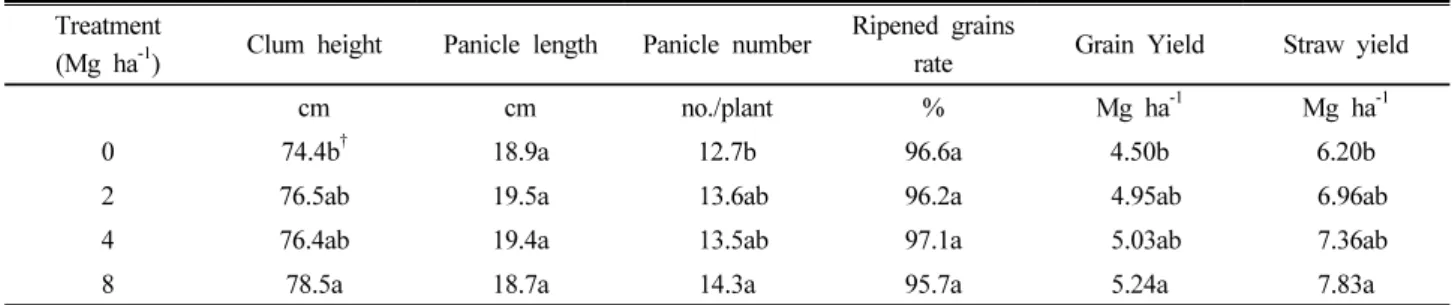
부산석고비료 처리에 따른 벼 생육과 수량은 Table 5와 같다. 간장은 무처리 74.4 cm에 비해 부산석고비료 처리량 이 증가함에 따라 증가하였고, 주당 수수도 부산석고비료 8 Mg ha

-1

에서는 14.3개로 무처리의 12.7개에 비해 1.6개가 더 많았다. 알곡수량은 무처리의 4.50 Mg ha

-1

에 비해 부산 석고비료 시용량이 증가함에 따라 증가하여 8 Mg ha

-1

시용 구에서 5.24 Mg ha

-1

로 16% 증가하였다.

농촌진흥청 (RDA, 2002)의 연구결과에 의하면 석고를 시 용함으로써 벼의 천립중과 현미수량이 증가되었으며, Lim et al. (2011)은 석고처리를 1.0% 수준까지 증가시킴에 따라 무처리구 5.3 Mg ha

-1

에 비하여 최대 6.0 Mg ha

-1

(13.2%) 까지 수량이 증가하였으나, 많은 양의 석고처리로 인해 증 가된 황산염은 독성을 유발시킬 수 있으며, 이로 인하여 수 량이 감소한 것으로 보고하였다.

논토양에 부산석고비료의 처리는 칼슘의 공급 효과로 토

양물리성을 개선할 수 있으며, 황산염의 증가는 전자수용체

로 작용하여 전자의 활성 저하시키고 황환원균의 활성을 증

가시키고 Ca는 토양용액 중 탄산과 침전을 형성하여 탄소

기질농도를 낮춤으로써 메탄 발생을 저감시키는 것으로 보

고하고 있는데 (Ali et al., 2007; Lim et al., 2012), 본 연

구에서도 부산석고비료는 논토양에 시용할 경우 벼 수량을

증가시킬 뿐만 아니라 메탄 배출을 효과적으로 저감할 수

있는 토양개량제로 이용할 수 있을 것으로 판단되었다.

(5)

Fig. 3. Relationship between the levels of inorganic components in soil solution and the methane emission.

Table 4. Soil chemical properties by different levels of by-product gypsum fertilizer application at harvesting stage.

Treatment

(Mg ha

-1

) pH OM Avail.

P

2

O

5

Exch. cations

K Ca Mg EC

1:5 g kg

-1

mg kg

-1

--- cmol

c

kg

-1

--- dS m

-1

0 7.6a

20.7a 90a 0.3a 5.9b 2.9a 0.38c

2 7.6a 19.7a 78a 0.3a 6.3b 3.0a 0.46bc

4 7.5ab 19.0a 74a 0.3a 7.3ab 3.0a 0.59ab

8 7.4b 19.0a 67a 0.3 7.7a 2.6a 0.75a

† Numbers followed by the same letter with a column are not significantly different (Duncan test, p < 0.05).

Table 5. Growth and rice yield by different levels of by-product gypsum fertilizer application at harvesting stage.

Treatment

(Mg ha

-1

) Clum height Panicle length Panicle number Ripened grains

rate Grain Yield Straw yield

cm cm no./plant % Mg ha

-1

Mg ha

-1

0 74.4b

18.9a 12.7b 96.6a 4.50b 6.20b

2 76.5ab 19.5a 13.6ab 96.2a 4.95ab 6.96ab

4 76.4ab 19.4a 13.5ab 97.1a 5.03ab 7.36ab

8 78.5a 18.7a 14.3a 95.7a 5.24a 7.83a

† Numbers followed by the same letter with a column are not significantly different (Duncan test, p < 0.05).

Conclusion

벼 재배 논에서 부산석고비료 시용량에 따른 메탄 배출 저감과 벼 수량에 미치는 영향을 평가하였다. 부산석고비료 시용량이 증가할수록 산화환원전위는 증가하였고, 메탄 발 생량은 유의적으로 감소하여 8 Mg ha

-1

시용구에서 60.6%

감소하였다. 토양용액중 Ca와 SO

42-

이온은 부산석고 시용

량이 증가할수록 증가하였고 메탄 발생량과는 부의 상관관

계를 나타내었다. 부산석고비료 시용량이 증가할수록 벼 수

량은 증가하여 8 Mg ha

-1

시용구에서 무시용구 대비 16% 증

가되었다. 따라서 부산석고비료는 메탄 배출을 효과적으로

저감시킬 뿐만 아니라 벼 수량을 증수시킬 수 있는 토양개

(6)

량제로 판단되었다.

References

Ali, M.A., C.H. Lee, and P.J. Kim. 2007. Effect of phospho- gypsum on reduction of methane emission from rice paddy soil. Korean J. Envir. Agri. 26(2):131-140.

Conrad, R. 1989. Control of methane production in terrestrial ecosystems. In: Exchange of trace gases between terrestrial ecosystems and the atmosphere, M.O. Andreae and D.S.

Schimel(eds.), pp. 39-58.

Denier Van der Gon, H.A.C., and H.U. Neue. 1994. Impact of gypsum application on the methane emission from a wetland rice field. Global Biogeochem. Cycles. 8:127-134.

Garica, J.L., B.K.C. Patel, and B. Ollivier. 2000. Taxonomic, phylogenetic and ecological diversity of methanogenic archaea. Anaerobe. 6:205-226.

Holzapfel-Pschorn, A., and W. Seiler. 1986. Methane emission during a cultivation period from an Italian rice paddy. J.

Geophy. Res. 91D:11803-11814.

Hori, K., K. Inubushi, S. Matsumoto, and H. Wada. 1990.

Competition for acetic acid between methane formation and sulfate reduction in paddy soil. Jpn. J. Soil Sci. Plant Nutr.

61:572-578.

Ju, O.K., T.J. Won, K.R. Cho, B.R. Choi, J.S. Seo, I.T. Park, and G.Y. Kim. 2013. New estimates of CH

4

emission scaling factors by amount of rice straw applied from Korea paddy fields. Korean J. Envir. Agri. 32(3):179-184.

Karl, T.R. and E.T. Kevin. 2003. Modern global climate change. Science 302:1719-1723.

Ko, J.Y., J.S. Lee, K.S. Woo, S.B. Song, J.R. Kang, M.C.

Seo, D.Y. Kwak, B.G. Oh, and M.H. Nam. 2011. Effects of soil organic matter contents, paddy types and agricultural climatic zone on CH

4

emissions from rice paddy field.

Korean J. Soil Sci. Fert. 44(5):887-894.

Le Mer, J. and P. Roger. 2001. Production, oxidation, emission and consumption of methane by soils: A review, Eur. J. Soil Biol. 37:25-50.

Lim C.H., S.Y. Kim, and P.J. Kim. 2011. Effect of gypsum application on reducing methane emission in a reclaimed coastal paddy soil. Korean J. Envir. Agri. 30(3):243-251.

Lim S.S., W.J. Choi, H.Y. Kim, J.W. Jung, and K.S. Yoon.

2012. Fly ash application effects on CH

4

and CO

2

emission in an incubation experiment with a paddy soil. Korean J.

Soil Sci. Fert. 45(5):853-860.

Lindau, C.W., D.P. Alford, P.K. Bollich, and S.D. Linscombe.

1993. Inhibition of methane evolution by calcium sulfate addition to flooded rice. Plant Soil. 158:299-301.

Neue, H.U., and R. Sass. 1994. Trace gas emissions from rice fields. In: Global atmospheric-biospheric chemistry Plenum Press, New York. 119-148.

NIAST. 2000. Method of analysis soil and plant. National Institute of Agricultural Science and Technology, Suwon, Korea.

Patrick, W.H. Jr. 1981. The role of inorganic redox systems in controlling reduction in paddy soils. In: Proc. Symp.

Paddy Soil, 107-117, Science Press, Beijing, China, Springer- Verlag.

RDA. 1995. Standard methods for agricultural experiment.

Rural Development Administration, Suwon, Korea.

RDA. 2002. Korea Agriculture on Reclaimed Lands. Honam Agricultural Research Institute, NICS, Iksan, Korea.

Rodhe, H. 1990, A comparison of the contribution of various gases to the greenhouse effect. Science. 247:1217-1219.

Rowell, D.L. 1994. Air in soils-supply and demand. pp. 125-129.

Soil Science : Method and applications. Longman Scientific and Technical, Larlow, Essex, England.

Ryu, J.H., S.C. Jung, G.Y. Kim, J.S. Lee, and K.H. Kim.

2012. LCA (Life Cycle Assessment) for evaluating carbon emission from conventional rice cultivation system: Comparison of top-down and bottom-up methodology. Korean J. Soil Sci. Fert. 45(6):1143-1152.

Sohn, B.K., D.J. Lee, B.K. Park, and K.S. Chae. 2007. Effects of phosphor-gypsum fertilizer as reclamation material in the newly reclaimed paddy fields. Korean J. Soil Sci. Fert.

40(2):145-150.

Takai, Y. 1970. The mechanism of methane fermentation in flooded paddy soil. Soil Sci. Plant Nutr. 16:238-244.

Yan, X., K. Yagi, H. Akiyama, and H. Akimoto. 2005. Statistical analysis of major variables controlling methane emission from rice field. Global Change Biol., 11:1131-1141.

Yamane, I. and K. Sato. 1961. Effect of temperature on the

formation of gases and ammonium nitrogen in the water-

logged soils. Sci. Rep. Res. Inst. Tohoku Univ. D (Agr.)

12:31-46.

수치

Table 1. Physico-chemical properties of paddy soil used in the experiment. pH OM Avail
Fig. 1. Change in Eh and CH 4  emission in paddy soils as  affected by by-product gypsum during rice cultivation.
Table 3. Inorganic components in soil solution by different levels of by-product gypsum fertilizer application.
Table 5. Growth and rice yield by different levels of by-product gypsum fertilizer application at harvesting stage.

참조

관련 문서

Key words: Net Global Warming Potential (net GWP), Greenhouse Gas (GHG), NECB (Net Ecosystem Carbon Budget), Rice Paddy, Fallow Season.. †Corresponding author : [email protected]

Keywords: Rice paddy, Nitrogen fertilizer, Controlled release fertilizer, Hairy vetch, Greenhouse gas, Greenhouse gas intensity.. Grain yield, total GWP and GHGI

Assessment of Methane (CH 4 ) Emissions from Rice Paddy and Crop Residues Burning in 2011 with the IPCC

Long-term Effects of Inorganic Fertilizer and Compost Application on Rice Sustainability in Paddy Soil.. Chang Hoon Lee*, Chang Young Park 1 , Ki Youl Jung 1 , and Seong Soo

The change of cultivation and utilization of chinese milk vetch(Astragalus sinicus L.) and the effect of fertilizer and soil fertility on paddy field as a green

Fluxes of carbon dioxide (CO 2 ) were measured above crop canopy using the Eddy Covariance (EC) method, and emission rate of methane (CH 4 ) was measured using

Emission characteristics of methane and nitrous oxide by management of water and nutrient in a rice paddy soil, Korean Journal of Environmental Agriculture 21(2): 136-143

∙ Estimation of methane emission by water management and rice straw application in paddy soil in Korea (Shin et al., 1995c).. ∙ Effects of water management rice straw and