․투고일: 2015.02.16, 심사일: 2015.03.18, 게재확정일: 2015.03.19
․Corresponding author: Chang-gue Son 176-9 Daehung-ro, Jung-gu, Daejeon, 301-724, Republic of Korea Liver and Immunology Research Center, Dae-jeon Oriental Hospital of Dae-jeon University
TEL: +82-42-229-6807
A Drug-Induced Liver Injury by Western Medication
Chang-gue Son
Liver and Immunology Research Center, Oriental Medical College in Dae-Jeon University
A Drug-Induced Liver Injury by Western Medication
Chang-gue Son
Liver and Immunology Research Center, Oriental Medical College in Dae-Jeon University
ABSTRACT
Objectives: To investigate the clinical features of drug-induced liver injury (DILI) and traditional Korean medicine (TKM) -based management.
Methods: A female patient diagnosed with DILI caused by Western drugs had been treated with Oriental therapies, then the subjective clinical outcome and biochemical parameters were monitored.
Results: A 73-year-old female had taken Western drugs (nonsteroidal anti-inflammatory and skeletal muscle relaxants) for about 3 months, and complained of severe abdominal discomfort and tiredness. Her RUCAM score was 9, which met the criteria for DILI (AST 90 IU/L, ALT 100 IU/L, ALP 191 IU/L, and GGT 614 IU/L). She was treated with herbal drugs, moxibustion, and acupuncture, and her symptoms completely resolved, with normalized hepatic enzymes within two weeks.
Conclusions: This case report provides a clinical characteristic for a typical DILI caused by Western medicine, and shows an example of a TKM-based application.
Key words: drug-induced liver injury, traditional Korean medicine, herbal medicine, RUCAM score
Ⅰ. Introduction
Among adverse drug reactions (ADRs) drug-induced liver injury (DILI) becomes a critical issue of medicine because DILI is responsible for 2-5% of hospitalization with jaundice and approximately
10% of all cases of acute hepatitis
1. In the United States, approximately 2,000 cases of acute liver failure occur annually and then 50% of them are caused by DILI
2. DILI is the major cause of failure in drug development or withdrawal of drugs from the market
3.
The most common drugs leading to DILI are
antibiotics, central nervous system agents,
immunomodulatory agents
4. Recently herbal drugs
often become a medical issue regarding possibility
of hepatotoxicity
5,6. The public reports on herbal
DILI would be a main cause of the distorted
the major studies on DILI even for herbal medicine-associated toxicity were conducted in western medicine field
8,9. Traditional Korean medicine (TKM) needs to play a more active role in issues of drug safety and ADRs including treatment of DILI.
This study aims to report a woman case with DILI by western medicine, which was recovered by TKM-based treatments.
Ⅱ. Report of the case
1. Medical history and examination
A 73-year-old woman has been healthy except a degenerative arthritis in both knees. She was standard body mass index (BMI, 22) with slight abdomen obesity. She hasn’t used alcohol, and has no family history of hepatic diseases. She was a homemaker doing a small amount of labor under no psychological stress. She got a prescription of nonsteroidal anti-inflammatory drug and skeletal muscle relaxants for her knee joint pain from August 2014 (Table 1). From October 2014 she had felt symptoms of digestive disorders such as indigestion, nausea, burp, vomiting tendency and heartburn respectively. The patient had visited a local western clinic and taken a medication for her symptom, but the symptoms became worsen slowly.
The patient begun to feel the severe fatigue and exhaustion with the worsen status of above symptoms on December 2014. She visited an Oriental hospital, and found an abnormality in laboratory tests;
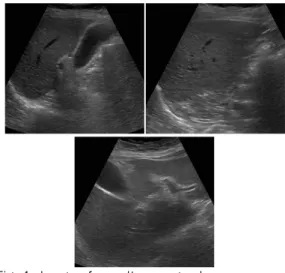
elevated levels of serum alanine aminotransferase (ALT, 91 IU/L) and aspartate aminotransferase (AST, 100 IU/L), alkaline phosphatase (ALP, 191 IU/L), gamma glutamyl transpeptidase (GGT, 614 IU/L), and total bilirubin (1.3 mg/ml). The tests for viral infections were negative (Table 2), and abdominal ultrasonography revealed normal features (Fig. 1).
Fig. 1. Images from ultrasonography.
Unremarkable sono-echogencity was found in the both lobes of the liver and biliary system.
Name of product
(Dose per day) Active ingredient Main action Warning for liver injury Mobic capsule
(7.5 mg twice) Meloxicam Nonsteroidal
anti-inflammatory effect
Hepatic side effects have been rarely reported (2% or less), increased
serum enzymes
10Anorex capsule
(25 mg twice) Dantrolene sodium Skeletal muscle relaxants
Potentially hepatotoxic as a symptomatic hepatitis (0.3% fatal and 2.4% non-fatal)
11Varidase tablet
(10000 IU twice) Streptokinase Effect on inflammatory edema
Rare hepatic dysfunction have been reported
12Stillen tablet (60 mg twice)
95% ethanol extract of Artemisia
Protective effect on gastritis by nonsteroidal
anti-inflammatory drug
Rarely increase of hepatic enzyme, ALT (0.26%)
13Table 1. Prescription of Western Drugs
2. Treatments and clinical outcome
As an outpatient, she was given with Chungganplus syrup (two packs per day) mainly with indirect moxibustion (both KI1, CV8) and acupuncture (mainly at HT4, Lu9, Lv3). Chungganplus is 10 ml syrup containing 2g extract from 13 herbs (5 g each of Artemisia capillaris Herba, Carapax Trionycis, Semen Raphani; 3 g each of Rhizoma Atractylodis Macrocephalae, Poria, Alismatis Rhizoma, Atractylodis Rhizoma, Salviae Miltiorrhizae Radix; 2 g each of Polyporus, Amomi Fructus, Aurantii Fructus, and 1 g of Glycyrrhizae Radix and Helenii Radix).
The subjective symptoms including fatigue,
indigestion and nausea gradually become improved from 5
thday of treatment, and then all symptoms disappeared at 15
thday after treatment. The serum levels of AST, ALT and ALP were lowered near to normal rage by 15
thday of treatment, but GGT was still high as approximately 6 times of normal upper limit (Table 2). The patient quoted the both further treatment and laboratory tests because she now satisfied with the clinical improvement.
Under telephone follow-up survey after one month later last treatment, it was confirmed that she was in healthy and normal activity without any complaint related to DILI.
Day of treatments by KM
AST (IU/L)
ALT (IU/L)
GGT (IU/L)
ALP (IU/L)
T. bilirubin
(mg/dl) Subject symptom
Day 1 91 100 614 191 1.3 NRS* 10
Day 6 60 83 537 160 1.2 NRS 6
Day 15 40 50 364 126 1.0 NRS 1
The patient showed no positive results for other hepatic viral infections as HBs Ab: negative, HCV Ab negative, HVA Ig M : negative, and HVA Ig G : positive respectively.
The upper normal limits are follows; 40 IU/L for AST and ALT, 64 IU/L for GGT, 120 IU/L for ALP, and 1.2 mg/dl for total bilirubin respectively.
Table 2. Change of Laboratory Finding and Symptoms
Ⅲ. Discussion and Conclusion
Medication can cause a diverse spectrum of ADRs including DILI. Approximately 80% of ADR is the augmented pharmacologic effects that show a dose dependent and predictable charaterisctics
14. Meanwhile most cases of DILI results from the idiosyncratic metabolic responses that show the dose independent and unpredictable patterns
15. It is difficult to confirm the DILI because no specific biomarkers or ‘gold standard’ diagnostic tests for DILI exists
16. Roussel Uclaf Causality Assessment Method (RUCAM) is commonly used as a causality assessment algorithm to measure the strength of association between suspected DILI and an implicated agent
17.
In this case, patient showed typical symptoms of acute liver injury; a severe fatigue, exhaustion and troubles in gastric function including nausea, burp, vomiting tendency and heartburn. Even though the patient visited a western clinic for her physical complains, the DILI was not founded due to the absence of blood test. The medical examinations in laboratory tests and radiography excluded other liver disorders likely viral hepatitis or hepatoma.
RUCAM score for the patient was 9 which indicated the strong probability of DILI by western drugs.
RUCAM score >8 general indicates the definitive causality between DILI and suspected agents
18. DILI is generally classified into three types;
hepatocelluar, cholestatic, mixed type, according to the pathological feature
19. It is defined as a rise in either ALT or ALP level, by calculating a fold ratio of the elevated ALT value by upper limit of normal (ULN) to the elevated ALP value by ULN
20. The fold ratio was 1.6 (R<2) which indicated a cholestatic pattern of hepatotoxicity, but this case
seemed to be a hepatocelluar type because the total bilirubin was not elevated> 2 folds of ULN.
This patient however showed a tendency of cholestatic pattern, which was supported by the drastic elevation of serum GGT level (9.6 times of ULN). ALP and GGT are normally anchored to membranes of hepatocytes, and thus their elevations are typical biomarker for cholestatis
21.
The patient of this case had taken the medications of meloxicam, dantrolene sodium and streptokinase for her knee arthritis and pain. Among those drugs, meloxicam and dantrolene sodium have been known to induce hepatotoxicity by approximately 2% of incidence
10,11. In particular, there is a previous report that meloxicam, a nonsteroidal anti-inflammatory drug (NSAID), induced a cholestatic pattern of DILI
22. Although the numerous drugs in fact could raise a hepatic injury, NSAID is belonged in major drug group exhibiting hepatotoxicity
23. Beside drug property, genetic factor, underlying condition and age are involved in risk factors. The hepatocellular type is more common in younger patients, whereas cholestatic pattern of DILI is known to increase with older age
24. The principle of management for DILI is to stop early the suspected agents. The patient of this case had recovered quickly the both subjective symptoms and objective biomarkers from laboratory tests within 15 days. The majority of patients with symptomatic acute DILI are expected to completely recover with supportive care, and then 5% to 15% of patients had chronic DILI and persistent laboratory abnormalities
24,25. One Korean study revealed 1.8% of deaths or transplantations among 371 hospitalized cases with DILI
6. In current case, TKM-based therapies including Chungganplus syrup might help the recovery quickly.
On the other hand, recently the herbal medicine
is concerned as a leading cause of DILI in Korea
26. However 0.5% of 567 hepatic adverse drug events (ADEs) and 0.1% of 1,418 ADEs was caused by herbal medication in two spontaneously reported studies in Korea
27,28. These conflict data resulted from the differences of study subjects, likely hospitalized patients with DILI versus total population with ADE or hepatic ADE. Some studies seem to exaggerate the possibility of herbal medicine-associated hepatotoxicity, which frequently leaded to distortion of reputation for herbal medicine in Korea
29. Traditional Korean medicine doctors sometimes attribute this status to that the herb-related DILI data have been conducted mainly by researchers in western medicine field.
Accordingly Traditional Korean medicine doctors need to play a leading role in drug safety study especially for herbal medicine.
This case report presented a typical patient with a western drug-induced DILI, which had been improved by TKM therapy. This study would be helpful to provide the practical knowledge of DILI and information to care the patient with DILI in TKM field.
Acknowledgement
This study was supported by a grant
(HI12C1920-010014) from the Oriental Medicine
R&D Project, Ministry of Health & Welfare.
양약으로 유발된 약인성 간손상 환자 임상보고
손창규
대전대학교 대전한방병원 간장면역센터
ABSTRACT
본 증례보고는 퇴행성 관절염으로 양방병원에서 치료를 받던 중에 발생한 약인성 간손상으로 한방병원에서 진단 및 치료 받은 73세의 여성 환자의 증례를 소개하고자 한다. 환자는 약 3개월 동안 양방병원에서 비스테로이드성 소염제와 근육이완제 등을 처방 받아 오던 중, 점차적으로 피로감과 오심, 구역감 등의 위장장애를 호소하였다. 양방 의원에서 수 차례 약물치료를 하였으나 호전되지 않고, 점차 극심한 피로감과 무기력감 및 위장증상으로 한방병원을 찾게 되었다. 한방병원에서 혈액검사상 에 급성감염(AST 90 IU/L, ALT 100 IU/L, ALP 191 IU/L, GGT 614 IU/L) 소견을 보였다. 초음파 검사상 정상적 소견과 다 른 기저질환의 배제 및 RUCAM score가 9로서 약인성 간손상으로 진단이 되었다. 15일간의 뜸치료와 침치료 및 한약물 (청간 플러스시럽)의 복용으로 주관적 증상은 완전히 소실되었으며, GGT를 제외한 간기능 검사도 정상으로 회복되었다. 그 동안 한 약물과 관련된 약인성 간손상에 대한 연구가 주로 양의학계에서 이루어지다 보니 한약물의 안전성에 대한 부정적 평가가 많았 었다. 그러한 의미에서 본 증례보고는 양약에 의한 약인성 간손상에 대한 전형적인 증상의 특성을 보여주고, 약인성 간손상에 대한 한의학적 관리 및 치료의 향후 연구에 대한 의미 있는 증례를 제시한다고 하겠다.
중심단어: 약물유인성 간손상, 한의학, 한약, RUCAM 척도