−
206
−체심 입방구조 Rh(001) 표면의 전자구조와 자성
조이현·B. Bialek·이재일*
인하대학교 물리학과, 인천시 남구 용현동 253, 인천 402-751
(2008년 11월 7일 받음, 2008년 12월 3일 최종수정본 받음, 2008년 12월 3일 게재확정)
최근의연구에따르면체심입방구조
(bcc)
를가지는Rh
은상자성상태와약간의에너지차를보이며강자성체가된다고한다.
이연구에서는
bcc Rh(001)
표면의전자구조와자성을일반기울기근사하에서총퍼텐셜선형보강평면파에너지띠계산방법을이용하여연구하였다
.
표면의자성상태는강자성상태를가졌으며, unrelaxed
된경우에표면층의자기모멘트는0.48
µB로덩 치상태의0.43
µB에비해증진되었으나,
표면바로밑층의자기모멘트는0.23
µB으로상당히줄어들었다.
총에너지및원자힘계산을통해
relaxed
된구조를구하였는데,
이때표면층은안쪽으로,
표면바로밑층은바깥쪽으로이동하여원래의층간격보다약
7.0 %
줄어들었다.
이러한층간간격변화는표면자성을약화시켜,
표면층과표면바로밑층의자기모멘트를0.36
µB및
0.14
µB로줄어들게하였다.
주제어
:
전자구조,
자성,
체심입방Rh(001)
표면The Electronic Structure and Magnetism of bcc Rh(001) Surface
L.-H. Cho, B. Bialek, and J. I. Lee*
Department of Physics, Inha University, Incheon 402-751, Korea
(Received 7 November 2008, Received in final form 3 December 2008, Accepted 3 December 2008)
According to the recent reports the bulk bcc Rh is ferromagnetic with a small difference of energy compared to paramagnetic state. In this study, the electronic structure and magnetism for bcc Rh(001) surface are investigated by means of the all-elec- tron full potential linearized augmented plane wave method within the generalized gradient approximation. It is found that the surface ferromagnetic state is preferable over the paramagnetic one. For unrelaxed system, the magnetic moment of the sur- face layer, 0.48
µB, is slightly increased comparing with the bulk value, 0.41
µBwhile the value of the subsurface layer, 0.23
µB, is much smaller than the bulk value. The total energy and atomic force calculations show that the surface layer is relaxed downward and the subsurface layer moves upward to reduce the layer distance between the surface and subsurface layers by 7.0 %. The relaxation effect leads to weakening the surface magnetic properties. Specifically, the value of the mag- netic moment of the surface atom is decreased to 0.36
µB. Since the spin polarization of the subsurface layer is only 0.14
µB, it is concluded that the bcc Rh(001) surface is rather weakly ferromagnetic.
Keywords :
electronic structure, magnetism, bcc Rh(001)
I. Introduction
Rhodium, a 4d transition metal (TM) element, does not exhibit ferromagnetic ordering in its naturally occurring bulk structure that is face centered cubic (fcc) structure. There have been continuous experimental and theoretical studies to examine the possibility of ferromagnetism at the surface [1-6].
The pseudopotential
ab initiodensity functional calculation for the fcc Rh(001) surface by Morrison
et al.showed that the surface layer has a considerably large magnetic moment (MM) of 1.797
µB[1]. This paper invoked the later experimental and theoretical investigations for the magnetism at the Rh(001) surface. The spin-polarized photoemission experiments by Wu
et al.
[2] showed the fcc Rh(001) surface is ferromagnetic, but the estimated MM of the surface layer is in between 0.1~
0.2
µBthat is much smaller than the value given by Morrison
*Tel: (032) 860-7654, E-mail: [email protected]
et al
. The linear magnetic dichroism in 3d core-level photoemission experiments by Goldoni
et al.[3] indicated the presence of the MM at the Rh(001) surface. Their follow up investigation [4] showed that the fcc Rh(001) surface is weakly ferromagnetic or superparamagnetic. The calculations by Cho and Scheffler [5] were consistent with the measure- ments by Wu
et al.[2] in a sense that the Rh surface ferromagnetic state is very close to the critical point with a very small MM. A more recent calculation by Stojic
et al.[6]
showed that the magnetism at the Rh(001) surface is not predicted by the plain local density approximation (LDA) or generalized gradient approximation (GGA), but the surface magnetism is induced if a ultra-soft potential
Ueffgreater than 1.2 eV is included into LDA+
Uor GGA+
Uapproach.
From the above investigations, it seems that the surface magnetism of Rh is very delicate and therefore there were some discrepancies between the theoretical and experimental data. In this situation, Hüger and Osuch [7] investigated the possibility of magnetism in bulk Rh system with non-close- packed structure. From the electronic structure calculation for the bulk Rh with bcc, fcc, hcp, and dhcp structures, they found that the bcc structured Rh is magnetic at optimum lattice constant of 3.08 Å. They discussed that the inducement and enhancement of magnetism in bcc Rh are related to the four- fold symmetry in non-close packed structure. Their calculation with the local spin density approximation gave the MM on Rh atom equal 0.26 or 0.31
µB, depending whether or not the spin-orbit coupling was included, and it was 0.41
µBper atom within GGA [4].
In this study, we attempted to investigate the magnetic properties of the (001) surface of bcc Rh with the use of full- potential all-electron first-principles method. For the purpose of comparison we also calculated the bulk properties of bcc Rh.
II. Details of Calculations
In order to determine the optimized lattice constant and the magnetic properties for bulk bcc Rh, we first recalculated the electronic structure for bcc Rh by the full-potential band method. The value of lattice constant for the bcc Rh obtained by the optimization procedure is identical with that reported by Hüger and Osuch [4].
For the study of magnetism on bcc Rh(001) surface, we
adopted a single slab model consisted of nine layers of bcc Rh with the initial lattice constant equal to 3.08 Å. Thus the two- dimensional unit cell along the [001] direction is a square with a side of 3.08 Å and the distance between layers is 1.54 Å.
Electronic structure calculations were carried out by using the full-potential linearized augmented plane-wave (FLAPW) method, as embodied in the QMD-FLAPW package [8,9]
within the generalized gradient approximation [10], which allows to solve the Kohn-Sham equation [11] for the investigated system in order to obtain its electronic structure.
Lattice harmonics with
l ≤8 were considered to describe the charge density, the potential and the wavefunctions inside each muffin-tin (MT) sphere within radius of 1.16 Å. A cutoff of 180 Ry was used for star function, and the value of 16 Ry was used for the plane-wave cutoff. Integration inside the Brillouin zone was replaced by summation over 66 irreducible k-points inside the Brillouin zone by the linear tetrahedron method. All core electrons were treated fully relativistically, while valence states were treated scalar relativistically, without spin-orbit coupling [12]. Self-consistency was assumed when the dif- ference between the input and the output charge (spin) densities was less than 2.0 × 10
−4electrons/a.u.
3.
In order to study the surface relaxation for bcc Rh(001) slab, we have carried out the total energy and the atomic force calculation [13]. The optimization process was terminated when the atomic force was less than 15 mRy/a.u.
III. Results and Discussion
In the first step of our study we calculated the electronic properties of the optimized bcc Rh bulk structure. In Fig. 1, the obtained electronic densities of states of the paramagnetic and ferromagnetic bcc Rh bulk are presented. When spin polarization in the system was not considered, a large peak in the DOS was found, in accordance with the results obtained by Hüger and Osuch [7]. The presence of a large number of states at the Fermi level (
EF) indicates instability of the system. This instability is corrected when the ferromagnetic ordering is assumed. As it is seen from Fig. 1(b), the number of states at
EFin ferromagnetic bcc bulk Rh is about 3 times smaller than the number of states in the paramagnetic bcc Rh.
A separation in energy of the valence d electrons in the
majority and minority spin channels is seen, which gives rise
to an exchange splitting in this form of Rh bulk. The
calculated MM on Rh atom in the system is 0.43
µB, which is in good agreement with the value obtained by Hüger and Osuch (0.41
µB) with the same method of calculations [7].
In the second step, we calculated the electronic structure for
the unrelaxed bcc Rh(001) slab, and then we performed the total energy and atomic force calculations to obtain the stable structure. The relaxed surface is energetically more stable than the unrelaxed one by 112 meV. We found that the surface (S) and subsurface (S-1) layers move inward by 0.04 Å and outward by 0.07 Å, respectively. In result we observed a contraction between the S and S-1 layers by about 7.0 %. The second subsurface (S-2) layer also moves outward by 0.03 Å which makes 2.8 % increase of the distance between the S-1
Fig. 1.
Calculated total density of states (DOS) of paramagnetic (top panel) and ferromagnetic (bottom panel) bcc Rh. In the ferromag- netic system spin-down states are multiplied by
−1. Fermi levels are set to zero.
Fig. 2.
Charge and spin density contour plots obtained for the fully relaxed bcc Rh(001) surface. The lowest contour starts from 1.0 × 10
−4electrons/(a.u.)
3and the subsequent lines differ times. In the spin contour panel solid lines represent positive polarization, and dashed lines represent negative polarization.
2
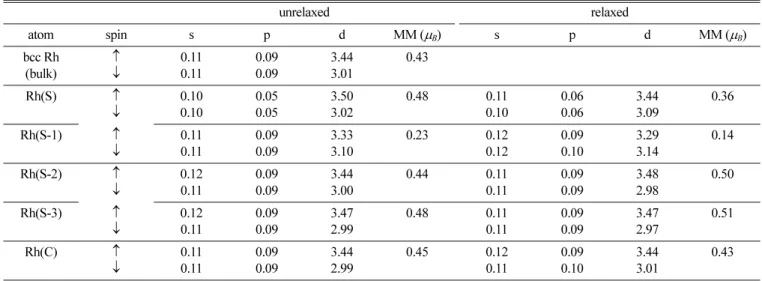
Table I.
Calculated
l-decomposed majority and minority electrons inside each muffin-tin sphere for bcc Rh bulk and bcc Rh(001) surface (unre- laxed and relaxed) together with the magnetic moments (MM) on the atoms.
unrelaxed relaxed
atom spin s p d MM (
µB) s p d MM (
µB)
bcc Rh
↑0.11 0.09 3.44 0.43
(bulk)
↓0.11 0.09 3.01
Rh(S)
↑0.10 0.05 3.50 0.48 0.11 0.06 3.44 0.36
↓
0.10 0.05 3.02 0.10 0.06 3.09
Rh(S-1)
↑0.11 0.09 3.33 0.23 0.12 0.09 3.29 0.14
↓
0.11 0.09 3.10 0.12 0.10 3.14
Rh(S-2)
↑0.12 0.09 3.44 0.44 0.11 0.09 3.48 0.50
↓
0.11 0.09 3.00 0.11 0.09 2.98
Rh(S-3)
↑0.12 0.09 3.47 0.48 0.11 0.09 3.47 0.51
↓
0.11 0.09 2.99 0.11 0.09 2.97
Rh(C)
↑0.11 0.09 3.44 0.45 0.12 0.09 3.44 0.43
↓
0.11 0.09 2.99 0.11 0.10 3.01
and the S-2 layers.
The magnetic properties are changed due to the creation of the surface. In Table I, we present the
l-decomposed majority and minority electrons inside each MT and the MM of the Rh atoms in the unrelaxed and the relaxed bcc Rh(001) slabs. It is seen that surface effects affect only the surface (S) and the first subsurface (S-1) layers in the system, while the properties of the deeper layers are not much different from the properties of bulk. The calculated MMs of the S and S-1 Rh atoms in the unrelaxed system were 0.48 and 0.23
µBand those for the relaxed system were 0.36 and 0.14
µB, while the values of the other layers in both systems were similar to bulk one.
The fact that the surface creation does not influence much the electronic and magnetic properties of the deep inner layers can be also confirmed by the charge and spin density contours for the slab system, presented in Fig. 2. The distribution of charge around the atoms in all but the top layer is very uniform. As expected, at the surface the charges are more delocalized and therefore the MM on Rh(S) atom (0.36
µB) is smaller than the values associated with the Rh(C), (S-3), and (S-2) atoms. Only the Rh(C) atom’s MM is exactly same as the MM of Rh in bcc bulk. The subsurface Rh(S-1) atom has the lowest MM, equal 0.14
µB, and the atoms in the second and third subsurface layers have MM equal to 0.50 and 0.51
µB, respectively. Those values differ from the values obtained for the unrelaxed surface. Smaller values of MM on the relaxed Rh(S) and Rh(S-1) atoms may be the consequence of the changes in the distances between the nearest neighbors.
Although the overall charge density as well as the total occupation of d states is hardly changed due to the relaxation, the data in Table I indicate that the distribution of electrons between the majority and the minority states changes.
Comparing the magnetic properties of the unrelaxed and relaxed surfaces we may conclude that ferromagnetism stabilizes the bcc Rh(001) surface, but it experiences structural instability due to the surface effects. This causes surface relaxation that in turn leads to a decrease of the MM of the Rh atoms in the two topmost layers of the surface.
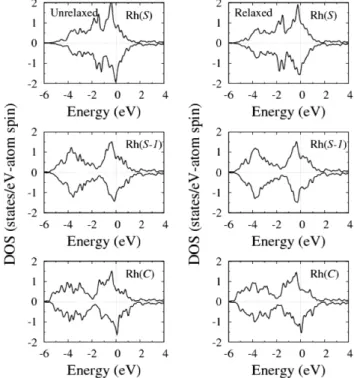
The calculated DOS for the investigated surfaces supports these conclusions. The layer-projected DOS pictures obtained for the unrelaxed and relaxed bcc Rh(001) surfaces are presented in Fig. 3. Since the DOS picture for the inner layers of the systems and the DOS for the center layer are alike, we show here Rh(C), (S-1), and (S) layers only. The most clear
feature that distinguishes the electronic structure of ferromag- netic bcc Rh(001) surface from that of paramagnetic one is much smaller number of electronic states at
EF. The peak of majority d states is observed at 1 eV below
EFin the unrelaxed surface. There is considerable number of minority d states at
EF. These minority spin states move slightly below
EF
, and their number becomes smaller when the relaxation is considered. Also, the majority d states move slightly towards
EF
, and this results in a smaller MM on Rh(S) atom. It is noticeable from the DOS pictures obtained for Rh(S-1) layers in the both systems that the subsurface layer is stabilized due to the relaxation. However, its magnetic properties are diluted.
The DOS obtained for the Rh(C) layers in the two systems resemble that calculated for the ferromagnetic bcc Rh bulk.
The results obtained in our study indicate that the bcc Rh(001) surface may be weakly ferromagnetic, similarly to the fcc Rh(001) surface [3].
IV. Conclusions
We investigated the surface electronic structure and magnetism for bcc Rh(001) surface. We carried on the calculations for the surface in non-magnetic and ferromagnetic
Fig. 3.