녹용 추출물이 치매 동물모델의 기억력 개선과 관련효소 활성에 미치는 효과
이미라1․손백신1․고리주안1․왕춘년1․방철명1․왕 젠1․모은경2․이선영3․성창근1†
1충남대학교 식품공학과
2(주)대덕바이오
3충남대학교 식품영양학과
Effects of the Deer Antler Extract on Scopolamine-induced Memory Impairment and Its Related Enzyme Activities
Mi-Ra Lee1, Bai-Shen Sun1, Li-Juan Gu1, Chun-Yan Wang1, Zhe-Ming Fang1, Zhen Wang1, Eun-Kyoung Mo2, Sun-Young Ly3, and Chang-Keun Sung1†
1
Dept. of Food Science and Technology, Chungnam National University, Daejon 305-764, Korea
2
DBIO Research Institute, Daejon 305-764, Korea
3
Dept. of Food and Nutrition, Chungnam National University, Daejon 305-764, Korea
Abstract
The aim of this study was to investigate the ameliorating effects of deer antler extract on the learning and memory impairments induced by the administration of scopolamine (2 mg/kg, i.p.) in rats. Tacrine was used as a positive control agent for evaluating the cognition enhancing activity of deer antler extract in scopol- amine-induced amnesia models. The results showed that the deer antler extract-treated group (200 mg/kg, p.o.) and the tacrine-treated group (10 mg/kg, p.o.) significantly ameliorated scopolamine-induced amnesia based on the Morris water maze test. Although there was no statistical significance of brain ACh contents among the experimental groups, the brain ACh contents of the deer antler extract-treated group was slightly higher than that of the scopolamine-treated group. The inhibitory effect of deer antler extract on the acetylcholinester- ase activity in the brain was significantly lower than that of scopolamine-treated group. The tacrine- and the deer antler-treated groups reduced the MAO-B activity compared to the scopolamine-treated group, but not significantly. These results suggest that the deer antler extract could be an effective agent for the prevention of the cognitive impairment induced by cholinergic dysfunction.
Key words: scopolamine, deer antler, acetylcholine, acetylcholinesterase, monoamine oxidase-B
†Corresponding author. E-mail: [email protected]
†Phone: 82-42-821-6722, Fax: 82-42-822-2287
서 론
치매(Dementia)에는 퇴행성 변화에 의한 Alzheimer' disease(AD)와 뇌경색 등으로 유발되는 뇌혈관성 치매 (cerebrovascular dementia) 그리고 중독성 치매 등이 있다.
65세 이상의 치매환자 중에서 Alzheimer' disease가 50~
60%를 차지하고 있으며, 여성이 남성보다 발병 빈도가 2~3 배 높은 것으로 나타났다(1).
Acetylcholine, dopamine, GABA 등의 신경전달물질은 노화에 따라 감소하는데(2), AD의 주 증상인 기억력 장애는 기억과 학습에 있어서 중요한 역할을 수행하는 cholinergic system의 심각한 손상에 의한 것으로 알려졌다(3). AD 질환 의 인지력 감소는 acetylcholine을 생성하는 신경세포의 손 상과 acetylcholine을 분해하는 효소인 acetylcholinester- ase(AChE) 활성이 증가되어 기억장애가 더욱 악화된다(4).
뇌 조직의 choline계 활성감소로 기억력이 감퇴되기 때문에 뇌 신경접합부의 콜린성 작용을 활성화하기 위하여 신경전 달물질인 acetylcholine의 작용을 활성화시키는 cholinergic agonist, acetylcholine 전구체, AChE의 활성을 억제하는 AChE inhibitor를 사용하는 많은 연구가 수행되고 있다 (5,6).
녹용(Cervus Parvum Cornu)은 매화록(Cervus nippon Temminck) 또는 마록(Cervus elaphus L) 및 동속 근연동물 의 털이 밀생되고 골질화 되지 않은 어린 뿔로 동양의학의 중요 약재로 중국 및 일본 등의 동양권 국가에서 오래 전부 터 활용되고 있는 양록산업의 주 생산물이다. 녹용의 효능은 강장작용, 신경쇠약 치료작용, 항노화, 항혈전, 혈압강하, 항 피로, 항스트레스, 항산화, 항염증효과, 콜레스테롤 저하, 면 역활성 증가 등 다양한 효능이 있는 것으로 보고되고 있다 (7). 녹용 성분에 대한 연구를 살펴보면 hexose, pentose, ur-
onic acid, sialic acid, 유리아미노산, 무기질, 특수지방산의 일종인 prostaglandins, 당지질 중 gangliosides의 존재가 확 인되었다. 또한 녹혈에는 인슐린 유사 성장인자(insulin-like growth factor; IGF), 유즙분비호르몬(prolactin; PRL), 황체 형성호르몬(lutenizing hormone; LH), 난포자극 호르몬 (follicle stimulating hormone; FSH), 테스토스테론(testos- terone)이 함유되어 있는 것으로 보고되었다(8-10). 그 중에 서 gangliosides는 bacterial toxin, glycoprotein, hormone 등 여러 생체 물질의 수용체 및 수용체 보조인자로 작용하 고, 면역세포의 기능발현에도 기여한다. 이처럼 다양한 기능 을 가지고 있는 gangliosides는 후천성 면역결핍증, 파킨슨 씨병, 노인성 치매 등 여러 질병의 치료제 및 각종 암에 응용 될 가능성이 제시되고 있으며 이와 관련된 연구가 활발히 진행되고 있다(11-13).
본 연구는 녹용 추출물 투여가 scopolamine으로 기억손상 을 유발한 실험동물의 기억력 개선에 미치는 효과를 규명하 고자 하였다. AChE 및 MAO-B 활성억제, 뇌조직 내 ace- tylcholine 함량을 항치매 약물인 tacrine과 비교하여 그 효 과를 분석하였다.
재료 및 방법
녹용 추출물 제조
본 연구에 사용한 녹용은 국내산 엘크(Cervun elaphus, Elk)의 상대부위로 농장에서 구입하여 -70oC에서 냉동보관 한 후 동결 건조하였다. 건조녹용(100 g)을 마쇄기로 분쇄하 고 70% 에탄올로 80oC에서 2시간씩 3회 추출하였다. 추출여 액을 60oC 이하에서 감압 진공농축기로 농축한 후 동결건조 하여 사용하였다. 동결건조 한 녹용 추출물의 수율은 5.2%
이었다.
실험동물
6주령 Sprague-Dawley계 수컷을 (주)샘타코에서 구입하 여 표준사료로 일주일 동안 사육실의 환경에 적응시킨 후 체중에 따라 임의로 각 군당 8마리씩 4군으로 나누어 실험에 사용하였다. 실험군은 대조군, scopolamine 투여군, tacrine 투여군, 녹용 추출물 투여군으로 나누었다. 식이와 물은 자 유섭취 방법으로 급여하였으며, 실험실의 사육조건은 온도 20±2oC, 습도 50±5%, 명암은 12시간(08:00~20:00)을 주기 로 자동 조절되었다.
약물투여
녹용 추출물은 200 mg/kg의 용량으로 경구투여 하였으 며, 기억손상 유도를 위한 scoplamine(Sigma, S1875, 2 mg/kg, i.p.)과 치매 치료제인 tacrine(Sigma, A3773, 10 mg/kg, p.o.)의 투여용량은 Kang 등(14)과 Kim 등(15)의 방 법에 준하여 결정하였다. 녹용 추출물과 tacrine은 인지시험 1시간 전에 경구투여 하였으며, 기억손상은 인지시험 30분
전에 유발시켰다. 대조군은 동량의 생리식염수만을 투여하 였다. 인지시험은 5일 동안 Morris water maze test를 실시 하였고, 시험 종료 후 실험동물을 희생하였다.
수중미로 시험(Morris water maze test)
실험동물의 공간기억 평가를 위한 수중미로 시험은(16) 원형 pool(직경 150 cm, 높이 60 cm) 안에 물을 30 cm 높이로 채우고(23±2oC), 수조 4 분면의 한 구획에 직경 10 cm의 도피대(escape platform)를 수면아래 1 cm에 위치하도록 하 고 탈지분유를 풀어 받침대가 보이지 않게 하였다. 실험 첫 날은 platform 없이 수조 안에서 실험동물이 60초간 자유롭 게 수영하도록 하였고, 4일 동안 매일 입수하는 사분면을 달리하여 하루 2번씩 반복하여 인지적응 훈련을 수행하였 다. 실험동물이 platform의 위치에 도달하면 10초 동안 plat- form에 머물게 하였으며, 120초 안에 platform을 찾지 못할 경우에는 10초 동안 platform에 올려놓고 기억하도록 하였 다. 수중미로 실험은 20분 간격으로 반복하였으며, 실험 5일 째에는 working memory를 측정하기 위하여 platform을 제 거하고 platform을 찾아가는 시간(escape latency)을 기록하 는 probe test를 실시하였다.
뇌조직 획분 분획
Water maze 시험 종료 후 실험동물을 희생시켜 뇌를 적 출하고 10배의 homogenization buffer(12.5 mM sodium phosphate buffer pH 7.0, 400 mM NaCl)로 균질화하여 1,000×g에서 10분간 원심분리한 후 상등액일부를 AChE의 효소원으로 사용하였다. 나머지 상등액은 14,000×g에서 40 분간 원심분리 하여 얻은 pellet을 mitochondria 획분으로 하였고, 50 mM Tris/HCl buffer(pH 7.4)로 세척한 후 MAO-B 활성 시료로 사용하였다. 뇌 균질액의 총 단백질 함량은 Bradford 방법(17)으로 측정하였다.
뇌조직 AChE 및 MAO-B 활성
AChE 활성은 acetylcholine iodide를 기질로 사용하는 Ellman 등의 방법(18)을 변형하여 분석하였다. 0.1 M phos- phate buffer(pH 8.0) 2.6 mL, 10 mM Ellman's 용액(10 mM DTNB, 15 mM sodium bicarbonate) 100 μL, 효소원 0.2 mL 을 cuvette에 넣고 410 nm에서 흡광도를 측정한 후, 75 mM acetylthiocholine iodide 20 μL을 첨가하여 410 nm에서 2분 간 흡광도 변화를 측정하여 계산하였다.
Monoamine oxidase-B의 활성은 Kalaira 등(19)의 방법 에 따라 H2O2의 생성능을 기초로 정량하였다. 각 시험관에 100 mM Na-Pi buffer(pH 7.4) 용액 460 μL, 30 mM sodium azide 70 μL, brain mitochondria 100 μL를 넣은 후 기질시약 인 10 mM benzylamine 70 μL를 넣고 37oC에서 30분간 가온 시켰다. 수조에서 꺼낸 후 1.8 mM 2,2'-azino-bis(3-ethyl benzthiazoline-6-sulfonic acid) 500 μL을 넣고 5 units의 horseradish peroxidase 50 μL을 넣어 혼합하였다. 0.75 M
HCl이 포함된 5% SDS 용액 250 μL을 넣고 혼합한 후 blank 를 대조로 하여 414 nm에서 흡광도를 측정하여 MAO-B의 활성을 계산하였다.
혈청 AChE 활성
혈청 acetylcholinesterase 활성은 Rappaport 등(20)의 방 법을 이용하였다. 혈청 0.5 mL을 0.15 M NaCl로 희석하여 60oC에서 10분간 배양한 후 얼음에 박아 냉각시켰다. 원심분 리 하여 침전물을 제거한 후 상등액 0.4 mL를 취해 blank로 사용하였다. 혈장 0.2 mL를 동량의 0.15 M NaCl로 희석한 후 3 mL의 증류수, 2 mL의 nitrophenol 용액, 0.2 mL의 ace- tylcholine chloride를 혼합하여 25oC에서 30분간 배양한 후 420 nm에서 흡광도를 측정하였다. 표준용액은 acetic acid를 단계적으로 희석하여 사용하였으며, 효소활성 범위는 0~
120 Rappapport units/mL에서 측정하였다.
Acetylcholine 함량
아세틸콜린 측정은 Hestrin의 방법(21)에 의하여 alkaline hydroxylamine을 가진 ο-acyl 유도물의 반응을 기초로 측 정하였다. 모든 hydroxylamine은 산 용액에서 ferric ion과 결합하여 붉은 자줏빛을 나타낸다. 뇌 균질액(12.5 mM so- dium phosphate buffer pH 7.0, 400 mM NaCl) 50 μL를 취하 여 1% hydroxylamine 50 μL를 첨가하여 혼합한 후 HCl을 이용하여 pH를 1.2±0.2로 조절하였다. FeCl3(10% in 0.1 N HCl) 500 μL를 첨가하고 540 nm에서 흡광도를 측정하여 acetylcholine 함량을 측정하였다.
통계처리
통계처리는 SPSS 통계 package program(statistical package social science, version 14.0)을 이용하여 분산분석 (ANOVA)을 실시하였고, 처리군 간의 유의성은 Duncan's multiple range test로 p<0.05 수준에서 유의성 검정을 실시 하였다.
결과 및 고찰
Morris water maze test
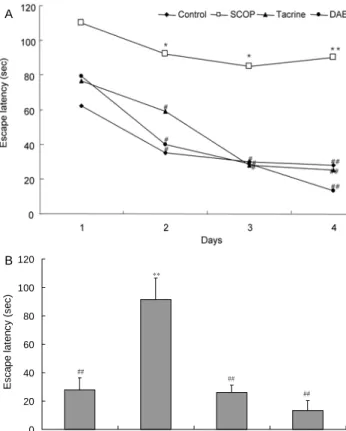
Scopolamine으로 기억손상을 유발한 흰쥐의 공간학습에 대한 녹용 추출물의 효과는 해마 의존적 공간학습 능력을 평가하는 Morris water maze test를 실행하여 Fig. 1에 나타 내었다. 하루 2번씩 4일 동안 인지훈련을 실시한 결과, sco- polamine 처리군은 수중미로 상의 platform의 위치를 찾아 가는 escape latency 시간이 감소하지 않아 scopolamine으 로 기억손상을 유발시킨 많은 치매모델 실험과 같은 결과를 보여주어 장기기억(long-term memory) 손상이 정상적으로 유도된 것을 확인할 수 있었다(22-24). 반면, 치매치료제인 tacrine 처리군과 녹용 추출물 처리군은 인지훈련 2일째부터 scopolamine에 의한 기억손상이 유의적으로 회복되었으며
A
0 20 40 60 80 100 120
Control SCOP Tacrine DAE
E sca pe l a te n c y ( s e c )
##
**
##
##
B
Fig. 1. Effect of the deer antler extract on escape latency during the training trial sessions of Morris water maze task in scopolamine-induced memory deficits rats. (A) Training trial session for 4 days (B) The probe trial section on 5 day. At 60 min before maze test, tacrine (10 mg/kg, p.o.), control (same volume of saline), DAE (deer antler extract, 200 mg/kg, p.o.) were administered to rats. Memory impairment was induced by scopol- amine treatment (2 mg/kg, i.p.). The training trials were carried out 30 min after a single scopolamine treatment. Results are ex- pressed as the mean
±
SD (n=8). *p<0.05, **p<0.01; compared with the control group. #p<0.05, ##p<0.01; compared with the scopol- amine-treated group.(p<0.05), 4일째에는 tacrine과 녹용 추출물 처리군 모두 대 조군과 비슷한 escape latency 시간으로 회복되어 scopol- amine 투여군보다 유의적인 개선효과를 보였다(Fig. 1A, p<0.01). 훈련 5일째 platform을 제거한 probe test를 시행한 결과는 Fig. 1B에 나타내었다. SCOP군은 91.60±15.00 sec 로 다른 실험군보다 유의적으로 escape latency 시간이 길었 다(p<0.01). 대조군 28.00±8.46 sec, Tacrine군 26.10±5.26 sec 그리고 DAE군은 13.40±7.01 sec로 escape latency 시간 이 가장 많이 감소하여 녹용 추출물 투여가 scopolamine으 로 유도한 치매 흰쥐의 장기기억 개선에 효과가 뛰어난 것으 로 나타났다.
ACh 함량
ACh은 모든 신경세포에서 발견되는 신경전달물질로 중 추신경계의 콜린성 시스템과 매우 관련성이 높다. ACh은 acetyl CoA와 choline acetyltransferase(ChAT)의 효소작용 으로 합성되며 AChE의 작용으로 acetate와 choline으로 분
0 5 10 15 20 25 30 35
Control SCOP Tacrine DAE
A c et y lc h ol in e ( n g/ m g pr o tei n)
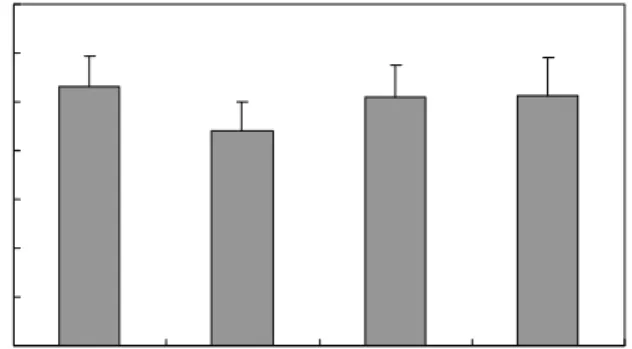
Fig. 2. Effect of the deer antler extract on acetylcholine con- tents in rat brain treated with scopolamine. At 60 min before maze test, tacrine (10 mg/kg, p.o.), control (same volume of sal- ine), DAE (deer antler extract, 200 mg/kg, p.o.) were administered to rats for 5 days. Memory impairment was induced by scopol- amine treatment (2 mg/kg, i.p.). The test was carried out 30 min after scopolamine treatment. Results are expressed as the mean
±
SD (n=8).해된다. 분해된 choline은 high affinity choline transporter 에 의해 다시 presynapse로 uptake 되어 ACh 합성반응에 관여하게 된다. 실험동물 및 임상연구에서 콜린성 신경계의 붕괴는 초기 알츠하이머 질환의 주요 원인으로 알려졌다 (25). ACh 생성에 미치는 녹용 추출물의 효과는 Fig. 2에 제시하였다. 대조군 26.12±3.14 ng/mg protein, SCOP군 22.10±2.85 ng/mg protein, Tacrine군 25.49±3.28 ng/mg protein, DAE군 25.55±4.04 ng/mg protein이었다. 그룹 간 유의적 차이는 보이지 않았으나, tacrine과 녹용 추출물 투여 군은 대조군과 비슷한 함량을 나타냈고, scopolamine 투여 군은 대조군보다 15% 감소하였다. Scopolamine은 항콜린성 제제로 시냅스에서 acetylcholine의 농도변화 없이 활성을 감소시키는 약물로 기억손상을 일으켜 노인성 중추신경 장 애와 관련된 연구에 많이 활용되는 약물로 알려져 있으나 (26), 본 연구에서는 scopolamine 투여군의 ACh 함량이 감 소하여 위의 보고와는 다른 결과를 얻었다. AChE 활성과 ACh 함량과의 관련성을 고려해 볼 때, scopolamine 투여는 AChE 활성을 증가시켜 시냅스 사이의 신경전달물질인 ACh의 분해를 촉진하여 뇌조직의 ACh 함량을 감소시키나, 녹용 추출물은 시냅스 말단의 AChE 활성을 저해하여 ACh 활성을 촉진시키고, 관련효소인 choline acetyltransferase를 활성화하여 뇌조직의 ACh 함량을 증가시킨 것으로 사료된다.
뇌조직 및 혈청 AChE 활성
녹용 추출물이 scopolamine으로 유도한 치매유발 흰쥐의 AChE 활성억제에 미치는 효과는 Table 1과 같다. SCOP군 의 뇌조직 AChE 활성은 1.17±0.36 pmol/min/μg protein으 로 대조군(0.80±0.16 pmol/min/μg protein: 100%) 대비 146%가 증가하였고, Tacrine군과 DAE군은 각각 107%
(0.86±0.15 pmol/min/μg protein), 116%(0.93±0.14 pmol/
min/μg protein)로 대조군과 비슷한 수준으로 AChE 활성을
Table 1. Effect of the deer antler extracts on acetylcholines- terase activity in rat brain and serum treated with scopol- amine
Group1) Brain AChE (pmol/min/μg protein)
Serum AChE (Rappaport units/mL) Control
SCOP Tacrine DAE
0.80±0.162)b3) 1.17±0.36a 0.86±0.15b 0.93±0.14b
20.27±6.94ab 25.09±2.02a 18.73±3.83b 19.23±3.01ab
1)Scopolamine (2 mg/kg, i.p.) was administered 30 min before trial. Deer antler extract (200 mg/kg, p.o.) and tacrine (10 mg/kg, p.o.), control (same volume of saline) were adminis- tered 60 min before acquisition trial for 5 days.
2)Mean±SD (n=8).
3)Significant difference was compared with the scopolamine- treated group at p<0.05.
억제하였다(p<0.05). 혈청 AChE의 활성은 대조군(20.27±
6.94 Rappaport units/mL, 100%), SCOP군은 25.09±2.02 Rappaport units/mL(123.8%), Tacrine군 18.73±3.83 Rappaport units/mL(92.4%), DAE군 19.23±3.01 Rappaport units/mL(91.8%)이었다. Scopolamine 투여군은 대조군보 다 123.8%로 활성이 증가하였으며, 치매 치료제인 tacrine은 scopolamine에 의한 AChE 활성을 유의적으로 저해하였다 (p<0.05). 반면 녹용추출물은 유의적 차이는 없으나, 치매치 료제인 tacrine과 비슷한 수준으로 대조군보다 높은 AChE 억제효과를 나타내었다. 이 결과를 통하여 볼 때, 녹용 추출 물은 tacrine, donepezil 같은 AChE inhibitor 치매 치료제와 같이 신경접합부에 있는 ACh을 분해하는 AChE 활성을 억 제하여 ACh의 활성을 촉진하므로 기억과 학습 개선에 효과 가 있는 것으로 사료된다(27,28).
MAO-B의 활성
MAO-B는 도파민(dopamine: DA)이나 세로토닌(5-hy- droxytryptamine: 5-HT), 노르아드레날린(noradrenaline:
NA) 등의 카테콜아민계 신경전달물질을 파괴하는 효소로 알려졌다(29). 뇌조직의 MAO-B의 활성에 미치는 녹용 추 출물의 효과는 Table 2와 같다. 각 군의 MAO-B의 활성은 대조군 9.79±0.99 nmol/mg protein/min, SCOP군 11.03
±0.31 nmol/mg protein/min, Tacrine군 10.58±1.63 nmol/
mg protein/min, DAE군 10.55±1.78 nmol/mg protein/min 으로 그룹 간의 유의적 차이를 보이지 않았으나, tacrine (108.1%)과 녹용 추출물 처리군(105.1%)은 비슷한 수준으로 scopolamine 투여군(112.6%)보다 MAO-B 활성을 감소시 키는 경향을 보였다. 녹용의 MAO 활성억제는 기능성 성분 인 estradiol, progesterone, uracil, hypoxanthine 등에 의한 것으로 보고되었다(30-32). MAO 억제제는 파킨슨병이나 알츠하이머 같은 퇴행성 뇌신경질환 치료 및 예방에 효과적 이나 몇몇 MAO 억제제는 심각한 부작용이 있은 것으로 알 려졌다(33). 따라서 녹용 추출물은 scopolamine에 의해 활성 이 증가된 MAO-B 저해효과가 치매 치료제인 tacrine보다
Table 2. Effect of the deer antler extract on monoamine oxidase-B activity in rat brain treated with scopolamine
Group1) Control SCOP Tacrine DAE
MAO-B (nmol/mg protein/min)
9.79±0.992) 100%3)
11.03±0.31 112.6%
10.58±1.63 108.1%
10.55±1.78 105.7%
1)Deer antler extract (200 mg/kg, p.o.) and tacrine (10 mg/kg) and control (same volume of saline) were administered 30 min before scopolamine injection. Scopolamine (2 mg/kg) was administered 30 min before trial. Tacrine (10 mg/kg, p.o.), control (same volume of saline) were administered 60 min before acquisition trial for 5 days.
2)Mean±SD (n=8).
3)Percent of control values.
크게 나타나므로, 천연물 유래의 새로운 MAO 억제제로 노 인성 치매 예방 및 치료에 효과가 있을 것으로 사료된다.
요 약
본 연구는 녹용 추출물이 scopolamine으로 기억손상을 유 발한 실험동물의 기억력 개선과 AChE, MAO-B의 활성억 제, 신경전달 물질인 ACh 함량을 치매 치료제인 tacrine과 비교하여 분석하였다. 공간인지력을 평가하는 Morris water maze test에서 scopolamine(2 mg/kg, i.p.)으로 기억손상을 유발한 경우 4일간의 인지훈련에도 불구하고 platform을 찾 아가는 escape latency 시간이 증가되었으며, tacrine과 녹용 추출물 투여군은 훈련 2일째부터 유의적으로 escape la- tency 시간이 감소하였다. 실험 5일째 platform을 제거한 probe test에서도 녹용 추출물 처리군은 scopolamine 처리 군보다도 escape latency 시간이 유의적으로 감소하여 장기 기억 개선효과가 있음을 보여주었다. 뇌의 신경전달물질인 ACh 생성은 대조군 대비 scopolamine 투여군은 84.7% 감소 하였으나, 녹용 추출물 투여군(97.5%)은 치매 치료제인 ta- crine(97.8%)과 비슷하게 정상적인 수치로 ACh 생성량을 증가시켰다. Tacrine 처리군은 scopolamine 투여로 상승한 뇌조직과 혈청의 AChE 활성을 유의적으로 감소시켰고, 녹 용 추출물 처리군은 뇌조직의 AChE 활성을 유의적으로 감 소시켰다. 뇌조직의 MAO-B 활성은 그룹 간 유의적인 차이 는 없었으나, tacrine과 녹용 추출물 처리군이 scopolamine 투여군보다 MAO-B 활성을 감소시키는 경향을 보였다. 따 라서 녹용 추출물은 scopolamine으로 기억손상을 유발한 치 매 동물모델에서 신경전달물질을 분해하는 효소의 활성을 저해함으로써 장기기억 활성을 촉진하고 콜린성 신경계를 자극하여 기억 및 학습 증진에 효과적으로 작용하는 천연물 유래 기능성 물질로 사료된다.
문 헌
1. Evans DA, Funkenstein HH, Albert MS, Scherr PA, Cook NR, Chown MJ, Hebert LE, Hennekens CH, Taylor JO.
1989. Prevalence of Alzheimer's disease in a community population of older persons. Higher than previously reported. JAMA 262: 2551-2556.
2. Trabace L, Cassano T, Steardo L, Pietra C, Villetti G,
Kendrick KM, Cuomo V. 2000. Biochemical and neuro- behavioral profile of CHF 2819, a novel, orally active ace- tylcholinesterase inhibitor for Alzheimer's disease. J
Pharmacol Exp Ther 294: 187-194.
3. Park CH, Kim SH, Choi W, Lee YJ, Kim JS, Kang SS, Suh YH. 1996. Novel anticholinesterase and antiamnesic activ- ities of dehydroevodiamine, a constituent of Evodia
rutaecarpa. Planta Med 62: 405-409.
4. Kasa P, Papp H, Torok I. 2000. Donepezil dose-dependently inhibits acetylcholinesterase activity in various areas and in the presynaptic cholinergic and the postsynaptic chol- inoceptive enzyme-positive structure in the human and rat brain. Neuroscience 101: 89-100.
5. Canal N, Imbimbo BP. 1996. Relationship between pharma- codynamic activity and cognitive effects of eptastigmine in patients with Alzheimer's disease. Clin Pharmacol Ther 60:
218-228.
6. Davies P, Maloney AJF. 1976. Selective loss of central chol- inergic neurons in Alzheimer type disease. Lancet 2: 1403.
7. Shin KH, Lim EB, Kim JH, Chung MS, Cho SI. 1989.
Pharmacological studies on powdered whole part of un- ossified antler. Kor J Pharmcogn 20: 180-187.
8. Ha H, Yoon SH. 1996. Analytical studies of constituents of antler. J Korean Soc Food Nutr 25: 279-282.
9. Hong ND, Won DH, Kim NJ, Chang SY, Youn WG, Kim HS. 1991. Studies of analysis of constituent of deer horn (Ⅰ). Kor J Pharmacogn 22: 171-182.
10. Invankina NF, Isay SV, Busarova NG, Mischenko TY. 1993.
Prostaglandin-like activity, fatty acid and phospholipid composition of sika deer (Cervus nippon) antlers at differ- ent growth stages. Comp Biochem Physiol B 106: 159-162.
11. Steven BO, Maribel A, Jennifer N. 2008. Carbohydrate- based experimental therapeutics for cancer, HIV/AIDS and other diseases. Acta Histochemica 110: 6-13.
12. Hasegawa T, Sugeno N, Atsushi T, Michiko MK, Akio K, Katsutoshi F, Taeko M, Yasuto I. 2007. Role of Neu4L siali- dase and its substrate ganglioside GD3 in neuronal apopto- sis induced by catechol metabolites. FEBS Letters 581:
406-412.
13. Takuma O, Keisuke I, Masaki W, Mariko O, Katsumi M.
2008. Formation of toxic Aβ(1-40) fibrils on GM1 ganglio- side-containing membranes mimicking lipid rafts: poly- morphisms in Aβ(1-40) fibrils. J Mol Biol 382: 1066-1074.
14. Kang SY, Lee KY, Park MJ, Kim YC. 2003. Decursin from
Angelica gigas mitigates amnesia induced by scopolamine
in mice. Neurobiol Learn Mem 79: 11-18.15. Kim DH, Kim DY, Kim YC, Jung JW, Lee SJ, Yoon BH, Cheon JH, Kim YS, Kang SS, Ko KH, Ryu JH. 2007.
Nodakenin, a coumarin coumpound, ameliorates scopol- amine-induced memory disruption in mice. Life Sci 80:
1944-1950.
16. Morris RG. 1984. Development of a water maze procedure for studying spatial learning in the rat. J Neurosci Meth
11: 47-60.
17. Bradford MM. 1976. A rapid and sensitive method for the quantitation of microgram quantities of protein utilizing the principle of protein-dye binding. Anal Biochem 72: 248-256.
18. Ellman GL, Courtney KD, Andres JrV, Feather-Stone RM.
1961. A new and rapid colormetric determination of ace- tylcholinesterase activity. Biochem Pharmacol 7: 88-95.
19. Kalaria RN, Mitchell MJ, Harik SI. 1987. Correlation of 1-methyl-4-phenyl-1,2,3,6-tetrahydropyridine neurotoxicity with blood-brain monoamine oxidase activity. Proc Natl
Acad Sci 84: 3521-3525.
20. Rappaport F, Fischl J, Pinto N. 1959. An improved method for the estiation of cholinesterase activity in serum. Clin
Chim Acta 4: 227-230.
21. Hestrin S. 1949. The reaction of acetylcholine and other carboxylic acid derivatives with hydroxylamine, and its an- alytical application. J Biochem Chem 180: 249-261.
22. Kim DH, Jeon SJ, Son KH, Jung JW, Lee SJ, Yoon BH, Cho YW, Cheong JH, Ko KH, Ryu JH. 2007. The ameliorat- ing effect of oroxylin A on scopolamine-induced memory impairment in mice. Neurobiol Learn Mem 87: 536-546.
23. Rispoli V, Rotrioti D, Carelli V, Liberatore F, Scipione, L, Marra R, Giorgioni G, Stefano AD. 2004. Choline pivaloyl esters improve in rats cognitive and memory performances impaired by scopolamine treatment or lesions of nucleus basalis of Meynert. Neurosci Lett 356: 199-202.
24. Lu MC, Hsieh MT, Wu CR, Cheng HY, Hsieh CC, Lin YT, Peng WH. 2007. Ameliorating effect of emodin, a constitute of Polygonatum multiflorum, on cycloheximide-induced impairment of memory consolidation in rats. J Ethno-
pharmcol 112: 552-556.
25. Woolf NJ. 1997. A possible role for cholinergic neurons of the basal forebrain and pontomesencephalon in conscious- ness. Conscious Cogn 6: 574-596.
26. Wesnes KA, Simpson PM, White L, Pinker S, Jertz G, Murhy M, Siegfried K. 1991. Cholinesterase inhibitor in the scopolamine model of dementia. Ann NY Acad Sci 640:
268-271.
27. Dawson GR, Iversen SD. 1993. The effects of novel chol- inesterase inhibitors and selective muscarinic receptor ago- nists in tests of reference and working memory. Behav
Brain Res 57: 143-153.
28. Giacobini E. 2004. Cholinesterase inhibitor: New role and therapeutic alternatives. Pharmacological 50: 433-440.
29. Hauptmann N, Grimsby J, Shih JC, Cadenas E. 1996. The metabolism of tyramine by monoamine oxidase A/B causes oxidative damage to mitochondrial DNA. Arch Biochem
Biphy 335: 295-304.
30. Chen XG, Chang DY, Cui ZY, Wang BX. 1992. Effects of the water extract of pilose antler on some biochemical in- dicators related to aging in old mice. Pharmacology and
Clinics of Chinese Materia Medica 8: 17-20.
31. Chen XG, Jia YG, Wang BX. 1992. Study on inhibitory ef- fects of the water extract of pilose antler on monoamine oxidase in old mice. China Journal of Chinese Materia
Medica 17: 107-110.
32. Zhou R, Wang J, Li S, Liu Y. 2009. Supercritical fluid ex- traction of monoamine oxidase inhibitor from antler velvet.
Sep Purif Technol 65: 275-281.
33. Kong LD, Cheng CHK, Tan RX. 2004. Inhibition of MAO A and B by some plant derived alkaloids, phenols and anthraquinones. J Ethnopharmacol 91: 351-355.
(2009년 2월 5일 접수; 2009년 3월 25일 채택)