1. INTRODUCTION
Wood is a natural, renewable, and sustainable material widely used for building and con- struction because of its specific strength and aesthetic appeal (Wang et al., 2014). These wooden materials can be used in many ways, such as to build log homes, interior framing, and wood buildings. However, wood is a com- plex of cellulose, hemicellulose, and lignin and is susceptible to degradation due to microbial
agents, which may cause significant losses of weight and strength. Protecting wood from such bio-deterioration has long been a challenge for wood researcher (Jain et al., 2011). The princi- pal problems of bio-deterioration are related to fungi (Nagaveni et al., 2011). In most cases, wood must be properly protected to avoid weathering-induced deterioration during its out- door use. Some wood preservatives are well known to protect the wood from wood-degrad- ing organisms, but cause environmental pollu-
Original Article
Evaluation of Two Species of Soft Wood Decay Resistance for Heat-Treated Wood Using the Catalyst (H 2 SO 4 ) 1
Kyung-Rok Won
2⋅Nam-Euy Hong
3⋅Su-Young Jung
4⋅Byung-Ro Kim
5⋅Hee-Seop Byeon
2,†ABSTRACT
This study was conducted to evaluate the resistance of heat-treated wood using the catalyst to decay caused by fungi for sapwood and heartwood of two tree species, Korean red pine (Pinus densiflora) and Japanese larch (Larix kaempferi), respectively. Wood samples were immersed for 10 min in sulfuric acid (7.5%) and then heat-treated at 130 ℃ for 90 min. Fomitopsis palustris, a brown-rot fungus, was used to examine the decay re- sistance of Korean red pine and Japanese larch wood. Weight and density of wood from the all conditions in- creased after heat treatment using the catalyst. Weight loss after decay resistance test was also dropped with a heat treatment. The lowest weight loss indicated at heat-treated heartwood of Japanese larch. Heat treatment us- ing the catalyst effectively increased the resistance of wood to decay caused by fungi.
Keywords : heat-treated wood using catalyst, sulfuric acid, decay resistance
1
Date Received January 13, 2017, Date Accepted March 1, 2017
2
College of Agriculture & Life Science, IALS, Gyeongsang National University, Jinju 52828, Republic of Korea
3Department of Development, Samyoung Industrial, Gimhae 51-62, Korea
4
Southern Forest Resources Research Center, National Institute of Forest Science, Jinju 52817, Republic of Korea
5Department of Wood and Paper Science, College of Agriculture, Life and Environment Science, Chungbuk National
University, Cheongju 28644, Republic of Korea
†
Corresponding author: Hee-Seop Byeon (e-mail: [email protected])
tion as they contain harmful substance.
Thermal treatment is an alternative to chem- ical treatment for wood preservation, which has sometimes been used to improve timber quality (Awoyemi and Jones, 2011; Poncsak et al., 2006). This heat treatment of wood is an envi- ronmentally friendly wood preservation technique. Wood is heated to temperatures above 200 ℃ depending on the wood species and the required wood properties (Kocaefe et al., 2010). Concurrently, heat treatment of tem- peratures above 200 ℃ adversely affects the me- chanical properties of wood and weight, and density (Yildiz et al., 2006). In order to prevent both bio-deterioration and adverse effects of heat treatment, a new heat treatment method us- ing a catalyst, sulfuric acid was developed.
With the existing methods of heat treatment, wood is degraded, dimensional stability is en- hanced, equilibrium moisture content is low- ered, and color darkens and biological dura- bility is increased (Sini et al., 2006). Changes in the chemical and physical properties of wood are caused by the high temperatures of heat treatment. Heat treatment using a catalyst re- sults in small changes in the physical and me- chanical properties of wood, as processing oc- curs at the relatively low temperature of 130
℃. The method also consumes less energy than non-catalyst-based methods. Furthermore, heat treatment using a catalyst enhances decay resist- ance at the wood surface because of charcoal coatings that result from the treatment.
In this study, the effects of heat-treated wood using the catalyst to decay caused by fungi,
wood from four conditions, sapwood and heart- wood of Korean red pine and Japanese larch wood were investigated, respectively.
2. MATREIALS and METHODS 2.1. Materials
The sapwood and heartwood of Korean red pine (Pinus densiflora Sieb. et Zucc.) and Japanese larch (Larix kaempferi (Lamb.) Carr.) dried at room temperature were used. Samples of 20 × 20 × 20 mm for the decay resistance test were cut from each of the dried wood for the two species. Ten samples from each of the two species were used for each condition.
Samples were maintained for six weeks at a constant temperature and humidity (20 ℃ ± 1℃, 65% RH ± 2%).
2.2. Heat treatment using the catalyst
Sulfuric acid was used as the catalyst for the
heat treatment at concentration of 7.5%. The
wood samples were immersed in the sulfuric
acid concentration (7.5%) for 10 min. The heat
treatment of the samples was performed at the
maximum temperature of 130 ℃ maintained for
90 min in a dry oven (Muffle furnace, JeioTech
OF-300, Korea). After heat treatment, the wood
samples were washed in distilled water to re-
move the residual sulfuric acid. Samples were
again maintained for 3 weeks at a constant
temperature and humidity (20 ± 1 ℃, RH 65 ±
2%). Changes in weight, density, and decay re-
sistance of the samples were measured.
2.3. Weight and air-dried density
The weight of before and after heat treatment using the catalyst for each specimen was meas- ured by electronic scale. And measurement of density in heat-treated wood was carried out ac- cording to KS F 2198 (air-dried density) standard in constant temperature and humidity room (temperature 20 ± 1 ℃, relative humidity 65 ± 2%).
2.4. Decay resistance test
The brown-rot fungus, Fomitopsis palustris (Berkeley et Curtis), was used to examine the decay resistance of sapwood and heartwood Korean red pine and Japanese larch. The potato dextrose agar medium (Becton, Dickinson and Company sparks, MD 21152) was sterilized at 121 ℃ for 30 min and poured 50 mℓ into plant culture dish (100 × 40 mm). Then the fungi for the decay resistance test were inoculated on to potato dextrose agar medium. The specimens were decayed for 60 days in constant temper- ature (26 ± 2 ℃) after decay operation.
Observation for decay resistance was con- ducted, and photographs were taken, every week after inoculation. After the decay resist- ance test, weight loss were measured for the each condition.
Weight loss ratio (P
wl) was calculated accord- ing to the equation (1):
P
wl=
× (%) ··· (1)
where W
1is weight before decay resistance test,
W
2is weight after decay resistance test.
2.5. Observation of heat-treated wood using the catalyst with scanning electron microscopy (SEM)
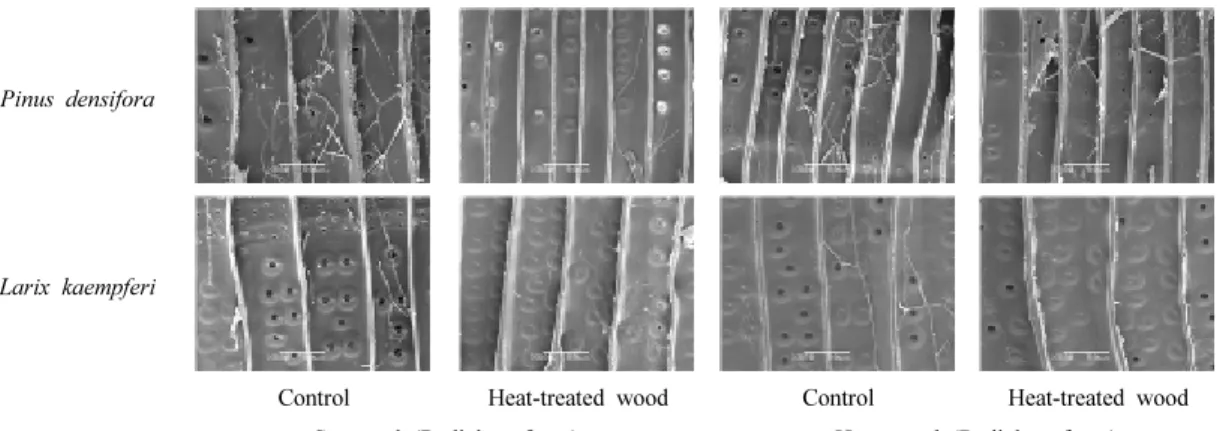
Samples used for scanning electron micro- scopy (SEM) were cut into 2 mm (T) × 10 mm (R) × 1 mm (L) pieces after heat-treatment with sulfuric acid and the decay resistance test.
To prepare for SEM, samples were freeze-dried and gold-coated prior to examination with a Hitachi S-2400 SEM. SEM images were ob- tained at accelerating voltage 5 kV at 500 magnification.
3. RESULTS and DISCUSSION 3.1. Weight changes of heat-treated
wood using the catalyst
Table 1 shows the mean values for weight and air-dried density of sapwood and heartwood from two species before and after heat treat- ment using the catalyst (H
2SO
4).
The weight changes were indicated in heat-treated wood using the catalyst. The change percentages of weight of Korean red pine wood in heat conditions at heat-treated sapwood and heat-treated heart wood decreased -4.98 and -4.52%, respectively. And change percentages of weight of Japanese larch wood at the same condition also decreased -1.26%
and -3.17%, respectively. Won et al., (2015) re-
ported that decreased weight of Korean red pine
wood at heating conditions of 180 ℃ for 12 h
and 24 h, and of 210 ℃ for 3h and 6h, of 9.18, 11.90, 11.11, and 17.46%, respectively. The weight of Japanese larch wood at the same condition also decreased by 9.99, 11.44, 11.41, and 20.39%, respectively. However, heat treat- ment with a catalyst caused small changes in the physical and mechanical properties owing to processing taking place at the relatively low temperature of 130 ℃.
3.2. Density changes of heat-treated wood using the catalyst
The density changes were indicated in heat-treated wood using the catalyst. The change percentages of density of Korean red pine wood in heat conditions at heat-treated
sapwood and heat-treated heart wood decreased -5.45 and -5.36%, respectively. And change percentages of density of Japanese larch wood at the same condition also decreased -2.04%
and -3.64%, respectively. For both species, weight and density after heat treatment were decreased. The decreasing percentages of weight and density were higher in Korean red pine wood using the catalyst than in Japanese larch wood using the catalyst.
3.3. Decay resistance
Table 2 shows the characteristics of decay re- sistance for sapwood and heartwood from two species after heat treatment using the catalyst.
Coverage by fungal hyphae was very slow in
Species Treatment conditions Weight (g) Density (g/cm
3)
Before After P
w(%)
2)Before After P
D(%)
3)Pinus densiflora Sap wood
Control 4.31
(0.62)
4.31
(0.62) 0 a
1)0.54 (0.07)
0.54
(0.07) 0 a
Heat-treated wood 4.42 (0.68)
4.20
(0.55) -4.98 b 0.55 (0.08)
0.52
(0.07) -5.45 b
Heart wood
Control 4.45
(0.52)
4.45
(0.52) 0 a 0.56
(0.07)
0.56
(0.07) 0 a
Heat-treated wood 4.42 (0.40)
4.22
(0.42) -4.52 b 0.56 (0.05)
0.53
(0.05) -5.36 b
Larix kaempferi Sap wood
Control 3.93
(0.38)
3.93
(0.38) 0 a 0.49
(0.05)
0.49
(0.05) 0 a
Heat-treated wood 3.96 (0.36)
3.91
(0.36) -1.26 b 0.49 (0.05)
0.48
(0.05) -2.04 b
Heart wood
Control 4.39
(0.51)
4.39
(0.51) 0 a 0.55
(0.07)
0.55
(0.07) 0 a
Heat-treated wood 4.42 (0.51)
4.28
(0.62) -3.17 b 0.55 (0.06)
0.53
(0.08) -3.64 b
1)
Means with the same letter are not significantly different at a P-value of 0.05 according to Duncan’s new multiple range test.
2)
P
Wis percentage of weight change after heat treatment,
3)